👀 Signal Messenger of note-taking apps 🤓 aka 100% open source and free (as in freedom) note taking app focused on your experience and your privacy. 🔑🛡️
Notesnook v3.2.0 came out last week with a bunch of new exciting updates.
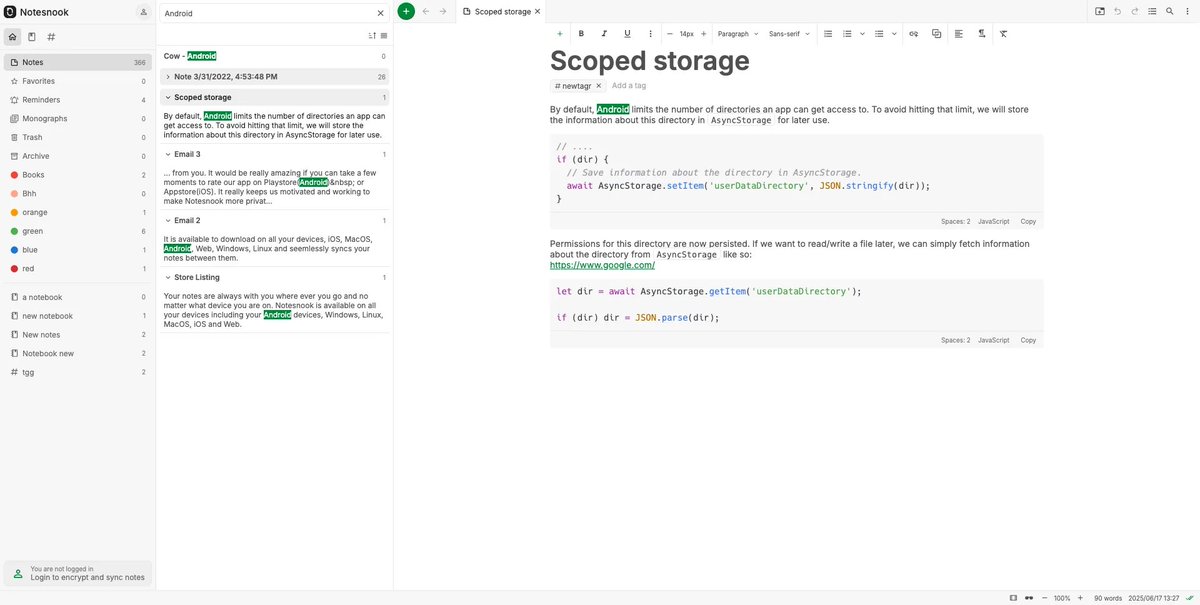
The search experience got a overhaul. Improvements include:
1. Token by token search highlighting.
2. Improved relevance based sorting.
3. Sort search results by title, date edited etc.
4. Jump directly to a specific search result within a note.
5. No more false positives.
Have y'all tried the new search?
Follow this thread to read more about v3.2.0 👇
Couldn't have said it better. I think the concept of "file-over-app" is inflated to mean, "it works everywhere" when in reality there's a lot of ifs and buts involved.
And that's okay. Obsidian is an app that has features requiring a certain kind of storage format that's not compatible with anything else...just like any other app.
Yes, the base format is Markdown and that's great but base format is not what makes Obsidian...obsidian. It's the plugins, the features, the canvas, the databases etc. You could write just markdown in which case why use Obsidian at all?
I want to debunk the claim that I see a lot around here that Obsidian is "just plain text markdown files" which means "you can take them anywhere and open them with any app"
That simply isn't true
Yes, maybe the raw text of the notes is markdown, but many other parts cannot be moved elsewhere and opened by other apps:
1. The .obsidian/ directory contains your JSON config with plugins, settings, hotkeys, workspace state, link format, attachment paths – those can't be moved elsewhere
2. Plugin state files – Readwise's path-to-ID map, Templater's settings, Tasks plugin's database, Excalidraw's drawing data – even if plugins can be recreated, these settings cannot
3. .canvas files – JSON, not markdown. They reference notes by path and won't survive a move
4. .base files – JSON-based database/views over your notes. Same path-fragility
5. .excalidraw.md files – markdown wrapper around an Excalidraw JSON blob. Looks like markdown, isn't really
6. The link graph itself – backlinks, graph view, "linked mentions" – all computed from filenames and link references. They survive because the references are in the markdown, but they require Obsidian (or an Obsidian-aware tool) to materialize
7. Plugin-managed folders – Readwise output, Web Clipper output, Daily Notes location, Templates folder. Each is a folder whose contents are owned by an external system tracked in plugin state
8. Sync state – Obsidian Sync, iCloud, Dropbox, Google Drive each maintain their own state about what's where and what's been resolved. Move operations interfere with this state
9. Embedded query results – Dataview queries, Tasks queries, Bases queries. The query is in the markdown; the result is computed live and never persisted
So technically you CAN move your files elsewhere, but you'd destroy most of what makes them valuable – the graph, the plugin state, the canvases, the embedded queries, the sync state, and any structural intent encoded in folder placement
Which means you're just as locked in to Obsidian as any other "proprietary" app, it's just a hidden lock-in that's obscured by inaccurate marketing
Saying "Obsidian is just markdown files" is like saying "your house is just bricks"
The bricks are real and moveable – but the architecture, plumbing, and wiring aren't bricks, and those are most of what makes the house function
@dan__brummitt Things have changed a lot since. We have launched new plans, export options are in the free plan now, free users can now add attachments etc. Give it a try! 😁
@kepano@fortelabs In your own words:
> Don’t lock your data into a format you can’t retrieve.
That's the literal definition of "portability". That's also why Obsidian uses Markdown as a base format instead of, say, a binary format.
@kepano@fortelabs But the whole premise of Obsidian is that "your files are portable". If apps need to have parity with Obsidian, and won't work without it...then doesn't that break portability?
@signalvoyager@signalapp What's the mistake? Enabling notifications? This is not isolated to Signal. If it were then we'd have a problem. Every single app's notifications gets saved in a place and manner that is outside that app's control. There's no opt out. That is why Apple fixed it.
We are very happy that today Apple issued a patch and a security advisory. This comes following @404mediaco reporting that the FBI accessed Signal message notification content via iOS despite the app being deleted.
Apple’s advisory confirmed that the bugs that allowed this to happen have been fixed in the latest iOS release. You can read more here: https://t.co/yE8ufSTQHk
Note that no action is needed for this fix to protect Signal users on iOS. Once you install the patch, all inadvertently-preserved notifications will be deleted and no forthcoming notifications will be preserved for deleted applications.
We’re grateful to Apple for the quick action here, and for understanding and acting on the stakes of this kind of issue. It takes an ecosystem to preserve the fundamental human right to private communication.
Privacy researcher reports that Claude Desktop app for macOS may be quietly changing browser access settings without explicit user consent https://t.co/PVBZOu0qvc
@signalvoyager If the OS is not secure, there's only so much you can do. AFAIK Signal did offer the option to disable/hide notification content. If your OS has a keylogger built-in, you can't really blame the apps you install for the secrets leaked.
Privacy and security on computing devices need to become far stronger to protect people from pervasive violations of their rights. Users have their privacy pervasively violated by corporations, criminals and governments. There are endless privacy and security weaknesses in software with exploits of those happening on a large scale. Operating systems, browsers and other apps need to do a much better job protecting users. Enormous progress is needed on both privacy and security.
GrapheneOS provides a massive upgrade for privacy and security over the standard Android Open Source Project. GrapheneOS is nowhere near good enough and we have an enormous amount of work to do improving both. Our work is an ongoing process and doesn't have an end point. Privacy and security heavily involve competition between attackers and defenders. Most defenders are making little progress and falling increasingly far behind.
Attackers continue improving their exploits of privacy and security weaknesses. Commercial exploit tools are increasingly widely deployed for broad attacks. Software has a very high density of privacy and security vulnerabilities. LLMs are accelerating both vulnerability discovery and exploit development. For most computing devices, defense is increasingly far behind offense. iOS and GrapheneOS are exceptional cases not representative of degrading privacy and security across computing devices.
Growing numbers of internet connected devices are incorporated into botnets. This harms the privacy and security of the internet as a whole through heavily pushing it towards centralization behind services such as Cloudflare. Insecure devices without security patches harm the internet as a whole. It isn't only embedded devices but also desktops, mobile devices and servers being used as part of these botnets. It isn't only people with these insecure devices who are harmed. It can get much worse.
We're building GrapheneOS to protect everyone's privacy and security. It's aimed at widespread adoption and is highly usable. It's compatible with the vast majority of Android apps. It has major privacy benefits for every user including stopping a lot of data collection by apps and services with a better permission model increasingly addressing being coerced to grant access. GrapheneOS has many users with little technical knowledge and isn't hard to install or use.
We're continuing to work on improving privacy, security, usability and app compatibility for all of our users. Contact Scopes, Storage Scopes, per-app Sensors toggle, VPN leak protection and many other features we provde are very important privacy protections. We're building alternatives to the Camera, Microphone and other permissions too. Our major improvements to exploit protections are there to protect user privacy. Privacy depends on security and that's why we heavily work on security too.
Contrary to what's often claimed, GrapheneOS is far more usable and requires far less sacrifice compared to other alternatives. Providing far better protection against sophisticated exploits isn't at the expense of that. Our opt-in sandboxed Google Play compatibility layer combines privacy and high usability. We're gradually making replacements for more Google services apps rely on. Location services, network-based location, geocoding and more has already been replaced and much more is coming.