Feeling deeply humbled to receive the Ascension Saint Thomas Guardian Angel Award, a recognition that comes from the kindness of our patients. Grateful to care for them alongside incredible team, and especially thankful to my clinic mentor Dr. Keswani! @AmitKeswaniMD@timir_paul
@thoughtson_tech@AmJCardio Excellent point. @thoughtson_tech
External validation, drift monitoring, and governance remain major bottlenecks to real-world AI adoption. The infrastructure gap deserves far more attention.
The biggest challenge in medical AI is no longer building models; it’s ensuring they are unbiased, externally validated, and effective in real-world practice.
My latest article in @AmJCardio examines these challenges and outlines a path toward responsible AI implementation
Cheers, chills, and a standing ovation when RASolute 302 showed unprecedented survival on daraxonrasib for patients with progressive pancreatic cancer
Seldom do you sense you’re witnessing a historic moment in cancer care but this feels like ras targeting has arrived
#ASCO26
This viral thread from @bschermd is a great read.
Veins and arteries see the exact same LDL/ApoB, yet plaque forms almost exclusively in arteries — and a pristine vein grafted into arterial flow rapidly develops atherosclerosis.
That points strongly to hemodynamic stress and endothelial injury as the primary trigger (Response to Injury) over a pure Response to Retention model.
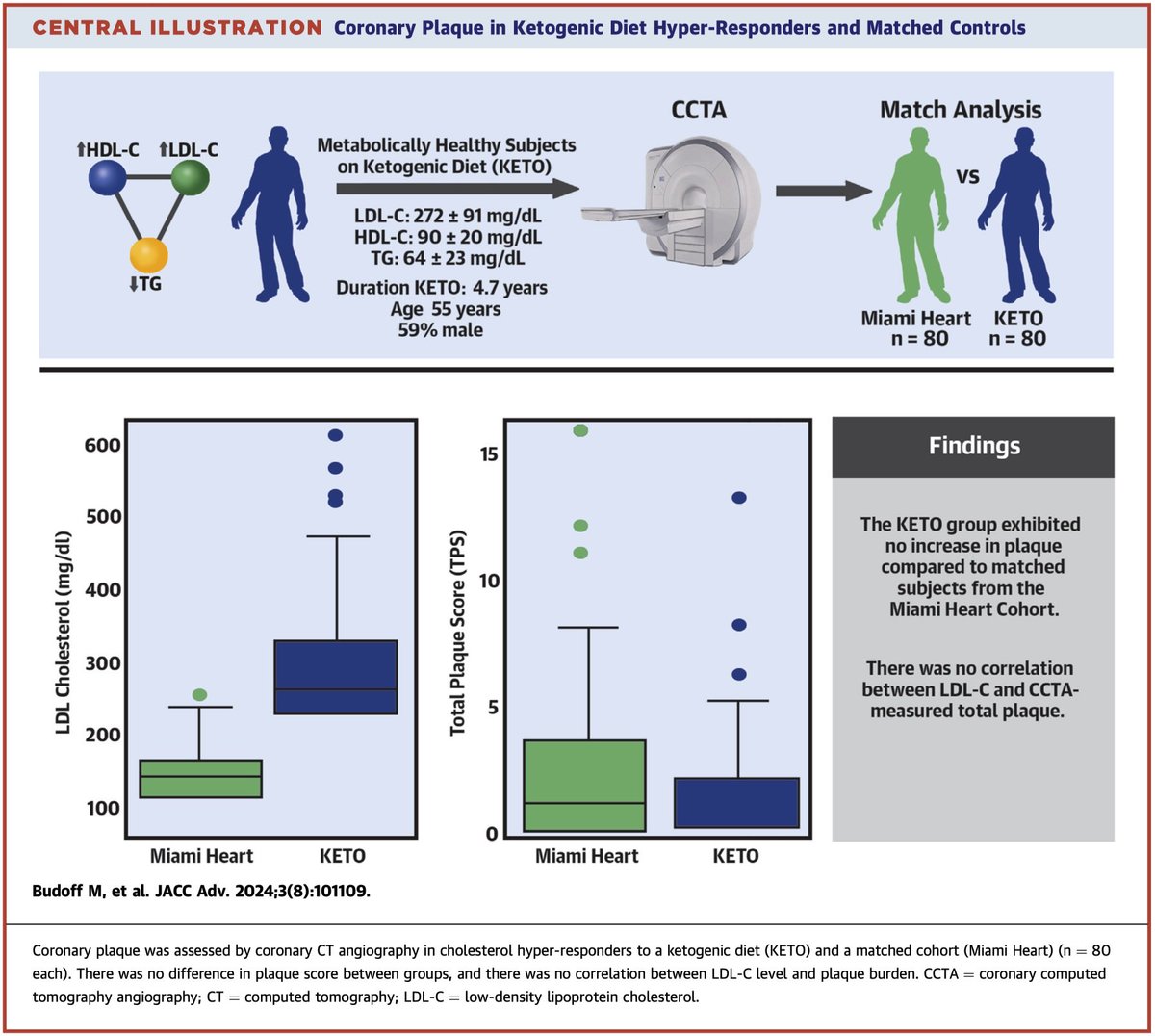
Our Keto-CTA data in a metabolically healthy cohort with a wide spread of LDL/ApoB (going from under 100 to over 500) show no association with either the presentation or progression of plaque.
Which is why we've needed to do this exact research for so long.
This central illustration is from our match analysis in JACC Advances (Budoff et al., 2024), where we compared 80 metabolically healthy ketogenic hyper-responders (mean LDL-C 272 mg/dL, HDL-C 90, TG 64, after 4.7 years on keto) to 80 tightly matched controls from the Miami Heart cohort (mean LDL-C 123 mg/dL).
Despite the ~149 mg/dL difference in LDL-C, there was no significant difference in coronary plaque burden by CCTA total plaque score, CAC score, or other measures. And crucially, there was no correlation between LDL-C levels and plaque burden in either group.
(Full paper: https://t.co/D6MY66oEoC)