OCEG is the global nonprofit that created GRC and Principled Performance. We educate and certify 120K+ members about governance, risk, and compliance (GRC)
The the Integrated Artificial Intelligence Professional (IAIP) certification is OFFICIALLY LIVE and open for enrollment. 📢
The gap between organizations with proper AI governance and those without grows wider daily, and now, more than ever, we need leaders. That's why we created the IAIP. It helps:
➡️ Position you as a leader in the rapidly evolving AI governance landscape
➡️ Give you access to the complete Integrated AI Framework
➡️ Make you part of an elite group of IAIP-certified professionals
➡️ Develop skills that position you as both an enabler of AI and protector of organizations
➡️ Build stakeholder confidence in your AI governance capabilities
➡️ Break down traditional silos between technical and governance teams
With IAIP, while others are still learning the basics of AI governance, the savviest GRC Professionals (pssst... that's YOU) will already be certified and leading the way.
OCEG's IAIP certification program includes:
✅ Comprehensive exam covering all aspects of integrated AI governance
✅ Access to the complete Integrated AI Framework
✅ All training materials and resources
✅ Certificate upon successful completion
The best part? Your Pro All Access Pass includes the entire certification, exam, framework, and all training materials for 𝗻𝗼 𝗮𝗱𝗱𝗶𝘁𝗶𝗼𝗻𝗮𝗹 𝗰𝗼𝘀𝘁.
🔗 Register for the official IAIP certification today: https://t.co/RhLUhFXvt8
#AIGovernance #GRC #GRCCertification #AI #AICertification #GRCTraining
RAPID REVIEW ⚡️ The 6 objectives of effective compliance & ethics:
➡️ Legal & regulatory compliance (avoiding fines and protecting reputation)
➡️ Organizational reputation (building trust with customers and partners)
➡️ Risk treatment (preventing problems through strong policies)
➡️ Competitive advantage (attracting customers and investors)
➡️ Employee engagement (higher satisfaction in ethical work environments)
➡️ Sustainable business growth (reduced risks, enhanced reputation)
Our ICEP certification teaches you to build compliance programs that deliver all six outcomes.
🔗 Learn more about the ICEP: https://t.co/jB5oS2VDpI
Are you familiar with GRC lines of accountability?
As practitioners, we understand that most compliance failures happen because accountability is unclear. Who owns compliance risks? Who provides oversight? Who gives independent assurance? We know that without clear lines, compliance programs become paperwork exercises instead of protective measures.
Here's an overview of the 5 Lines of Accountability:
➡️ 1st Line: Operations teams who own and manage compliance risks daily
➡️ 2nd Line: Oversight functions providing control and monitoring
➡️ 3rd Line: Internal audit providing independent assurance
➡️ 4th Line: Senior management accountable for organization-wide performance
➡️ 5th Line: Board of Directors with ultimate governance accountability
ICEP certification teaches you to design accountability structures that actually prevent compliance failures.
🔗 Master compliance accountability with us: https://t.co/jB5oS2VDpI
We all know GRC *loves* its acronyms (hello, the term itself is one), but sometimes they get overwhelming. We often hear from junior practitioners that studying is made simple through acronyms... until they're fishing through the entire alphabet to remember what the acronym itself stands for.
Let's break a common one from our Integrated Data Privacy Professional certification down: CUDS ⬇️
CUDS is the framework that determines whether your organization treats personal data as a strategic asset or a compliance burden. It stands for:
🌐 Collect & Gather: How and where personal data enters your organization
🌐 Use & Process: What you do with personal data to achieve business objectives
🌐 Disclose & Transfer: How personal data moves between organizations and jurisdictions
🌐 Store & Dispose: How personal data is retained, secured, and eventually destroyed
Remembering CUDS becomes helpful when we consider that *most* organizations only focus on storage and security, while *smart* organizations are designing privacy controls across the entire CUDS lifecycle.
Like this take? Become a free OCEG member for more GRC education opportunities straight to your email inbox: https://t.co/Tg8CZiZS2w
How can you tell if data privacy is becoming a business enabler or an operational constraint? Good question. 😏
The answer lies in understanding Privacy by Design. Privacy by Design means considering privacy issues at the *design* phase of any system, service, product, or process that involves processing personal information, then maintaining those protections throughout the entire data lifecycle (psssttt... this lifecycle is called CUDS, and you can learn more about it in our post from yesterday).
Once Privacy by Design is achieved, Privacy by Default can be developed to go a step further in the data protection process: implementing personal information minimization and purpose limitation so that only necessary data is processed, stored for limited periods, and accessed on a "need to know" basis.
🔗 Want to learn more? We cover all of this and more in our Integrated Data Privacy Professional certification: https://t.co/9bapuXRlb2
Integrated risk management is the future, and it's a foundational pillar of any good GRC program. But... what is it? 🤔
Integrated risk management is a structured approach using empowered actors for managing, overseeing, and assessing key risks across an organization by leveraging skills from across the enterprise to ensure proper risk management from many participants.
Traditional risk management treats risks as isolated problems to be minimized. Integrated Risk Management recognizes that risks and rewards are two sides of the same uncertainty coin. In short:
💡 Traditional RM: Reactive, siloed, focused on hazard mitigation
💡 Integrated RM: Proactive, holistic, balances risk with reward
Integrated risk management teaches us that risk isn't a problem to be dealt with as it comes. It's a problem that's inevitable and should be anticipated and prepared for.
Good thing our certification teaches that. 😏
🔗 Learn more: https://t.co/JtlL7OVLrQ
Why do some organizations thrive in chaos while others crumble? In our experience the answer usually lies in how they LEARN.
While most companies *react* to change, companies with well-embedded GRC teams sense it coming and *adapt* before everyone else even notices something shifted.
That's the beauty of being a GRC professional. We make sense of signals that matter before the rest of the company knows that they matter. And, that's exactly what the LEARN component of GRC teaches:
➡️ External context monitoring that spots trends early
➡️ Internal capability assessment that reveals true strengths
➡️ Stakeholder relationship mapping that prevents surprises
➡️ Cultural insights that predict how change will actually unfold
Plus? It's exclusive to OCEG's model of GRC training.
🔗 Discover OCEG methodology: https://t.co/Tg8CZiZS2w
"We need more assurance" usually means "We don't trust what we're being told."
We've found that before designing another audit, the question worth asking is: What level of assurance do you actually need? Not everything requires the same rigor. The key is matching assurance level to actual risk:
➡️ Lower assurance for routine operations with established controls
➡️ Limited assurance for moderate-risk areas requiring periodic validation
➡️ Reasonable assurance for high-stakes areas where mistakes are costly
➡️ Design that balances cost with confidence needs
🔗 Lear to design better assurance: https://t.co/6eA5VvZ4QU
Residual risk is what keeps executives awake at night. In our experience, it's also what separates amateur auditors from professionals who actually understand the business. 🥶
Many risk professionals think audit is about finding problems, but in 2 decades of doing this we've learned that's only half of it. The work at the core of being a GRC professional lies in understanding what risk remains after *all* the controls are working (otherwise known as residual risk).
Here's what we teach our professionals to focus on:
➡️ Inherent risk (aka what exists before any controls are considered)
➡️ Control risk (aka what remains due to control limitations)
➡️ Detection risk (aka what audit procedures might miss)
➡️ Residual risk (aka what management must accept or address further)
🔗 Build your risk detection muscle with us: https://t.co/Mj6plkBKNt
Data poisoning, model stealing, model inversion? SPOOKY. 👻
This is the reality that AI systems face. They constantly produce security threats that require a different lens than traditional cybersecurity frameworks provide.
We've watched organizations spend years protecting their networks while leaving their AI models completely vulnerable. The attacks can compromise intellectual property, manipulate outcomes, or expose sensitive training data in these ways:
➡️ Data poisoning where malicious training data corrupts model behavior
➡️ Model stealing where proprietary AI models get replicated without authorization
➡️ Model inversion where sensitive information gets extracted from model outputs
➡️ Adversarial attacks where inputs are designed to fool AI decision-making
Most security teams are still figuring this out. IAIP certification gives you the security controls to protect AI systems throughout their lifecycle.
🔗 Secure your AI systems with our training: https://t.co/6cLwXYVhSB
Are you medium sized business that doesn't know where to begin with compliance? Are you *drowning* in legal jargon and checklists that contradict each other? We know. So, we've simplified where to begin with transforming organizational compliance into a few easy steps:
1️⃣ Start with assessing personal attitudes toward compliance. This is the hardest to change because it's rooted in individual mindset.
2️⃣ Understand the personal ethics already at play. These are deeply ingrained moral principles.
3️⃣ Observe group behaviors. Pay attention to how teams collectively act.
4️⃣ Map your organizational culture. Look at the values, beliefs, and behaviors across the entire organization.
5️⃣ Build your compliance culture. This is the overall environment regarding compliance and ethics.
Compliance culture isn't about values posters and ethics training. It's about understanding how personal attitudes, group behaviors, and organizational culture interact to drive actual compliance behavior.
🔗 Interested in learning more? View our compliance resource library: https://t.co/irnUzNKMDE
Data Privacy Impact Assessments aren't just regulatory paperwork. In our experience, they're the process that determines whether your high-risk data processing creates business opportunities or compliance crises.
We've watched organizations scramble to complete DPIAs after launching new technologies, only to discover fundamental privacy issues that could have been designed out from the start. The reality is that DPIAs are required for processing activities that pose high risks to individuals.
Here's what we teach our professionals to look for when determining if a DPIA is needed:
➡️ Technology risks where AI, facial recognition, or automated decision-making are involved
➡️ Scale risks from large-scale profiling or systematic monitoring of public spaces
➡️ Sensitive data risks when processing biometric data, genetic data, or children's data for profiling
➡️ Vulnerability risks where processing could result in physical harm if breached
Organizations that conduct effective DPIAs use a systematic five-step approach. They describe the processing and its purposes, assess necessity and proportionality, identify and assess privacy risks, design measures to address those risks, and document their decisions and safeguards.
🔗 Learn how to conduct effective privacy impact assessments with us: https://t.co/9bapuXRlb2
Everyone wants their risk management to be bulletproof. The real risk comes from assuming that your risk management program is, in fact, bulletproof solely because you've implemented a comprehensive program structure.
That's step one to practicing reactive risk management over *proactive* risk management, and the answer to this is eliminating siloed thinking. Here's what we recommend doing to avoid this:
➡️ Stand up a unified framework spanning all four GRC components (LEARN-ALIGN-PERFORM-REVIEW)
➡️ Proactively identify opportunities, obstacles, and obligations
➡️ Utilize detective controls that *actually* detect what matters (psssttt... this means aligning on what matters to the organization first)
➡️ Analyze gaps and understand the areas where your team is reactive in their risk management process, then develop strategies that address the root causes of your team's reactivity
🔗 Learn more strategy: https://t.co/VrouXVe5Km
We all know that some auditors become trusted advisors while others remain box-checkers. The question is why?
It's not because of their technical skills. They aren't lacking, and advisors are still the subject matter expert. Where many advisors fail is in understanding the Lines of Accountability and where *real* business value gets created.
Most professionals think assurance is a Third Line activity, but it's not. Smart GRC professionals know EVERY line provides assurance in different ways:
➡️ First Line owns and manages daily performance, risk, and compliance
➡️ Second Line establishes frameworks and provides oversight
➡️ Third Line delivers independent evaluation
➡️ Integration across all lines creates sustainable confidence
🔗 Learn about integrated GRC to stop thinking in siloes: https://t.co/yE1qz6jQZD
The best protectors don't just prevent failure. They enable success.
🔗 Learn about the Protector Code and join 150k+ global GRC professionals by becoming a free member: https://t.co/aLnDAVJlN3
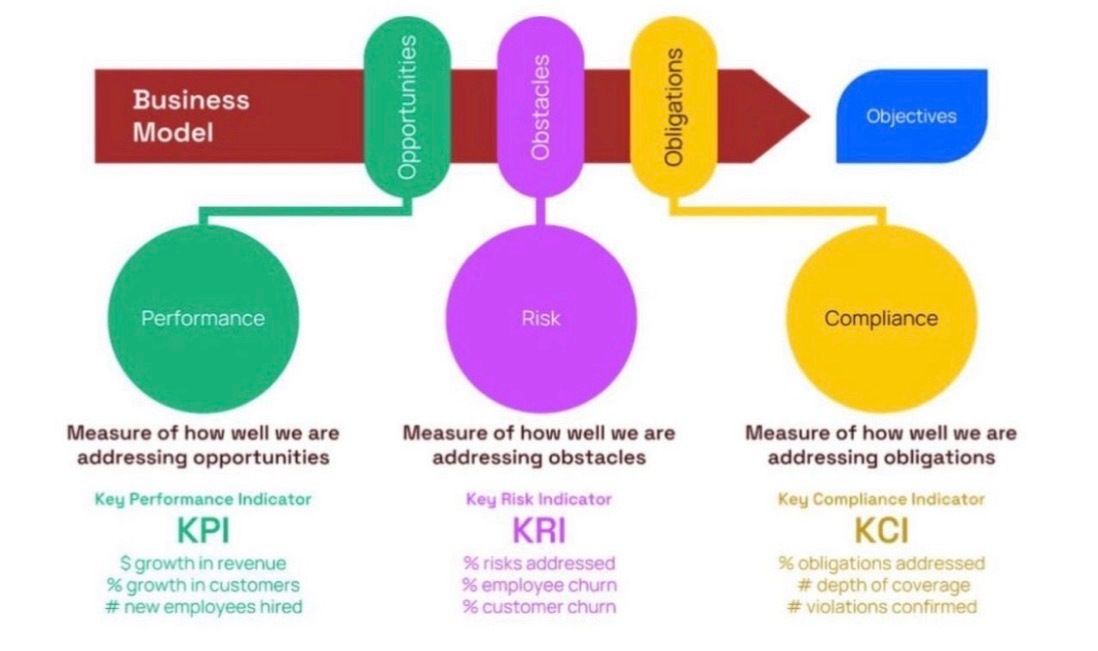
Did you know that your business model is actually an uncertainty processing machine? Every organization drives toward objectives, but the road to achieving them is filled with uncertainty that shows up as three distinct forces.
➡️ Opportunities (the good uncertainty). These are the positive surprises that could boost your objectives. New markets opening up. Competitors stumbling. Technology breakthroughs that favor you. You track these with KPIs through Performance Management.
➡️ Obstacles (the bad uncertainty). The stuff that could derail everything. Supply chain breakdowns. Cyber attacks. That key client who might walk. You manage these with KRIs through Risk Management.
➡️ Obligations (the non-negotiable reality). Both the rules you must follow and promises you’ve made. Regulatory requirements, stakeholder commitments, your own policies. You handle these with KCIs through Compliance Management.
Our GRCP certification equips you to handle all of the above with... certainty. 🙂↕️
🔗 Learn about it the GRCP today: https://t.co/VrouXVe5Km
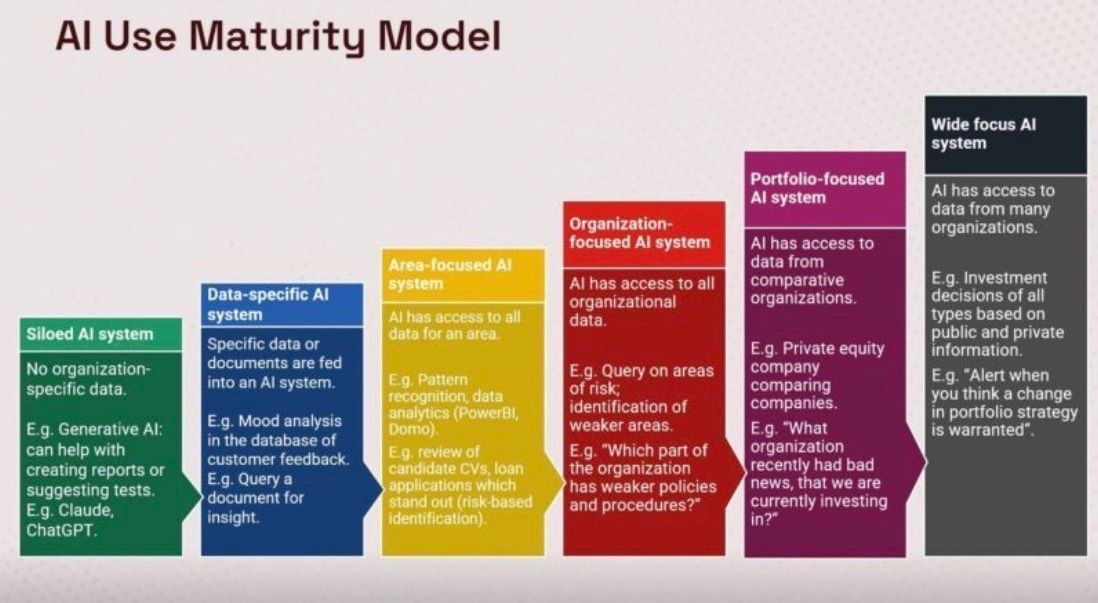
Most organizations get stuck at stage 2 of Al maturity while their competitors move to stage 5. The difference? A strategic, integrated approach. 🔍
Your Al implementation might be underperforming because you're limiting its potential. The reality is that siloed systems *can't* deliver the cross-organizational insights that drive true competitive advantage.
OCEG's maturity model reveals the progressive stages that transform Al from a basic tool to a true strategic business partner:
➡️ Move beyond isolated Al applications to area-focused systems
➡️ Expand from organizational data to portfolio-wide insights
➡️ Develop governance frameworks that scale with increasing data access
➡️ Implement proper controls that grow stronger with each maturity level
GRC professionals who understand this progression and are trained in Principled Performance (an OCEG-exclusive teaching) have the most advanced Al maturity models across industries.
🔗 Dive into OCEG's knowledge by becoming a FREE member: https://t.co/Tg8CZiZS2w
Most organizations think they’re strategic but they’re actually just reactive.
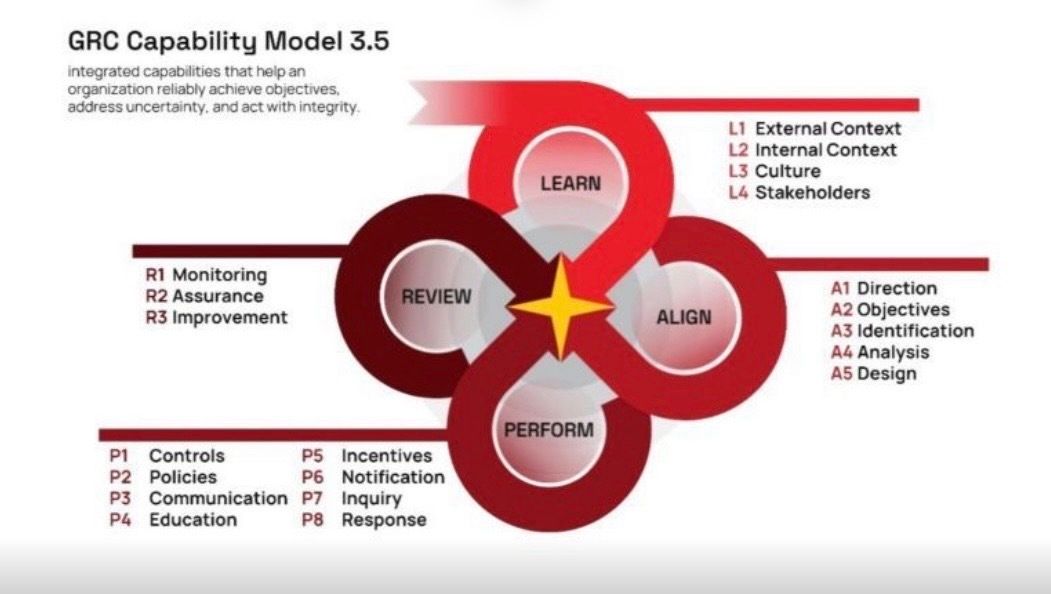
The difference lies in understanding the LEARN-ALIGN-PERFORM-REVIEW cycle that drives effective GRC implementation. After 20+ years of developing this methodology, we’ve seen how this integrated approach transforms organizational decision-making.
➡️ LEARN - Who are we? Where are we? What might affect us? Who do we serve? Understanding your complete organizational context before making any moves.
➡️ ALIGN - Where are we going? How will we get there? Systematically addressing opportunities, obstacles, and obligations along your strategic path.
➡️ PERFORM - How proactive are we? How do we detect problems and progress? Building systems that respond effectively to both favorable and unfavorable events.
➡️ REVIEW - Are we making progress? How confident are we? Continuous improvement through honest assessment and strategic adjustment.
This is the foundation our 150k+ global members use across diverse roles, departments, and organizations to achieve Principled Performance.
🔗 Download the FREE GRC Capability Model to learn more about this approach: https://t.co/s5kiv2R9Bg
Ever wonder why some AI implementations soar while others crash and burn?
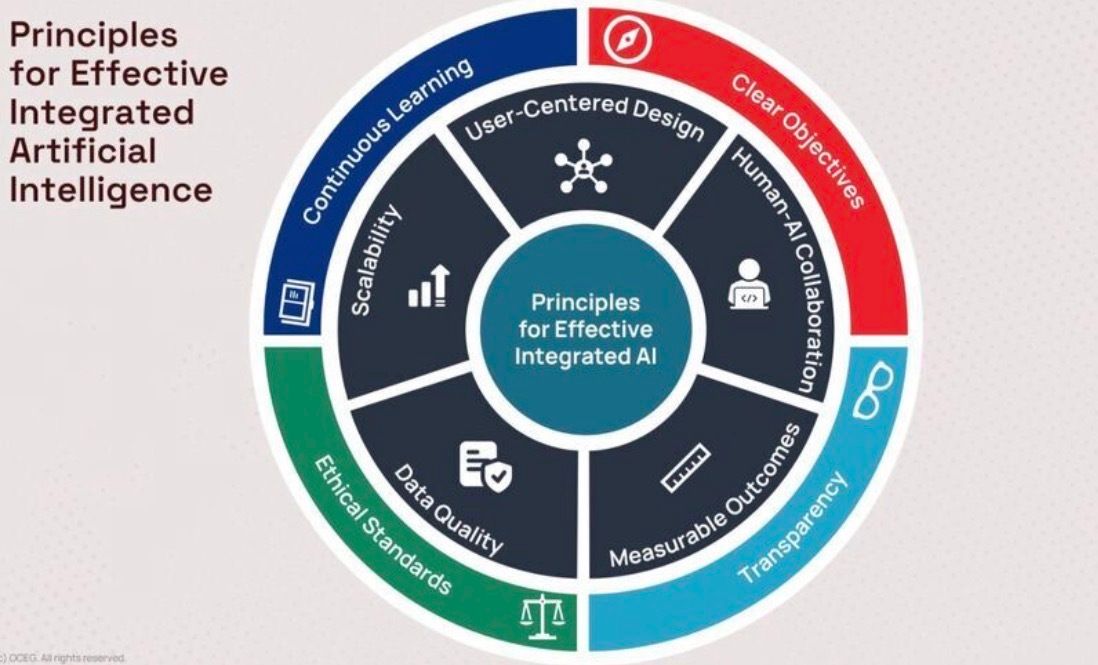
The difference doesn't lie solely in the technology a team uses. It also lies in whether the team has a principled approach to integration.
Our IAIP training introduces you to the comprehensive framework we recommend for effective integrated AI that successful organizations follow. The model addresses every crucial dimension:
➡️ Data Quality at the foundation
➡️ User-Centered Design that actually serves people
➡️ Measurable Outcomes that demonstrate real value
➡️ Ethical Standards that keep you on solid ground
➡️ Human-AI Collaboration that enhances human capabilities
🔗 Learn more today: https://t.co/6cLwXYVhSB
End 2026 in the right way. Download our FREE Information Security resources before they're gone! 🤭
🔗 Download our Information Security resources today: https://t.co/HMuWAGSDL7
Why do some organizations thrive under pressure while others crumble at the first sign of uncertainty? Hint: they’ve cracked the code on reliability.
You need three layers working together: Governance, Management, AND Assurance, but most organizations only do one at a time, siloed. Maybe two if they’re lucky. But conducting all three simultaneously is where reliability lives. Here's why:
✅ Management is direct control. You arrange resources, establish policies, make things happen. The CIO manages the IT department by setting budgets, hiring people, creating processes.
✅ Governance is indirect influence. You constrain and conscribe what’s possible. The Board governs IT by setting limits on what the CIO can do, establishing boundaries, defining acceptable risk levels.
✅ Assurance is objective evaluation. You provide confidence that what you believe is happening is actually happening. Internal audit assures both management and governance that the IT controls are working as designed.
The reliability factor of making all three work in tandem with each other changes everything, and THAT'S what Principled Performance is about: bringing disconnected systems together reliably to achieve organizational objectives.
🔗 Learn about it in our GRCP certification: https://t.co/VrouXVe5Km