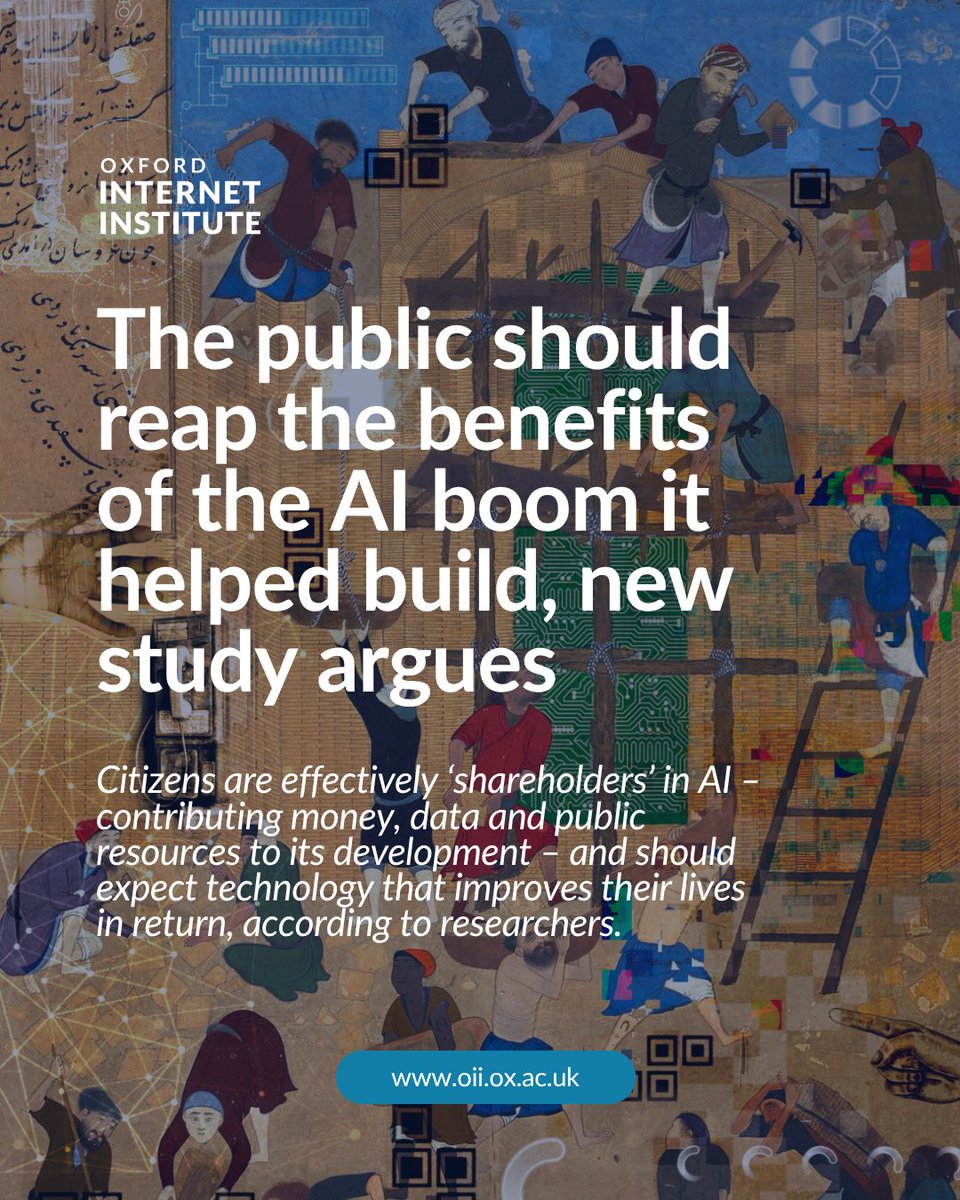
New! If the public helps build AI through funding, data and resources, should it share in the benefits?@oiioxford researchers argue citizens are effectively AI “shareholders” and technology policy should aim for happiness and well-being, not just growth and risk reduction. 1/2
The OII Halloween Lecture returns. On 30 Oct, Prof @josswright presents Paranormal Distributions: A statistical investigation of hauntings in the United Kingdom.
17:30 to 18:30, Rewley House or Zoom. Learn more and register: https://t.co/g7XjEJSg7y
He argues that companies seeking public support should owe us a ‘happiness dividend’, showing with evidence how AI helps people connect with each other, build meaningful skills and act autonomously.
Listen from 3:15:00: https://t.co/Ckh4CTre2q
Prof @b_mittelstadt joined BBC Berkshire to discuss how the public subsidises the AI industry, through tax breaks, infrastructure and research funding, and access to land, water, electricity and public data.
Listen from 3:15:00: https://t.co/Ckh4CTre2q
ICYMI: In their new essay for @ForeignAffairs, Niall Ferguson, Eric Schmidt and @oiioxford doctoral researcher Lisa Klaassen argue that AI is an imperial technology, not merely a commercial one, and that Washington and Beijing are building rival empires of intelligence.
Artificial intelligence “will not merely enrich the powers that dominate it but also provide the basic operating system on which everyone else must depend,” write @nfergus, Lisa Klaassen, and @ericschmidt.
https://t.co/1dI85Oxchm
Some caveats:
• Participants were paid to talk to our models
• The behaviors we measured were fairly low-cost
• Donations came from a study bonus, not people's own pockets
• In the real world, attention may limit AI's influence more than how persuasive any one conversation is
Our results suggest that findings from attitude-only AI persuasion studies may generalize poorly to behavior.
Comparisons like AI vs humans, personalized vs generic messages, or one prompt vs another could look quite different if the outcome were what people actually do.
We also saw hints that AI moved attitudes and behavior in different groups of people: attitude change was concentrated among those who didn't already support the petition, while the boost in signing came mostly from those who already did (exploratory).
i.e. persuading the unconvinced vs. mobilizing the already sympathetic.
So what does drive action? Our data don't give a clear answer. But in an exploratory analysis of the transcripts, explicit requests to sign appeared in 62-94% of persuasion conversations (vs 0.1% in control), and how often a strategy asked loosely tracked its effect on signing - echoing campaign research on the power of a direct ask.
Interestingly, effects on signing were fairly consistent across strategies (all within 7.5 points), while effects on attitudes varied by an order of magnitude - some strategies barely moved attitudes at all.
More broadly, the conditions that moved attitudes most weren't the ones that moved behavior most. Across 15 conditions in our first study and 8 strategies in our second, effects on attitudes were not significantly correlated with effects on behavior (r = 0.05 and 0.18).
Why? Possibly different mechanisms. How much people said they learned during the conversation tracked attitude change closely (r = 0.87 & 0.85), but not signing behavior (r = -0.15 & -0.16).
All 8 strategies increased signing. But the information strategy - again the best for changing attitudes - was the least effective at changing behavior (+16.2pp, vs +23.7pp for Mega).
But are the strategies that best change attitudes also the best at changing behavior?
Prior work (incl. ours) finds that AI is most persuasive at changing attitudes when it packs conversations with information. To test whether this holds for behavior, we pitted that information strategy against 7 theory-driven strategies for getting people to act - e.g. emotional appeals, anticipated regret, commitment escalation, and a "Mega" prompt that combined them all.
We found that AI conversations substantially changed behavior.
After a ~7 min conversation, the share of people opting to leave the study and sign the petition rose from 25% to 38% in our first study, and from 21% to 40% in our second.
To test this, we built a custom petition-signing website (styled to look just like a real one) which we could dynamically populate with the verbatim content of real, active UK petitions.
After chatting with the AI, participants in our studies were asked if they wanted to sign a petition. To do so, they had to *leave* the Prolific study, go to our petition website, enter their full name and email, agree to receive updates from the organization, and click "Sign this petition".
This let us observe real signing behavior - without actually changing support for real petitions, and while (hopefully!) minimizing demand effects.
(Everyone was debriefed afterwards and offered the real petition.)
New in @PNASNews:
In two large experiments (~18k obs from ~14.8k people), we find that brief conversations with AI can get people to take real political action - incl. signing real petitions and giving money to charity.
Surprisingly, the persuasion strategy that worked best for changing people's attitudes - packing convos with info - was the least effective at changing behavior!
🧵
Published in Royal Society Open Science, the study calls for AI that delivers meaningful public benefit. Lead author @SandraWachter5 , co-authors @b_mittelstadt@DariaOnitiu@NettaWeinstein. Read more and download the study: https://t.co/9b8fYdYpVh 2/2
New! If the public helps build AI through funding, data and resources, should it share in the benefits?@oiioxford researchers argue citizens are effectively AI “shareholders” and technology policy should aim for happiness and well-being, not just growth and risk reduction. 1/2