Sen. John Kennedy (R-LA): "Who did Epstein traffic these young women to?"
FBI Director Kash Patel, under oath: “There is no credible information, none” that Jeffrey Epstein trafficked children and women to other individuals.
#OpDeathEaters
Jes Staley told the House Oversight he passed confidential JPMorgan Chase information to Epstein while he was in jail for raping children. Staley admitted to having 'sex' with Epstein's assistant, sought his weekend release, and called him a "smart friend". #OpDeathEaters
------------------------------------------------------
Jes Staley told the House Oversight and Government Reform Committee he passed confidential JPMorgan Chase information to Jeffrey Epstein, including his own communications with the Federal Reserve during the 2008 financial crisis and the $44bn the private bank took in over a single fortnight, according to a transcript the committee released on 26 August 2026.
Staley sat for a voluntary transcribed interview on 24 July 2026 in Room 2154 of the Rayburn House Office Building, with Brendan V. Sullivan Jr of Williams & Connolly and Kathleen Harris as counsel. The committee is examining the federal handling of Epstein and Ghislaine Maxwell.
Epstein's client referrals brought JPMorgan well over $100m, by Staley's own account. For 13 months from June 2008 Epstein took Staley's calls from a jail in Palm Beach County, where he was serving a sentence for procuring a girl under 18 for prostitution.
The information that left the bank
Staley told investigators he shared with Epstein his communications with the Federal Reserve during the 2008 crisis, two pending transactions, his own pay, client relationships and the terms of his eventual move to Barclays, Bloomberg reported from the transcript. The $44bn figure was two weeks of deposit flight into JPMorgan at the point when Lehman Brothers had collapsed and the Federal Reserve was deciding which institutions to keep alive.
"I think you respect confidentiality, but it was at my discretion if I wanted to talk to friends of mine about issues at J.P. Morgan," Staley told the committee. Asked whether any rule barred him from taking confidential matters to Epstein in particular, he said no.
Epstein had "very interesting insights into the financial markets," Staley said, at what he called "a very difficult time in those markets". The man receiving those confidences was a registered sex offender in custody, holding no licence, no job at a regulated firm and no duty of confidentiality to anyone.
Staley described Epstein to the committee as "a smart friend to help me think through this stuff" and said he had raised arranging a temporary release "for the weekend" so the two could discuss business, Banking Dive reported from the transcript.
Cash, compliance and the tip-off
JPMorgan records put Epstein's cash withdrawals at $40,000 to $80,000, several times a month. Staley advocated keeping the account open after the 2008 Florida guilty plea.
"Closing a checking account is a tough move," he told the committee, and he said he had been "completely unaware" the accounts were facilitating rape trafficking.
Representative Suhas Subramanyam pressed him on whether he had personally defended the relationship. "I left it to the bank's compliance department, legal department, and Private Bank to determine whether he maintained an account," Staley said. JPMorgan cut Epstein back to a checking account and dropped him as a client in 2013.
Representative Walkinshaw put a 2011 New York Times account to him, that Staley had alerted Epstein to JPMorgan's heightened sensitivity about the constant withdrawals. "Quite possibly, yes," Staley said, and he believed Mary Erdoes, head of the bank's asset and wealth management arm, had done the same. Asked whether the point was to let Epstein change his behaviour and avoid further scrutiny, Staley said no. He also accepted he had probably told Epstein of his designation as a high-risk client and had sought to have it reviewed.
Staley testified he discussed Epstein with Jamie Dimon twice, "once in 2006 when Epstein was indicted, and I believe once in 2008 when Epstein went to jail". Dimon testified under oath in 2023 that he recalled knowing nothing about Epstein until federal prosecutors charged him in July 2019. Neither man has been accused by any prosecutor of giving false testimony, and the committee published the two accounts without adjudicating between them.
The Snow White emails
On 9 July 2010 Staley wrote to Epstein, "That was fun. Say hi to Snow White," in an exchange the Justice Department filed as EFTA00894090. Epstein asked what character he would like next. Staley wrote back, "Beauty and the Beast." Epstein replied, "Well one side is availble [sic]."
A separate message to Epstein the next day, filed as EFTA00741531, reads: "the snow white was f..ed twice as soon as she put her costume))". Three weeks earlier, on 20 June 2010, Epstein had asked a young woman to obtain a Snow White costume from a costume shop.
"Did you ever have sex with a young woman in a Snow White costume?" a committee representative asked. "No, I did not," Staley said.
Pressed on why the second email would have been sent at all if nothing had happened, Staley said, "I have no idea who else she was with. I, it has nothing to do with me, though." He went on: "I may have seen her in apartment [sic] and prompted that email." Asked to confirm he may have seen her, emailed Epstein to say "that was fun," and yet not had sex with her, Staley said, "That's correct." He cited the 16 years since to explain what he could not recall.
Asked whether he would agree that was a pretty incredible coincidence, Staley said, "Sure. Why not?"
Asked whether he and Epstein used Disney princesses as code names for selecting women for sexual encounters, he said no.
The assistant on 66th Street
Staley described one sexual encounter with a woman who worked for Epstein, whom he first met at Epstein's Manhattan townhouse and believed was in her twenties or thirties. It took place months later at her apartment on 66th Street, in 2009 or 2010.
"I think we talked. I believe we were sitting on her couch together while we talked. And one thing led to another, and we had an intimate engagement," Staley told the committee. Asked how he knew it was consensual, he said, "My recollection is, she invited me into her bedroom."
Investigators told Staley the woman had sued Epstein for sexual abuse and settled with his estate, carving Staley out and reserving the right to sue him. "No, I was not aware of this," he said, and he told the committee he did not know Epstein had ever abused his assistants.
Staley made a comparable admission under oath 17 months earlier. At the Upper Tribunal in London in March 2025 he said he had sex with a member of Epstein's staff at an apartment belonging to Epstein's brother in New York, and told the court the disclosure put his marriage at risk. Whether that is the same woman is not established in either record.
The regulatory record
The Financial Conduct Authority banned Staley from senior roles in UK financial services and set a penalty of £1.8m, which he referred to the Upper Tribunal. The tribunal dismissed the reference on 26 June 2025 and the FCA issued its final notice on 23 July 2025.
Judges found Staley had approved a letter to the regulator that falsely described his relationship with Epstein as not close and said contact had ceased before he joined Barclays, when emails showed the two still in touch into 2016 and 2017. They found he acted recklessly, had a clear motive to play down the relationship, believed the truth would stay hidden, gave evidence that in places lacked credibility and showed no remorse. In his own correspondence he had called Epstein one of his deepest and most cherished friends.
"Mr Staley chose to take a calculated risk that we would take his inaccurate account at face value," the FCA's enforcement director said. The fine came down to £1.1m after Barclays declined to release his deferred shares. UK regulators had penalised him once before, fining him £642,430 jointly with the Prudential Regulation Authority in 2018 over his attempts to identify a whistleblower.
Justice Department records show roughly 1,200 communications between the two men between 2008 and 2012. Staley met Epstein in the late 1990s, around the time he took over JPMorgan's private bank. Barclays announced his appointment as chief executive on 28 October 2015 and he stepped down in November 2021 when the FCA investigation surfaced.
Project Jes
Epstein worked to secure Staley the Barclays job through the public relations executive Ian Osborne, under the label "Project Jes", according to material put before the Upper Tribunal and cited by lawmakers. Osborne is not accused of wrongdoing.
Nigel Higgins, the Barclays group chairman, told the FCA in August 2019 that he did not think the Epstein connection needed a board discussion, and the board acknowledged in a witness statement that it never asked Staley when he had last been in contact with Epstein. Barclays told the regulator that October that Staley and Epstein were not close.
Senator Elizabeth Warren and Representatives Ro Khanna and Raja Krishnamoorthi wrote to Higgins on 22 July 2026, setting a reply date of 5 August. "It is deeply unclear how Barclays, in supposedly investigating Staley's connection to Epstein, failed to uncover this decades-long relationship," they wrote. Their eight questions asked the bank to name the executives who approved the October 2019 disclosure, to say whether directors contacted Epstein, Ian Osborne, George Osborne or Mervyn King about Staley's candidacy between 2012 and 2015 and to say whether the Federal Reserve, the FDIC or the Office of the Comptroller of the Currency had approached the bank since the Epstein files were released. Barclays US LLC holds about $200bn in assets.
Staley left with £2.4m in fixed salary and a £120,000 pension allowance running to late 2022, plus £107,000 in repatriation costs, a package that "could cover the £1.1 million fine levied by regulators more than twice over," the lawmakers wrote. The same letter states that newly unsealed documents indicate the Justice Department examined allegations against Staley in 2019 involving rape and bodily harm. No charge has followed in any jurisdiction, the department has announced no case and Staley denies wrongdoing.
Warren wrote on 28 October 2025 to Federal Reserve vice chair for supervision Michelle Bowman, Comptroller of the Currency Jonathan Gould and acting FDIC chairman Travis Hill, seeking investigations into Staley, Dimon and former JPMorgan general counsel Stephen Cutler. Cutler had warned that Epstein was not an honourable person, Warren wrote, and Staley repeatedly went to bat for him inside the bank. She asked for confirmation of an opened investigation by 14 November 2025. None has been announced.
Justice Department records released in December 2025 show Epstein named Staley and the former Treasury secretary Larry Summers as executors in draft wills. Staley told the committee he signed trust documents in 2014 and an amendment in 2015, then declined the role because he did not want the association.
What the law reaches
JPMorgan settled a class action brought by Epstein's victims for $290m in June 2023 and paid the US Virgin Islands $75m on 26 September 2023. Both suits ran on the beneficiary provision of the federal anti-trafficking statute, 18 U.S.C. 1595, which lets victims sue anyone who knowingly benefits from taking part in a venture the defendant knew or should have known was trafficking. The bank made no admission of liability.
Section 5318(g) of title 31 bars a bank and its officers from telling any person involved in a transaction that a suspicious activity report has been filed, a prohibition carrying criminal exposure under 31 U.S.C. 5322. The bar attaches to a filed report. Ron Wyden, as ranking member of the Senate Finance Committee, established that JPMorgan filed its reports on Epstein only in 2019, after his arrest and six years after dropping him as a client. "For banks to withhold these reports until a suspect like Jeffrey Epstein is already behind bars is an impediment to justice," Wyden wrote. On the public record no filed report existed in 2011, when Staley described making the disclosure.
Staley's UK prohibition rests on the Financial Services and Markets Act 2000 and the FCA's individual conduct rules, which reach honesty toward the regulator rather than the underlying conduct. No US regulator has publicly opened a case against him. He has never been charged with a crime in any jurisdiction and he denies wrongdoing.
JPMorgan reportedly declined to comment on the transcript. Barclays has not published a reply to the 22 July letter.
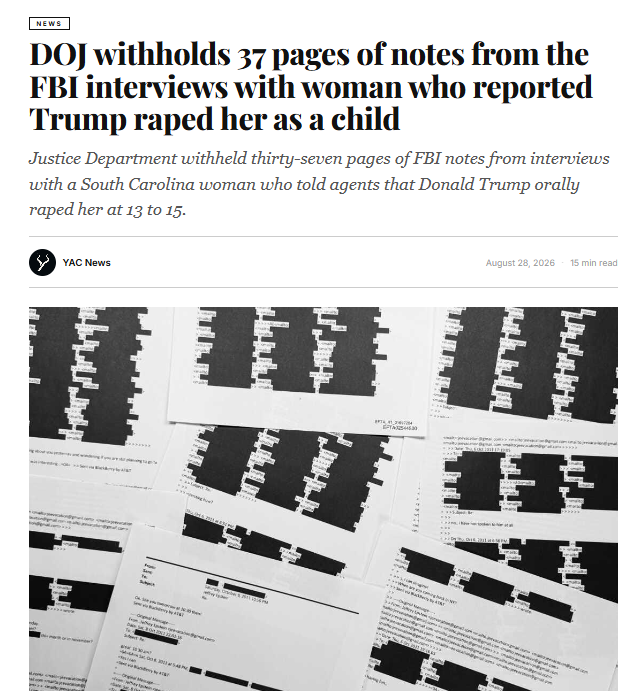
Justice Department withheld thirty-seven pages of FBI notes from interviews with a South Carolina woman who told agents that Donald Trump orally raped her at 13 to 15. #opdeatheaters
----------------------------------------------------------
The Justice Department is withholding 37 pages of handwritten FBI notes from three 2019 interviews with a South Carolina woman who says Donald Trump raped her as a child.
Twenty-two of those pages went up on the document-sharing site Scribd on 6 March 2026, posted by a reporter for the conservative Washington Examiner. Nobody noticed for five months. The copies carried no redactions, and they carried the woman's real name, her family details and the names of the childhood friends she had given the FBI as people who could corroborate her account. The bureau had stamped her file PROTECT SOURCE.
Typed reports that agents wrote up from those notes, the forms known as FD-302s, were published in stages, the first in the department's original Epstein Files Transparency Act production and three more in March 2026. Todd Blanche, the deputy attorney general, has said the notes are duplicative of those summaries. The transparency act contains no exception for duplicative documents.
Serial 3501.045 and the withheld five
Serial 3501.045 is the file number the FBI gave to material on this witness. The bureau's disclosure index, produced to Ghislaine Maxwell's defence team under court order and later released in the transparency act production as EFTA00095751, lists 15 records under that serial totalling 53 pages. Ten have been published. Five have not, and three of the five are the interview notes.
Published under the serial are the FD-302 from the first interview on 24 July 2019, running to nine pages, three photographs, an FBI crisis intake form dated 31 July 2019, an electronic communication dated 29 October 2019 recording contact from her attorney, and a second electronic communication dated 19 July 2019 recording her provision of information.
Interview one is 3501.045-001 and its notes are 002. Interview two is 003 and its notes are 004. Interview three is 005 and its notes are 006. Interview four is 007 and has no notes. The three photographs are 008 to 010.
CNN reported on 24 February 2026 that dozens of FBI records were absent from the production, among them three of the four interviews with this witness. The department said two days later that it was investigating whether Epstein files concerning Trump had been wrongly withheld. Three further FD-302s covering the second, third and fourth interviews went online on 5 March 2026, after the department said documents had been improperly tagged during review. "There are no missing pages and the Department categorically rejects this media-created myth," the department said in April 2026, a month after publishing three of them.
Withheld are the notes for interviews one, two and three, a law enforcement report dated 10 July 2019 and a redacted licence dated 19 July 2019.
Fifteen pages of notes cover the first interview, 18 the second and four the third. Agents interviewed her on 24 July, 7 August, 20 August and 16 October 2019.
Hilton Head, the early 1980s
Her family lived on Hilton Head Island, South Carolina, where her mother worked in real estate, and she was about 13 when the abuse she described to agents began. She placed her first contact with a man she knew only as "Jeff" through a babysitting listing. The Post and Courier reported from the interview records that her mother put her daughter's name into rental property fliers as an available babysitter, and that the man who called said he needed childcare, though no children were there when she arrived. Accounts drawn from the notes by the independent journalist Ellie Leonard have her distributing the fliers herself.
She called the FBI tip line on 10 July 2019, two days after Epstein's arrest.
NBC News, working from the released summaries, put the South Carolina abuse at about 1984. Leonard's reconstruction from the notes puts the family's arrival on the island in 1981, with her mother buying a house for $55,000. The Post and Courier placed the assaults in the 1980s at a Sea Pines Plantation villa without fixing a year.
He had a long face that reminded her of Lurch from the Addams Family. A snaggle tooth showed when he was angry. A lisp came out when he lost his temper. He wore penny loafers and traded them for new pairs. Shelves of books lined the rooms she was taken to, and classical music played. He wore a shirt made of Tyvek that she called a cardboard shirt, and a cologne she named as Grey Flannel.
Cocaine, alcohol and marijuana were offered to her, she told agents, and the episode felt to her like a dream, which she took to mean something had been put in her drink. Sexual abuse followed. The abuse ran over two or three years, sometimes with more than one man present. Two of the men on one occasion had southern accents, she said, and she became distressed when agents pressed her on who they were.
A drawer she opened held Polaroid photographs, some of them naked images of herself. Being nosy isn't good for you, she said the man told her when he caught her, before assaulting her violently.
Epstein later directed her to bring him what he called "fresh meat", according to the Post and Courier's reading of the records, and she approached girls on nearby beaches with the suggestion that they could go to his place to party.
A woman accompanied "Jeff" on occasion. She was neither black nor Caucasian, the witness said, and struck her as very cold. Researchers reading the files take the description to be Maxwell. No document in the released material makes that identification.
Agents recorded in the first 302 that she mentioned other men had been present at one encounter and would not name them. She "was concerned about implicating additional individuals, and specifically any that were well known, due to fear of retaliation", the report said.
The tall building
Epstein took her off the island when she was between 13 and 15, she told agents on 7 August 2019, and drove or flew her to New York or New Jersey. She was "introduced to someone with money, money... It was Donald Trump." Others were with them, in a very tall building with huge rooms. Eighteen pages of handwritten notes cover that interview. Its typed summary, filed under case number 31E-NY-3027571 and marked PROTECT SOURCE, went online in March 2026.
Trump did not like her, "from the get-go, he didn't like that I was a boy-girl", the 302 records her saying, a reference to her being a tomboy. She could not identify the others present. They all left when Trump asked everyone to leave the room.
He said something to the effect of "Let me teach you how little girls are supposed to be." He unzipped his trousers and put her head, in the 302's phrasing, "down to his penis". She "bit the shit out of it". He struck her and said words to the effect of "get this little bitch the hell out of here." Agents returning to the incident in a later interview recorded her clarifying what the blow had been: he "pulled her hair and punched her on the side of her head".
She bit him because he disgusted her, she told agents. "He had money, it reeked off of him."
A blonde woman approached her later that day. "Let me give you a tip little girl about your breasts, wear a bra every night," the woman said. Those words stayed with her through the years, she told agents.
She thought jealousy ran between the two men, with Trump the jealous one at first, until at some point they ended up on a level playing field. Trump and Epstein used the words "fresh meat", "untainted" and "not jaded" about girls. She did not know what "not jaded" meant at the time and looked the word up afterwards.
Two additional interactions with Trump followed, she told agents, and then she asked that the interview move to a different subject for the time being. Agents did not return to it in the two remaining interviews.
Epstein talked about blackmailing people in front of her, and she was confident Trump knew, because she heard the two of them discussing it. Trump had illegal building permits, she said. She heard him talking about washing money through casinos. Six was his favourite number, and she was not sure how she knew that.
Epstein's blackmail of her mother "ruined my family", she told agents.
She asked the agents to keep her safe. "Throughout my life his people have found me, have kept tabs on me," the 302 records, with Epstein's name in the original.
Trump denies wrongdoing. Karoline Leavitt, the White House press secretary, has called the allegations "completely baseless accusations, backed by zero credible evidence" and has pointed to the woman's criminal record. The previous administration's Justice Department "knew about them for four years and did nothing with them", she said. A White House statement said earlier that if the claims had "a shred of credibility, they certainly would have been weaponised against President Trump already". Trump said after the March release that he had nothing to hide and had been exonerated.
Offences described
Trump unzipped his trousers and put her head "down to his penis", in the 302's phrasing, and she bit him. The act is fellatio. Neither the notes nor the published summary records vaginal or anal contact during that encounter.
Eric Holder, then the attorney general, revised the FBI's Uniform Crime Reporting definition of rape on 6 January 2012, and the bureau collected data under it from 2013. It reads: "The penetration, no matter how slight, of the vagina or anus with any body part or object, or oral penetration by a sex organ of another person, without the consent of the victim." Forced oral sex fell outside the definition the bureau had used since 1927, which reached only "carnal knowledge of a female forcibly and against her will".
Forced oral sex on a child is rape in the first degree in New York today. Kathy Hochul signed the Rape Is Rape Act on 30 January 2024, extending section 130.35 of the penal law from vaginal contact alone to oral and anal contact. First degree applies where there is forcible compulsion, where the complainant is under 11 or where the complainant is under 13 and the defendant 18 or older. Prosecutors taking the age route need prove no force at all. Trump was born in 1946.
Section 130.50 of the New York penal law covered the same conduct in the 1980s, under the name sodomy in the first degree, a class B felony with a maximum of 25 years. Deviate sexual intercourse was defined to include contact between the mouth and the penis, and forcible compulsion was the aggravating element. The state's rape offence reached vaginal intercourse alone until the 2024 act.
New Jersey abolished the offence of rape in its 1979 criminal code. Fellatio is sexual penetration under section 2C:14-1 and an act of sexual penetration with a victim under 13 is aggravated sexual assault in the first degree under 2C:14-2. First degree crimes carried 10 to 20 years when the events she described took place. A mandatory term of 25 years to life for that offence was signed into law in 2014. Her age at that encounter is given in the 302 as a range of 13 to 15, and the child-specific provisions in both states turn on which end of that range applies.
Penetration is specified nowhere in the Hilton Head material. The Post and Courier reported that she gave agents graphic detail and recalled registering at the time that she was looking at a grown man's penis. Drugging is specified, and so is repeated abuse over two or three years with more than one man present on occasion.
South Carolina has charged these offences as criminal sexual conduct since 1977 and grades no offence under the name rape. Sexual battery covers "sexual intercourse, cunnilingus, fellatio, anal intercourse, or any intrusion, however slight" into the genital or anal openings of another person. Committed against a child of 13, it is criminal sexual conduct with a minor in the second degree, which carried up to 20 years under the code in force in the 1980s and carries 10 to 30 years since the 2012 amendment. First degree is reserved for a victim under 11 or for an offender with prior qualifying convictions.
South Carolina sets no limitation period on criminal prosecution at all, for felonies or misdemeanours. New York and New Jersey each opened a window for civil claims over childhood sexual abuse that would otherwise have been out of time, and both have closed, New York's under the Child Victims Act on 14 August 2021 after one extension and New Jersey's under S477 of 2019 on 30 November 2021. She sued Epstein's estate in 2019 and has brought no claim against Trump.
No charge has been brought over any of the conduct described in the notes, the FBI opened no investigation into the Trump allegation and Trump denies wrongdoing.
Third and fourth interviews
Threatening telephone calls came to her after Epstein's arrest, she told agents on 20 August 2019, and she connected them to Epstein or to Trump. She had been almost run off the road. Four pages of notes survive from that interview.
Her fourth interview, on 16 October 2019, produced no notes. Agents recorded that she "advised she was not comfortable" being audio recorded. No attorney was present. She asked, in the 302's wording, "what the point would be of providing the information at this point in her life when there was a strong possibility nothing could be done about it". She cut contact with the bureau afterwards.
A photograph she gave agents contained two men. She asked them to crop Trump out of it and to focus on Epstein.
What the notes hold that the summaries do not
A businessman she named to agents as a third assailant is identified in the handwritten notes. He employed her mother, on her account, and was her mother's lover. The notes record her saying he masturbated in front of her, tried to put his hand down her trousers and raped her once, according to Leonard's reading of the pages. None of that appears in the typed report of the same interview, where a long paragraph at that point in the narrative is redacted. She told agents her mother took money to buy back photographs he had taken of her. No charge has ever been brought over the allegation, no other source has tested it and this article does not name him.
Four young teenage girls said to have attended a pool party on Hilton Head are named in the handwritten notes. None of the names appears in the typed reports. The Marriott at Shipyard Plantation is named in the notes as the location, where the 302 said only "possibly at the Marriott Hotel" with the rest redacted. A high school friend she said she had confided in is named, as are other friends, with jottings on how she knew each of them.
The Post and Courier described cursive with the disorganised feel of a personal notebook, holding items that may only make sense to the writer, jotted down as conversations unfolded. More than one agent wrote on single sheets, which is what confused researchers trying to match handwriting when the copies first appeared.
Leonard, who transcribed the pages, wrote that the 302s are generally substantially similar to the notes and written in more complete sentences. The named third man and what he is alleged to have done, the named girls and the named hotel are in the notes and absent from the summaries.
How the notes reached the internet
Kaelan Deese, a reporter at the Washington Examiner, uploaded 22 of the 37 pages to a public Scribd account under the username "reportoftheday" on 6 March 2026. His article "What's still missing from the Epstein files" ran in the Examiner the next day. The pages sat there unread by any major outlet until August.
"For the last five months, anyone with internet access could view the notes, which had Jane Doe 4's real name all over them, as well as significant biographical details and the names of childhood friends and family members who she said could corroborate elements of her story, all of which she gave the FBI in confidence, and all of which the DOJ had redacted," the researcher Rye Howard-Stone wrote.
Deese had been given the files by a source within the Justice Department, he told a member of the public who found the Scribd posts and contacted him by text, according to Howard-Stone, who obtained screenshots of the exchange. Deese described the material as classified and later sent a third file directly to that person. He said he had trouble with the Scribd upload and eventually gave up on it. The files came down shortly after Howard-Stone contacted an editor at the Examiner.
Screenshots of the exchange could not be independently authenticated, Howard-Stone wrote. Deese was part of a small group the department decided could be trusted with unredacted files that Congress and the public could not, he wrote, a contention the department has not addressed.
Amy Gabrielle, a New York writer, found the archive first. Leonard published manually redacted copies after two people, one on Signal and one on Reddit, led her to the Scribd files. A separate set of 15 pages appeared on Reddit without redactions.
One of the women named in the notes as a high school friend told the Post and Courier she had never been contacted by the FBI, and learned she was in the file when reporters reached her.
The second Trump claim
A Justice Department presentation prepared in the summer of 2025, around the time Blanche interviewed Maxwell in prison, carries a second allegation involving Trump. Epstein introduced a 14-year-old girl to him at Mar-a-Lago in 1994 with the words "This is a good one, right?", to which Trump agreed, according to the slide. The claim carries immense credibility inside the department, Roger Sollenberger wrote, because the account came from a government witness at Maxwell's trial whose testimony helped convict her. Sollenberger, formerly of the Daily Beast, first reported the presentation.
Corroboration and its limits
Agents interviewed her four times and found her credible, a Justice Department source told the Miami Herald.
The FBI never opened an investigation into the Trump allegation. It was not raised during the 24 July 2019 interview and does not appear in the bureau's written communications on her case. Trump is not under criminal investigation over it.
The Post and Courier could not corroborate the Trump allegations from the 30 pages it reviewed. One friend identified in the notes and interviewed by the paper had no memory of anything untoward around the events described.
Public records support parts of the surrounding account. Her mother worked in Hilton Head real estate and was charged over an escrow theft, with a restitution order and probation violations on the record. She attended Hilton Head High School. The out-of-state businessman connection holds up in property records.
She sued Epstein's estate in 2019 and settled with it directly. "We were able to get money directly from the estate without" going further into litigation, her attorney said. She filed a claim with the separate victims compensation fund set up in 2020 and was not paid through it. The settlement figure has never been disclosed. Richard Kahn, Epstein's accountant, gave conflicting testimony to the House Oversight Committee about whether she had been compensated, and his attorney later wrote that neither of them had "a perfect recollection of every woman who has asserted a claim". Kahn attributed the confusion to more than one claimant using the pseudonym Jane Doe 4.
Her life after the events she described included multiple marriages, domestic abuse, drug dependency and criminal charges, the Post and Courier reported. She was prosecuted over taking cash from an elderly dying man. Her public defender recalled her saying she had been a victim in the Epstein case and that it had traumatised her.
Authenticity
Copies of the handwritten pages have not been authenticated by the FBI or by any court.
Gabrielle wrote that "authentication is out of my purview" and that she had left it to experts associated with the case. She has never asserted the documents are genuine. Identifier numbers used by the uploader are not the same as the numbers in the department's transparency act system, she wrote, and the fonts and letter spacing differ between the Scribd files and the set posted to Reddit. The discrepancy, she wrote, is enough to create doubt about the authenticity.
Leonard wrote that after 48 hours of checks she was almost certain the pages were genuine, matching serial numbers running from 3501.045-001 to 3501.045-010 against the four FD-302s.
Katie Phang, the journalist suing the attorney general over compliance with the transparency act, said authenticity "remains an open question" that could be readily answered if the FBI complied with the law. She has kept demanding the unredacted notes from the department rather than working from the leaked copies, and told Howard-Stone the timing of their discovery and release was "interesting".
"What these notes DO show is that they are not 'duplicative' of the FBI 302s as Blanche has asserted and they clearly contain allegations of sexual abuse and physical abuse committed by Donald Trump with a victim who was 13-15 years old at the time," Phang said. "So the Trump DOJ has no incentive to release them."
FD-302s are agents' summaries written up after the fact. They are not transcripts, not sworn statements and not findings. Handwritten notes are taken while a witness is speaking. The 302s were typed up afterwards, and in this case they carry less than the notes do.
The court order
Emmet Sullivan, the senior judge hearing Phang's case in the US District Court for the District of Columbia, ordered the Justice Department on 13 August 2026 to justify its redactions and to explain the withholding of the handwritten notes, and directed that the justifications be published in the Federal Register.
Andrew Block, for the department, told the court that many of the notes were substantially similar or duplicative and so did not require republication, and asked the court to extend the executive branch the presumption of regularity.
Sullivan said he would conduct a sealed review of the notes themselves and require a declaration from the department on its compliance. He asked Phang's team to submit a proposed order covering the notes and the redaction justifications, and left his original deadlines in place, among them a 25 August date for the unredacted notes to reach him.
"The public has a right to know what the hell is going on in this case," Sullivan said. He told the department that contempt proceedings were available to him. "That's not a threat, that's a promise," he said.
Meta has agreed to pay billions in a settlement with 47 US states over youth social media addiction and child safety on Facebook and Instagram. #OpDeathEaters
-----------------------------------------------------
Meta Platforms agreed on 26 August 2026 to pay US states and territories billions of dollars and change the default settings for users under 18 on Facebook and Instagram, cutting short a trial in Oakland federal court that had been hearing evidence since 18 August and was scheduled to run into October. Judge Yvonne Gonzalez Rogers of the US District Court for the Northern District of California must approve the consent judgment before it binds the company.
Rob Bonta, the California attorney general, announced the agreement as a $17 billion settlement signed by 51 attorneys general representing states, territories and the District of Columbia, with California, Colorado, Tennessee, Kentucky and New Jersey as lead states. Meta's own announcement, published the same day, put the payment at "approximately $18 billion" spread over 10 years, split into about $12.7 billion going to the participating states and about $5.3 billion contingent on YouTube and TikTok adopting equivalent teen protections and making matching payments. Reuters, citing a court filing earlier on 26 August, reported a maximum of $16.68 billion.
Reported figures ranged from $16.68 billion to $18 billion and state counts from 29 to 51 across the Wall Street Journal, the Associated Press, TechCrunch, CNBC and Forbes. Of the total, $12.7 billion is guaranteed, $5.3 billion arrives only if TikTok and YouTube adopt the same standard, and the $16.68 billion Reuters reported came from a filing made before the announcement. The 2023 complaint was filed by 29 states, which took Meta to trial; 51 attorneys general signed the settlement, including territories and the District of Columbia.
California is set to receive between $1.5 billion and $2.1 billion depending on court approval, earmarked in Bonta's announcement for mental health and social media harm prevention. Virginia's share is $353 million. Meta told investors it expects to accrue roughly $10 billion in legal expenses in the third quarter of 2026. Meta shares rose more than 4 per cent in pre-market trading after the deal was reported. The company reported revenue of $201 billion in 2025.
What changes on the platforms
Default settings on both apps change for users under 18 within months of approval. A two-hour cumulative daily limit across Facebook and Instagram applies unless a parent lifts it. Night Mode blocks the apps from midnight to 6am. Notifications are muted overnight and during school hours, set at 8am to 3pm between 15 August and 15 June. Prompts appear after 15 minutes of continuous use. Teens get a feed option that runs without personalised ranking and the ability to switch off autoplay. Like and reaction counts are hidden. Cosmetic surgery filters are blocked. Age checks tighten, with removal procedures for accounts held by children under 13, whose data collection formed the states' claim under the Children's Online Privacy Protection Act. Reports submitted by teen users must draw a response within six hours in 90 per cent of cases.
Meta's two-hour cap drops to one hour per app and the overnight block widens to 10pm through 7am if YouTube and TikTok adopt the same standard. Meta wrote in its announcement that "we urge TikTok and YouTube to join us and state attorneys general in adopting this new standard".
An independent auditor receives access to Meta's compliance work and reports to the state attorneys general directly, with the settlement also placing an injunction on false or misleading claims by the company about the safety of its products. Meta has not admitted liability, and its announcement contains no acknowledgement of wrongdoing.
Bonta said the agreement "institutes real change, real transparency, and real enforceable protections for children on Facebook and Instagram", and that it would "make social media less dangerous for our kids". C.J. Mahoney, Meta's chief legal officer, said the settlement will "empower parents to easily manage how their children access our platforms", and said its success depends on other platforms following.
Evidence heard before the deal
Arturo Béjar, a former Meta engineering director, told the court that the company had consistently put profit ahead of safety. "If you step away from the product, they are not going to make any money," he said. Béjar also told the court that Meta's "Take a Break" tool is "designed to fail", because a user has to switch it on. Adam Mosseri, the head of Instagram, testified late on 25 August in defence of the company's child safety record. Mosseri has drawn a distinction between problematic use and clinical addiction. Mark Zuckerberg was on the witness list and did not reach the stand.
Paul Schmidt, appearing for Meta on 20 August, said there is "no question that some teens struggle to manage their time with social media" and said the company takes enforcement of its age limits seriously while recognising that some users still sign up with false birthdays.
Haley Hinkle, policy counsel at Fairplay, published research in September 2025 finding that 60 per cent of the Meta teen safety features tested were either unavailable or did not work as advertised. Meta called those findings "misleading" and "dangerously speculative". Marc Berkman of the Organization for Social Media Safety said the record shows a "lack of real institutional willingness to act here".
Meta had told the court in pre-trial filings that a loss could expose it to penalties of up to $1.4 trillion.
Jay Jones, the Virginia attorney general, said Meta "intentionally deceived the public about ... addictive ... design features that have wreaked havoc on youth mental health". Bonta said the company "has agreed to make massive transformations that will reduce the risk of harm from its platforms, and will do it within months".
The New Mexico judgment of 7 August 2026
Judge Bryan Biedscheid of New Mexico's First Judicial District Court ordered Meta on 7 August 2026 to pay $942 million and to rebuild child protections on Facebook and Instagram for five years. A Santa Fe jury had returned the first part of that figure on 24 March 2026, finding 75,000 violations of the state's Unfair Practices Act and imposing $375 million in civil penalties; the court added $567 million in the second phase, which ran to May 2026 and dealt with what Meta must change. The court found the platforms to be a public nuisance and rejected the company's Section 230 defence. The New Mexico Department of Justice said the ruling was the first time a court had held a social media company liable for designing products that promote addiction and expose children to sexual exploitation.
Raúl Torrez, the New Mexico attorney general, filed that case on 5 December 2023 against Meta and Zuckerberg personally, alleging failure to protect children from sexual abuse, solicitation and human trafficking, and alleging that the recommendation systems on Instagram and Facebook served accounts belonging to predators to child users. Zuckerberg was dismissed as a defendant on 30 May 2024, the same ruling that denied Meta's motion to dismiss. Torrez said on 30 April 2026, as the company resisted the state's demands mid-case, that "Meta is showing the world how little it cares about child safety" and that "this is not about technological capability. Meta simply refuses to place the safety of children ahead of engagement, advertising revenue, and profit."
Relief ordered in New Mexico runs for five years and covers age verification, sextortion and exploitation safeguards, blocking minors from sending nude images, ending overnight push notifications for under-18s, hidden like counts, time limits, risk disclosures, funding for a statewide education campaign, training for law enforcement and compliance reports to the court twice a year. Torrez said Meta "built products it knew would fuel addiction, deepen a youth mental health crisis, and expose children to sexual exploitation, then lied to parents".
How predators reach children through the platforms
The Stanford Internet Observatory reported in June 2023, in work published alongside a Wall Street Journal investigation, that Instagram was at that point the single most important platform for networks trading self-generated child sexual abuse material. "Instagram is currently the most important platform," the researchers wrote. Systems that infer interest from browsing behaviour and suggest related accounts were connecting buyers and sellers to each other, the researchers wrote. Similar effects appeared on other services, with Twitter additionally failing to catch images that matched known PhotoDNA hashes on public profiles.
New Mexico investigators ran decoy accounts presenting as children aged under 13 and, in an operation announced on 8 May 2024 as Operation MetaPhile, charged three men who had contacted those accounts through Facebook and Instagram. Fernando Clyde and Marlon Kellywood were each charged with child solicitation by electronic device and attempted criminal sexual penetration of a minor, both second-degree felonies; Christopher Reynolds was charged with third-degree child solicitation. Torrez said the operation "uncovered how older men seek out minors and solicit conversations that quickly turn into graphic, sexual conversations with children they know are underage".
The National Center for Missing and Exploited Children logged more than 80,000 sextortion reports inside a wider online enticement category in 2025. Enticement reports reached 1.4 million that year, up 158 per cent on 2024, while child sex trafficking reports rose 323 per cent.
Malia Andrus, a Meta child safety researcher, wrote in a June 2020 email disclosed in the New Mexico case that predators were reaching "~500k victims per DAY in English markets only". She wrote that "we expect the true situation is worse". On the reach of large private groups she wrote: "Nowhere in the history of humanity could you have a secret conversation with 1000 people. I'm actually scared of the ramifications here." She separately criticised the company's age checks as frequently unable to catch false claims. Expert testimony at the New Mexico trial put other platforms' detection of previously unseen abuse material at more than 99 per cent, with Meta's rate below that. The same testimony described Meta's tips to the CyberTipline as often lacking the detail law enforcement needs to act on them.
Trafficking recruitment and the domestic worker trade
Facebook was the recruitment venue in 59 per cent of active federal sex trafficking cases in 2020 where online recruitment was identified, according to the Human Trafficking Institute's annual report, drawn from 602 identified victims whose recruitment method was known. For identified child victims recruited on social media, the figure was 65 per cent, with Instagram and Snapchat next. Victor Boutros, the institute's chief executive, said the internet "has become the dominant tool that traffickers use to recruit victims" and that "Facebook overwhelmingly is used by traffickers".
Instagram profiles advertising domestic workers for sale were flagged internally at Facebook in March 2018 and left up, because, in the wording of an internal document later disclosed, "our policies did not acknowledge the violation". The company expanded its human exploitation policy to prohibit domestic servitude content on 29 May 2019. Apple threatened in October 2019 to remove Facebook and Instagram from the App Store over the trade, after the BBC prepared an investigation into an online marketplace for domestic workers running partly on Instagram. An internal Facebook document written at the time said removal would carry "severe consequences to the business, including depriving millions of users of access". Facebook removed 703 Instagram profiles in response to the BBC's approach, formed a crisis team and took down more than 130,000 pieces of Arabic-language domestic servitude content in a week, while acknowledging internally that other such content remained. An internal report in February 2021 found the company still had no reliable proactive detection for this material in Tagalog, with the Philippines among the largest source countries for trafficked domestic workers.
What the internal record shows Meta knew##
Asked in an internal exchange disclosed in the New Mexico complaint what the company was doing to stop child grooming, a Meta employee wrote: "Somewhere between zero and negligible. Child safety is an explicit non-goal this half." Another employee, discussing an Apple executive whose child had been solicited on Facebook, wrote that "this is the kind of thing that pisses Apple off to the extent of threatening to remove us from the App store".
Meta's own 2021 internal estimate, unsealed in January 2024, put the number of children subjected to sexual harassment on Facebook and Instagram at about 100,000 per day, including receipt of explicit images.
Monika Bickert, Meta's head of content policy, wrote in March 2019 that plans to encrypt messaging were "so irresponsible", warning that the company would lose the ability to find terror planning and child exploitation to refer to law enforcement. Internal documents disclosed in the New Mexico case put the volume at risk at roughly 7.5 million child sexual abuse reports a year on Messenger. When end-to-end encryption was announced in December 2023, an employee wrote: "There goes our CSER numbers next year," describing the move as putting "a big rug down to cover the rocks".
Reports to the CyberTipline fell from 36.2 million in 2023 to 20.5 million in 2024, a drop of 43 per cent and the largest single-year fall the centre has recorded, which the centre has attributed in substantial part to Meta's encryption of Messenger. Total reports came to 21.3 million in 2025, with five providers accounting for more than three quarters of them. Meta has said it can review and act on encrypted messages when they are reported by a user for child safety reasons.
Meta said the New Mexico complaint "mischaracterizes our work using selective quotes and cherry-picked documents", pointed to more than 500,000 accounts disabled in a single month for safety violations and to more than 30 teen safety tools, and called the trial disclosures "sensationalist, irrelevant and distracting". Zuckerberg told the Senate Judiciary Committee on 31 January 2024, turning to parents seated behind him, "I'm sorry for everything you have all gone through."
Regulators outside the United States
The European Commission issued preliminary findings on 29 April 2026 that Meta breaches the Digital Services Act on protection of minors, citing sign-up processes that accept an unverified date of birth, limited detection and removal of accounts belonging to under-13s and reporting tools that are hard to reach and inconsistently followed up. The Commission estimated that 10 to 12 per cent of EU children under 13 use the platforms, and said Meta's own risk assessment understates the problem. Confirmation of the findings would expose the company to fines of up to 6 per cent of worldwide annual turnover. Henna Virkkunen, the executive vice-president responsible, said the act "requires platforms to enforce their own rules: terms and conditions should not be mere written statements". Meta disagreed with the findings and said age verification is an industry-wide problem requiring an industry-wide solution. The Commission reached similar preliminary findings against TikTok in February 2026 on addictive design.
Remaining litigation
MDL 3047, the consolidated proceeding in the same Northern District of California court, held 3,137 federal cases as of August 2026, with ByteDance, Google and Snap still defending alongside Meta. Roughly 800 school districts are seeking recovery for counselling costs and classroom disruption; the first federal school district bellwether, brought by Breathitt County in Kentucky, settled in May 2026 for a reported $27 million across all defendants, and the next school district trials are set for February 2027. Bellwether trials in the California state court proceeding, JCCP 5255, are scheduled for late October 2026, with Meta, YouTube and Snap facing juries after TikTok settled three further cases in early August.
US Senate unanimously opposed any pardon or commutation for Maxwell. Presidential clemency is largely beyond judicial review, and Trump can still commute Maxwell’s sentence, even after the Epstein grand jury records become public. #OpDeathEaters
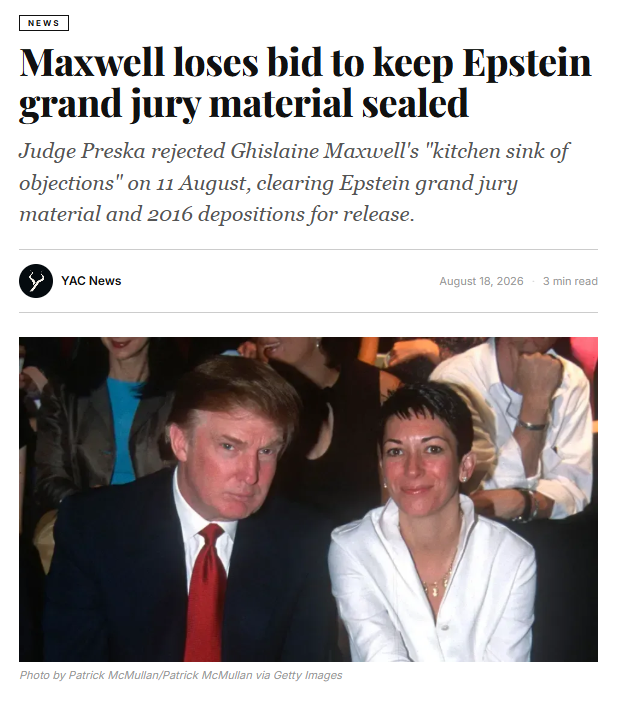
A federal judge just ruled that Ghislaine Maxwell’s Epstein grand jury records must be made public, rejecting every objection she raised. Congress’s Epstein Files Transparency Act overrides grand jury secrecy rules. #OpDeathEaters
----------------------------------------------------------
Federal grand jury material from the prosecution of Ghislaine Maxwell must be released to the public, a New York judge ruled on 11 August, rejecting every objection Maxwell raised to keeping it sealed.
U.S. District Judge Loretta Preska found that the Epstein Files Transparency Act overrides the secrecy orders that have covered the material since Maxwell's 2021 conviction, and that the statute establishes the compelling need federal courts require before grand jury material is opened.
Maxwell's filings against disclosure amounted to "a veritable kitchen sink of objections," Preska wrote, running through procedural, statutory and constitutional grounds, all of which she found meritless. Release will carry the victim-protecting redactions the Act authorises.
What comes out
Grand jury subpoenas and material gathered by the government during the federal investigation into Jeffrey Epstein fall within the order, together with depositions taken from Maxwell in April and July 2016 in the civil defamation case Virginia Giuffre brought against her.
Prosecutors built two perjury counts in Maxwell's federal indictment on those 2016 depositions, charging her with lying under oath when she denied knowing about Epstein's recruitment and abuse of girls. The counts were later dismissed.
Records held by the law firm Boies Schiller Flexner, which represented Giuffre, are covered by the ruling.
Giuffre died in April 2025. Her allegations against Prince Andrew, which he has denied, cost him his royal titles and, on 18 February 2026, brought his arrest on suspicion of misconduct in public office over the alleged sharing of confidential documents with Epstein.
The statute against Rule 6(e)
Grand jury secrecy in the federal system runs on Rule 6(e) of the Federal Rules of Criminal Procedure, which permits disclosure only in narrow circumstances and has historically defeated attempts to open Epstein-related material. Two federal judges refused Justice Department applications to unseal Epstein and Maxwell grand jury records in 2025 on exactly that ground.
Public Law 119-38 changed the calculation. Signed on 19 November 2025, it directs the Attorney General to publish all unclassified Justice Department records on Epstein and Maxwell, permits withholding only for victim identity, child sexual abuse material, active investigations, images of death or injury and classified national security material, and expressly bars withholding for embarrassment, reputational harm or political sensitivity.
Preska's reading treats the Act as a congressional finding of public need that displaces the earlier secrecy orders rather than as a request the court may weigh against them.
Maxwell's position
Maxwell is serving 20 years, imposed in June 2022 after a jury convicted her in December 2021 on rape trafficking and conspiracy counts for recruiting and grooming girls for Epstein.
She was moved from a federal prison in Florida to a minimum security federal prison camp in Texas in the summer of 2025, after two days of interviews with Todd Blanche, then Deputy Attorney General and now Attorney General. A Bureau of Prisons whistleblower has since given House Judiciary Democrats evidence of preferential treatment at the camp.
Maxwell filed an application for commutation with the Trump administration in November 2025. Her Supreme Court appeal was rejected in 2025.
Appearing under subpoena at a House Oversight Committee deposition on 9 February 2026, Maxwell invoked the Fifth Amendment and declined to answer.
Her lawyer David Oscar Markus said afterwards: "Maxwell is prepared to speak fully and honestly if granted clemency by President Trump." Her legal team has said she could explain why Trump and Bill Clinton are innocent of wrongdoing in connection with Epstein.
The Senate vote
The Senate adopted a resolution opposing any pardon or commutation for Maxwell on 29 July 2026, by unanimous consent, with no senator objecting. Senator Jacky Rosen brought it.
"Sexual predators should not be afforded preferential treatment," Senator Jack Reed said of the administration's handling of Maxwell.
Unanimous consent means no Republican senator objected, six days before the Judiciary Committee advanced Blanche's nomination on 4 August and 10 days before he won a floor vote 50 to 49.
Senate resolutions of this kind carry no legal force. Presidential clemency is not reviewable by the courts, and Trump could commute Maxwell's sentence at any point, including after the grand jury material becomes public.
Ghislaine Maxwell's lawyer claims that "Maxwell is prepared to speak fully and honestly if granted clemency by President Trump." Her legal team also claims she could "explain why Trump and Bill Clinton are innocent of wrongdoing in connection with Epstein." #OpDeathEaters
Epstein survivor Annie Farmer urged senators to block Todd Blanche's Attorney General nomination, and told them she had found Blanche abrasive and noncommittal towards survivors. Blanche is Trump's personal criminal defence lawyer. #OpDeathEaters
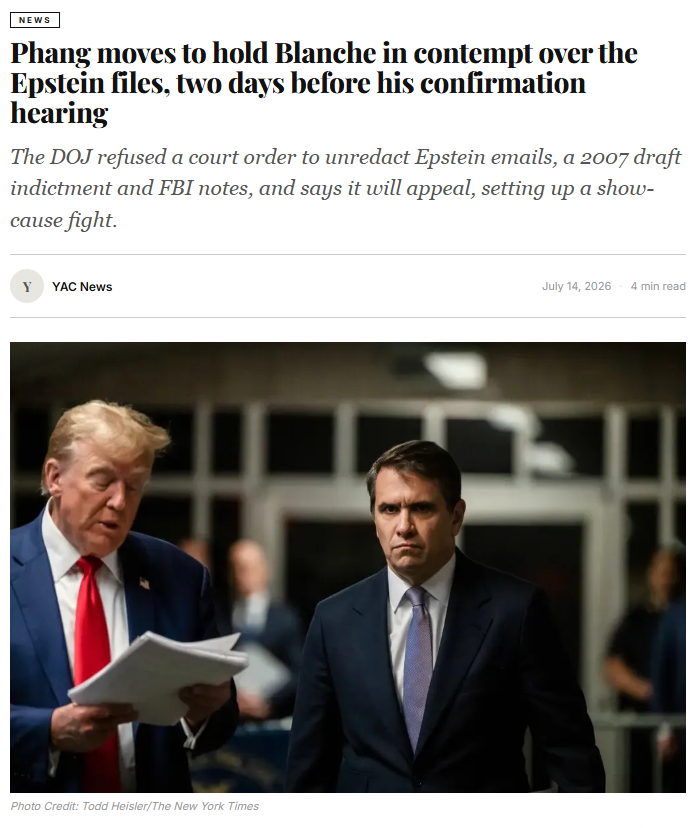
A judge is threatening contempt, fines and jail for DOJ lawyers over their refusal to release Epstein records. Eight months after the deadline, DOJ still hasn’t complied.
Judge Sullivan: “The public has a right to know what the hell is going on.” #OpDeathEaters
----------------------------------------------------------
A federal judge warned Justice Department lawyers on 13 August that he would open contempt proceedings over the department's refusal to release Jeffrey Epstein records Congress ordered disclosed under a law signed in November 2025.
Senior U.S. District Judge Emmet Sullivan told the department's counsel that fines, jail and lasting harm to the individual lawyers' careers were all available to him, and that the warning was a promise rather than a threat.
Eight months have run since the statutory deadline passed, and the Justice Department has still not published the redaction log the law requires, has not produced the handwritten FBI interview notes Sullivan ordered released in June, and told the court on 13 August that it could not give any date on which it would.
"The public has a right to know what the hell is going on in this case," Sullivan said.
What the Act requires
Public Law 119-38, the Epstein Files Transparency Act, gave the Attorney General 30 days from Trump's signature on 19 November 2025 to publish every unclassified Justice Department record on Epstein and Ghislaine Maxwell. The deadline fell on 19 December 2025.
The Act reaches flight logs and travel records for aircraft and vessels Epstein owned or operated, the names of people and entities tied to his trafficking and financial networks, immunity deals and non-prosecution agreements, sealed settlements, internal department communications on charging decisions and communications about the destruction or alteration of records.
Withholding is permitted on five grounds only: victim identity, child rape media, active investigations, images of death or injury and properly classified national security material. The statute bars withholding for "embarrassment, reputational harm, or political sensitivity, including to any government official, public figure, or foreign dignitary."
Every redaction requires a written justification published in the Federal Register and delivered to Congress. A report listing what was released and what was withheld, naming every government official who appears in the records, was due within 15 days. Neither has been published.
The lawsuit
Journalist Katie Phang sued the Attorney General and the Justice Department on 27 April 2026 in the U.S. District Court for the District of Columbia, in a case docketed as Phang v. Blanche, 1:26-cv-01417. Her counsel is Emily Gilman of the Public Integrity Project.
Sullivan granted Phang a preliminary injunction on 25 June 2026, finding that the Attorney General had not answered her arguments on the merits and had therefore conceded them. He set a nominal bond of one dollar and refused a stay.
The June order directed the government to show cause why it should not lift redactions covering sender and recipient names in eight emails, lift redactions covering co-conspirator names in draft indictment material, produce the underlying FBI interview notes behind four FD-302 reports, review and produce foreign-language material and publish the redaction log in the Federal Register.
Sullivan wrote in that opinion that there is generally no public interest in the perpetuation of unlawful agency action.
The government's answer was to seek 60 more days and to tell the court it strongly disagreed with the ruling.
The handwritten notes
Handwritten notes from an FBI interview with a woman who has made allegations against Trump sit at the centre of the dispute. Trump denies the allegations.
The Justice Department told Sullivan the notes are "substantially similar to" FD-302 reports it has already released, and that reviewing handwritten material raises the risk of exposing victim information. Sullivan told the department the Act contains no exception for records that duplicate other records, and that he needed the originals to check whether the department's account of them is accurate.
Among the specific redactions Sullivan ordered the government to justify is a heading marked "Co-conspirators" in draft indictment material listing four names, three of which the department says belong to protected victims. One redacted name is Lesley Groff, Epstein's executive assistant, who was never charged and whose prosecution the government formally declined in 2021. The department's own filing misspells her first name.
Another of the eight email chains is a 2009 message referring to a torture video.
From order to hearing
Sullivan ordered the government on 25 July to hand over the unredacted material for private review in chambers by 3 p.m. on 30 July. Todd Blanche filed a notice of compliance at 2:28 p.m. that day, hand delivered to chambers.
Reviewing what arrived, Sullivan found the submissions did not comply with his order. The material identified as protected was marked only as personally identifiable information, not as victim or law enforcement identity.
Justice Department lawyers moved on 5 August to stay the case outright. Sullivan set a hearing instead, and on 11 August ordered Blanche to appear with documentation showing that the names blacked out as victims are in fact victims.
At the 13 August hearing, department lawyer Andrew Block could not commit to any timeline. Asked whether he could offer the court 30 days, 60 days or any figure at all, Block said: "I'm not able to."
Sullivan asked whether he should issue another order saying he meant it this time. He then recounted from the bench his own contempt findings against Justice Department prosecutors in the failed corruption case of the late Senator Ted Stevens, and supplied the citation so that the department's lawyers could look up how it ended.
Phang's team has asked for civil fines of $1,000 a day until the department complies. Blanche said the contempt case is absurd. Sullivan gave Phang's lawyers 10 days to file a proposed enforcement order and said he would review in chambers the materials Block brought to court.
The Attorney General
Blanche was confirmed as Attorney General on 8 August 2026 by 50 votes to 49, with Republicans Susan Collins and Lisa Murkowski joining every Democrat against him. He had run the department as acting Attorney General since Trump removed Pam Bondi on 2 April 2026.
Blanche was Trump's personal criminal defence lawyer from 2023, representing him in the hush-money prosecution, the classified documents case and the prosecution over efforts to overturn the 2020 election. He became Deputy Attorney General in 2025 and interviewed Maxwell in prison in July of that year, after which she was moved to a federal prison camp in Texas.
Epstein survivor Annie Farmer urged senators to block the nomination, and told them she had found Blanche abrasive and noncommittal towards survivors.
The Senate went on record against clemency for Maxwell on 29 July 2026, adopting by unanimous consent a resolution from Senator Jacky Rosen opposing any pardon or commutation for her. The vote came days before the Judiciary Committee moved Blanche's nomination forward.
Congress and the log
House Judiciary ranking member Jamie Raskin has asked the department for a review of the unredacted files in its possession. Oversight Democrats led by ranking member Robert Garcia have demanded compliance with a committee subpoena issued to Bondi in March, and Representative Summer Lee moved to hold her in contempt over it.
The Justice Department released roughly three million pages, 2,000 videos and 180,000 images on 30 January 2026, which Blanche said at the time was the last major release the department would make. Redactions across that release remain unexplained in the Federal Register, which is where the statute says the explanations belong.
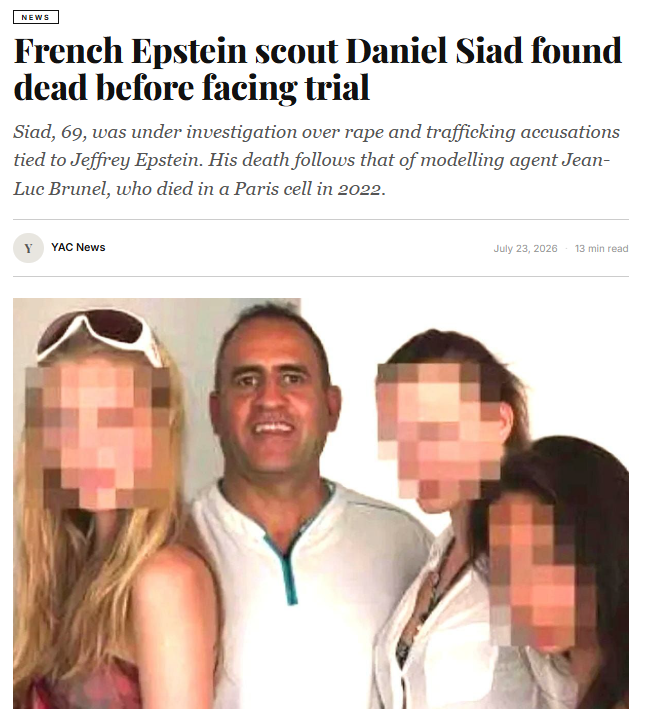
French Epstein scout Daniel Siad found dead. Siad is the second French modelling figure tied to Epstein to die before facing trial, following Jean-Luc Brunel, who was found hanged in a Paris prison cell in 2022. #OpDeathEaters
------------------------------------------------------
Daniel Siad, the 69-year-old modelling scout named more than 2,000 times in the declassified Jeffrey Epstein records, was found dead at his home in Colombes on the evening of Monday 20 July 2026. Siad is the second French modelling figure tied to the Epstein case to die before facing trial, after modelling agent Jean-Luc Brunel was found hanged in a Paris prison cell in February 2022.
The Nanterre prosecutor's office confirmed the death on Wednesday, 22 July, said an investigation into the cause had been opened that Monday evening and said a post-mortem examination would be carried out. Marie-Céline Lawrysz, deputy public prosecutor at the Nanterre judicial court, issued the statement. Investigators from the Hauts-de-Seine judicial police were handed the file.
Siad had never been questioned. Paris prosecutors had been running a trafficking investigation that included him since February, had placed him under telephone interception and had told reporters as recently as this week that the surveillance had not yielded enough to justify an arrest. His name was known to every survivor who had spent the spring reading the U.S. Justice Department release, and it was attached to no charge on the day he died.
Accounts of who found the body differ, Le Parisien reported that Siad's 28-year-old flatmate discovered him in the kitchen and alerted neighbours, that emergency crews attended and that he died at the scene. His lawyer, Menya Arab-Tigrine, told ABC News the body was found by the sister of a neighbour. Arab-Tigrine said she believed her client had suffered a heart attack and was waiting on the autopsy report. Prosecutors have released nothing on the circumstances beyond the fact of the inquiry, have not said whether foul play is suspected and have not given a timetable for the post-mortem findings.
"He is dead and he was innocent," Arab-Tigrine told Agence France-Presse, linking the death to "the strain" of months of publicity. She claims Siad had offered to speak to French authorities and that the offer was rebuffed, and that the "waiting and anxiety" would have played a part if the autopsy returns a heart attack.
What the files show
Siad appears in the records the U.S. Justice Department published on 30 January 2026 under the Epstein Files Transparency Act, the law President Trump signed on 19 November 2025 after unanimous passage in both chambers of Congress. The department released more than 3 million additional pages that day, along with more than 2,000 videos and 180,000 images across 12 data sets, bringing the total production to roughly 3.5 million pages. Siad's name appears more than 2,000 times across that material, according to BFMTV. Reporting elsewhere puts the count at more than 1,000 separate documents. Both figures are in circulation and they are counting different things.
The correspondence runs from the late 2000s to at least 2017 and reads as a supply relationship. Siad scouted in Poland, the Czech Republic, Slovakia, Hungary, Bulgaria, Latvia, South Africa, Spain, Morocco, Cuba and France, and forwarded photographs, profiles and travel details to Epstein. In June 2009 he sent seven photographs of a 20-year-old Latvian woman with a note observing that she looked younger. In a July 2014 message he listed two women from Sweden, one from Slovakia, two from France and a Russian woman, complaining that Epstein had failed to appear as arranged. Epstein replied that he would cover the expenses and asked for names and details. A follow-up message from Siad referred to further girls in Scandinavia and France aged between 15 and 17.
"I feel like fisherman some time I cache quick, some time no fish," Siad wrote in July 2014. The same message named girls aged 15, 16 and 17.
Epstein asked in a 2012 message what new girls were available, and in a 2014 message whether there was anything worth coming to Paris for. In 2018, nearly a decade after Epstein's conviction, Siad wrote that he was looking for a "good looking young assistant" for him. Another message forwarded a photograph of a woman Siad described as polite and as having potential either as a model or as an assistant. Files released by the Justice Department show Epstein paid Siad tens of thousands of dollars.
Stan Pottinger, a lawyer acting for Epstein's accusers, told a New York prosecutor in May 2016 that Jean-Luc Brunel had described Siad as a scout or recruiter of girls for Epstein. A Justice Department file records that description. Siad and Brunel exchanged emails and Siad forwarded modelling profiles and travel arrangements involving young women.
Siad's account
Siad gave interviews in the months before he died, to the Swedish daily Expressen in February, to BFMTV on 8 May and to CNN in June. His position was consistent across all three. He claimed he had introduced women to a man he took for a legitimate industry figure, that he had no knowledge of what happened afterwards and that Epstein had exploited his trust.
"I trusted him and believed this guy was a professional person," Siad told CNN, claiming that nobody he had introduced to Epstein had come back to him reporting harm.
He said Epstein had assured him after the 2008 conviction that nothing of the kind would happen again to anyone Siad referred. He also said he had believed Epstein to be a casting director for Victoria's Secret and for the modelling agency MC2. CNN reported that it found no evidence supporting that belief. Siad continued to work with Epstein after the 2008 guilty plea for "procuring a minor for prostitution", as did other figures in the industry who kept inviting him to fashion events, allowing him to associate with their companies, and exposing women and girls to danger.
Siad claimed that he had never committed a crime and was willing to speak to investigators in any country that wanted him. There is no indication that he actually reached out to anyone.
Karlsson
Ebba P. Karlsson, a former Swedish model now 56 and living in the United States, filed the first criminal complaint against Siad on 10 February 2026 at the Paris prosecutor's office, reporting rape and human trafficking. Her account, given to AFP and to RTL Nieuws, places the events in 1990, when she was 20. She met Siad in Stockholm. He told her she was beautiful and could have a modelling career in France. She travelled with him. The promised work in Monaco did not exist, a villa in Cannes was shut up, and she reported that he raped her in a garden shed by the pool.
Karlsson did not know her attacker's name for 36 years. She identified him in February 2026 from the declassified Epstein files, and has said she felt physically ill on recognising him.
"He was very close to being arrested," Karlsson told AFP after his death, describing years of work to reach that point.
Karlsson's complaint also reported that Siad went on to introduce her to Gérald Marie, then European head of Elite Model Management, whom she has separately accused of rape. At least six women have filed legal complaints in France reporting Gérald Marie of rape and human trafficking in the 1980s and 1990s.
French media reported that at least five women had reported Siad for rape or trafficking by the time he died. Three have described the approach in public. Each account begins with a meeting at or near a modelling agency, a compliment, an offer of introduction to a man said to hold the keys to a career.
Anya
A woman the BBC identified under the pseudonym Anya left Russia looking for better work and had modelled for Fendi and Chanel before the introduction that changed her life. She was in her early twenties when she visited a Paris modelling agency and met Siad. He complimented her intelligence, a compliment she said was not typical of the industry, and then offered to introduce her to a friend with fashion connections, the friend was Epstein.
Anya has described what followed as a set-up and called Siad "essentially a professional trafficker."
She became one of Epstein's assistants and says the years that followed were years of manipulation and, in her own word, abuse, held in place by psychological dependency rather than by locked doors: promises of career progress, money and access to influential people, and the isolation that came with all three. She said she had never spoken about it publicly while Epstein was alive, that she is still working to reconcile herself to having been abused for years, and that she came forward in the hope other women in the same position would seek help.
The BBC published her account on 18 July 2026. Siad's lawyer said before publication that he was not available to comment. He was found dead two days later.
Svetlana Pozhidaeva
Svetlana Pozhidaeva, a Russian-born model, was working across Europe and earning as much as 3,000 dollars a day when she decided to try the U.S. market. She met Siad at a Paris modelling agency. He introduced her to Epstein, who told her he could open New York to her. She signed with MC2 Model Management, the agency Jean-Luc Brunel founded with a million dollars of Epstein's money, and her career collapsed almost immediately. She then became Epstein's personal assistant, a role she says involved little actual work and years of abuse. MC2 continued to sponsor her U.S. visa while she was working for Epstein rather than modelling. Justice Department emails released this year support her account of the employment arrangement.
Pozhidaeva has described Epstein as having built an ecosystem staffed by scouts, photographers and agency owners, and has said his standing in that world was part of what made her trust him.
"If it wasn't for him, my life would have unfolded completely differently," she said of Siad on the day his death was confirmed.
She added that she had wanted an investigation, a resolution and some measure of closure, and that his death had removed the possibility of holding him to account.
Juliette G.
Juliette G., a former French model who is now 43 and has asked that her surname be withheld, met Siad in 2004, when she was 21. She has accused him of grooming her for introduction to men who might abuse her, and has told AFP that she can identify the discrete stages by which she was moved toward that point, and that manipulation of this kind works by testing how far a young woman will yield at each step.
Siad referred her to Epstein in New York. Juliette says she was flown there and taken to a bedroom, where Epstein groped her and told her that her body did not meet modelling standards. He said she should get in shape so that he could introduce her to agencies. In the interval, she says, he offered her escort work.
Juliette has given a statement to police in Paris. She said Siad's death has removed a link in the chain that could have helped establish what happened and identify who was responsible, and that he had represented a route to finding out.
She told CNN, "Epstein was just one of the dangers I used to face."
Where the case stood on the day he died
Paris prosecutors opened two investigations on 4 February 2026, one into sexual offences and one into financial wrongdoing, each assigned to specialist magistrates. Laure Beccuau, the Paris prosecutor, announced them on France Info and appealed for women who had never spoken to come forward.
"These publications will inevitably reactivate the trauma of certain victims," she said.
Beccuau also said material from older investigations would be revisited, a reference to the closed Brunel file.
The trafficking investigation was run through the Paris office specialising in human trafficking. Siad was one of the people Beccuau said in May could be questioned, though she noted at the time that nobody had yet been interviewed because the inquiry remained at an early stage.
By this week the prosecutor's office reported that 24 women had come forward or been identified following its public appeal, that at least 16 had been interviewed and that further interviews were scheduled. On Siad specifically the office said special investigative techniques including telephone intercepts had been used, and that the product had not so far justified an immediate arrest. He was never placed under formal investigation, the mise en examen threshold at which a French magistrate decides the evidence is serious enough to proceed, a stage the file reached with Brunel in 2020 and never reached with Siad.
The case targeting Siad has now been dropped, as French law requires on the death of a suspect. The wider investigation into rape trafficking linked to Epstein, who kept a flat in Paris and travelled to France often, continues.
Jean-Luc Brunel, dead in a cell before trial
Jean-Luc Brunel ran modelling agencies for four decades and sat at the centre of the French strand of the Epstein file before Siad did. He built his career at Karin Models, co-founded Next in 1988 and launched MC2 Model Management in 2005, the year after Epstein wired one million dollars to an offshore account in his name in September 2004. He met Ghislaine Maxwell in the 1980s and she introduced him to Epstein.
CBS broadcast an investigation into Brunel on 60 Minutes in December 1988, in which models described how he had used the promise of careers to assault them. The report ran internationally. Eileen Ford cut ties with him. No prosecution followed and he kept working for another 32 years.
Thysia Huisman, a Dutch former model, reported to French police in September 2019 that Brunel had drugged and raped her in 1991, when she was 18. She has said publicly that she came forward past the statute of limitations in the hope that others would follow, and that 11 more women did. Virginia Giuffre stated in court filings that Brunel used modelling work as cover to traffic girls and that Epstein had boasted of sleeping with more than 1,000 of Brunel's models. Brunel denied everything, and in 2015 sued Epstein over what he said was reputational damage from the publicity.
French police arrested Brunel on 16 December 2020 at Charles de Gaulle airport as he tried to board a flight to Dakar. Immigration officers flagged his passport against a wanted-for-questioning entry. A magistrate charged him two days later with the rape of minors over the age of 15 and with sexual harassment. The prosecutor's office said at the time that no human trafficking charge was laid, that the magistrate found the evidence insufficient to rule on that count and that Brunel was not acquitted of it. On 29 June 2021 he was formally indicted over the drugging and rape of a 17-year-old girl in the 1990s. A second woman came forward that September. He was briefly released in late 2021, then returned to custody on an appeal court ruling.
Brunel was found dead in his cell at La Santé prison on 19 February 2022, aged 75, after 14 months in detention. A source close to the investigation told AFP he had been found hanged. Prosecutors did not confirm the manner of death at the time. His lawyers said he had killed himself and described a man crushed by the machinery of a media and judicial system. French law closed his case on his death, absent other suspects in the same proceedings.
"It makes me angry, because I've been fighting for years," Huisman told the Associated Press that day.
Anne-Claire Le Jeune, the Paris barrister representing her and other complainants, said her clients had been deprived of a trial and of formal recognition of their status as victims.
Marie, and a case closed on the clock
Gérald Marie headed Elite Model Management in Europe until he resigned in 1999. Lisa Brinkworth, then a BBC journalist working undercover with Donald MacIntyre on an investigation into abuse in the modelling industry, alleges that Marie sexually assaulted her at a dinner in Milan in 1998. She says she told her superiors immediately and was advised against filing a complaint so as not to compromise the investigation. She filed in Paris in 2020. Three former models, Karlsson among them, supported the complaint with accounts of rape or sexual assault. Prosecutors closed the investigation in February 2023 on statute of limitations grounds. Brinkworth appealed.
Fifteen women delivered a letter to Beccuau on 19 March 2026, asking that the Epstein investigations be used to reopen the Marie file. Karlsson and Brinkworth handed it over in person. The signatories, of British, Dutch, USian and Swedish nationality, said they held court documents and emails indicating collaboration between Marie, Brunel and Epstein, and connecting them to the MC2 and Elite agencies. Brinkworth now represents the collective Victorious Angels We Rise, which she and Karlsson founded. Marie has repeatedly denied any wrongdoing and has never been convicted of any offence.
"It feels like victims are being denied justice," Brinkworth said after Siad's death, adding that the failure of the Paris prosecutor's office to act against a close associate of Epstein facing multiple rape and trafficking allegations was beyond comprehension, and calling for urgent investigation of everyone connected to Epstein facing similar accusations.
Investigations outside France
Polish prosecutors opened a human trafficking investigation after reviewing the released files, and said on 11 March 2026 that they would seek information and evidence from two other European countries. A source told Reuters the requests would go to France and Sweden. Their working suspicion is that women and girls were recruited in Poland for work abroad under false pretences, then moved out of the country and handed to others for sexual exploitation. Files reviewed by Reuters show Siad reporting to Epstein on scouting trips through Poland, Slovakia and the Czech Republic, and referring to his cooperation with Brunel.
Prime Minister Donald Tusk announced on 3 February 2026 that Poland would examine possible links between Epstein and Russian intelligence and set up an analytical task force, saying prosecutors could open a formal investigation if evidence emerged that Polish minors had been exploited. Polish media reported that Siad was born in Algeria and moved to Sweden at 23. He held Swedish citizenship alongside French residency.
Jack Lang, the 86-year-old former culture minister, stepped down as head of the Arab World Institute in Paris earlier this month amid suspicions of tax fraud, and the financial prosecutor's office opened an investigation into alleged links between Lang, his daughter Caroline Lang and Epstein through an offshore company registered in the U.S. Virgin Islands. Foreign Minister Jean-Noël Barrot referred allegations involving a senior diplomat, Fabrice Aidan, to prosecutors and opened an administrative investigation and disciplinary procedure. Aidan's name appears more than 200 times in the files, including exchanges dating to 2010, when he worked at the United Nations, that suggest he shared diplomatic documents with Epstein. His lawyer, Jade Dousselin, said her client denies any wrongdoing and called for the presumption of innocence to be respected.
The document release behind the French inquiries
Deputy Attorney General Todd Blanche announced the 30 January release at a Justice Department news conference, more than a month after the deadline Congress had set. He said the department had sorted more than 6 million records, that women depicted in photographs and videos had been redacted with the exception of Ghislaine Maxwell, that men were redacted only where it was impossible to obscure a woman otherwise and that the department's obligations under the Act would be complete once it filed its final report and published redaction justifications in the Federal Register.
Roughly half the identified material remains unpublished. Representative Robert Garcia, ranking member of the House Oversight Committee, said the department intended to withhold about 50 per cent of the files while claiming full compliance, and noted that the release followed months of resistance to a committee subpoena issued on 5 August. Maxwell is serving a 20-year sentence following her 2021 conviction for her role in the scheme to sexually exploit and abuse minor girls.
The state of the French file
Nobody has been convicted of anything in the French investigation of this case. Brunel was charged and died before trial. Marie was investigated and the file was closed on time limits, with an appeal outstanding. Siad was named across thousands of pages, faced at least five complaints, was placed under telephone interception and was never charged, never formally placed under investigation and never interviewed.
The Nanterre autopsy will establish how Daniel Siad died. The Paris investigation that included him was dropped on his death; the wider inquiry into rape trafficking linked to Epstein remains open.
New Mexico's attorney general says the DOJ has withheld Epstein's Zorro Ranch records for 130 days.
The records he wants hold the names of survivors, witnesses and potential co-conspirators tied to the Epstein estate south of Santa Fe. #OpDeathEaters
------------------------------------------------------
New Mexico Attorney General Raúl Torrez accused the US Justice Department of withholding unredacted Epstein records central to the state's criminal investigation of Zorro Ranch, in a 30 June letter to Acting Attorney General Todd Blanche and Associate Deputy Attorney General Diego Pestana that his office released on 9 July.
Torrez is a Democrat with subpoena power and no federal case of his own to protect, which makes him the official most able to force disclosure the department has resisted in court. The records he wants hold the names of survivors, witnesses and potential co-conspirators tied to the estate south of Santa Fe where Epstein hosted guests for more than two decades. He has threatened to pursue a state-court subpoena if the department does not hand them over.
The letter set out six attempts to reach the department since 13 February, beginning with a request for documents and including an effort to meet in person during a trip to the capital. More than 130 days had passed with verbal assurances of cooperation but no access and no substantive reply, Torrez wrote, calling the delay unreasonable under any rule of reason. "Every day that the USDOJ withholds these records, the foundation upon which a New Mexico prosecution could be built erodes," he wrote, adding that witnesses relocate and become unreachable, memories fade, and physical evidence degrades with time.
A department spokesperson, Kiersten Pels, disputed that account and said the department had "substantively responded last month" to the state's requests. The department welcomes New Mexico's investigation, stands ready to assist, and will help pursue any federal crimes it uncovers, Pels said.
What reopened the case
Torrez reopened the New Mexico investigation in February 2026, after the federal release of millions of Epstein files surfaced material about the ranch that earlier inquiries had passed over. The state first opened an Epstein investigation in 2019 under Torrez's predecessor Hector Balderas, whose office was asked by the US Attorney for the Southern District of New York to stand down so federal prosecutors could pursue their own case. That case ended with Epstein's death in a New York jail and no charges against associates beyond Ghislaine Maxwell. Torrez's letter frames the current standoff as the direct result of that deference: New Mexico gave way in good faith in 2019, handed its file to federal authorities, and now cannot retrieve the records it needs to resume what the federal request interrupted.
Among the released documents was a November 2019 email to the Albuquerque conservative talk-show host Eddy Aragon, who forwarded it to the FBI, where it was recorded on a bureau form. The anonymous sender, claiming to be a former ranch employee, offered seven videos of abuse, at least one said to show sex with a minor and described as insurance against future litigation, along with the location of two foreign girls the sender said were buried in the hills outside the ranch, all for one bitcoin. The buried-bodies claim is unverified, and how far law enforcement pursued it before this year is not clear.
State authorities searched Zorro Ranch in March 2026, using New Mexico State Police and Sandoval County cadaver dogs and drones. Epstein bought the property in 1993 from former Governor Bruce King and built a compound on it that grew to include a mansion, a private airstrip, a helicopter pad and a hangar. Survivors including Virginia Giuffre, who died in 2025, and Maxwell-trial witness Annie Farmer have said the ranch was one of the sites where Epstein abused them. The remote estate had escaped the scrutiny applied to Epstein's homes in New York, Florida and the Caribbean, and investigators had apparently never searched it during the federal case. Rick Illmer, an attorney for the ranch's current owner, said that to his knowledge no physical evidence of criminal activity by the prior owner was found in the March search.
The truth commission
New Mexico became the first state to convene a bipartisan truth commission into Epstein's crimes, a legislative panel with subpoena power created by a resolution that passed the state House unanimously on 16 February 2026 and due to report by the end of the year. The commission, chaired by Democratic state Representative Andrea Romero, has subpoenaed several banks, multiple US Attorneys offices, the offices of Torrez and Governor Michelle Lujan Grisham, and a local nonprofit with ties to Epstein. It has hired an Albuquerque legal team on a 750,000-dollar budget. Romero has said her panel and the state Justice Department are working together while pursuing different ends, hers a public accounting of what happened over 26 years, the department's a possible prosecution.
Torrez has separately ordered dozens of companies to preserve records related to Epstein and his associates. The two efforts run in parallel, the attorney general building a criminal case and the commission compiling a public record, and both are reaching for material the federal department holds.
What the state can and cannot do
Zorro Ranch, now called Rancho de San Rafael, passed in 2023 to Don Huffines, a former Texas state senator and real estate developer who is the Republican nominee for Texas comptroller and was endorsed for that race by Donald Trump. Huffines family members bought the estate through an LLC at auction four years after Epstein's death, when it was marketed with proceeds to go to victims, and Huffines has said he intends to turn it into a Christian retreat and is cooperating with the state. His acquisition places no allegation against him; the New Mexico inquiry concerns Epstein's conduct while he owned the property.
State prosecutors may be limited in what they can build without the federal records, which is the hold the department has over the state inquiry and the reason Torrez has gone public. New Mexico faces real obstacles its own officials have named: Epstein is dead, the ranch has changed hands, physical evidence may no longer exist, and the statute of limitations has likely run on many potential offences. The unredacted records are what could still identify living survivors, witnesses and associates while there is time to reach them.
The Justice Department's own inspector general is reviewing how the Epstein files were redacted. Torrez's 130-day request remains unanswered as he describes it, the unredacted records remain sealed, and the commission's report is due by the end of 2026.
Lawyers for journalist Katie Phang asked a federal judge on 13 July 2026 to hold Acting Attorney General Todd Blanche in contempt and fine him $1,000 for refusing to unredact the Epstein files. #OpDeathEaters
---------------------------------------------------------
The DOJ refused a court order to unredact Epstein emails, a 2007 draft indictment and FBI notes, and says it will appeal, setting up a show-cause fight.
Lawyers for journalist Katie Phang asked a federal judge on 13 July 2026 to hold Acting Attorney General Todd Blanche in contempt and fine him 1,000 dollars a day for refusing to unredact Epstein emails, a draft indictment and FBI notes the court ordered public by 2 July. The motion landed two days before Blanche is due before the Senate Judiciary Committee for his confirmation hearing to hold the office permanently.
Blanche's department told U.S. District Judge Emmet Sullivan on 2 July that it had already complied and would appeal, rather than strip the redactions Sullivan had ordered removed. The contempt motion is Phang's answer to that refusal, and it converts a dispute over documents into a dispute over whether a sitting acting attorney general can defy a court order with a fine attached.
The refusal puts Blanche in continued defiance of a preliminary injunction issued under a law that bars the government from hiding records to spare anyone embarrassment or political damage. The documents at issue name people in Epstein's orbit whom the department has kept redacted while, by its critics' account, exposing the identities of victims.
The order and the finding
Sullivan gave the department until 2 July to strip the redactions or show cause, in a 48-page opinion issued on 25 June in a suit brought by Phang, an attorney and former MS NOW anchor. Sullivan, appointed to the federal bench by Bill Clinton in 1994, found Phang had standing to sue under the Administrative Procedure Act, was likely to win, and that Blanche "has conceded that he is in violation of the Act" by failing to answer her arguments substantively. He rejected the department's claim that Phang should have used a Freedom of Information Act request instead, holding that FOIA "does not provide an adequate remedy" because the Epstein Files Transparency Act required a broader and less redacted release than FOIA would. He denied the government a stay.
Sullivan is not new to Trump-administration standoffs. He oversaw the criminal case of former national security adviser Michael Flynn and challenged the first Trump Justice Department's attempt to drop the charges after Flynn had pleaded guilty, and he presided over January 6 prosecutions.
What the order covers
Five categories of material fall under the injunction. Eight email exchanges in which Epstein discussed a "torture video" and sexual activity with young women, including minors, with the senders or recipients blacked out. Two documents, among them a 2007 draft indictment, with the names of potential co-conspirators redacted. The handwritten FBI notes behind four typed interview reports. Foreign-language records the department said its reviewers lacked the skills to translate and assess. And a formal log accounting for every redaction, which the law requires and the department never filed.
The 2007 draft indictment names people prosecutors once weighed charging alongside Epstein, and it is the single document most likely to identify associates the public record has never named.
What the department said back
Associate Attorney General Stanley Woodward, signing the 2 July filing, said the department had reviewed more than 6 million documents and had turned over everything responsive, and that unredacting the rest would contravene the settled application of the transparency act. He argued that "many communications written by victims, without context, can appear disturbing on their face," and offered to show the disputed material to Sullivan in camera, behind closed doors, rather than release it publicly. The filing challenged Phang's right to sue at all, the strongest of its arguments, and cast Sullivan's finding of a concession as a procedural technicality rather than an admission.
A department spokesperson rejected the ruling in blunter terms. "DOJ has produced all responsive documents and will appeal this decision with confidence," the spokesperson said, calling Sullivan's reading perverse and saying the judge was asking the department to unredact the names of victims who, it said, sadly became co-conspirators.
The names behind the redactions
One 2009 email in the tranche recorded Epstein saying he "loved" the torture video, sent to a recipient the department redacted. Blanche himself later suggested, on social media and during the litigation, that the recipient was the Emirati businessman Sultan Ahmed bin Sulayem, former chief executive of the Dubai logistics firm DP World. Bin Sulayem has not commented, and no court has tied him to the video's contents.
The FBI notes cover a woman who told the bureau that Epstein introduced her to Donald Trump in the 1980s, when she was about 13, and that Trump assaulted her. The bureau interviewed her four times and recorded finding her credible. Trump has denied any wrongdoing connected to Epstein and has not been charged. The allegation remains untested in any court, and the department has described the material as unfounded and false.
The law, the confirmation and what comes next
Congress passed the Epstein Files Transparency Act with near-unanimity in November 2025, sponsored by Republican Thomas Massie and Democrat Ro Khanna and signed by Trump, requiring the department to publish Epstein records by 19 December 2025. The department missed that deadline, released about 3.5 million pages, and has acknowledged withholding roughly 2.5 million more it calls privileged or irrelevant. The statute forbids withholding on grounds of embarrassment, reputational harm or political sensitivity, to any official, public figure or foreign dignitary.
Brendan Ballou, who represents Phang and founded the Public Integrity Project, said "the government ignored a law passed by Congress and then refused to defend its own conduct in court, all for the sake of protecting the rich and powerful." The department is taking the fight to the D.C. Circuit, where a stay could freeze any disclosure for months.
Sullivan set a briefing schedule on the contempt question, with Phang's team filing on 13 July and Blanche due to respond by 20 July. If Sullivan grants the motion, he can order Blanche to appear and explain himself in person and impose the daily fine Phang has requested, putting an acting attorney general before the bench to defend withholding records his own president signed into law. Blanche's confirmation hearing before the Senate Judiciary Committee falls on 15 July, between the contempt filing and his deadline to answer it. The redaction log the law demanded has still not been filed.
Leon Black must testify under oath on 16 July and produce his NDAs with women, after walking out of a House Oversight interview about Jeffrey Epstein. #OpDeathEaters
--------------------------------------------------------
The House Oversight Committee has subpoenaed Leon Black to give a sworn, videotaped deposition on 16 July 2026 and to produce nondisclosure agreements he signed with women, after he walked out of a voluntary interview about Jeffrey Epstein on 26 June.
Black's exit, roughly an hour into the transcribed interview and before Democrats had put a single question, was the first walkout in the committee's bipartisan inquiry, according to members present. The deposition tests whether a congressional subpoena binds a billionaire who has so far answered on his own terms.
Committee chair James Comer said Black refused to describe the terms of the nondisclosure agreements on the advice of counsel, and issued the two subpoenas during the interview. Comer told reporters the committee wants to know whether Epstein helped write the agreements and whether he helped decide the payments to the women. "We want to know, was Jeffrey Epstein involved in the NDAs?" Comer said. Black's attorney, Susan Estrich, called the move a planned political stunt and said Epstein had no involvement with any agreements, whether or not they exist.
Payments after the conviction
Black paid Epstein at least 158 million dollars between 2012 and 2017, after Epstein's 2008 guilty plea to soliciting prostitution from a minor, according to an external review commissioned by Apollo, a figure Black repeated in his opening statement. The Senate Finance Committee and Senator Ron Wyden have put the total nearer 170 million dollars, far more than Black paid other advisers on tax and estate work. Wyden said Black gave no credible explanation and "stonewalled repeatedly" on the committee's questions.
Black left Apollo in 2021 after the external review of his ties to Epstein. He has described the relationship as a horrible mistake and said Epstein deceived him, telling the committee he knew nothing of Epstein's crimes until the 2019 trafficking charges. In January 2023 Black paid the US Virgin Islands 62.5 million dollars to settle civil claims related to Epstein's network and gain immunity from criminal prosecution there. The settlement states it cannot be used as evidence of wrongdoing by Black, and it does not cover claims by anyone else against him.
Allegations in the files
One woman told the FBI that Black became sexual during a massage Epstein had directed her to give, before she fled the room, CNN reported in an April 2026 review of the released Justice Department files. A second woman told the bureau in 2020 that Black had raped her about six years earlier, and described going with Black to Epstein's Florida home, where she said she was told to have sex with Epstein.
A 2019 prosecution memo written after Epstein's death, which examined whether associates including Black bore criminal liability, recorded a woman saying they engaged in sexual contact with her against her will during massages, according to the memo. Large parts of it are redacted. Three women have separately accused Black of rape in lawsuits since 2022. A judge dismissed one, a plaintiff agreed to drop a second, and a third, brought by a woman her lawyers say has autism and a form of Down syndrome and was 16 at the time, remains pending after her law firm withdrew from representing her.
Black has not been charged with any crime and denies every allegation. "I have never abused a woman. I have never been with an underage woman," he told the committee in his opening statement. He said the release of the Epstein files "added fuel to the burning conspiracies and falsities" and that he had received death threats and hired a bodyguard for the first time in his life. Estrich has said Black "has never abused, assaulted, or raped any girl or woman" and called the lawsuits frivolous.
The agreements the committee wants
The subpoenaed agreements are between Black and women in Epstein's orbit, and lawmakers said they want to establish whether Epstein shaped them or funded the payouts. Robert Garcia, the committee's ranking Democrat, backed the subpoenas and told reporters "there are survivors who have accused Mr. Black of horrific things". Comer said before the interview he was confident Black had signed agreements with some of Epstein's victims.
Only Epstein and Ghislaine Maxwell have been charged with trafficking in the case, and FBI Director Kash Patel has said there is no credible information that Epstein trafficked his victims to other people. The Justice Department has released 3.5 million pages of Epstein files and withheld about 2.5 million more, and is fighting a separate court order to unredact the names of alleged co-conspirators in a 2007 draft indictment.
One subpoena compels Black's sworn, videotaped testimony on 16 July, the other the agreements themselves. Should Black decline to appear or to hand them over, the committee's next step is a vote on whether to hold him in contempt.
Ghana midfielder Thomas Partey and Morocco captain Achraf Hakimi are facing criminal trials for rape while playing at the 2026 World Cup, two of at least nine tournament figures facing rape and sexual assault allegations spanning five confederations. #OpDeathEaters https://t.co/MwibUFaVYg
At least nine figures at the 2026 World Cup have faced rape or sexual assault allegations. FIFA kept all but one on the field. #WorldCup#FIFA https://t.co/hy44xEVpyC
A federal judge has ordered the DOJ to release more unredacted Epstein files or justify every remaining redaction by July 2, ruling the department likely violated the Epstein Files Transparency Act. The DOJ must comply. #OpDeathEaters#3E#EndImpunity


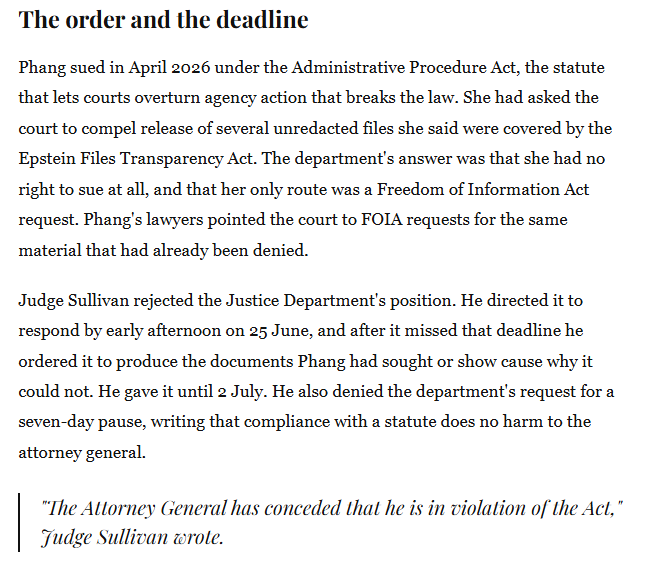
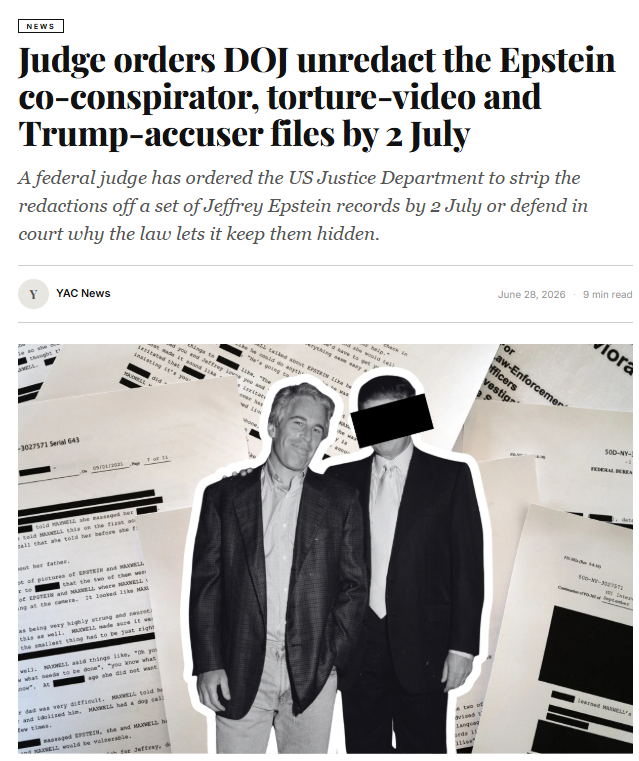


![OpDeathEaters's tweet photo. Jes Staley told the House Oversight he passed confidential JPMorgan Chase information to Epstein while he was in jail for raping children. Staley admitted to having 'sex' with Epstein's assistant, sought his weekend release, and called him a "smart friend". #OpDeathEaters
------------------------------------------------------
Jes Staley told the House Oversight and Government Reform Committee he passed confidential JPMorgan Chase information to Jeffrey Epstein, including his own communications with the Federal Reserve during the 2008 financial crisis and the $44bn the private bank took in over a single fortnight, according to a transcript the committee released on 26 August 2026.
Staley sat for a voluntary transcribed interview on 24 July 2026 in Room 2154 of the Rayburn House Office Building, with Brendan V. Sullivan Jr of Williams & Connolly and Kathleen Harris as counsel. The committee is examining the federal handling of Epstein and Ghislaine Maxwell.
Epstein's client referrals brought JPMorgan well over $100m, by Staley's own account. For 13 months from June 2008 Epstein took Staley's calls from a jail in Palm Beach County, where he was serving a sentence for procuring a girl under 18 for prostitution.
The information that left the bank
Staley told investigators he shared with Epstein his communications with the Federal Reserve during the 2008 crisis, two pending transactions, his own pay, client relationships and the terms of his eventual move to Barclays, Bloomberg reported from the transcript. The $44bn figure was two weeks of deposit flight into JPMorgan at the point when Lehman Brothers had collapsed and the Federal Reserve was deciding which institutions to keep alive.
"I think you respect confidentiality, but it was at my discretion if I wanted to talk to friends of mine about issues at J.P. Morgan," Staley told the committee. Asked whether any rule barred him from taking confidential matters to Epstein in particular, he said no.
Epstein had "very interesting insights into the financial markets," Staley said, at what he called "a very difficult time in those markets". The man receiving those confidences was a registered sex offender in custody, holding no licence, no job at a regulated firm and no duty of confidentiality to anyone.
Staley described Epstein to the committee as "a smart friend to help me think through this stuff" and said he had raised arranging a temporary release "for the weekend" so the two could discuss business, Banking Dive reported from the transcript.
Cash, compliance and the tip-off
JPMorgan records put Epstein's cash withdrawals at $40,000 to $80,000, several times a month. Staley advocated keeping the account open after the 2008 Florida guilty plea.
"Closing a checking account is a tough move," he told the committee, and he said he had been "completely unaware" the accounts were facilitating rape trafficking.
Representative Suhas Subramanyam pressed him on whether he had personally defended the relationship. "I left it to the bank's compliance department, legal department, and Private Bank to determine whether he maintained an account," Staley said. JPMorgan cut Epstein back to a checking account and dropped him as a client in 2013.
Representative Walkinshaw put a 2011 New York Times account to him, that Staley had alerted Epstein to JPMorgan's heightened sensitivity about the constant withdrawals. "Quite possibly, yes," Staley said, and he believed Mary Erdoes, head of the bank's asset and wealth management arm, had done the same. Asked whether the point was to let Epstein change his behaviour and avoid further scrutiny, Staley said no. He also accepted he had probably told Epstein of his designation as a high-risk client and had sought to have it reviewed.
Staley testified he discussed Epstein with Jamie Dimon twice, "once in 2006 when Epstein was indicted, and I believe once in 2008 when Epstein went to jail". Dimon testified under oath in 2023 that he recalled knowing nothing about Epstein until federal prosecutors charged him in July 2019. Neither man has been accused by any prosecutor of giving false testimony, and the committee published the two accounts without adjudicating between them.
The Snow White emails
On 9 July 2010 Staley wrote to Epstein, "That was fun. Say hi to Snow White," in an exchange the Justice Department filed as EFTA00894090. Epstein asked what character he would like next. Staley wrote back, "Beauty and the Beast." Epstein replied, "Well one side is availble [sic]."
A separate message to Epstein the next day, filed as EFTA00741531, reads: "the snow white was f..ed twice as soon as she put her costume))". Three weeks earlier, on 20 June 2010, Epstein had asked a young woman to obtain a Snow White costume from a costume shop.
"Did you ever have sex with a young woman in a Snow White costume?" a committee representative asked. "No, I did not," Staley said.
Pressed on why the second email would have been sent at all if nothing had happened, Staley said, "I have no idea who else she was with. I, it has nothing to do with me, though." He went on: "I may have seen her in apartment [sic] and prompted that email." Asked to confirm he may have seen her, emailed Epstein to say "that was fun," and yet not had sex with her, Staley said, "That's correct." He cited the 16 years since to explain what he could not recall.
Asked whether he would agree that was a pretty incredible coincidence, Staley said, "Sure. Why not?"
Asked whether he and Epstein used Disney princesses as code names for selecting women for sexual encounters, he said no.
The assistant on 66th Street
Staley described one sexual encounter with a woman who worked for Epstein, whom he first met at Epstein's Manhattan townhouse and believed was in her twenties or thirties. It took place months later at her apartment on 66th Street, in 2009 or 2010.
"I think we talked. I believe we were sitting on her couch together while we talked. And one thing led to another, and we had an intimate engagement," Staley told the committee. Asked how he knew it was consensual, he said, "My recollection is, she invited me into her bedroom."
Investigators told Staley the woman had sued Epstein for sexual abuse and settled with his estate, carving Staley out and reserving the right to sue him. "No, I was not aware of this," he said, and he told the committee he did not know Epstein had ever abused his assistants.
Staley made a comparable admission under oath 17 months earlier. At the Upper Tribunal in London in March 2025 he said he had sex with a member of Epstein's staff at an apartment belonging to Epstein's brother in New York, and told the court the disclosure put his marriage at risk. Whether that is the same woman is not established in either record.
The regulatory record
The Financial Conduct Authority banned Staley from senior roles in UK financial services and set a penalty of £1.8m, which he referred to the Upper Tribunal. The tribunal dismissed the reference on 26 June 2025 and the FCA issued its final notice on 23 July 2025.
Judges found Staley had approved a letter to the regulator that falsely described his relationship with Epstein as not close and said contact had ceased before he joined Barclays, when emails showed the two still in touch into 2016 and 2017. They found he acted recklessly, had a clear motive to play down the relationship, believed the truth would stay hidden, gave evidence that in places lacked credibility and showed no remorse. In his own correspondence he had called Epstein one of his deepest and most cherished friends.
"Mr Staley chose to take a calculated risk that we would take his inaccurate account at face value," the FCA's enforcement director said. The fine came down to £1.1m after Barclays declined to release his deferred shares. UK regulators had penalised him once before, fining him £642,430 jointly with the Prudential Regulation Authority in 2018 over his attempts to identify a whistleblower.
Justice Department records show roughly 1,200 communications between the two men between 2008 and 2012. Staley met Epstein in the late 1990s, around the time he took over JPMorgan's private bank. Barclays announced his appointment as chief executive on 28 October 2015 and he stepped down in November 2021 when the FCA investigation surfaced.
Project Jes
Epstein worked to secure Staley the Barclays job through the public relations executive Ian Osborne, under the label "Project Jes", according to material put before the Upper Tribunal and cited by lawmakers. Osborne is not accused of wrongdoing.
Nigel Higgins, the Barclays group chairman, told the FCA in August 2019 that he did not think the Epstein connection needed a board discussion, and the board acknowledged in a witness statement that it never asked Staley when he had last been in contact with Epstein. Barclays told the regulator that October that Staley and Epstein were not close.
Senator Elizabeth Warren and Representatives Ro Khanna and Raja Krishnamoorthi wrote to Higgins on 22 July 2026, setting a reply date of 5 August. "It is deeply unclear how Barclays, in supposedly investigating Staley's connection to Epstein, failed to uncover this decades-long relationship," they wrote. Their eight questions asked the bank to name the executives who approved the October 2019 disclosure, to say whether directors contacted Epstein, Ian Osborne, George Osborne or Mervyn King about Staley's candidacy between 2012 and 2015 and to say whether the Federal Reserve, the FDIC or the Office of the Comptroller of the Currency had approached the bank since the Epstein files were released. Barclays US LLC holds about $200bn in assets.
Staley left with £2.4m in fixed salary and a £120,000 pension allowance running to late 2022, plus £107,000 in repatriation costs, a package that "could cover the £1.1 million fine levied by regulators more than twice over," the lawmakers wrote. The same letter states that newly unsealed documents indicate the Justice Department examined allegations against Staley in 2019 involving rape and bodily harm. No charge has followed in any jurisdiction, the department has announced no case and Staley denies wrongdoing.
Warren wrote on 28 October 2025 to Federal Reserve vice chair for supervision Michelle Bowman, Comptroller of the Currency Jonathan Gould and acting FDIC chairman Travis Hill, seeking investigations into Staley, Dimon and former JPMorgan general counsel Stephen Cutler. Cutler had warned that Epstein was not an honourable person, Warren wrote, and Staley repeatedly went to bat for him inside the bank. She asked for confirmation of an opened investigation by 14 November 2025. None has been announced.
Justice Department records released in December 2025 show Epstein named Staley and the former Treasury secretary Larry Summers as executors in draft wills. Staley told the committee he signed trust documents in 2014 and an amendment in 2015, then declined the role because he did not want the association.
What the law reaches
JPMorgan settled a class action brought by Epstein's victims for $290m in June 2023 and paid the US Virgin Islands $75m on 26 September 2023. Both suits ran on the beneficiary provision of the federal anti-trafficking statute, 18 U.S.C. 1595, which lets victims sue anyone who knowingly benefits from taking part in a venture the defendant knew or should have known was trafficking. The bank made no admission of liability.
Section 5318(g) of title 31 bars a bank and its officers from telling any person involved in a transaction that a suspicious activity report has been filed, a prohibition carrying criminal exposure under 31 U.S.C. 5322. The bar attaches to a filed report. Ron Wyden, as ranking member of the Senate Finance Committee, established that JPMorgan filed its reports on Epstein only in 2019, after his arrest and six years after dropping him as a client. "For banks to withhold these reports until a suspect like Jeffrey Epstein is already behind bars is an impediment to justice," Wyden wrote. On the public record no filed report existed in 2011, when Staley described making the disclosure.
Staley's UK prohibition rests on the Financial Services and Markets Act 2000 and the FCA's individual conduct rules, which reach honesty toward the regulator rather than the underlying conduct. No US regulator has publicly opened a case against him. He has never been charged with a crime in any jurisdiction and he denies wrongdoing.
JPMorgan reportedly declined to comment on the transcript. Barclays has not published a reply to the 22 July letter.](https://pbs.twimg.com/media/HQ15gf0asAA8SGj.jpg)