Update for zenBTC and zenZEC users,
The Zenrock Foundation appreciates the patience of users during the wind-down process. As a brief update, the UK administrators for Zenrock Laboratories Limited (in administration) are currently seeking legal guidance relating to the wind-down of zenBTC and zenZEC. Once that guidance is received, which is expected shortly, details on the next steps for zenBTC and zenZEC users and timing will be published here on X.
On March 26, 2026, at approximately 9AM ET, a significant amount of $ROCK tokens were stolen from the Zenrock foundation on zrChain. We are investigating and here are the facts as we understand them now.
A sophisticated attacker identified and exploited a vulnerability in zrChain's authorization logic. This exploit allowed the attacker to move $ROCK tokens from internal wallets without authorization.
We want to make clear that this attack in no way interacted with or impacted Zenrock's decentralized custody of BTC or ZEC. As such, zenBTC and zenZEC assets remain 100% secure.
Moreover, this incident did not compromise any private keys, the MPC custody system, or any user-controlled assets. The core security model of Zenrock's decentralized MPC infrastructure remains sound.
We are evaluating available options to seek to remediate this impact on the $ROCK token. We plan to publish a detailed technical post-mortem and continue to update our community over the course of the next couple of days with more information.
The SEC publishing a retail crypto custody guide is a bigger deal than it sounds.
Custody is now a mainstream conversation. The infrastructure needs to match.
The SEC just published a crypto custody guide for retail investors.
Self-custody or third-party. That's the binary they present.
Both carry real risk. One lost seed phrase. One compromised custodian.
The middle ground: no single party holds a complete key.
That's zenBTC.
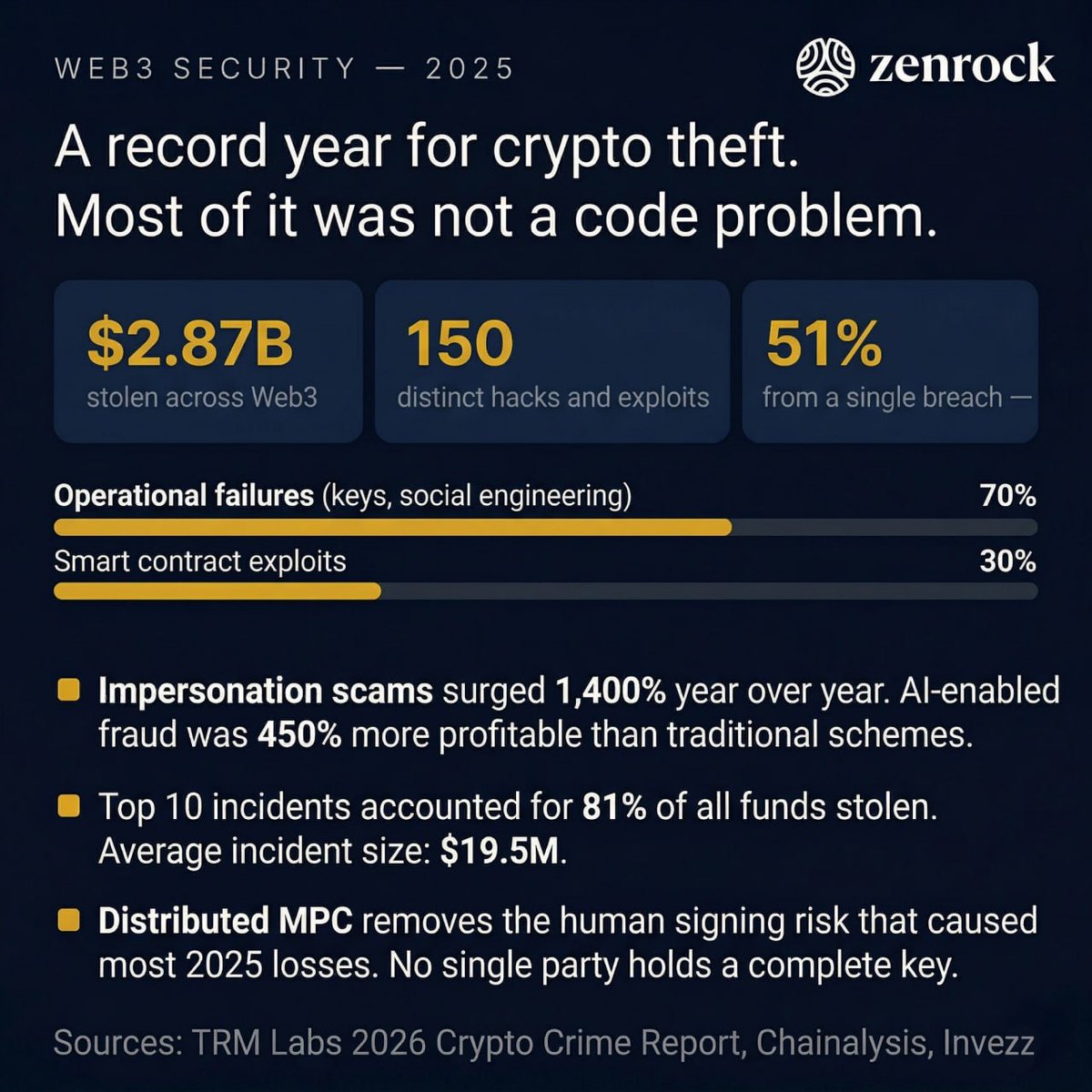
The structural flaw in most custody models: one compromised identity can authorize a catastrophic transaction.
$2.87B stolen in 2025 proves it.
zenBTC is built differently. No single party holds a complete key. No social engineering. No single point of failure.
zenBTC now has some of the tightest spreads of any BTC asset on Solana.
That's thanks to @Hadron_Fi. A new generalizable propAMM design built for customizable liquidity rules.
What this means for traders:
→ Deep, efficient BTC liquidity on Solana
→ Tight spreads without mercenary LPs
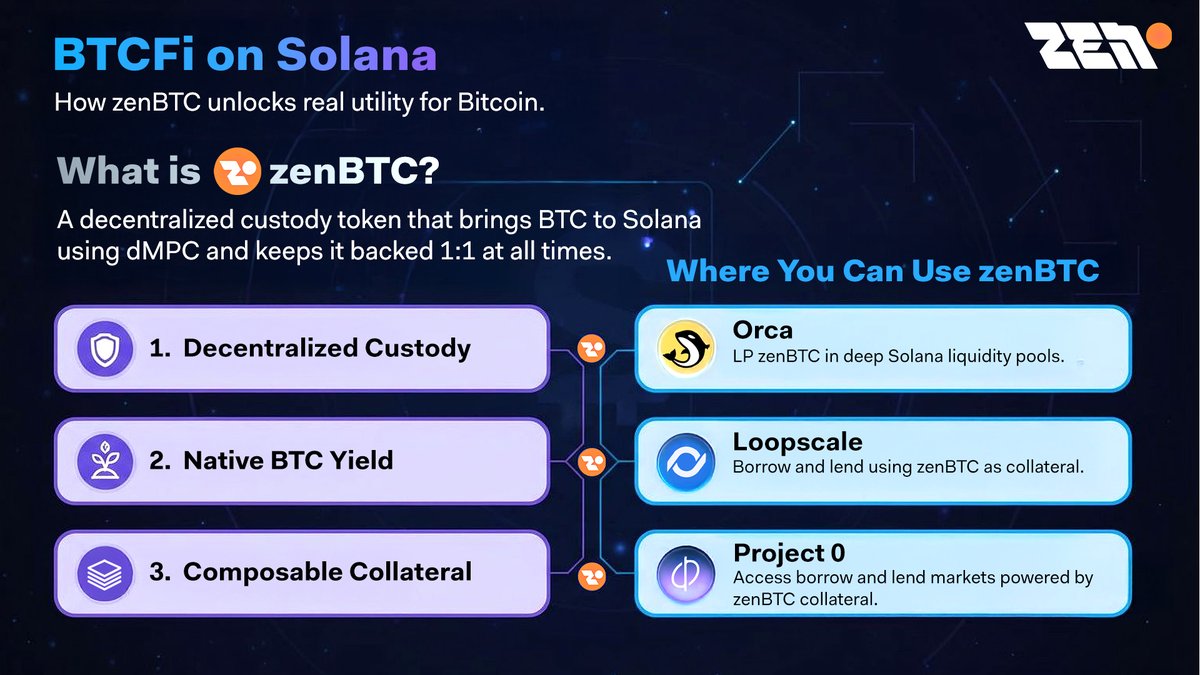
→ Direct access to sustainable BTC yield backed by Zenrock protocol fees
BTC on Solana just got tighter.
Hadron is open to teams and makers on Solana 🥳
Spin up a pool and start receiving orders in <30 mins
No more waiting for tight spreads on your assets
We’re onboarding early teams and makers, more below (1/4) 👇
Hadron is open to teams and makers on Solana 🥳
Spin up a pool and start receiving orders in <30 mins
No more waiting for tight spreads on your assets
We’re onboarding early teams and makers, more below (1/4) 👇
$1T+ of Bitcoin sits idle, yet “yield” is everywhere.
Lenders froze. Strategies broke. Incentives masked returns.
Real yield comes from activity.
What is your BTC yield actually coming from?
$1T+ of Bitcoin sits idle, yet “yield” is everywhere.
Lenders froze. Strategies broke. Incentives masked returns.
Real yield comes from activity.
What is your BTC yield actually coming from?
45% market share.
The BitGo moment forced the market to ask a simple question: who actually holds the BTC?
That question is why new custody models like zenBTC are emerging.
wBTC market share has fallen to ~45%.
The BitGo announcement pushed many to rethink a core question: who controls the BTC?
As Bitcoin moves into DeFi, custody matters.
zenBTC uses decentralized MPC custody while enabling BTC yield on Solana.
$2.7M was drained from a Solv Protocol vault exploit.
An attacker triggered a double-mint bug 22 times, extracting 38 BTC.
As Bitcoin moves into defi, custody design matters.
zenBTC utilizes decentralized custody models to eliminate single points of failure.