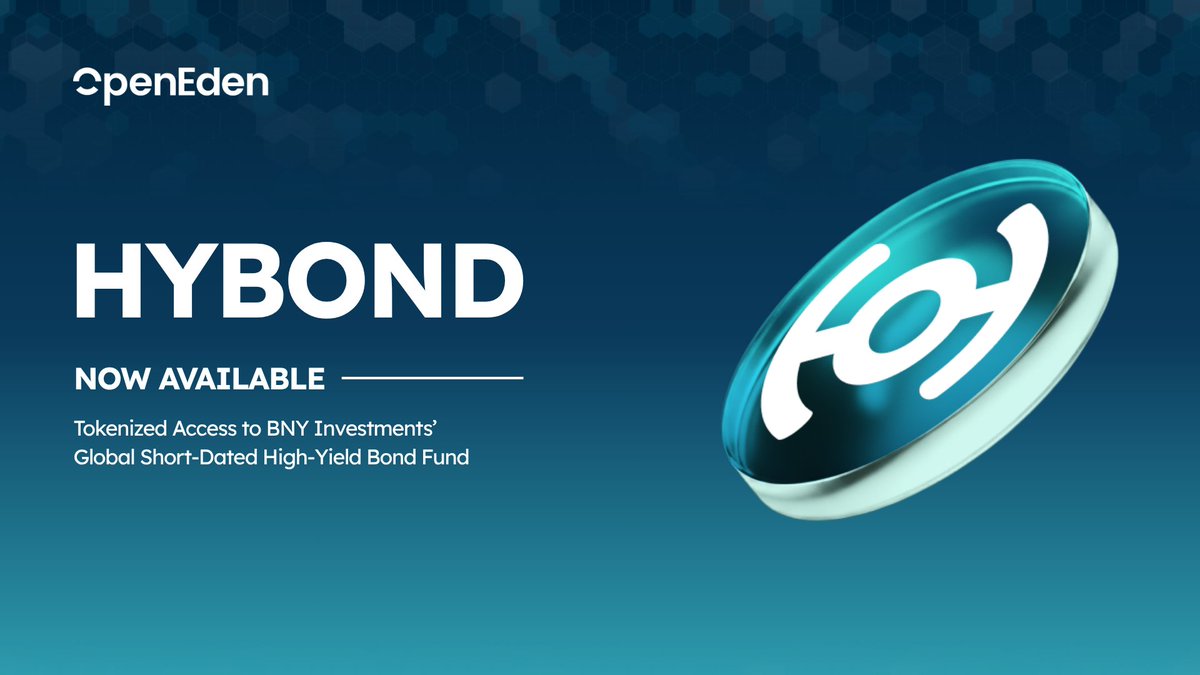
HYBOND, the first in the market to offer tokenized access to BNY Investments' Global Short-Dated High-Yield Bond Fund.
With 1:1 exposure to the underlying bond strategy, HYBOND brings BNY Investments’ deep credit management expertise on-chain while retaining the governance and regulatory oversight of a traditional fund structure.
Most tokenized products have focused on treasuries and cash equivalents. HYBOND moves up the credit curve by bringing top-tier fixed-income strategies on-chain.
Tokenized RWAs sit at $32.2B today, about 0.005% of global assets.
BCG projects the market reaches $16T by 2030.
The gap between those two numbers is where the opportunity lies.
Tokenized RWAs have grown 40% YTD while the broader crypto market fell 20%.
The asset mix explains why.
Private credit and US Treasuries make up the majority of tokenized assets today, both defined by transparent cash flows, familiar risk profiles, and regulated structures.
Institutional adoption is driven by asset fundamentals, not crypto market cycles. And tokenization scales where it has real utility.
https://t.co/npPWUfqx10
#OpenDigest | 19 June 2026
Each week, we bring you the biggest headlines, sharpest insights, and key updates on stablecoins, tokenized RWAs, and the OpenEden ecosystem.
All in one place.👇
🟣 Our Co-Founder and CTO, Duke Du, shared his experience speaking at Unchained Summit's RWA panel, diving into where institutional demand actually sits, and which asset class breaks out after Treasuries.
https://t.co/0pVgLUjUX5
I was in Da Nang last month for @UnchainedSummit to speak on a panel on "Real World Assets in Asia: tokenization, yield and institutional demand."
It was one of the more substantive RWA conversations I've been part of. We got past "can tokenization work" and into the harder questions: where institutional demand actually sits, and which asset class breaks out after Treasuries.
The part that stuck with me was Vietnam. It ranks among the highest globally for grassroots crypto adoption, but institutional RWA infrastructure here is still early. Grassroots adoption creates users. Licensing, custody and settlement create markets. The demand is already here; the infrastructure is what comes next.
And the talent is the real story. A good part of our developer team at OpenEden builds from Vietnam, and meeting them in person was one of the highlights of my trip. The engineering depth here is real, and with continued regulatory clarity, Vietnam can become a serious infrastructure hub for the region.
Grateful for the invitation to speak at the event, and to my fellow speakers on the panel: Sangamesh Ravichandran (@Blockchainxtech), Jason Tay (@HashKeyOTC), John Bui (@joinrepublic), Cristian Ulloa (@liquidloansio), and @harrybui31 (@TheSpartanGroup).
The tokenized economy is creating a reinforcing loop between RWAs and stablecoins.
RWAs need stablecoins to move, settle, and unlock liquidity. Stablecoins need RWAs to turn idle digital dollars into productive capital.
As this loop strengthens, the market will need more than token issuance.
It will need regulated and capital-efficient assets, custody, compliance, settlement, and on-chain utility to work together in practice.
That is what will define tokenization at an institutional scale.
https://t.co/hGaR6oRGPk
Stablecoins have scaled as digital cash. The next step is for them to scale as productive capital.
Of the $300B+ in stablecoin supply today, only around $4.6B is yield-bearing.
As stablecoins become a larger part of how digital dollars are held and moved, idle balances are becoming harder to justify.
But yield alone is not enough. Structure matters.
USDO, is a yield-bearing stablecoin issued by OpenEden Digital, a bankruptcy-remote segregated accounts company licensed under the Bermuda Monetary Authority’s DABA framework. It is backed by tokenized US Treasuries and distributes yield through a rebasing mechanism while maintaining a 1:1 USD peg.
Stablecoins should not just move capital. They should make capital work reliably.
I was in Da Nang last month for @UnchainedSummit to speak on a panel on "Real World Assets in Asia: tokenization, yield and institutional demand."
It was one of the more substantive RWA conversations I've been part of. We got past "can tokenization work" and into the harder questions: where institutional demand actually sits, and which asset class breaks out after Treasuries.
The part that stuck with me was Vietnam. It ranks among the highest globally for grassroots crypto adoption, but institutional RWA infrastructure here is still early. Grassroots adoption creates users. Licensing, custody and settlement create markets. The demand is already here; the infrastructure is what comes next.
And the talent is the real story. A good part of our developer team at OpenEden builds from Vietnam, and meeting them in person was one of the highlights of my trip. The engineering depth here is real, and with continued regulatory clarity, Vietnam can become a serious infrastructure hub for the region.
Grateful for the invitation to speak at the event, and to my fellow speakers on the panel: Sangamesh Ravichandran (@Blockchainxtech), Jason Tay (@HashKeyOTC), John Bui (@joinrepublic), Cristian Ulloa (@liquidloansio), and @harrybui31 (@TheSpartanGroup).
#OpenDigest | 12 June 2026
Each week, we bring you the biggest headlines, sharpest insights, and key updates on stablecoins, tokenized RWAs, and the OpenEden ecosystem.
All in one place.👇
🟣 OpenEden is hiring for an IT Security Lead with Web3 experience to help secure our cloud infrastructure, internal systems, and digital asset operations.
https://t.co/GRhEvcwraA
We're looking for an IT Security Lead with Web3 experience to help secure our cloud infrastructure, internal systems, and digital asset operations.
If you're a good fit, apply via our Career Page here: https://t.co/lYkkIH9PxG