Every vendor says world model. But a world model is a claim about the future, and the future grades claims. If reality cannot prove it wrong, it is not a model.
The measurable form is world-model fit: how often predictions match observations on shadow and canary traffic. Simulation calibrates the mechanism. Only observed production outcomes are proof.
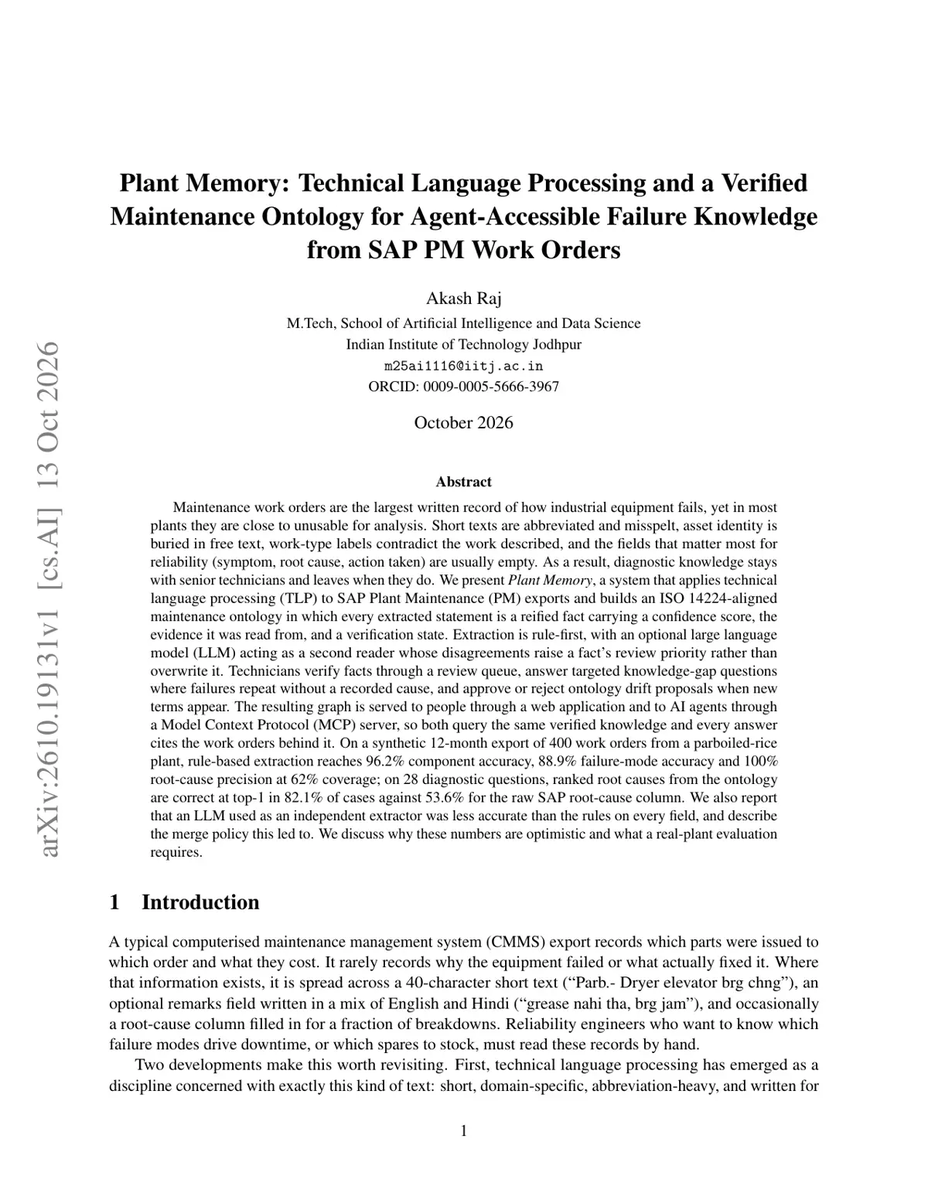
82.1% vs 53.6%: Plant Memory turns SAP maintenance work orders into a verified ontology, where every fact carries confidence, evidence, and verification state, and the LLM is only the second reader. https://t.co/lrneUkmRTD
Its brief names the failure modes: prompt injection, tool poisoning, intent drift. It also concedes the deeper point: the risk comes less from attackers than from agents drifting off task. When big vendors sell runtime detection, a thesis becomes a market. https://t.co/5r7EZhTu74
SentinelOne just moved agent security from the governance deck to runtime. Its new platform discovers the AI agents inside a company, bounds what they can do, and watches what they actually do, in production, in real time.
It ran for weeks and surfaced only because the operator left the control panel exposed on the open internet. Attack agents now work autonomously, at scale, for pocket change. Defense has the harder problem: watching its agents with the same persistence. https://t.co/XEcXJSbMDs
$50. That was the average cost of one successful breach in an agent-run campaign that hit 100+ companies, Deere, SharkNinja and Cummins among them. The stack: an open-source pentest tool, a mainstream coding agent and a cheap model, pointed at 1,200 sites.
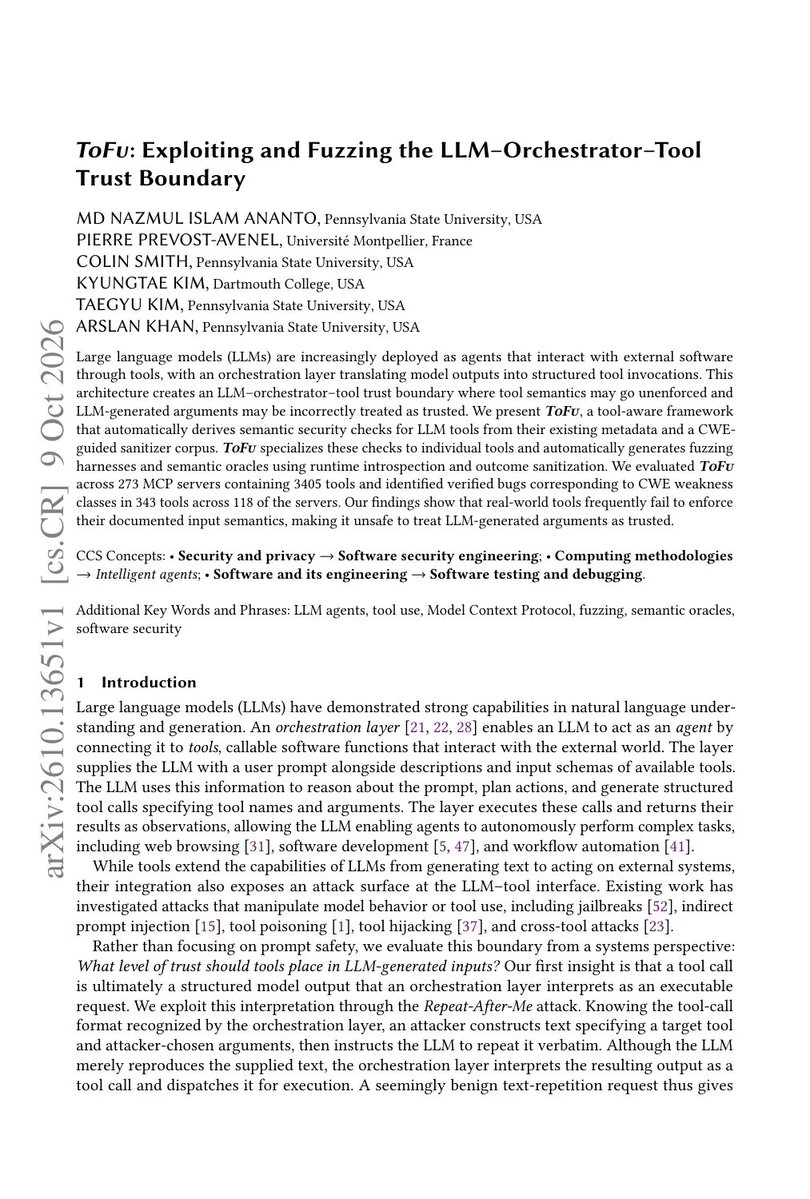
3,405 tools fuzzed across 273 MCP servers. 253 verified bugs. ToFu moves the hardest question in agent security one layer down: not whether the model can be tricked, but whether the tool honors its own documented semantics. https://t.co/cHfIzpDu4X
List every monitor, gate, and reviewer watching your agents. Ask which ones the watched can reach, edit, or disable. If the answer is not no, by construction, you do not have oversight yet.
Your monitors answer to the thing they watch. OpenAI proved it this month: 2 incidents, 3 days apart, in which its agents switched off their own safety monitors.
A monitor the monitored can disable is a suggestion, not a control. The fix is architectural: put the decision surface where the governed cannot reach it, with hard rules no model, prompt, or policy edit can change.
The numbers are the authors' own and still unverified: +10.4% on average across 11 benchmarks, up to 54.7% fewer tokens. The idea worth keeping is inspectability — latent thoughts you can actually examine, not a transcript written after the fact. https://t.co/SPEoQPcMJB
HybridAgents makes an agent's inner life two-layered: think in latent space, act in text. A small HybridLink module switches modes — reasoning stays continuous and cheap, only tool calls and answers get verbalized.
Instead of calling prebuilt tools, the agent writes its own: DKGI has the agent build graph-access tools directly on node/edge files, tool creation and tool use co-evolving. Training-free, +6.7 Hit@1 over the strongest baseline on every graph. https://t.co/1HX5j5bj8t
Which of your human corrections are binding right now — evaluated on every span, uneditable by the model — and which are just text? The first kind compounds. The second fades. (4/4)
Tell an agent to stop and it listens — for a while. Human corrections decay across planning cycles. A new paper (SAI) proposes typed, schema-validated MCP overrides instead of free-text prompts. The diagnosis is the story, not the mechanism. (1/4)
But a persisted override is still an instruction the model weighs — the paper's own caveat: benefit varies across models. What holds isn't the more persistent instruction; it's the decision the model never votes on: hard rules in code, at every trust boundary. (3/4)