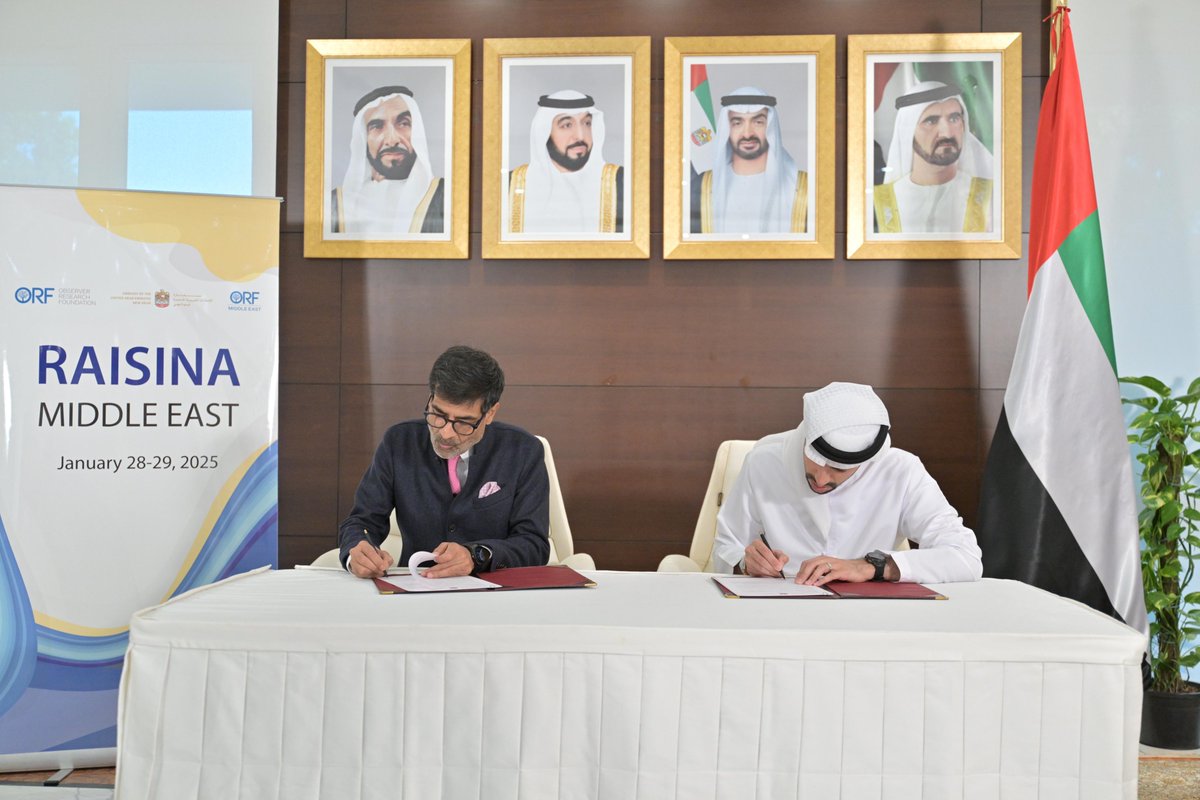
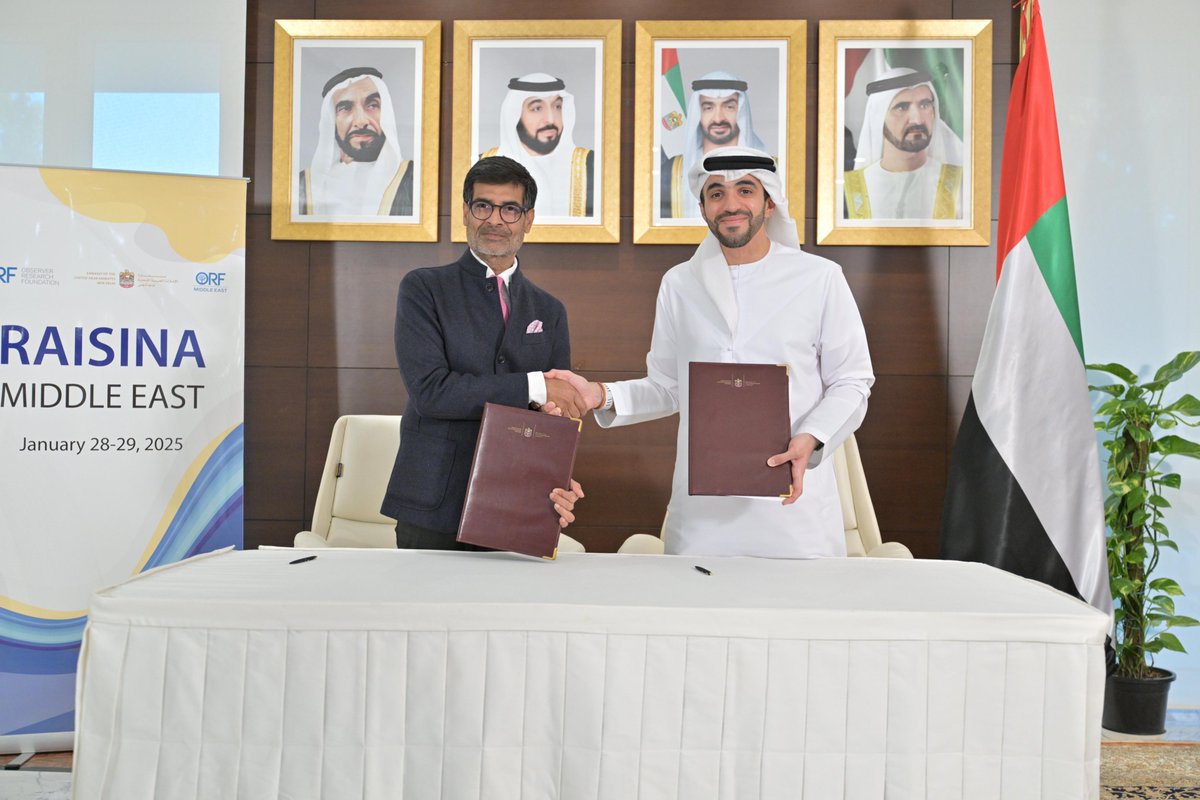
.@orf_middleeast and @orfonline signed an MoU with the UAE Embassy (@UAEembassyIndia) in India to host the inaugural edition of Raisina Middle East on January 28-29, 2025.
The institutions are delighted to take this significant step forward in fostering greater regional cooperation and dialogue.
@aj_alshaali@samirsaran@raisinadialogue
Foreign exchange (#FX) risk is an important factor while discussing global #greenfinance flows between developed and #developing countries.
@P_Dhruba analyses the role of FX risk relative to the broader cost of #capital for cross-border green finance flows.
Read here: https://t.co/EQhfLhM5DD
The world's busiest #trade and logistics hubs are operating in an era where disruption has become part of the operating #environment.
@omareconomics, President of the @Bah_Economists Society, explains why world-class infrastructure such as ports and airports, combined with the region's strategic geography, will remain the foundation of the #Gulf's position as a global logistics hub.
Watch here: https://t.co/dYPCwsx0Ll
The world's most formidable #military is almost entirely dependent on #China for the #criticalminerals its #defense production chains run on.
Cauvery Ganapathy examines the critical minerals problem at the heart of #American defense.
Read here: https://t.co/P4iVoT1X13
Middle powers often seek a larger role in #global affairs but the harder task is aligning #foreign policy ambition with domestic #political realities.
#Indonesia's expanding engagement in the Middle East highlights that tension, raising questions about how far its tradition of bebas aktif— independent and active engagement in world affairs —can stretch before it encounters limits at home.
Read More by @SinGulfura: https://t.co/LwVkDl0SeU
The #Hormuz crisis has disrupted fertiliser and steel industries, two sectors tied to hydrocarbons and #Gulf shipping. In response, governments are turning back to green hydrogen and ammonia for long-term #energy security.
In our latest Expert Speaks, Leigh Mante examines how countries such as #Morocco, #Egypt, #Australia, and #India are positioning themselves within evolving #hydrogen supply chains as governments look to secure more reliable production beyond traditional energy corridors.
The spread of conflict across the #MiddleEast is constraining capital flows and energy transfers, creating uncertainty that reverberates from #Europe to #Asia.
'Under the persistent #economic fragility and domestic political uncertainty, #Turkey may operationalise the conflict as an economic breakthrough', writes Ekin Keleş.
Read here: https://t.co/vlXZC0UDvM
The future of #Iran will have important implications for Russia's interests across the #MiddleEast and #Eurasia. Stability in Iran, regional dynamics, and the balance between #Moscow's various partnerships are all likely to shape #Russia's approach in the years ahead.
@HannaNotte, Director of the Eurasia Nonproliferation Program at the @JamesMartinCNS, examines why internal instability in Iran would present significant challenges for Russia and why a weakened but intact Islamic Republic could deepen its ties with both Russia and #China.
Watch here: https://t.co/PAvF4aayV4
Economic resilience is often discussed in terms of #budgets, reserves, and #government spending. But in an increasingly #digital economy, resilience also depends on whether businesses can remain connected, data can move securely, and critical services can continue operating during crises.
@thedkaleka and @JyotsnaMehra explore why #fiscal resilience and digital resilience are becoming inseparable challenges for #Gulf policymakers.
Read:https://t.co/e5SdFzVSL8
For years, #Gulf states have invested heavily in becoming global centres for #connectivity, #cloud computing, and #digital services. But as ownership of subsea cable infrastructure becomes increasingly concentrated among a handful of #technology firms, questions of resilience, influence, and strategic autonomy are moving to the forefront.
This Expert Speaks explores what #digital sovereignty means in an era of hyperscaler-led infrastructure.
Read: https://t.co/cjffQ6dT4O
@orfmiddleeast recently convened a discussion titled ‘The Gulf’s Economic Resilience amid Regional Turbulence’. The session brought together distinguished experts and policymakers to explore how #Gulf countries are preparing to recover from the crisis’ adverse consequences, and unpack how they intend to build longer-term #resilience and future-proof their #growth models.
@blondearabist , @tarekfad, @ShakuMaku, @mahdijasimg, @Karazaov, @KabirTaneja, @mannat_jaspal, @SY51309089
After #Iran declared the Strait of #Hormuz closed, #Iraq’s oil revenues collapsed from nearly $7 billion in a normal month to barely $1 billion in April.
With oil funding the state, public salaries, welfare and patronage networks, the shock quickly became a budget emergency, leaving Prime Minister Ali al‑Zaidi with little capacity for structural reform.
Read our Expert Speaks by @SamriddhiVij: https://t.co/nLDrTwaI9u
The US-Iran #peace deal includes a #ceasefire and the reopening of the Strait of #Hormuz, with further negotiations expected over the next sixty days.
Tracking developments since the onset of the conflict, @orfmiddleeast experts react to the peace deal and the challenges that could influence its implementation.
@KabirTaneja, @SinGulfura, @SamriddhiVij, @Karazaov, @mahdijasimg
Read more: https://t.co/Tz5Daq1YkR
Opportunities that arise during a #conflict, while providing short-term gains, can also offer long-term access based on strong #bilateral ties.
#Indigenisation will be a core by-product of the #defence diversification.
Writes @KabirTaneja:
https://t.co/3g0Ue7UcAm
Transit bottlenecks triggered by the #Iran conflict have driven up costs, disrupting industrial capacity-building efforts, and forcing #governments to rethink #fiscal priorities.
In this online panel discussion titled ‘The Hormuz Disruption : How the Iran War is Reconfiguring Critical Mineral Value-Chains’, experts assess the conflict's impact on de-risking efforts, identify emerging chokepoints, and consider what recalibration looks like for countries trying to build industrial capacity in a fragile #supplychain landscape.
Watch here: https://t.co/NdnVKByn41
@ashzforbes, @RiceUniversity, @ChatamHouse, @NUedukz
The Board of Peace promises to rebuild #Gaza and end the war, backed by pledged funds and a multinational force. Yet, it was launched amidst #OperationEpicFury against #Iran, exposing the hollowness of #American coercion as #Russia, Iran, and Gaza resisted.
@SinGulfura examines the Board's financial architecture, its #security framework, and the #political challenges surrounding Gaza that continue to complicate implementation.
Read here: https://t.co/2wPQRxtyvW
Rising #geopolitical competition over advanced #technologies is reshaping how states approach the infrastructure that underpins #digital power.
In this Policy Brief, Elizabeth Heyes argues that hyper scale #data centres, often treated as technical or commercial assets, are becoming increasingly central to #geopolitical strategy, even as they face constraints in resource supply chains, physical infrastructure, and data #governance regimes.
Read here: https://t.co/bL0sPK9R3F