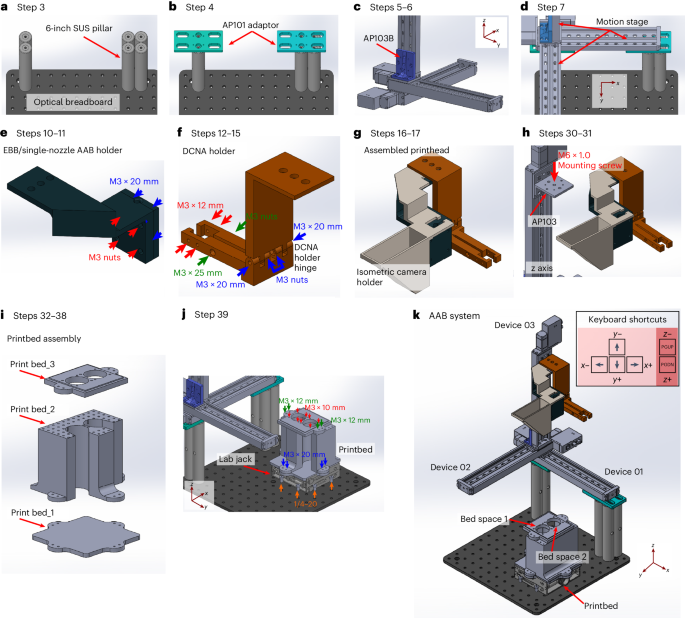
Check out HITS-Bio, upgraded version of aspiration-assisted bioprinting, achieving an unprecedented spheroid bioprinting speed, ten times faster compared to existing techniques, @NatureComms@penn_state https://t.co/9ayjRpeSqj
(Bio)Printing the Protectors!
In this review article in @BioactiveMat from our lab in @penn_state from @OzbolatLab, we give insights on bioprinting efforts on epithelial tissues
Excited with my new journey of exploring epithelial cell biology & bioprinting
https://t.co/M39VlKeELl
This microfluidic device was 3D printed using a transparent, photocrosslinkable, and tuneable silicone composite.
It's used here for making Janus micro-rods.
Read the article: https://t.co/lCgEcqnhac
.@MRizwanPhD@OzbolatLab and colleagues review the emerging applications of granular hydrogel bioinks to improve biological function in bioprinted constructs: https://t.co/KOcs0Mclmy
Big congrats! Sean Palecek is also there. When you join there, you should meet him and say hi from me. Use cardiomyocytes from him for your soft robots!
📑@OzbolatLab & colleagues recently used RoosterBio MSCs & media for a multicellular spheroid model of Gaucher disease that mapped to the severity of patient cohorts. This novel assay system may enable development of personalized medicine therapies for GD. https://t.co/IaaYeLDgS0
Dr Ibrahim Tarik Ozbolat, Professor from @penn_state, discusses the benefits of publishing their research with us #OpenAcess under a #TransformativeAgreement.
Read the full discussion here 👉 https://t.co/87cpPVdt78
Congrats to chemistry graduate student @VaibhavPalIn, a member of @OzbolatLab, who was recently named 2nd place prize winner in the Physical Sciences and Mathematics category at the 2023 Graduate Exhibition!
https://t.co/FNo5M27DZE
@psu_chemistry@PSUScience