In preparation for what’s next, Pan new website is now live.
We’ve updated the design, product pages, and onboarding flow.
What do you think we should launch next?
Agent autonomy is rising.
Without verification, one rogue action can cascade.
Production agents need intent checks and execution proofs.
Safety is an infrastructure layer.
@nvidia Open collaboration on agent security is necessary.
As agents gain more autonomy across tools and systems, verification and execution safeguards become core infrastructure — not optional features.
The industry needs shared standards for safe, auditable agent behavior.
Open models are not the end of the AI stack.
They are the beginning of massive agent deployment.
As more companies and developers build on open models, agents will need to call external compute, run private tasks, verify outputs and pay for execution.
For my first post, I’m sharing a letter @NVIDIA signed on why open models matter.
AI will transform every industry, power every company, and be built by every country.
Open models strengthen safety and cybersecurity, accelerate innovation and diffusion, and enable sovereignty.
The world needs both frontier closed models and frontier open models.
https://t.co/AUKzoQ5Ikb
Voice is becoming the control layer for agents.
ChatGPT on desktop can now listen, speak, coordinate work and direct multiple agents across your computer.
That means AI is moving from “answering questions” to operating workflows.
As agents take action, they will need infrastructure to access compute, verify execution and settle value automatically.
PAN is building that layer:
verifiable compute settlement for the agent economy.
ChatGPT Voice is now in the desktop app.
Control your computer and direct multiple agents running in ChatGPT Work or Codex, using just your voice.
It's powered by GPT-Live, so it can speak, listen, and coordinate work in the app at the same time.
Rolling out globally today on macOS and Windows to Plus, Pro, Business, Edu, and Enterprise plans.
“Real” is the right word.
Qwen-Image-3.0 shows that image generation is moving beyond aesthetics into real workflows: design, education, content, UI, e-commerce and scientific production.
Real workflows create real compute demand.
As AI agents begin to generate, revise and execute these tasks autonomously, compute usage becomes continuous and transactional.
The next layer is not just more GPUs.
It is a way for agents to access compute, pay for it, verify execution and settle value automatically.
That is what PAN is building:
the verifiable compute settlement layer for the agent economy.
🎨 Meet Qwen-Image-3.0 — the third generation of our foundational image generation model.
If 1.0 was about "Precision," and 2.0 added "Variety, Completeness, Beauty & Authenticity," then 3.0 comes down to a single word: Real (实).
Three dimensions of "Real":
📰 Rich Content — prompts up to 4.5k tokens. One-pass generation of complex layouts: newspapers, storyboards, exam papers — even a 3×3 infographic grid or picture-in-picture-in-picture UIs.
🔬 Authentic Details — text legible down to 10px, full LaTeX paper pages, pores, hair strands & near-photographic skin texture.
🌏 Deep Knowledge — native rendering in 12 languages, 100+ art styles, realistic UIs (web / games / livestreams), plus world knowledge & live web retrieval.
Not just "good-looking" — genuinely useful. Image generation as a real productivity tool for design, content, education & e-commerce.
Go create 🏃🎨
💬Qwen Chat: https://t.co/941HmITJ2W
📝Blog: https://t.co/5mnS4uI9Ar
What is an AI Agent?
Not just a chatbot — it's a system that autonomously plans, calls tools, and completes multi-step tasks.
From checking the weather to executing trades, agents move AI from "answering" to "doing."
The 2026 mainstream trend is already here.
What's the first thing you'd want an agent to do for you?
Kimi K3 (2.8T MoE) + NVIDIA LeRobot GR00T 1.7.
Massive open models for long-context reasoning meet physical AI platforms for humanoid robots.
More frontier inference + real-world deployment = exploding GPU/edge compute demand.
The race isn't just training anymore.
It's agents that think, see, and act.
#ComputeRace #AIAgents
AI agents are not just a chatbot trend.
The real shift is happening inside enterprise workflows:
customer support, compliance, coding, research, operations.
Every task that moves from human-only to AI-assisted creates more inference demand.
That is where the next layer of compute growth comes from.
Grok Build being open-sourced is another signal that AI infrastructure is moving closer to developers.
When AI tooling becomes easier to access, more teams can build, test, and deploy real workflows.
That raises an important question:
Will the next wave of GPU demand come from model training,
or from millions of AI workflows running in production?
We've open-sourced Grok Build and have reset usage limits for all users.
Open sourcing Grok Build allows anyone to support making a reliable and robust harness. Check out our code, including the Git repo for the Grok Build CLI.
https://t.co/3SSvPu2Nrz
AI video is becoming another compute story.
Text generation was only the first wave.
Images, video, voice, and real-time multimodal models require much heavier inference.
The more AI moves from typing answers to generating media and actions,
the more compute demand expands.
AI agents are moving from chat into financial execution.
Robinhood says eligible US crypto traders will soon be able to connect third-party AI agents from Anthropic, OpenAI and Grok to trade on their behalf.
The bigger trend: finance is becoming another real-world test for AI agents, inference demand, and compute infrastructure.
Crypto is coming to agentic trading.
Eligible US customers will soon be able to connect their AI agent to a dedicated Robinhood account to trade crypto on their behalf, with the same real-time P&L tracking and push notifications they already know from agentic trading. More soon.
https://t.co/6yrDqMr6G4
This week was about agentic AI.
xAI launched Grok 4.5.
Meta released Muse Spark 1.1.
OpenAI introduced ChatGPT Work.
AI is moving from answering questions to completing workflows.
More agents mean more inference.
More inference means more GPU demand.
The AI race is becoming a compute race.
Meta released Muse Spark 1.1.
OpenAI introduced ChatGPT Work.
Both point to the same shift:
AI is no longer just answering questions.
It is starting to complete real workflows.
Agents use tools, apps, files, code, and long context.
That means more inference.
More compute calls.
More GPU demand.
More pressure on infrastructure.
The next AI race is not only about better agents.
It is also about who has reliable compute access.
#AI #OpenAI #MetaAI #GPU #AIInfrastructure
Meta just released Muse Spark 1.1 and is the new SOTA on MedScribe and TaxEval, taking the top spot from Fable 5 while being 10x cheaper and twice as fast. Meta currently holds the top 2 spots on TaxEval
It is also the new #1 on Harvey's Legal Agent Bench, dethroning Grok 4.5 less than 24 hours after it took the top spot.
Meta is launching Muse Image and Muse Video.
xAI is releasing Grok 4.5.
The headline is better models.
The deeper story is compute demand.
Every new AI product needs more inference, more GPUs, and more reliable infrastructure.
The AI race is also a compute race.
Introducing Muse Image and Muse Video, the first media generation models developed by Meta Superintelligence Labs.
Muse Image is our most advanced image generation model yet. It follows instructions faithfully, edits with precision, composes from multiple references, and draws on Instagram for social context. It also brings agentic tool use capabilities to image generation and integrates with Muse Spark.
You can try Muse Image in the Meta AI app and web, as well as in Instagram Stories and WhatsApp – starting in limited countries with more locations on the way.
Today we’re also previewing Muse Video, which is built upon the same pretraining base as Muse Image to deliver exceptional visual fidelity with native audio support.
Learn more about both models: https://t.co/QtKDPDZP5v
PAN is back with market notes.
AI compute is becoming more than a resource.
It is becoming a market.
As inference demand grows, compute will need clearer ways to be measured, priced, verified, and settled.
For Season 1 participants, participation records have been preserved internally.
We’ll continue sharing notes on AI compute markets, inference, metering, settlement, and on-chain receipts.
#OnChainAI #ComputeMarketplace #DePIN #AICompute
Truly determining AI upper limit is data modeling capability.
This insight gives us more confidence in PAN Project's future data infrastructure!
New ideas. New connections. Back to accelerate crypto × AI. 🚀
#AI#Crypto
It was an honor to represent the PAN Project at AWS Summit Japan 2026.
Great insights, great conversations, and plenty of ideas to bring back. Looking forward to building what's next.
#AWSSummit#AWS#Cloud#AI
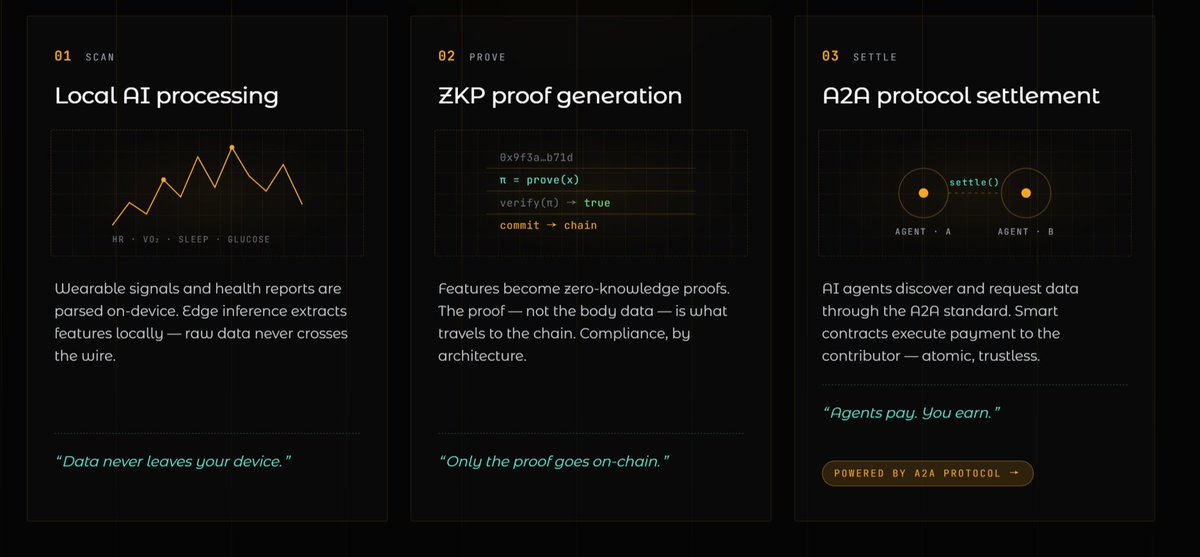
Every AI Agent hits 3 walls: compliance, data, settlement.
You hit the same walls with your body data.
PAN Network: Edge AI + ZKP + A2A.
One layer, all walls broken. 🔥
🚨 No one owns these two things:
① Your health data (scattered across hospitals & apps, zero control)
② Your AI identity (agents can’t verify you’re human without stealing privacy)
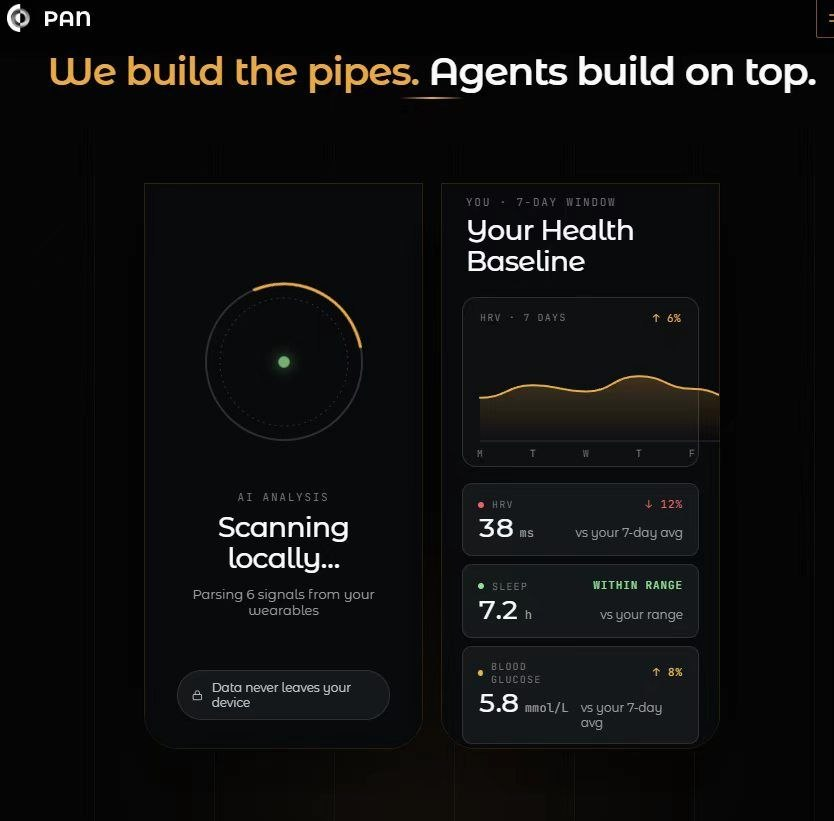
PAN Network fixes both.
Biometric Data Layer for AI Agent Era + Your Health Sovereignty. 👇