Non-US market hours still drive Bitcoin’s largest moves. Despite the swift rise of Bitcoin spot ETFs, IBIT being the fastest ETF on record to hit $50 billion in AUM, a 10% or greater price move week still usually prints outside NYSE hours. Since January 2021, Asia has owned 51 of the 85 weeks with at least a 10% one-way move, and the largest share of the variance. Even so, US market hours have taken a larger piece of those big weeks, 24% of the variance before the January 2024 spot ETF listings, 33% after. While Asia is still the default, US hours have become a bigger part of the move than they used to be.
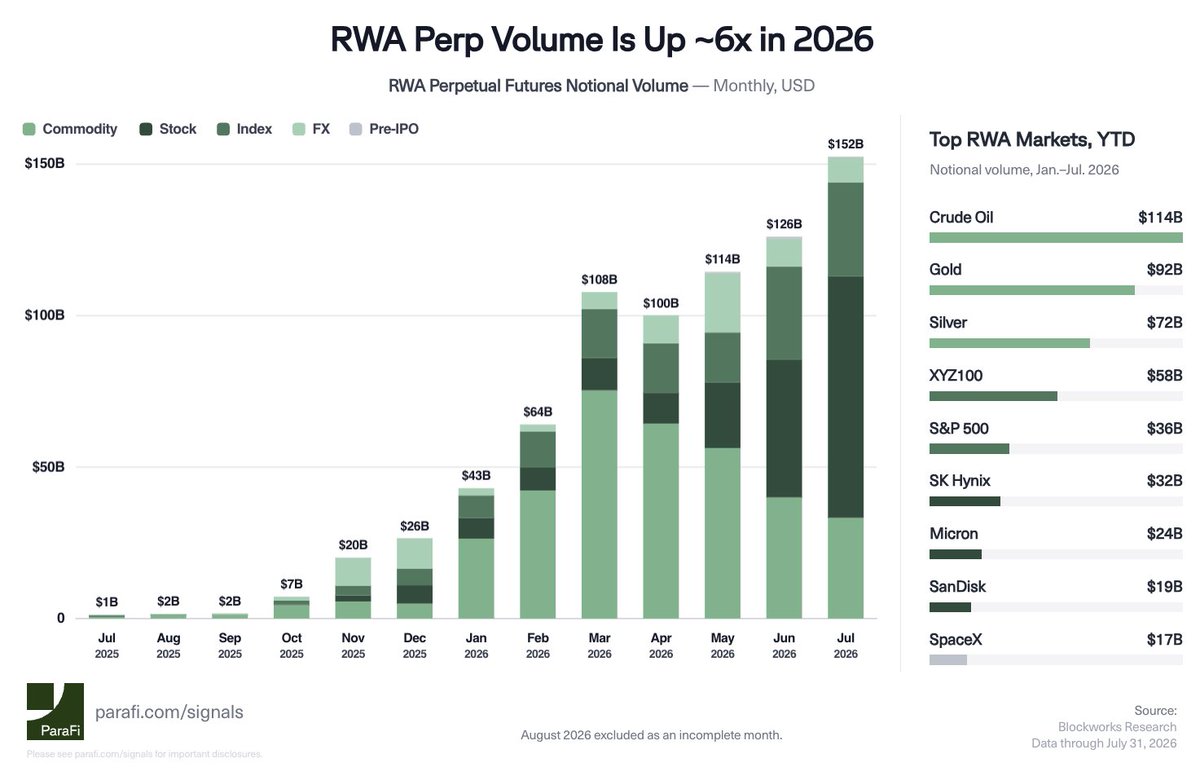
Perpetual futures trading volume linked to Real World Assets (“RWAs”) reached $152 billion in July 2026, up ~6x since the start of the year and more than 100x YoY. RWAs now represent 33% of all perp decentralized exchange (DEX) volume.
Trading spans commodities such as crude oil, gold and silver, major indices including the Nasdaq-linked XYZ100 and S&P 500, and equities such as SK Hynix, Micron, SanDisk and SpaceX.
Perp DEXs have emerged as a 24/7 global derivatives layer, offering continuous access, liquidity, leverage, price discovery and cross-market arbitrage for assets historically constrained by market hours, geography and private-market access.
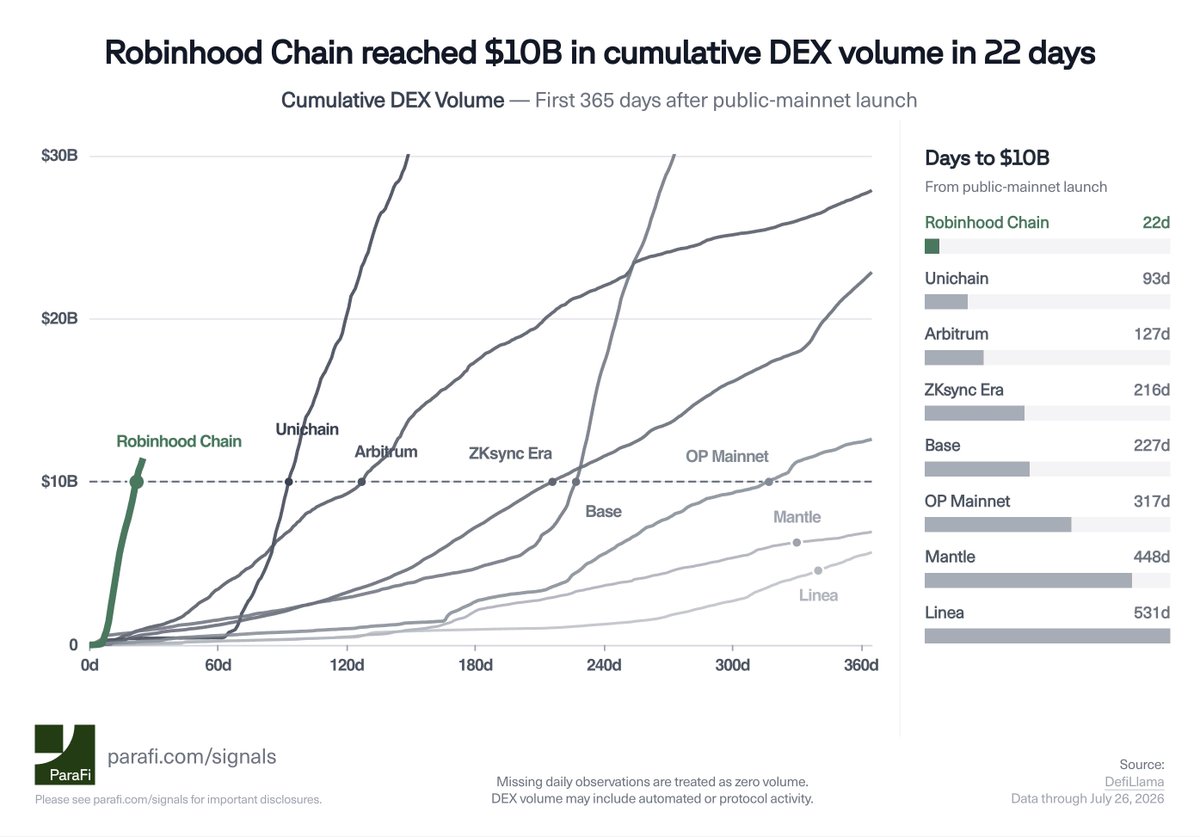
New-chain launches are far from over, but the playbook is changing. Robinhood Chain crossed $10 billion of DEX volume in 22 days, showing how an established consumer platform can bootstrap liquidity and activity far faster than a standalone network building distribution from scratch. More than 80% of early DEX volume was memecoin-driven, but roughly $70 million of tokenized real-world assets and more than $400 million of stablecoins point to a broader financial stack taking shape. Building on the success of chain integrations by Coinbase and Telegram, Robinhood may be the turning point where app-owned chains become a repeatable vertical integration strategy across distribution, trading, settlement, and economics.
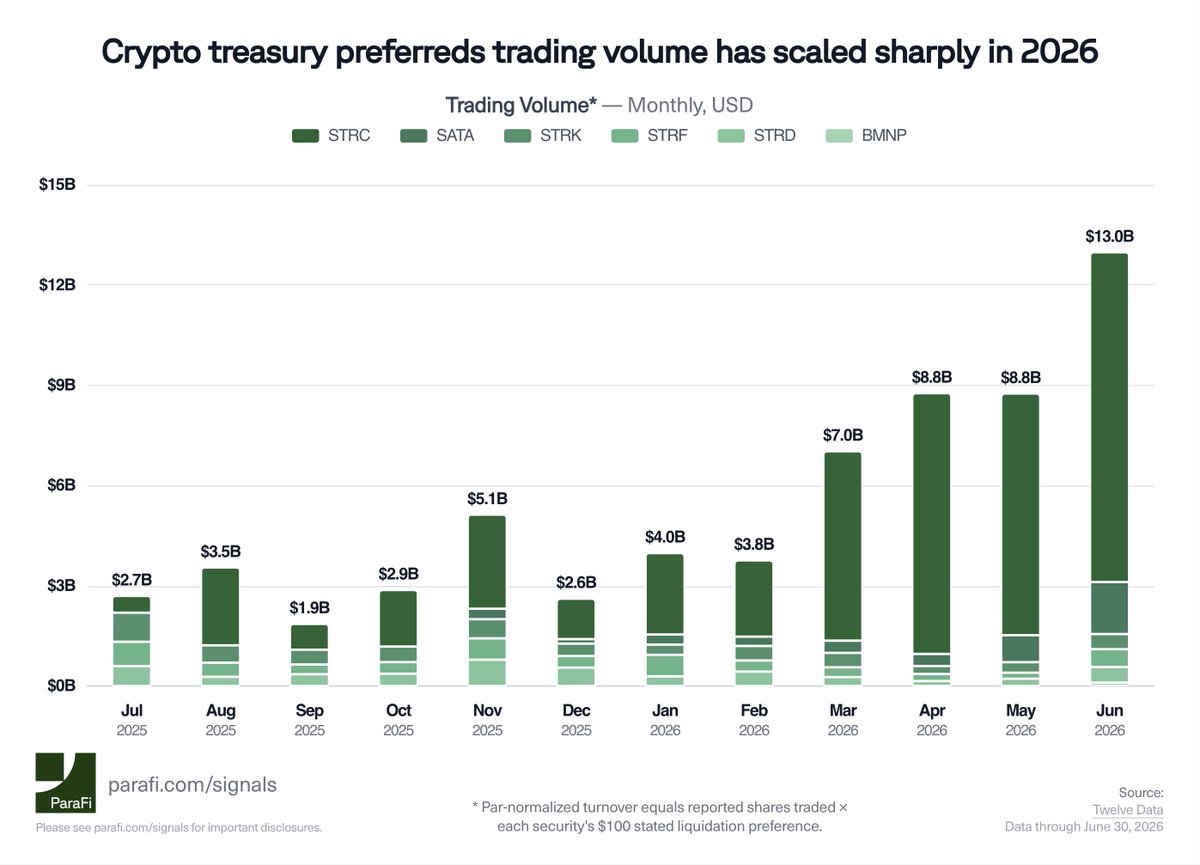
Trading activity in crypto treasury preferreds has accelerated sharply in 2026, with monthly par-normalized volume reaching approximately $13B in June. The step-change has been driven by STRC and a growing number of new preferred listings, transforming what was once a niche market for bespoke financing dominated by financial institutions (banks and insurers) into a broader, more liquid, and increasingly evergreen asset class.
Beyond higher trading volumes, the key signal is the maturation of the preferred equity market itself. As liquidity deepens, these instruments become increasingly more efficient not only on coupon and issuer quality, but also on secondary-market depth, relative value, and the durability of investor demand. This evolution is beginning to extend beyond crypto: in June, Alphabet launched its first convertible preferred offering as part of an $80B + equity raise to fund AI infrastructure, while Super Micro Computer announced a $3.75B convertible preferred issuance within a $7B capital raise for AI expansion, underscoring the growing role of preferred equity as a scalable financing instrument across sectors.
Solana apps like @phantom, @Pumpfun, and @JupiterExchange now generate meaningfully more revenue than the chain itself. In May 2026, Solana apps generated ~$94M in monthly retained revenue versus ~$18.6M in Solana Real Economic Value (REV), a measure of chain fees plus MEV tips.
That gap has persisted even after chain fees normalized following the TRUMP/MELANIA memecoin frenzy in January 2025. In our view, the data suggests that Solana is increasingly behaving like a platform economy where applications capture multiple times more value than the base chain itself.
Tokenized equities reached ~$1.6B AUM (>60x YoY) after xStocks and Ondo released permissionless products. Total holders of tokenized equities reached ~300K (35.6% share of RWA market), overtaking commodities to become the most widely held RWA asset class. Nvidia, Tesla and S&P 500 lead distribution with over >100K holders. We believe the rapid adoption reflects a simple but powerful unlock; for the first time, anyone in the world with an internet connection can access U.S. equities.
We are excited to share several promotions and team additions across ParaFi.
Promotions
• Adrian Uberto has been promoted to President, continuing as Partner and COO
• Anjan Vinod has been promoted to Partner
New Team Members
• Jeff Park joins as Partner and Portfolio Manager, following investing and portfolio management roles at ProCap Financial, Bitwise, Corbin Capital, Harvard Management Company, and Morgan Stanley
• Ryan Silva joins as Head of Trading, bringing experience across crypto, macro, and fixed income markets from firms including BlockTower and Borderless
• Dani de la Lama joins as Counsel following investment fund formation and structuring roles at Simpson Thacher and Weil
• Leah Valente joins as an Analyst after prior investing and research roles at DCG and Artemis
We believe the opportunity ahead in digital assets has never been greater, and we continue to invest heavily in building the strongest team in the industry. We are actively hiring across investing, engineering, trading, and operations roles.
Please reach out to [email protected]
Tokenized real-world assets (RWA) on public blockchains (excluding stablecoins) crossed $34B in May 2026, up from $11B in May 2025. A 3x move in 12 months.
U.S. Treasuries lead at $15.2B, nearly half the tokenized RWA market, and almost double their September 2025 level.
The drivers are multiple: exchange collateral integrations, compressed DeFi yields, and a growing institutional preference for yield-bearing alternatives to idle stablecoin balances.
Exchanges including Binance and OKX now accept BlackRock's BUIDL, Franklin Templeton's BENJI and others as off-exchange collateral. Tokenized Treasuries can earn yield and serve as margin on the same venues where capital used to sit idle.
Stablecoin reserves on derivatives exchanges peaked at $67.7B in late November 2025 and have since contracted by ~$7B. Tokenized Treasuries broke out of a $9B plateau and added $6B over the same window.
Tokenized treasuries are increasingly the productive collateral option that idle dollars can be measured against.
Crypto card volumes have grown 12x over the past two years, now exceeding $650M in monthly volume.
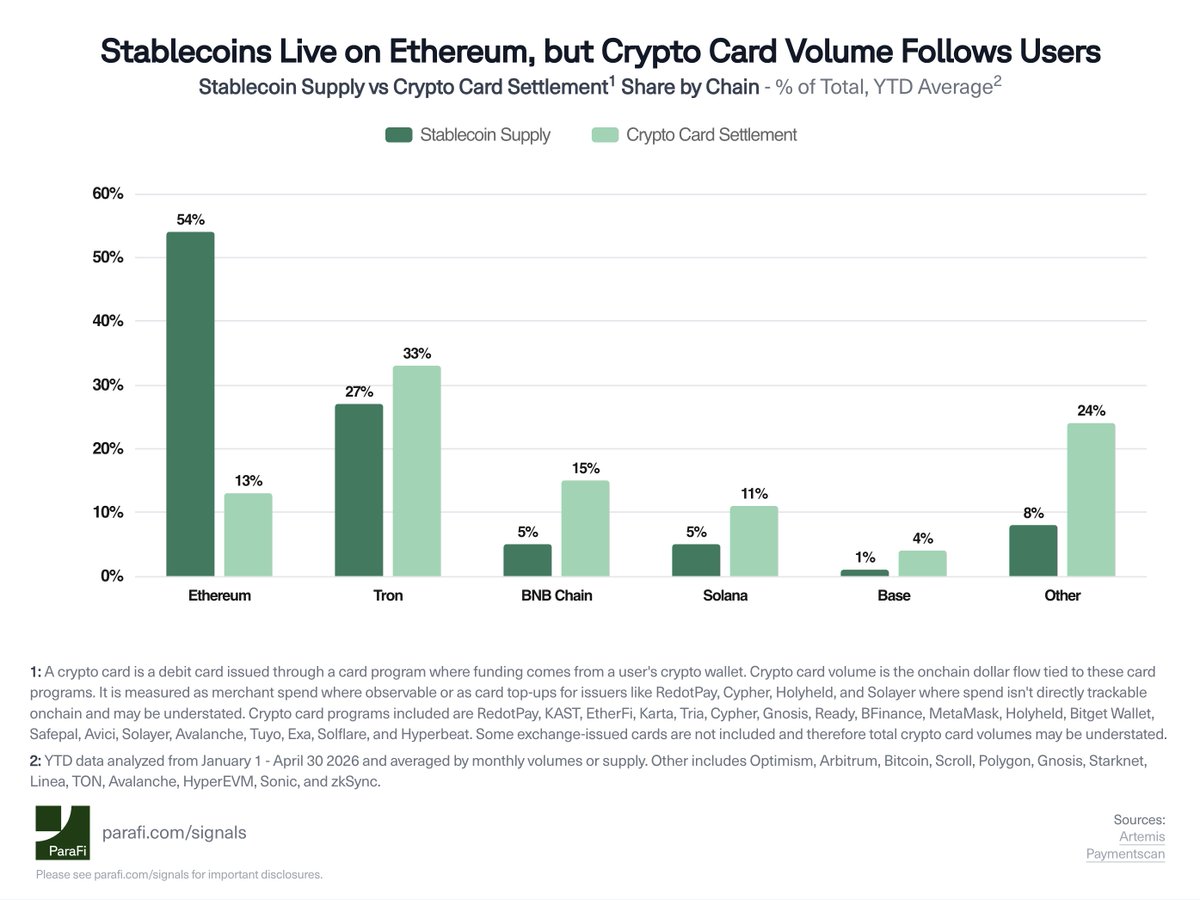
At the same time, where stablecoins live and where they’re spent are diverging. Ethereum holds 54% of stablecoin supply but accounts for just 13% of crypto card settlement, while Tron holds 27% of supply but processes 33% of card volume.
The gap is less about fees and more about distribution. Much of crypto card activity flows through providers like RedotPay, whose user base is concentrated in Asia and MENA, where users already hold USDT on Tron.
1/ Thrilled to announce our Series A extension at a $192M valuation.
Crypto is at an inflection point. The bottleneck to growth is no longer just the technology.
It's the trust gap between issuers and investors.
Blockworks will solve that.
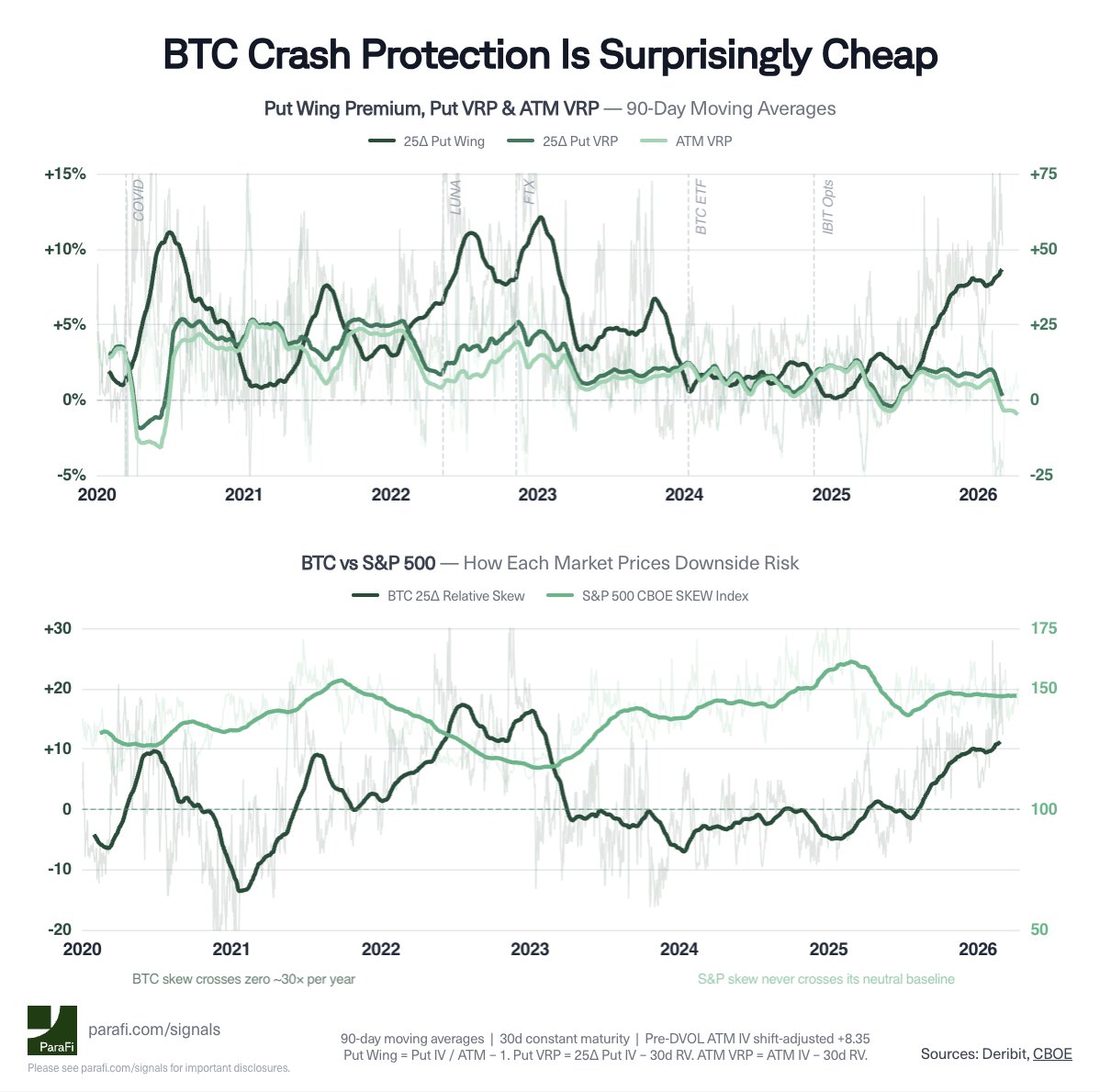
Why does BTC's crash protection appear cheap?
Despite multiple 50-80% drawdowns since 2020, BTC's 25-delta put wing, a standard measure of crash insurance cost, has averaged just ~5% above at-the-money (ATM) implied volatility (IV). On ~11% of all days, the premium disappears entirely. In 2024, that figure reached 29%.
One possible driver is persistent vol selling. Out-of-the-money (OTM) puts carry the richest IV on the surface, and Chart 1 shows that the 25δ put's vol risk premium consistently exceeds the ATM vol risk premium. That extra carry attracts systematic sellers, increasingly tied to ETF-related flows, whose supply compresses the put wing even as tail risk remains.
For context, Chart 2 shows S&P 500 crash protection virtually never gets this cheap, while BTC's skew crosses zero ~30 times per year.
From such low starting levels, it can be theorized that a major drawdown could trigger a meaningful repricing.