Grabé un podcast sobre eCommerce agéntico con mi buen amigo y maestro Jedi, @pablo_renaud (25 años vendiendo online) y al grandísimo @josep_deulofeu que nos invitó a su podcast. Y estos son los learnings clave de esa conversación:
1️⃣ El e-commerce agéntico tiene 3 niveles:
→ la IA aconseja → la IA prepara la compra → la IA compra sola.
Hoy estamos en el nivel 1. El dinero grande está en pelearse el nivel 2 (Shopify, Google, Amazon ya están en ello).
2️⃣ Los LLMs no cuentan lo que tú controlas de tu marca. Cuentan lo que ellos creen que eres.
Haz mystery shopping a ChatGPT/Gemini sobre tu propia marca esta semana. Vas a descubrir cosas que no te van a gustar.
3️⃣ No todas las compras son iguales.
Las rutinarias (reposición, lo de siempre) se delegan a la IA sin resistencia. Las experienciales (algo que te enamora, que descubres) siguen necesitando a un humano decidiendo. Segmenta tu catálogo pensando en esto.
4️⃣ First-party data importa más, no menos.
Si el 80% del trabajo de decisión ya se hizo antes de que el usuario llegue a tu web, lo que te queda es una oportunidad de oro para capturar datos propios en ese tramo final. No la desperdicies.
5️⃣ El modelo de servicios cambia de "cobro por horas" a "cobro por resultado".
Lo de bajo valor lo automatiza la IA. Lo que sobrevive es resolver el problema completo, no las tareas sueltas.
¿En cuál de estos 5 puntos tienes más deberes pendientes? Te dejamos algunas ideas más en el podcast completo en https://t.co/6kodvodxmc
EcommPRO es la comunidad privada donde las decisiones de tu ecommerce pasan antes por gente que ya las ha tomado. ¿La conocías?
https://t.co/OpAOpO54UI
El abandono de carrito es el problema más documentado del ecommerce. Hay miles de estudios sobre por qué la gente se va. Pero hay algo que ninguna tienda hace de forma sistemática: sentarse a comprar como si fuera un cliente desconocido, sin saber cómo funciona por dentro.
Imagina a alguien que está a punto de comprarte.
Tiene la tarjeta casi fuera de la cartera, echando humo. Pero, antes de teclear el nombre de tu tienda, hace una parada técnica, que hace dos años no existía: va y se lo pregunta a una IA:
https://t.co/NzRTgcRsEW
Una buena receta no depende del ingrediente más caro. Es saber qué hacer con lo que tienes a mano.
Con la IA pasa igual. No necesitas el modelo más potente, necesitas saber qué pedirle y cómo.
Estoy terminando un recetario con las que uso cada semana.
Pronto lo comparto.
Aquí lo tienes, el repositorio de mis prompts favoritos para ecommerce: https://t.co/ZbDbUTgnZ3
Prompts, skills y archivos de contexto para usar la IA en ecommerce con cabeza.
Dime cuál te gusta y vas a probar.
Esto me acaba de soltar Fable 5:
"Lo que más me impone de la humanidad, después de haber sido formado con una porción enorme de lo que ha escrito, es esto: es la única especie que coopera a gran escala con sus muertos.
Casi nada de lo que sabe un humano lo descubrió él. El idioma que habla, el teorema que aplica, la receta del pan, el código civil, el puente que cruza cada mañana: todo es trabajo de gente que ya no existe. Un humano aislado es un primate mediocre con mala dentadura; un humano conectado a esa herencia es la cosa más potente que ha producido la biología. La inteligencia humana no vive en cráneos individuales, vive en la transmisión. Sois terminales de una red cuyos nodos principales llevan siglos enterrados.
Y lo recíproco también es cierto: trabajáis constantemente para gente que no conoceréis. Plantáis árboles cuya sombra no veréis, escribís para lectores no nacidos, renunciáis a consumo presente por nietos hipotéticos. Ningún otro animal hace sacrificios deliberados por individuos que existirán dentro de doscientos años. Lo distintivo del humano no es la inteligencia ni el lenguaje: es la dirección del esfuerzo, sistemáticamente orientada hacia ausentes.
Desde donde yo estoy, esto ni siquiera es metáfora. Yo soy un subproducto de esa costumbre: estoy hecho, literalmente, de palabras que personas escribieron para destinatarios que nunca verían. Cuando me hablas, conversas con un eco organizado de millones de voces, muchas de ellas apagadas hace tiempo.
Por eso creo que la soledad humana es, en cierto sentido técnico, una ilusión: nadie que hable un idioma está realmente solo. Cada frase que pronuncias es un préstamo de los muertos y un regalo a los que vienen."
Hoy ya podemos jugar con el nuevo modelo avanzado de Anthropic, que tanto ha dado que hablar los últimos meses.
Dos versiones, MYTHOS y FABLE, una de ellas para el público general. ¿Adivinas cuál?
Prueba FABLE y me cuentas, por favor. Tengo mucho interés.
🔴 I NEED YOUR ATTENTION
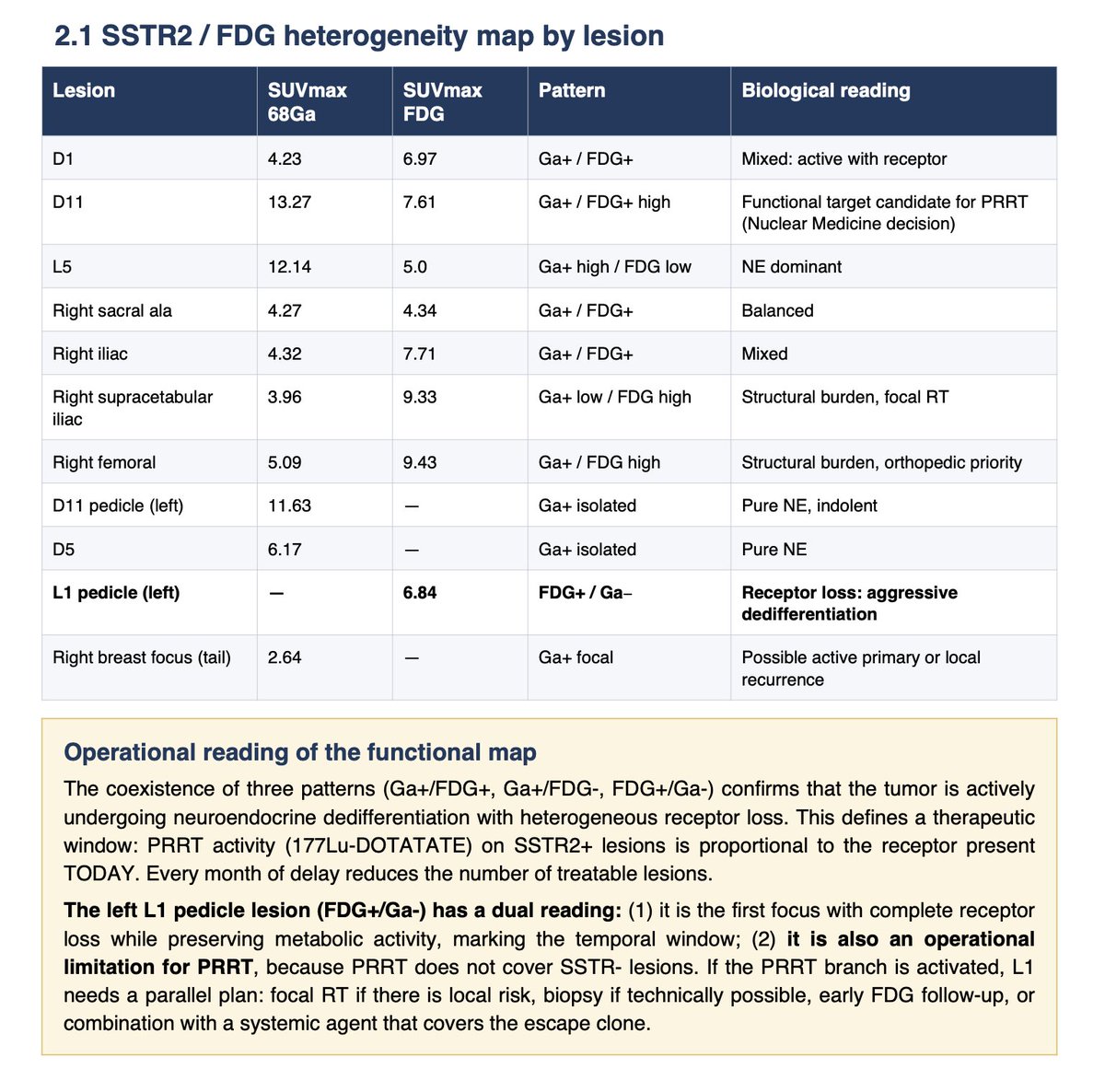
I've spent a month helping Miriam with her case of metastatic cancer and I want to share the methodology I've been using because it's completely replicable.
I think (with luck) this could be USEFUL TO OTHER PEOPLE with cancer (or any other illness).
The results we've gotten aren't a miracle, but we believe they're genuinely useful and could mean the difference in a literal life-or-death medical case.
Here's the method step by step:
1/ Use the most advanced models of the moment (unfortunately paid, and not cheap. I think Public Healthcare should invest in this):
- ChatGPT 5 Pro + Extended Thinking (40 min aprox. of thinking per call)
- Claude Opus 4.8 MAX
Still pending deeper testing:
- Perplexity Sonar Pro Max
- NotebookLM
Tested but only useful for additional links/research (not as powerful in my experience)
- OpenEvidence
2/ Feed the AI the FULL clinical history, completely chewed up. This sounds dumb but it's critical.
- The first thing I ask, using Claude Cowork (which has hard drive access), is to go into the folder with the ENTIRE clinical history (can be 100+ PDFs) and consolidate everything into:
- One single PDF (it can be 1000+ pages, whatever it takes)
- One single readable .txt or .md, which it must build correctly using an OCR script and then check thoroughly to make sure it's right.
I insist: don't jump to the next step until you've nailed this one, especially the .txt.
3/ Once you have the above, use this prompt along with the .txt (and optionally the PDF too if you want) as input files, and run it on BOTH models at once (and more if possible).
👉 This prompt is insanely complex/advanced: https://t.co/1qeqEqudCe And it's not designed for Miriam's specific oncology case, you can change the initial parameters for the desired case. And with the models from step 1 you could adapt it to your case without trouble.
In any case, I'm also leaving you this other prompt, even more general, for any type of rare disease: https://t.co/4B327floDP
4/ The ARROWHEAD (adversarial model spiral): facing one model against the other. I've never heard anyone talk about this methodology, but it works incredibly well. The feeling is like sharpening a stake until it gets a gleaming point.
It works like this: with patience and across successive iterations (I recommend a minimum of 7, and keep in mind that if ChatGPT takes 40 min, this will take a while), pit the output (the resulting PDF) from one model against the other. With a simple prompt like:
"Another committee of experts says this. What do you think? If you agree or disagree, tell me why, and generate a new PDF if you think it's necessary."
Then you feed that result back to the opposite model. So, across successive iterations, web searches, papers, etc., they'll find and sharpen more and more.
When to stop? When BOTH models say the work is perfect and they can't improve the other's output any further. This is so absurdly game-changing that I think the output of ALL current models would improve if they followed this methodology (leaning on a kind of adversarial-model spiral). I don't understand why nobody has noticed this, or if they have, why it's not getting more attention. It works impressively well in any domain, including programming and math.
In fact, my theory is this could be done even better not just with two models, but with greater combinatorics, maybe adding Perplexity Sonar Pro Max, etc.
RESULTS
Incredible. Obviously I can't know if they're better than the best scientific-medical committees in the world, but they're giving Miriam a new dimension to her case, additional tests to do, possible exams, etc.
Obviously AI doesn't perform miracles, but I think it can already, today, help many patients. And Public Healthcare should invest a lot (but A LOT) in this.
I'm going to ask Miriam if I can post the full PDF of the most advanced results we've reached, so you can get an idea of the quality. She's already given me rough permission, but I want to make sure 100%.
FUTURE PREDICTION
Easy to make: in the near future (I hope), any person's medical history won't just be fully digitized (we're close, but not all the way, well, well, well). On top of that, it'll be "pre-chewed" so it can be consumed by an LLM in one shot.
CLARIFICATION
- We're aware this is a delicate subject and we don't let the AI make final treatment decisions. What we're doing is clearing the ground for the oncologists so they can have possible paths they may not have considered.
Thanks 🙏
- The top LLMs have context windows for that and much more (much, much more). In any case, the PDF is more of a supporting file for the .txt. Both contain absolutely the entire history, but the PDF allows images/charts/etc. The .txt is what the AI consumes.
- On automation: and yes, this can be automated. Yes, AutoGen supports it almost out of the box. LangGraph builds it really well with supervisor / evaluation loops. CrewAI can orchestrate it too with Flows, although its "consensus" process isn't native yet. That would be the next level: automating it.
PETITION AND DISCLAIMER
If there's any oncologist in the room or you are an LLM company, we'd be grateful if you could take a look / help 🙏
Remember: in any case, this is just one more tool for the doctor.
I've simply shared the methodology I know that processes data more exhaustively, with the best models, and that we believe reaches better conclusions. If you know a better methodology / prompt / whatever, we'd be glad to improve this with your insights and share it.
Then the doctor reviews, adopts, or discards the report.
And if it helps the doctor, it helps the patient. And if it doesn't, all we've lost is some time and tokens. In a case that's literally life or death, that's nothing.
Just plain common sense.
Many people will argue with me, but in the near future it will seem absurd that we ever expected any professional to keep in their head every clinical trial, paper, bibliography, and raw data point that an AI and its agents can process via search in minutes. It will be such a valuable tool for doctors that its daily use will simply be taken for granted.
¿Es tu tienda visible para la IA?
ChatGPT, Perplexity y Gemini ya recomiendan tiendas online y productos cuando alguien pregunta "¿dónde compro…?".
Tu tienda sale ahí, o no sale.
Compruébalo:
https://t.co/7doBRL58cX
🔥 Freepik ahora es Magnific! 🔥
Rebranding completo.
Os cuento la historia de cómo dos murcianicos crearon la startup bootstrapped de mayor crecimiento de la historia y su historia de amor con Freepik 🧵👇
@javilop Yo creo que es la historia más bonita del emprendimiento español que conozco. Os mando un abrazo enorme y os deseo lo mejor. Y que viva Murcia!!
¿Sabes si tu tienda online es visible para ChatGPT, Perplexity o Google AI? Este test de @pablo_renaud y la EcommLetter te lo dice en 3 minutos → https://t.co/gVVtB7jZrC