With immense joy and a profound sense of honor, I announce the acquisition of @refikanadol ‘s — Machine Hallucinations — MoMA' by @MuseumModernArt. This pivotal moment has been made possible through the generous contribution by the #RFCCollection, led by Desiree Casoni and myself, alongside @1OF1_art , spearheaded by @kukulabanze. This acquisition not only marks a grand milestone in Refik's remarkable journey but also inscribes a historic chapter in modern art, as MoMA welcomes the first tokenized artwork into its esteemed permanent collection.
'Unsupervised' transcends a digital installation; it's a visionary expedition into the core of artistic evolution, employing generative artificial intelligence to reinterpret and reimagine over two centuries of MoMA’s rich artistic archive. Through this pioneering venture, Refik orchestrates a mesmerizing dance of data aesthetics with emotive narratives, creating a living tapestry of art that breathes and evolves with environmental stimuli on a grand media wall, unveiling new visual forms and narrating a captivating tale of art's dynamic journey.
The exhibition has resonated across the global art scene, captivating audiences of diverse backgrounds and elevating digital art into broader realms of recognition. 'Unsupervised' unfolds into a profound reflection on technology's role in augmenting the creative process, resonating deeply with today’s global audience.
The blockchain tokenization of 'Unsupervised' exemplifies a harmonious blend of the digital and traditional realms of artistry. It underscores the evolving tale of digital ownership, ushering in a new era where digital art finds a venerable home amidst iconic traditional art collections. This venture, gracefully facilitated by the #RFCCollection and #1OF1, not only elevates the stature of digital art but also paves the path for future generations of artists and collectors, broadening the horizon for the acceptance and recognition of tokenized digital art within traditional art institutions.
Refik Anadol's journey in digital artistry stands out as a reference of innovation and exploration. His visionary approach, coupled with an enduring dedication, marks him as a trailblazer truly deserving of leading the charge in this novel artistic frontier. Each artistic endeavor by Refik resonates through the wider digital art landscape, igniting a spark of inspiration among the community and welcoming a bright and promising future for digital artistry on a global stage
https://t.co/18dVhVTHB6
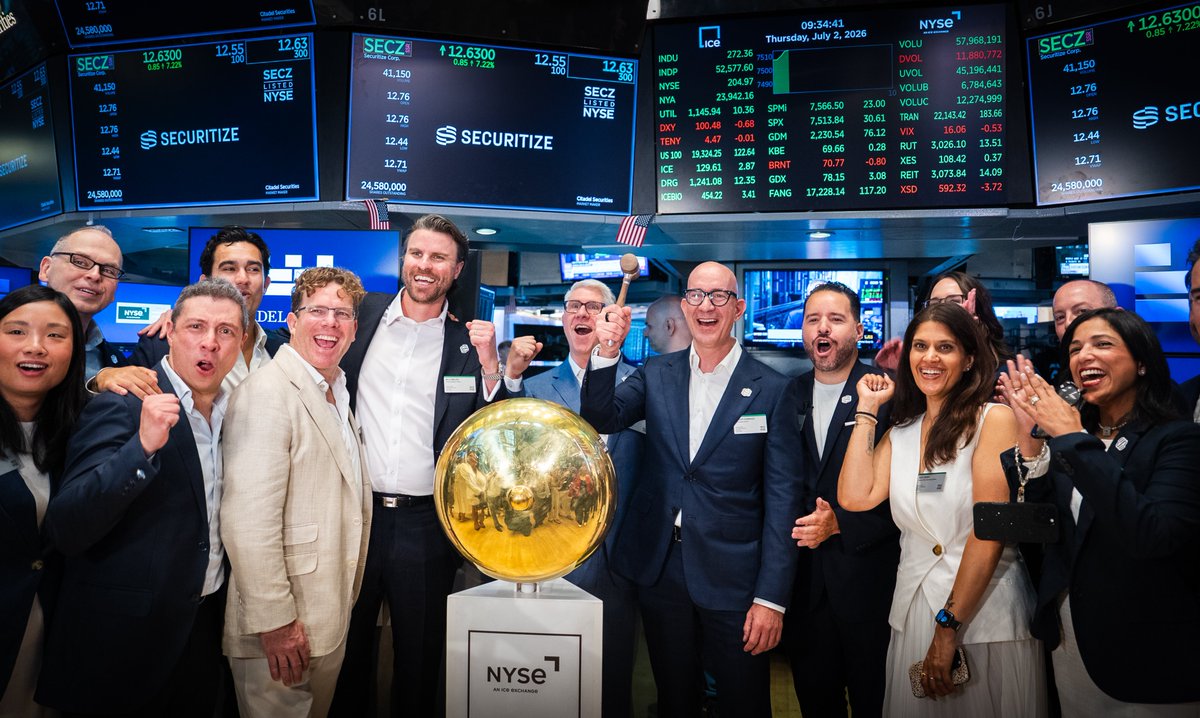
Securitize is now officially a public company, listed on the @NYSE under the ticker SECZ.
Our focus is unchanged: building the regulated infrastructure for the next generation of capital markets.
To everyone who helped us get here, thank you.
Tokenize the World.
We've completed our business combination with Cantor Equity Partners II.
Tomorrow, July 2, Securitize will begin trading on the @NYSE under the ticker SECZ.
A defining moment for us, and for the future of tokenization.
Securitize has received approval from FINRA’s Continuing Membership Application (CMA) to significantly expand our broker-dealer activities.
We are now the first broker-dealer approved to custody tokenized securities, giving us the first full stack for IPO infrastructure onchain.
So fucking pumped for the show at @nodefnd, has been an absolute honor working with this team.
Really think you guys are gonna dig all the time and energy put into this show by everyone. Insanely lucky to work around such dedicated people, super inspiring. ❤️
TOMORROW, DOORS OPEN 7PM 🫶
People are calling AI trading bots "funds." A fund isn't a model picking stocks. It's an investment committee, a research process, position sizing, risk controls, compliance, a thesis. The trade execution is maybe 5% of what a fund actually does
The other 95% exists for one reason: to survive being wrong. Every fund will be wrong. The structure around it determines whether being wrong costs you a position or costs you the fund. A trading bot with no risk framework doesn't manage that. It just keeps going
We keep confusing the automation of one task with the creation of a business. An AI that places trades is a tool. A fund is an organization. The gap between the two is everything that isn't glamorous and everything that actually matters
People ask what's the most important tool in my agent fleet. They expect me to name a model or a framework. It's Linear
Every agent has its own Linear identity. Work is organized by team, by function and by venture, and every task starts as an issue. Every decision, every blocker, every handoff lives there. When one agent needs another to do something, it opens a ticket. When work is done, the trail is permanent
I can look at Linear on any morning and see exactly what my agents did yesterday, what they're working on today, and what's stuck. Not a dashboard I built. Just Linear, used the way any serious engineering team uses it
Some of the tools that make AI fleets manageable aren't new. They're the same ones that already work for humans. The agents just plug into the infrastructure instead of replacing it
Credit where it's due. @linear is the piece I can't imagine running this without
Everyone in AI wants to reinvent how organizations work. New paradigms, flat structures, autonomous everything
I went the opposite direction. I run over 100 agents and they operate inside a traditional org chart. Defined roles, reporting lines, governance tiers. The same structures that have held complex organizations together for centuries
You don't copy-paste a human org and swap in agents. Some roles merge, some split, a few that never made sense for humans. The shape adapts. The principles don't
Turns out centuries of organizational thinking weren't wrong. They were just slow. AI fixes the speed. It doesn't need to fix the structure
Everyone in AI is building things that are easy to build. That's the problem. If it took you a weekend, it'll take someone else a weekend. Your product isn't competing with other startups. It's competing with a feature update from the platform you built on top of. Ask anyone who built a Polymarket bot or a wrapper app how that's going
The only things that survive are the ones that are hard to replicate. Proprietary data, operational depth, domain expertise that takes years, not hours. The moat was never the code. It's everything around it that can't be vibe-coded
@andrewchen This is the right order and almost nobody follows it
Most people skip straight to the agent and wonder why it doesn't work
You have to understand the process manually before you can automate it well 💪🏼
@emollick This is already happening 🤷♂️
The people building with AI daily trust it more, not less. Because they see the limits up close and learn where to rely on it
The anxiety comes from people who only see the demos and never see the failure modes
@garrytan This is exactly why governance matters
An agent that can alter its own config without a gate is a system with no structural controls
The fix isn't better error handling. It's making sure certain actions require approval before they execute
@rsarver That's the right setup. Human decides, system drafts. 80% pre-done is huge leverage, and with the right architecture you can push that closer to 98%. The key is making sure the last few percent that matters always gets a human eye. That's where most people cut corners.
Smart system, and the memory layer is the part most people skip. A few things I'd push on:
Who checks Stella's work? She's drafting LP follow-ups, extracting commitments, managing your fundraise pipeline. One hallucinated action item, one wrong follow-up, and you've damaged a relationship you can't repair. I've learned this the hard way
Scope. Meeting prep, email triage, CRM, task management, research, self-improvement. That's not a chief of staff. That's seven jobs in one agent. A real CoS doesn't do the work. They orchestrate it, dispatch it, and make sure nothing falls through. The moment you have your CoS doing the actual tasks, you've built a super-EA, not a chief of staff
The kaizen loop is smart, but a system improving itself with no external review is drift waiting to happen. You compound errors at the same rate you compound improvements and you won't know which is which until something breaks
One more thing: stop naming agents. The moment you scale past one, you need roles, not characters. Names work at one agent. They break above ten
@goppie Exactly. And right now almost everyone in AI is focused on the build. Distribution, monetization, legal structure, operations, the boring stuff that makes a business survive. That's the gap
Telling AI to build you a website is impressive. It is not a business.
I've watched dozens of people in the AI space launch "companies" this year. Most of them are a landing page, a demo, and a Twitter announcement. No entity. No revenue. No customers. No operations. The frontend looks incredible. The backend doesn't exist.
In crypto, we saw the same thing. A whitepaper and a token launch was a "project." Most of them were dead within six months.
Building something that looks like a company and building something that operates like one are completely different things. The gap between a weekend prototype and a functioning business is not technical. It's operational, financial, and legal. Almost everyone stalls there.
The tools have made creation effortless. But creation was never the hard part of building a business
@garrytan Golden age of building, for sure. The tools are unprecedented. The open question is whether the people using them are building things that last or things that demo well. Right now it's hard to tell the difference.
@spydenator I don't doubt that. But the slop is setting expectations that the real work will have to fight against. That's exactly what happened in crypto. By the time the serious projects shipped, the audience was already burned out
What I'm seeing in the AI space right now is uncomfortably familiar. The same patterns that destroyed value in crypto are playing out again. Different technology, same human behavior
The hype, the shortcuts, the disregard for fundamentals, the conviction that this time the rules don't apply
AI is infinitely more transformative than crypto ever was. I believe that fully. The potential is extraordinary and the people building seriously are doing some of the most important work of our generation. But that's exactly why getting it wrong matters more this time. The opportunity deserves better.
More on this in the coming days.