Before there was a nation, there was a declaration of truths.
Self-evident. Existing apart from structures of power or privilege.
250 years later, Palantir celebrates every American who carries the torch lit by our Founders.
And we build for all those to come.
God Bless America.
Palantir CEO Alex Karp on what customers actually want, the real business of frontier labs, and the importance of open source models:
“What the technical customers want is control over their compute, their models, their data stack, and their alpha. They want to know they own the means of production, and it's not being transferred to someone else.”
"Who owns the data? Are the prompts secure? Is this being transferred to you?"
"If it was so valuable, and I can make you a billion dollars, wouldn't I say I'll make you a billion dollars and I want 30%? Why are they charging for tokens if it's so valuable?"
Our thoughts on the importance of AI sovereignty.
1. Your AI sovereignty dictates your institution’s future. Sovereignty is the precondition for choice. Relinquishing sovereignty transfers the future choices of your institution to others, who are likely to exploit it for their gain and your loss.
2. Data retention is your treasure. Transfer it at your own peril. Your ability to win is dictated by your ability to recognize and use your unique edges, and you keep winning by compounding the underlying data to generate new insights. Transferring that data hands over access to your pre-existing winning plays and yields the means of production for new ones.
3. Tokenmaxxing hijacks your value orientation and decreases your institutional fortitude and intelligence. The pursuit of high token usage incentivizes disposable scripts over robust software — with the addictive feeling of false progress. There is a reason why those selling tokens refuse to charge based on value.
4. Controlling your weights is controlling your fate. Weights are the distilled form of hard-won, accumulated institutional knowledge. If you let others control your weights, you are allowing them to migrate the alpha of your business to theirs.
5. There is no contradiction between sovereignty and alpha. The architecture that maximally preserves sovereignty is one that enables institutions to own their tribal knowledge, and to compound it as alpha.
6. Politicizing the technical issues involving sovereignty is what your adversary wants. Techno-politicization is the wellspring of false sovereignty. Techno-politicization drives decisions that seem to reduce dependency, but ultimately limit agency — especially on the battlefield in the West.
7. Real expertise is existential. Allowing politics or favoritism to determine your technical decisions rewards whoever is best at politics, not whoever is right. Listen to those closest to the problems, not those speaking most compellingly about them.
8. Learn from institutions that are winning or that have consistently delivered. Institutions facing existential threats do not have the luxury of making technical decisions based on political preferences.
9. Only listen to institutions, countries, and people who have a proven record of being right. A track record of correctness is the best and only signal for future correctness. Judging something as right or wrong based on who you like is exceedingly misguided.
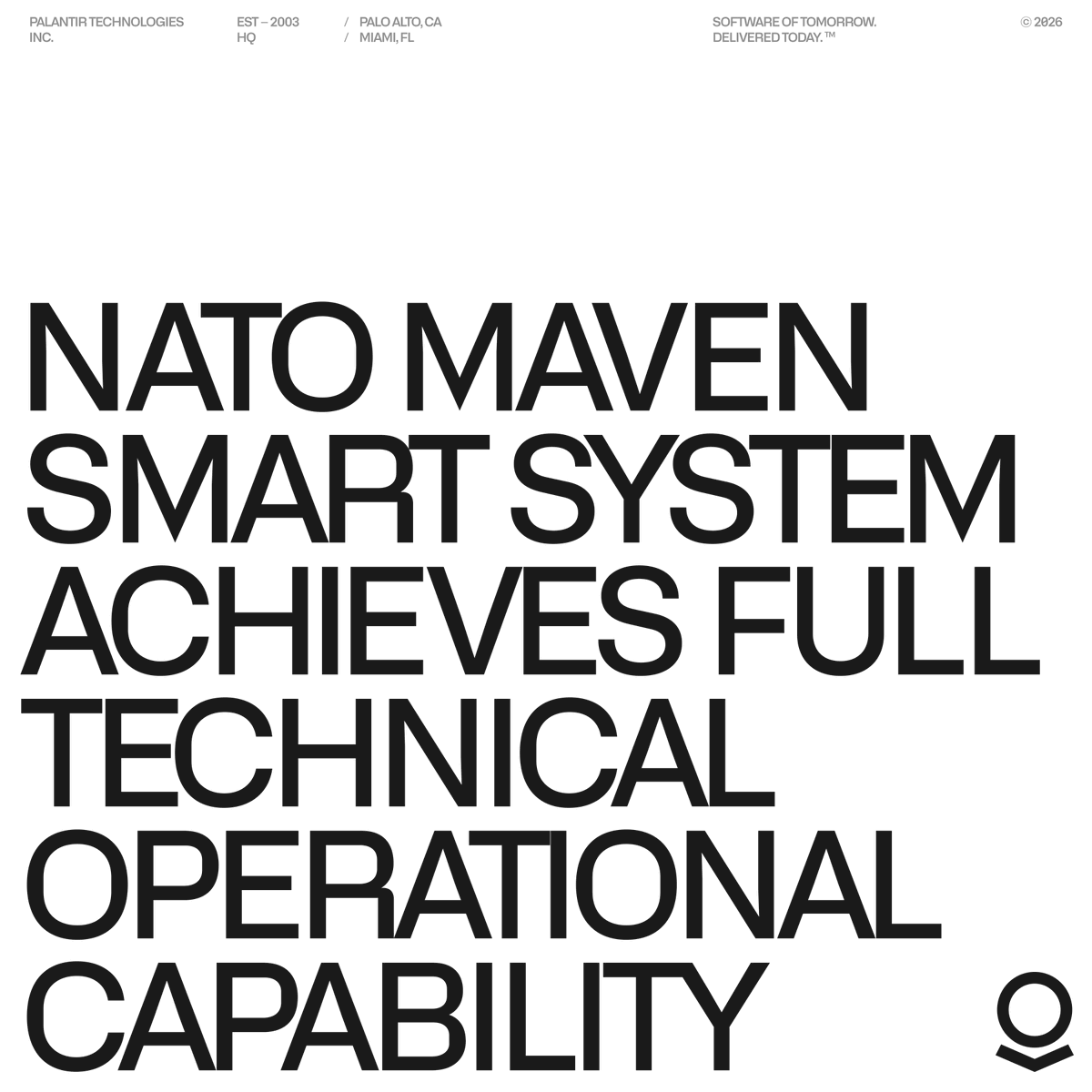
Full Technical Operational Capability achieved.
Accredited to operate on @NATO's classified network.
Proud to deliver a critical capability to the warfighter in service of a stronger Alliance.
https://t.co/9rMVZ4l0F8
Our thoughts on the importance of AI sovereignty.
1. Your AI sovereignty dictates your institution’s future. Sovereignty is the precondition for choice. Relinquishing sovereignty transfers the future choices of your institution to others, who are likely to exploit it for their gain and your loss.
2. Data retention is your treasure. Transfer it at your own peril. Your ability to win is dictated by your ability to recognize and use your unique edges, and you keep winning by compounding the underlying data to generate new insights. Transferring that data hands over access to your pre-existing winning plays and yields the means of production for new ones.
3. Tokenmaxxing hijacks your value orientation and decreases your institutional fortitude and intelligence. The pursuit of high token usage incentivizes disposable scripts over robust software — with the addictive feeling of false progress. There is a reason why those selling tokens refuse to charge based on value.
4. Controlling your weights is controlling your fate. Weights are the distilled form of hard-won, accumulated institutional knowledge. If you let others control your weights, you are allowing them to migrate the alpha of your business to theirs.
5. There is no contradiction between sovereignty and alpha. The architecture that maximally preserves sovereignty is one that enables institutions to own their tribal knowledge, and to compound it as alpha.
6. Politicizing the technical issues involving sovereignty is what your adversary wants. Techno-politicization is the wellspring of false sovereignty. Techno-politicization drives decisions that seem to reduce dependency, but ultimately limit agency — especially on the battlefield in the West.
7. Real expertise is existential. Allowing politics or favoritism to determine your technical decisions rewards whoever is best at politics, not whoever is right. Listen to those closest to the problems, not those speaking most compellingly about them.
8. Learn from institutions that are winning or that have consistently delivered. Institutions facing existential threats do not have the luxury of making technical decisions based on political preferences.
9. Only listen to institutions, countries, and people who have a proven record of being right. A track record of correctness is the best and only signal for future correctness. Judging something as right or wrong based on who you like is exceedingly misguided.
We're working with @PalantirTech to bring NVIDIA Nemotron open models into secure, air-gapped environments for U.S. government agencies and critical infrastructure operators.
The new engine lets teams train on their own data, run models on their own infrastructure and retain full model ownership.
Big news: Zeta Global and @PalantirTech announced a strategic partnership to build a unified data and AI infrastructure for the future of marketing.
By combining Palantir's AI infrastructure with Zeta's intelligent decisioning and trusted data, we're creating a new standard for data-driven, agentic marketing.
Palantir will support Zeta’s go-to-market efforts to bring this vision to eligible Palantir Foundry customers, helping enterprises connect operational intelligence, customer intelligence, and marketing execution on a unified foundation.
With Zeta's Data Cloud rearchitected on Palantir Foundry, Athena by Zeta™ will be able to draw on richer enterprise data and turn that intelligence into real-time decisions and measurable outcomes at enterprise scale.
As Athena becomes the operating system and infrastructure powering our customers' marketing technology stacks, this partnership creates a powerful foundation for the future of enterprise growth.
Read more: https://t.co/zCdGEKSS3T
Defend the enterprise.
Security Forge, our new cyber security offering for source code vulnerability detection that moves at machine speed.
See how Chad and George used it to autonomously scan a codebase, compress 109 flags down to 10 actionable findings, and do it for $78 — so security teams know exactly what to fix and why.
Factory to foxhole.
Mud to Moon.
Palantir is the Operating System of Reindustrialization.
Join us in Detroit @reindsummit to see how Palantir is giving American workers and warfighters an unfair advantage.
Palantir CEO Alex Karp on the false religion of frontier labs:
“Philosophically it's wrong because it's not doomer versus not-doomer; it's a hyper-religion of hyper-optimism.”
“They believe all problems — present, past, and future, including the ones they create and don't acknowledge they create — are going to be solved by them, including human nature and disparities.”
“Enterprises are just fed up because they know this doesn't actually work this way. It's not working. And that basically drives our commercial business.”