At Partisia Foundation, we work on the infrastructure behind that challenge.
We have applied this across humanitarian aid distribution, digital identity, healthcare data collaboration and verification networks.
Yusef Fanous will be attending the @UNDP Blockchain Advisory Group meeting in Paris.
If you are working through similar questions, connect with @Yusef_Fanous .
Post
Blockchain is a powerful technology.
As it develops, we are seeing more ways it can support public good in practical settings:
digital payments,
digital identity,
climate finance,
public service delivery.
But when these systems involve sensitive data, transparency alone is not enough.
They also need privacy, accountability and control over what is exposed.
In practice, the challenge shows up across digital identity, tokenisation, NGO workflows and research.
The hard part is rarely just moving data.
It is deciding what can be used, what can be proven, who can verify it, and what should remain protected.
At Partisia Foundation, we work on infrastructure for that layer: enabling data to be used, verified and coordinated without making exposure the default.
How do systems prove what needs to be proven without exposing more information than necessary?
That question matters for compliance, for users, organisations and institutions that still need privacy.
As finance, tokenisation and digital identity move into more serious adoption, it becomes harder to ignore.
@Yusef_Fanous , Chief Commercial Officer at Partisia Foundation, will be at @proofoftalk in Paris next week.
If this is the kind of challenge you are building, funding or exploring, let’s connect.
Useful event context:
Finance Magnates’ recap notes that the session explored tokenised assets and the infrastructure needed for broader retail and institutional adoption.
That included ownership, settlement, interoperability, operations, compliance, and APAC regulatory positioning.
🔗Source:
https://t.co/qxVrVb4FUR
On May, Partisia Foundation joined the Future of Finance Tokenisation panel at @F_M_events Singapore.
Leeny Luong joined David Jenkins @OMGroupAU, Justin Christopher @CalastoneLtd, Amos Song @DigiFTTech, and Christopher Forbes @CMCMarkets to discuss how tokenisation is evolving across financial markets.
One takeaway from the discussion:
Tokenised finance needs more than asset representation.
It needs secure coordination, confidential computation, and programmable trust.
This is why the timing matters.
The FCA and Bank of England are now framing tokenisation around wholesale market infrastructure, settlement instruments, tokenised collateral, and the move from pilots to production.
BIS has also explored how tokenisation can bring messaging, reconciliation, and asset transfer closer together.
So the deeper question becomes:
What architecture allows institutions to coordinate around tokenised markets with trust?
📌Sources:
🔗https://t.co/VDUTrGgwVk
🔗https://t.co/p4ExcTZO5Y
Tokenisation is moving from issuance to infrastructure readiness.
The question is no longer only whether financial assets can be tokenised.
It is whether tokenised markets can support ownership, settlement, interoperability, compliance, and institutional coordination at scale.
That is the real trust layer.
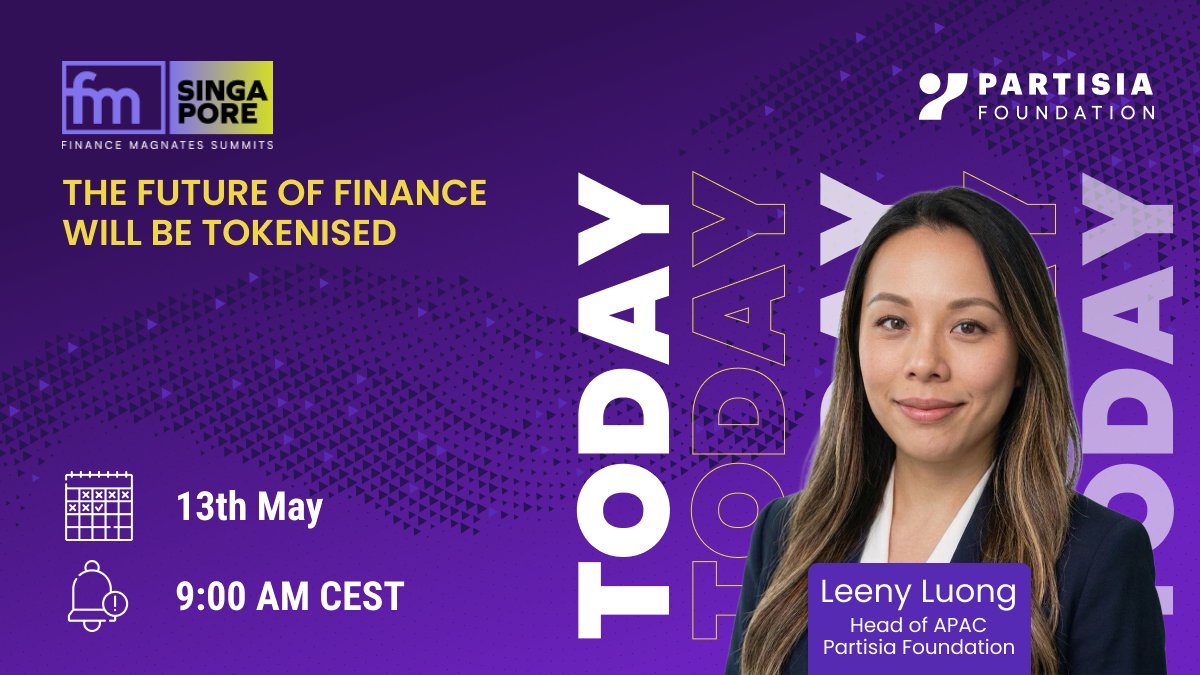
Today at @F_M_events Singapore:
As tokenisation matures, the infrastructure conversation is increasingly becoming about:
• secure coordination,
• confidential computation,
• and programmable trust.
Leeny Luong joins the Future of Finance Tokenisation panel alongside David Jenkins @OMGroupAU, Justin Christopher @CalastoneLtd, Amos Song @DigiFTTech, and Christopher Forbes @CMCMarkets.
📅13 May
⏲️3:00 PM SGT / 8:00 AM UK / 9:00 AM CEST
If you’re attending FM Singapore, don’t miss the discussion.
Tomorrow at @F_M_events Singapore:
Leeny Luong joins the Future of Finance Tokenisation panel alongside David Jenkins @OMGroupAU , Justin Christopher @CalastoneLtd , Amos Song @DigiFTTech , and Christopher Forbes @CMCMarkets .
📅13 May
⏲️3:00 PM SGT / 8:00 AM UK / 9:00 AM CEST
The discussion moves beyond token issuance into the harder infrastructure questions: confidential coordination, interoperability, compliance, and verifiable execution.
🔗Check out more at https://t.co/mSx7nCAYzg
The data rail is the half nobody is solving.
Encrypted storage keeps data out of plaintext. The computation on top is where the real risk sits and where MPC carries the weight. Agents that act on sensitive data without ever reading it is the standard worth building toward.
Good thread👍
The institutions that adopt privacy-preserving infrastructure first are not just safer.
They are the ones that enterprise clients, privacy-conscious partners and regulators choose over everyone else when the choice is available.
First mover in infrastructure is not a soft advantage, but a structural one.
Trust takes years to build, seconds to break and forever to repair.
That is the cost of a single breach.
The institutions that remove the possibility of that moment are not just safer, they are faster, cheaper and trusted with more volume.
Tokenisation isn’t the hard part anymore.
The harder question is how institutions coordinate around tokenised assets without exposing sensitive data, counterparties, strategies, or operational intelligence.
Institutional finance requires more than issuance infrastructure.
It requires programmable trust infrastructure.
That conversation is becoming impossible to ignore.
Leeny Luong from Partisia Foundation joins the Future of Finance Tokenisation panel @F_M_events.
📅13 May
⏲️3:00 PM SGT / 8:00 AM UK / 9:00 AM CEST
Trust takes years to build, seconds to break and forever to repair.
That is the cost of a single breach.
The institutions that remove the possibility of that moment are not just safer, they are faster, cheaper and trusted with more volume.
Add years of private messages, behavioural patterns and academic records and you have built one of the most complete profiles a person will ever generate, before they are old enough to consent to any of it.
Education data is often considered low risk.
That assumption deserves a second look.
- A student ID links to a name. - A name links to a school.
- A school links to a location, a schedule, a network of friends, parents, addresses and routines.
You cannot lose what you never held.
Most breach post-mortems tell the same story.
The liability did not arrive with the attacker. It was built into the decision to store in the first place.
Three breaches last week. Same mistake each time. They collected what they only needed to check, then kept it somewhere it did not belong.
Is this a pattern?
One week. Three institutions. One pattern.
France lost 18 million identity records. The Asian Football Confederation lost 150,000 passport scans. Microsoft tracked 35,000 compromised users across 26 countries.
Every single one happened because data was stored, not verified.
Passport scans do not expire. Biometric data cannot be reset like a password. Once it is out, the person it belongs to carries that exposure for life.
Institutions collect this data because the system demands it. Not because they want the liability.
The question worth asking on both sides is whether there is a better way to verify without becoming a target in the process.