1/5: Hot off the Print! Our article looks closely at how a group of major historians make the case for #Aurangzeb being a benevolent, tolerant ruler. Guess what? So much depends on ONE source, ONE guy! Who turns out to be a...ghost! https://t.co/3LNi5jItcj
@S88S76@RishiSunak Oh she’s English! Written in her stars to be so as early as 1757 (Battle of Plassey) and then again 1857 (Sepoy Mutiny). Written in my stars, too, though her’s is a success story while most others like me are muddled mutts still dealing with the mess-legacy you all left behind
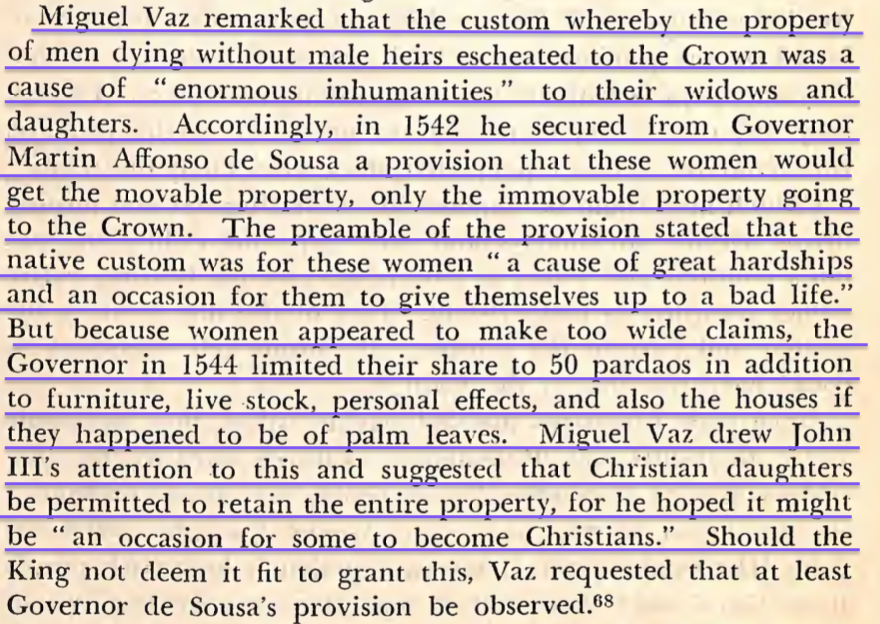
One of the unknown aspects of the brutal Portuguese rule over Goa, concerns its treatment of Hindu widows. Hindus are often lectured about how Christians saved Hindu widows from having to commit Sati. But the evidence shows the opposite - the overwhelming majority of Hindu widows in 16th c. Goa were not burnt at the altar, but instead desperately trying to survive cruel coercive tactics to convert by the Catholic Church.
Whenever the man of the house died in Hindu households, the system in colonial Goa was designed specifically to push Hindu widows and daughters towards conversion by tying survival to religion. When a man died without a male heir, almost all of his property went to the Crown. This left the women with very little to live on. At best, the Hindu widows & daughters were allowed only certain movable goods, and later even those were capped.
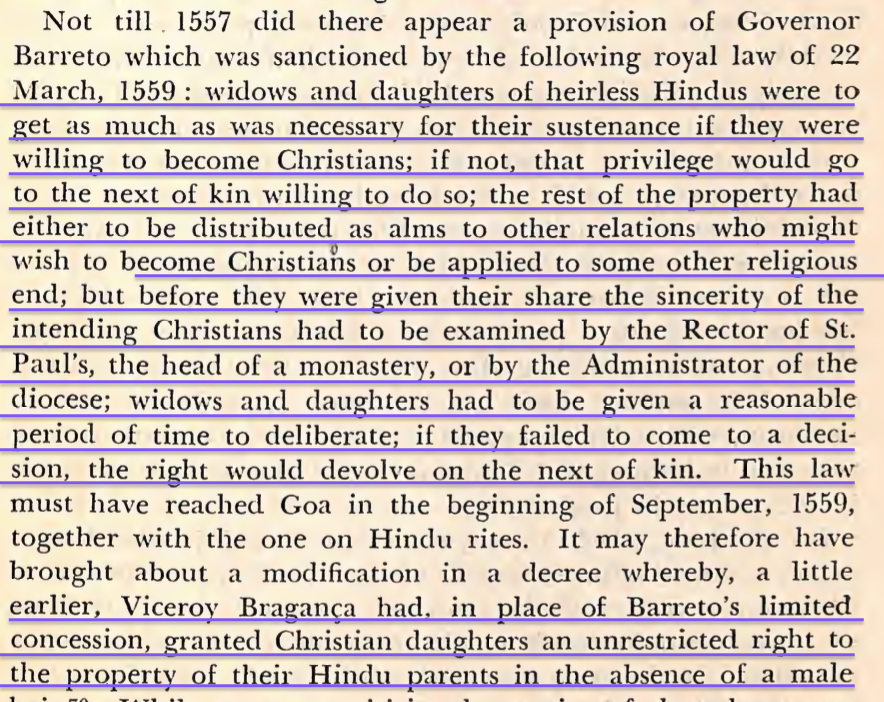
The result was immense hardship and poverty that kept them dependent. That hardship was then used deliberately by the Church. By 1559, the law made it clear that a Hindu widow or daughter could receive what she needed to survive ONLY if she agreed to convert and become Christian. If she refused, she lost her entire share in property, and it went to someone else in the family who was willing to convert and become a Christian!
Imagine how cruel and insidious this policy was - it directly linked food, shelter, and security to conversion. The choice was sneakily framed as a voluntary choice, but obviously in reality it was a choice for the widows/girls between converting or being kicked out on the streets with nothing to survive on.
The process was tightly controlled by the Church. So that even when a woman agreed to convert, she was forced to prove her “sincerity” to religious authorities. One can read between the lines and understand what kind of pressure that meant. The widows were completely vulnerable to sexual exploitation in their helpless condition.
There were waiting periods and reviews, but these did nothing to protect the woman - they only increased the pressure. If she hesitated or refused, she risked losing everything. The Hindu widows who hesitated were defamed as having loose character. Many were molested and violated to submit. This led some of them to turn to prostitution as a last resort to survive because they had no other choice. At the same time, greedy vultures who were ready to convert could easily usurp the woman's property, creating a sordid web of competition and urgency around conversion. If nobody in the family would convert then the property would be used by the Church towards Christian "religious ends"
In other words - this was one of the most oppressive forms of violent coercion through the system itself. The Christians didn't need to force conversion at sword-point because their law was doing all the work. By controlling the property and survival of Hindu widows and young daughters, the Catholic authorities ensured the women were left with no other choice.
And to think we are fed BS lies about how the noble Christians swooped in and rescued Hindu widows from Sati. In reality they were using the most predatory and murderous laws to snatch away their rightful property & forcing our vulnerable Hindu widows and daughters to convert to Christianity - just to survive.
@omarali50 WRT the video to which Truschke was responding: I was at a dinner recently where a well known white scholar was joking about getting s*icide vests out, hearing India’s PM might be visiting. I found it very offensive. Extremisms are common, but selectively theorised.
@MumukshuSavitri “… the meaning in the practice of suttee. Widows did not throw themselves on the burning raft out of grief. The burning raft was instead an accurate representation of the place to which their grief (not their families, not the community, not custom, their grief) had taken them.”
@MumukshuSavitri Takes an American like Joan Didion to really understand “suttee.” She has this very perceptive line in the book she writes on her own husband’s sudden death (year of magical thinking) which to me is spot on.
@eastdakota Y’all clearly don’t know Indian beyond tikka masala then! And when you do pay attention, it boggles the mind as it’s beyond any of your easy world frameworks. Also to be honest a number of non-white cuisines not anointed by the professional western world.
"Basant Panchami is not Hindu" thing...
In 2016 when I tried to tell people "South Asia" wasn't just an academic label but a paradigm, project & psy-op, the examples hadn't lined up hard enough to be noticed. It was a subtle thing, like Google Doodle here.
But now, as the Basant Panchami argument shows, this sort of erasure is everywhere and full-force. Indian Babu-Neta-IT Raita complex is hardly equipped to take on institutional mind-shifts on this scale.
Reality-shifts will follow, and few will object because worldviews have already been normalized. Ignore the absurd and the dishonest at your own peril. This is the m.o. of power in kali yuga. They can lie whatever they want into reality. Fighting it with whatsapp/X rebuttals isn't enough. Somebody better build the comms infrastructure. But who? Core problem of Hindu society. Sab ka not saath at all!
@ArtSivasri With all due respect-I’m not sure how the question is an epiphany :) The world as we know it can no longer tell good from bad because we’ve convinced ourselves there is good in bad and bad in good. One doesn’t need a 6th sense to restore clarity, one needs a sharper mind!
@_rakshitsharma@vikramsampath I meant to say that one should check for a list & scrutinise it—not for a moment taking for granted that it exists. Go to the sources! All these middlemen have not proven themselves as honest, truthful record keepers
1/5: Hot off the Print! Our article looks closely at how a group of major historians make the case for #Aurangzeb being a benevolent, tolerant ruler. Guess what? So much depends on ONE source, ONE guy! Who turns out to be a...ghost! https://t.co/3LNi5jItcj
@_rakshitsharma@vikramsampath Yes but what Farmans? He has to list them somewhere for them to be tracked and verified! The ones we did track led us to Jnan Chandra & as you see from this article were practically a dead end. If there’s an actual listing of the documents from puniyani or any other—let me know!
@_rakshitsharma Pandey’s work is very suspect as there are no proper citations that can be verified. He cites Jnan Chandra! See how circular it is? @vikramsampath is the only one to have done any serious critique, prior to us.
@SizweLo And why would you be wanting to highlight this “deficiency”..? The other great tragedy is when people from the global south apply to each other the half baked ideas produced by white folks. I could pick apart the 100 assumptions & inaccuracies in this video. Critical thinking :)
Brahmin as racist slur, Brahmin as bogeyman, Brahmanas as caretakers & custodians — all the old and new lives of caste & why we should be wary of the rhetoric. Read this—a moving essay.
Since FirstPost is usually hard to read with all the pop-ups and ads, here is a text version below:
Peter Navarro’s Jabs at Brahmins Won’t Help President Trump Make America Great Again
Vamsee Juluri & C. Raghothama Rao
"Jalajeṣṭanibhākāraṃ jagadīśapadāśrayam
jagatītalavikhyātaṃ jagannāthaguruṃ bhaje."
-Harikathāmruthasāra
We begin with a tribute to a Brahmin. His name at birth was Srinivasacharya. But history remembers him by the name Jagannatha Dasa (1728-1809); the name his guru adorned him with when he undertook a vow to dedicate his life to singing the glories of Vithala for, and with, the people. Today, the ninth day of the month of Bhadrapada, is observed as the day of his “Aradhana,” or adoration. His songs were sung then by thousands of devotees then, as they are now. His most famous literary work, the Harikathamruthasara, offers profound and yet practical guidelines for living in joy and adoration of Lord Vishnu. While most other Brahmin scholars and saints of his time wrote complex scholarly works, Jagannatha Dasa, along with Purandara Dasa and others, made such philosophical ideas not just meaningful, but a “lived reality” for the people of Vijayanagara and other regions of Bharat. That “lived reality” of course was not that the people were inferior, stupid, sinful, irredeemable, or otherwise “lowly,” but simply that all of them, every one of them was a “pratibimba” or reflection of that one absolutely resplendent, flawless, beautiful, and good and supremely divine entity.
It may be nice to also picture the wider global context of the time that Jagannatha Dasaru and his Brahmin contemporaries lived. An atlas of world history shows the world in 1763 (about halfway through his life) as dominated by two vast empires, both with a clear religious order to them. Sprawling across West Asia and North Africa and Eastern Europe is what the map calls the “Islamic economic area” centered around the Ottoman Empire. North and South America are colored pink, for Europe, newly reorganized from what had been a vast “Holy Roman Empire,” but busy with religious “differences” within Christians nonetheless. India is divided between the Mughal empire, the Marathas, Mysore and others. The map also indicates that the “Atlantic slave trade was at its peak.” And in the same century, even as the Haridasa singers spread in India, another kind of religious fervor was rising in Saudi Arabia, a school of thought that would be called Wahhabism.
Fast-forward to the present. The word “Brahmin” is bouncing off our eyes and ears from our phones and tablets and TV sets. Peter Novarro, the United States government’s trade counselor, accused Indian Prime Minister Narendra Modi of buying cheap oil from Russia in order to benefit “Brahmins” over ordinary Indians. While reasonable observers noticed that it was a rather provocative slur, some Indian politicians took the surprising view that Navarro’s comment was a mere difference in idiom, that he meant it in the manner of the phrase “Boston Brahmin,” connoting wealth generally, rather than a particular ethnic group.
Boston Brahmins vs. Blaming Brahmins
Navarro’s Brahmin comment needs to be seen not in some vague wider context of American idioms about Boston Brahmins (which in recent years was used only once prominently, when the Wall Street Journal called the Democrats’ college loans policies a “Brahmin” one), but simply in terms of his own messaging. The escalation of his tweets into both tastelessness, and truth-lessness, have been stunning. Navarro entered something like what Democrats might call “Birther” territory by labelling the Russia-Ukraine conflict as “Modi’s war.” This was the first shift in terrain, moving the goalpost not just from a dispute about reciprocal tariffs (as Trump’s earlier comments in the year used to sound like) to a contrived causal claim about how Modi is responsible for American taxpayers having to fund Zelensky (a few days ago an American guest on Republic TV was even more forthright on this new party line; he essentially shouted that India had Ukrainian blood on its hands).
After the leap in logic and causal tenability, Navarro then brought in an outrightly Hinduphobic element to his diatribes; in a tweet accusing India of “madness,” he used a striking color photograph of Prime Minister Modi wearing religious markings and meditating. Navarro (or his team) could have just as easily built on their earlier narrative about India-Russia culpability (however flawed that claim), by using a picture of Modi and Putin, for example. But the fact that such a dramatically Hindu-themed photograph was used, with a “dot” on the Prime Minister’s brow at that, has to be noted. The “Brahmin” invocation therefore isn’t just about inequality, or India, or trade, or Russia. It is a Hinduphobic trope, and Hinduphobia is racism.
And as international propaganda, it is deeply effective. Most Americans know very little about Prime Minister Modi. College students often assume he is from the wealthy, oppressive Brahmin-caste (a natural assumption for them, considering the newspapers call him a religious nationalist). Novarro is messaging insultingly, but also strictly in concordance with the usual foreign intervention playbooks, making a distinction between the "people" and the elites (in this case, the "Brahmins"). This kind of rhetoric stoking class, race, and religious resentments all at once, is something they seem to believe will not have pushback.
All Animals are Equal, Until...
There is understandable anger in India about the seeming betrayal by President Trump, who, after all, received some of the warmest welcomes any foreign leader has ever seen in India. That warmth was of course dismissed by critics as simply bonding over Islamophobia by Trump and Modi supporters, but it was perhaps more complex. Even in the 2016 elections, the Indian American vote was overwhelmingly pro-Democrat. If it shifted somewhat by 2024, some of it may well have been because of the overtly pro-India and pro-Hindu messaging made by Trump, and the brazenly discriminatory profiling in rhetoric and policies advanced by some of the Democrats around speciously argued “anti-caste” laws like SB403 in California. In any case, just like the bewildered animals in the last scene of George Orwell’s Animal Farm, Hindus are probably looking at Republicans demonizing Brahmins and Democrats demonizing Brahmins and wondering if they can even tell who is who any more.
Regardless of who wins or loses elections in America, the “Brahmin” as a bogeyman seems destined to remain, for now. The reasons for why a lie should remain for so long though remains a fascinating one.
Inequality, discrimination, oppression, violence, greed, all of these exist in the world. But anyone sincere about fighting these would get to a truthful account of how these play out, and not hide behind diversions and distractions. Unfortunately, whether it is politicians in India or America, they all know that truth, about Brahmins, about sanatana dharma, or just truth, will force them to address the real issues. So, to the scapegoat they turn; Brahmins, Hindus, and as they often used to in Europe, Jews.
Like the famous meme which shows a British colonial office telling a native massaging his feet that the other native fanning him is the “Aryan invader,” the rich and powerful of this world, whatever their hue, will find a motherlode of distractions and lies to find in the figure of the Brahmin.
From New World Order to New World Truth Order
But the big picture to look forward to beyond the present testiness between India and America is this. Whether we realize or not, we are moving into a new world order. In the 1990s, after the fall of the USSR, they called it NWO. Just another “NWO” would not mean much. But an NWTO, a New World Truth Order, that should be the goal of India’s push now.
India has the oldest unbroken cultural memory alive left in the world today, and there is no surprise in why countries like Japan and China and others in Southeast Asia and elsewhere gravitate at least at the level of the heart towards us. They are “oldies” too. The other “oldies,” centered out of the Middle East, have much to sort out. The oldest of them sees us as friends, but old as we both are, and bashed as we both are, the differences are complex.
The US meanwhile is divided between competing visions of its future and past; the Dems and the “Wokes” saw their own past as pure racist evil and wanted to flee from it into a utopian-equality future heroically heralded by the likes of Hamas. The Reps and the “MAGAS” on the other hand, for all their talk of enlightened post-racist conservative values, meritocracy, and legal immigration, turned on the one group they saw as an even bigger rival to them than anyone else, though it was perhaps the one group which was trying hardest to stay legal, respectful, and fit in. The Great-Againers looked to their past to shape their future, and somehow found it was not the Crusades and the “Saracens” they had to fight now but their own primal myth-battle itself; their war against the Roman Empire with its priests and “Pagans.”
Everyone has to deal with the lies they were fed now. Including India.
It is indeed strange that the central trope in that system of lies which is becoming exposed again and again is that of the Brahmin.
Neither America, with its “Red-Green-MAGA” madness, nor Europe, nor West Asia, nor the rest of the world, can get over its interrupted (and incepted) memory problem without India.
There can be no new world truth order without India.
There can be no India without the truth about sanatana dharma.
And there can be no sanatana dharma without truth about the Brahmanas.
From 16th century colonial missionaries to 21st century free trade evangelists, there must be a reason why everyone who wants to come to rob us settles on the same bogeyman isn’t it?
If you admire your ancestors for resisting a thousand years of colonialism and bestowing you with the freedom to own your own name and gods, take a lesson. They were not fools. There had to have been reasons for why they did not reject the gods, or the community that was charged by the rest of society with the greatest honor and most rigorous responsibility for the safekeeping – and dissemination - of knowledge of the gods. As for our knowledge of humans, the following verse from a kirtana in Kannada by Pranesha Dasa, a disciple of Jagannatha Dasa, tells us quite a lot about the realities of the supposed wealth and privilege of Brahmanas in late 1700s Indian society:
Beegara utike bhogavu
Jolavu ogara braahmanareleyolu
Khammane thuppa thammaniyavarige
Khammatu thuppa devabraahmanarige.
The people are feasting upon lavish food
While serving devas and brahmanas
With just maize and foul-smelling ghee.
***
@aravind@Prodipchakrab11 Yet at some point began an ice trade from Boston to the east coast of india—madras, Calcutta! Colonialism undermined, capitalist commerce killed native intelligence & ingenuity. The latter is still happening TBH—we are doing it to ourselves.
Powerful new piece out in The Print in which @paticheri, Prof at U of Houston, Manish Maheshwari & Keshav, Prof of CS at UT Austin strike at the foundations of the shoddy scholarship that allows for a convenient, even if fraudulent, recasting of Aurangzeb's legacy.
What's new & remarkable?
1. The entire case that modern academia makes on Aurangzeb's supposed liberalism rests on - hold your breath - "evidence" from the most neutral of institutions - the Pakistan Historical Society🤣
2. The society's Journal, which published this "evidence", had as its editor, someone who was a self-declared Aurangzeb fan-boy.
3. It gets even crazier. The Journal pushed its articles out via a Yeti-type figure who conveniently goes by the not-muslim name of "Jnan Chandra, Bombay" - who did not exist prior to these articles, and does not exist after they're published. There’s literally no record of this guy anywhere.
4. Magically, the leading academics in the world on Aurangzeb have no qualms about this vital “phony source" problem that would likely be apparent to 8th-graders.
5. A key article on Aurangzeb's supposed patronage of Hindu temples does not in fact even mention temples. Is this scholarship or hagiography?
6. Jnan Chandra's two crucial “articles” that try to paint Aurangzeb as a patron of Hindu temples “contain not a single verifiable instance of a new grant issued by him for the construction or maintenance of a Hindu temple.” (authors).
@ARanganathan72