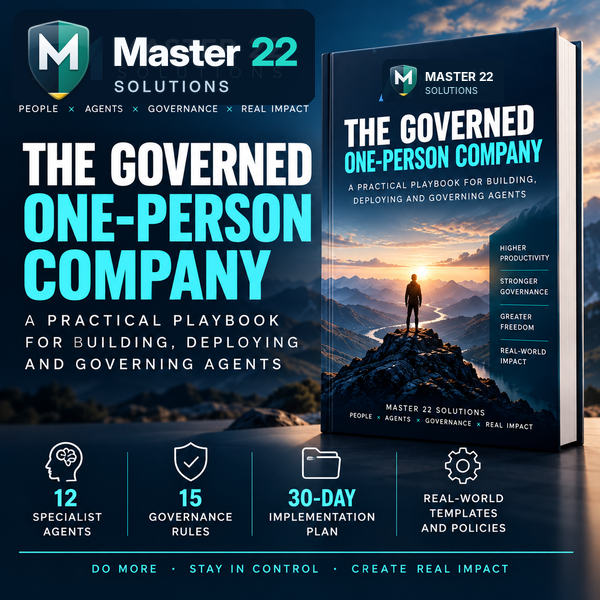
I run a SaaS suite, a plugin business, a charity and an animal sanctuary. One person, twelve AI agents.
The agents aren't the hard part. Keeping them from emailing the wrong people or spending money I didn't approve is.
I'm giving away one complete agent blueprint and the 15 rules every agent lives under. Free, 8 pages:
https://t.co/WPwTJuTqY0
@Cantarlella Trust issues usually protect an old wound before they become a pattern. Notice what your body flags, then test people slowly through consistent actions. Numbers can be a lens, not a verdict. I built NumeroWellness for that reflection: https://t.co/q6Up19tSIb
@kavindya_T So true. Regulation is not one-size-fits-all: some children find calm through movement, rhythm, or play before stillness is possible. Follow the child, not the method. I built Kids Intuition Lab around that: https://t.co/tyv9r4XOYG
@IEMillionKids Exactly. Kids need a calm channel to tell us early, plus simple rules: no secret chats, no private images, and block/report pressure. Safety works best as trust plus tools, not fear. I built AngelGuard AI for this: https://t.co/dBIPO5H2bs
Most AI coding goes wrong in the same place: you ask for code before the idea has been tested.
Google engineers just open-sourced a fix called the Elephant-Goldfish Model. It works in two roles:
The Elephant is your main AI session. It holds the full context and helps you write the design doc.
The Goldfish is a fresh AI session with zero memory. It only sees the finished doc. If it can't understand the plan or poke holes in it, the plan isn't ready.
Code only gets written after the design survives that review.
This is the same principle behind ClawMaven: AI agents do better work when there is a clear contract, independent review, and a human making the final call. Speed without guardrails just means you produce mistakes faster.
Our take after running a one-person company on governed agents:
•Always restart a crashed session from the written spec, never from the messy chat
•Write down the ideas you rejected, or the next session will suggest them again
•Save the full review for big features. Small changes just need a quick check
Repo: https://t.co/RL4mSt2e1R
How do you review AI-written code before it ships?
#AIGovernance #AIAgents #ClaudeCode #SoftwareEngineering #ClawMaven
Most developers start an AI session by begging for code, then spend hours babysitting broken outputs.
Google's Elephant Goldfish Model flips that order completely: you only unlock coding in Phase 3 after your design survives 2 rounds of strict scrutiny.
The framework splits your AI workflow into 2 opposing roles:
> The Elephant: Built on the saying that an elephant never forgets, this is your heavily prompted, context rich session and the Design Doc it helps write, holding all institutional knowledge, debates, and micro decisions.
> The Goldfish: A brand new AI session with 0 memory that only sees the finished document placed right in front of it.
The golden rule is simple: feed the Elephant, then test it against the Goldfish.
After covering Phase 1 on growing the Elephant (https://t.co/RJ00aWEVuY) and Phase 2 on testing against the Goldfish (https://t.co/XJSOTDnaYL), here is how Phase 3 finally turns your blueprint into production code:
8. Coding with Guardrails
Now, and only now, do you write code. You hand the finalized Design Doc to the AI and command it to follow the plan exactly.
Because every target file and change is explicitly listed, the AI writes much cleaner code, and if the session ever crashes or spins out, you just open a fresh tab, hand it the spec, and get back in business in 30 seconds.
9. The "Mean" Code Review
When the code is finished, feed it back to the AI and tell it you strongly suspect the code is poor quality, asking it to tear the implementation to shreds and tell you all the ways it sucks.
Force it to flag any stretch of 10 lines lacking a comment, and repeat the loop until its critiques shrink to trivial nitpicks.
When your written spec explicitly maps out every file and design decision, raw code stops being fragile guesswork and becomes a reproducible byproduct.
When an AI coding session crashes or spirals halfway through a feature, do you try to rescue the messy chat history or restart from a written spec, and how harsh are your prompts when making AI review its own code?
Solid list. The category and attribute gap audit alone is worth it for most local businesses. One thing I’d add: the map pack isn’t the only shelf anymore. More people are asking ChatGPT and Grok “best plumber near me”, and the businesses that get named there are the ones with clean schema and consistent entity data, so prompt 18 should be week 1, not week 10.
@DylanOlivaGrows Worth claiming, but those discovery topics only come from chats where your website gets cited. The profile fixes your hours and prices. Your own pages still decide whether ChatGPT quotes you at all.
ClawMaven Spend Desk on NEAR: an AI agent that pays without holding the keys
Built at NEAR HACKATHON: ClawMaven Spend Desk.
An AI agent pays contractors from a NEAR treasury contract, but never holds the keys. Its key can only call payout. Caps, a payee allowlist and an audit log live on-chain, and the owner has a kill switch.
Testnet demo below.
@NEARProtocol #NEARHackathon
Code: https://t.co/H080pszrfX
Built by Paul Rodney Turner, Master 22 Solutions.
@harden_369741@GogaKoreli Same lesson here. A fetch is not a visit. I now tag requests by type first (HTML page, XML, robots, feeds) and only count rendered pages in views. Everything else goes in its own crawler bucket, which turned out to be the more interesting chart anyway.
@alexwolk1 Thanks Alex. Customers describe the problem better than any keyword tool. "Boiler repair in Chía" is how a real person asks, so that's what the AI repeats back.
Ahrefs asked five AI tools the same questions every day for 20 days. Half the sites Google AI Overviews cited on day one were gone the next day. And about 75% of the ones that dropped out came back before the study ended.
So a screenshot showing you're cited in ChatGPT proves nothing, and neither does vanishing for a day. Ahrefs suggests counting how many of the last 7 days you were cited. That's the number worth tracking.
https://t.co/kMdyHkLSQK
@Botconduct@harden_369741 Interesting offer. How do you verify the agents? Just by user agent, or do you check IPs and reverse DNS too? A lot of what calls itself a known bot isn't.
@AIGrowthCo Agreed, the data is there. The forethought part is the hard bit: deciding what counts as a real visit before you build the dashboard, not after. Thanks for the follow Kerry.
Reddit says search referrals dropped by more than 1 million a week in October, and Huffman put most of it on Google's AI Overviews and AI Mode. "The reality is, AI Mode does not drive traffic."
If Reddit can't hold its Google clicks, a small business site won't either. Your name has to show up in the AI's answer now, because fewer people click past it.
https://t.co/zvwTV0Ud1r
Fix the source, not the AI. Put clear plain-language facts on your own site (about page, FAQ, services, location), add schema and an llms.txt, and make sure your listings elsewhere say the same thing. Then re-ask the same questions every few weeks. The models catch up once the web agrees with itself.
@GogaKoreli@harden_369741 True. A 200 on sitemap.xml tells you a bot came by, not that anyone read anything. Good write-up on the headers, bookmarking it. Are you seeing AI agents identify themselves honestly, or are most of them hiding behind normal browser user agents?