I've read thirty companies' positioning from the outside in.
No NDAs, no inside access, no client engagements. Just their words against the market's words, and the gap between them.
After thirty of these, the pattern is clear enough to name.
Almost every company falls into one of three structural failures.
Failure one.
The company owns a noun that the customer can already feel, and refuses to claim it. Cloudflare. 37signals. PC Financial. The proof has been accumulating for a decade. The marketing keeps describing a different word.
Failure two.
The company claims a noun the experience hasn't earned. Notion's all-in-one. OpenAI's AGI. Rate dot com's everything-at-once. The deck got ahead of the product. The customer feels the gap before they can name it.
Failure three.
The company knows what it owns, then makes the position optional. Bumble removed the filter that built it. Glossier started explaining the thing that was working in silence. Wealthsimple wanted to outgrow the door it had earned. The position survives in the early customers. It dies in the late ones.
None of these are marketing problems. They're operating problems that show up in the marketing last.
The thirty reads are now organized in one place. Each one is a single company, the same method, the same diagnostic question. What is the noun this company actually owns, and what is it costing them not to say it.
If you run a company, brand, or product, the report closest to your structural problem is probably not the one closest to your industry.
The full list, sorted by failure mode yours to enjoy.
https://t.co/1a5rExzRng
Everyone on this platform is shouting the same three words: awareness, clarity, articulate a clear idea.
It's the exact opposite of what wins the work.
The advice is: be more visible, be more legible, plant your flag on an idea and repeat it until it sticks. Get into the consideration set. Be known.
All of that is real.
None of it is the thing.
You can skip all of it.
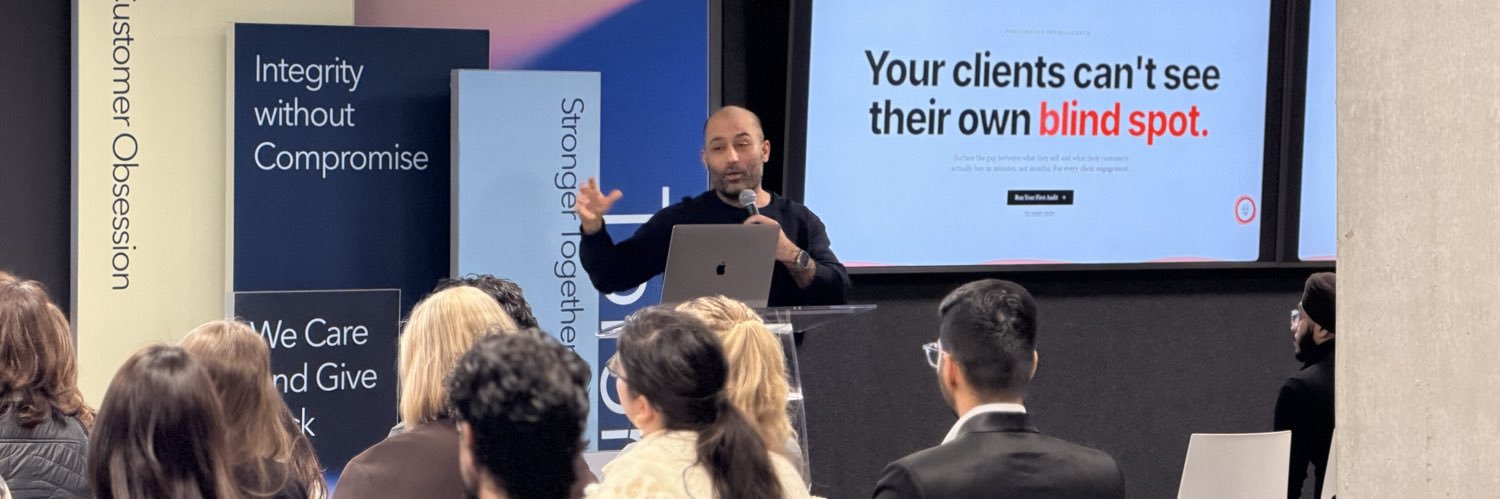
Clients don't buy because they understand you. They buy when you understand their problem better than they do, and differently from how they've been thinking about it.
Sit with the difference.
"Understand me" puts you at the center.
"I understand your problem" puts them at the center, which is the only chair the buyer is actually sitting in.
Here's the part most people get wrong, including the version of me from a few years ago.
It's not enough to make the buyer feel understood. The feeling is cheap. A warm seller, a flattering discovery call, an empath with a deck can manufacture the feeling of being understood without understanding anything at all.
So the lever was never the feeling.
It's the demonstration.
Show the buyer you grasp their specific problem in writing before they've paid you a dollar, and the feeling takes care of itself because it's earned rather than performed.
This breaks the rule everyone repeats: earn credibility first, then get the meeting, then win the work. It says a nobody can't sell to a somebody.
Wrong.
A point of view on their actual problem, sent cold, is the one asset you can build on a Tuesday with no brand, no case studies, and no network. It's the only kind of proof that exists before the claim.
Awareness gets you known.
Demonstration gets you in.
I'm writing the full argument in the upcoming newsletter: why understanding loses to the famous firm in some rooms and beats it in others, how to pry open a committee, and the one belief on which the whole thing rests.
Subscribe here, and you'll get it the moment it lands on 30th June 2026
https://t.co/sKhhvpc4wL
three years of content. nothing new in any of it. actions speak louder than words. i've just said it five million ways. the people with the same machine keep skipping the part where you find out it's already true.
Everyone has AI now, and somehow the thoughts got worse.
Most content I read has me wondering: did this person think at all about what they slopped together? Did they even ask the internet once where this problem has already occurred, who solved it, and what they ran into while doing it?
The answer is a resounding no.
In the absence of understanding, people invent delusional new terms for things that were solved a million times over. Things that are battle-tested. Market-proven. Boring. Old.
Old is where it's at.
Once you actually know the old ideas, the ones that survived, you get to build from a foundation that holds weight. You can find the blind spots. The gaps. The places where what was true stopped being true. That's the work worth doing.
But you can't revise reality if you never started from it.
That's the part the AI didn't fix. It gave everyone a faster way to skip the only step that mattered: knowing what already exists before declaring yourself original.
I'll go further, at my own expense.
In three years of content, I have produced nothing new. Nothing revolutionary. It's the same old boring truth, dressed five million different ways:
Actions speak louder than words.
That's it. That's the whole catalogue. I've just had to keep saying it because the market keeps forgetting it the moment a new tool makes forgetting feel like progress.
The tool was never the bottleneck.
The thinking was.
So here's the uncomfortable question now that everyone has the same machine:
What happened to independent thought?
LOL.
I wrote about the part of building with AI that has nothing to do with the tools. https://t.co/A9I1gtNFQ5
"If you don't talk about it, it doesn't exist."
That belief is why most companies are paying to advertise a gap.
I hear it constantly. Do something great, spend money telling people, and wait. Stay quiet, and you vanish. It sounds obviously true. Nobody buys what they have never heard of.
So the work becomes the words. Hire the agency. Tighten the value prop. Buy the ads. Say the thing louder.
Here is what that belief misses.
Talking about a position and owning one are two different jobs.
Communication makes a position known.
Capital allocation makes it true.
You need both, and most people try to swap one for the other.
There are four levels to this.
You say it.
You prove it.
You live it.
You own it.
Most companies are stuck on level one, polishing language, while believing they are working on their position. They are decorating a claim they never funded.
That is glitter.
The companies that own mental territory build the other three levels with capital, the costly, structural decisions a competitor cannot copy in a quarter.
That is gravity.
Think about what a customer actually does. They do not audit your messaging. They feel the result. The price. The wait. The way the product behaves years later. They never need to know how you built it. They need to feel it is real.
So the belief has it backwards. If you did not fund it, talking louder will not save you. And if you did fund it, the proof speaks before you do.
Try this. Pull your last ten real decisions. Who you hired. What you funded. What you killed. Where you expanded. What you bought. Lay them next to the one concept you claim to own.
Point them all at the same thing, and you have a position.
Communication just makes it louder.
Point them in ten directions and no campaign fixes that. You do not have a positioning problem. You have a proof problem, and proof is bought with capital, not copy.
Your budget is already telling the market what you stand for. The only open question is whether you wrote that message on purpose.
Your P&L is the only positioning statement that counts.
Most positioning advice has the order backwards.
People scan the category, find what buyers already reward, pick an open lane, and call that positioning.
It is not. It is shopping.
The confusion stacks three different problems into one map.
Category demand is one map. It tells you what the market rewards today. Availability, distribution, salience. Laws of buying.
Mental ownership is a different map. It tells you what concept a company has become inseparable from over time. Association, identity, gravity. Laws of mind.
Awareness is a third thing. An unknown company has no free associations. It has zero associations. Open is not owned.
If you only pick concepts the category already weights, you are not positioning. You are building a better version of what already exists.
That is framing.
The companies that own a concept did not find a category that already paid for it. They acted like the concept for years, and the category bent toward them.
Activism in outdoor gear.
Safety in automotive.
Convenience in retail.
None of these were validated lanes when the work started. They became lanes because someone paid the price to own them.
So here is the order.
Decide what concept you want to become inseparable from. Build everything to prove it, including the things you will say no to. The proof is what you sacrifice, not what you say.
The risk of picking a concept and not paying the price is real. But that is an execution failure, not a positioning flaw.
Positioning chooses the concept.
Execution earns the ownership.
Framing comes last.
Most people do these in the wrong order.
I keep watching people position things from the wrong end, and it took me a while to see why it bothered me.
They start with the words. What should we say? What word do we want to own? I understand the pull. Words are the part you can argue about in a room and walk out feeling like you did something. I’ve sat in those rooms, and for a long time (in my early years) I thought that was the work.
The longer I look at companies that came to mean something, the less I believe a position is written at all.
https://t.co/PUr58PH9JW