#Bitcoin is the most significant breakthrough in "money technology" since the invention of coinage 2500 years ago. BTC is native digital scarcity, exchangable P2P, free of middlemen, permissionless, censorship-resistant, programmable, unseizable, unstoppable, and inevitable!
With many crypto fans souring on bitcoin, some are getting behind Zcash, a privacy token that lets users shield transaction details and remain anonymous https://t.co/5VxWOrqyBW
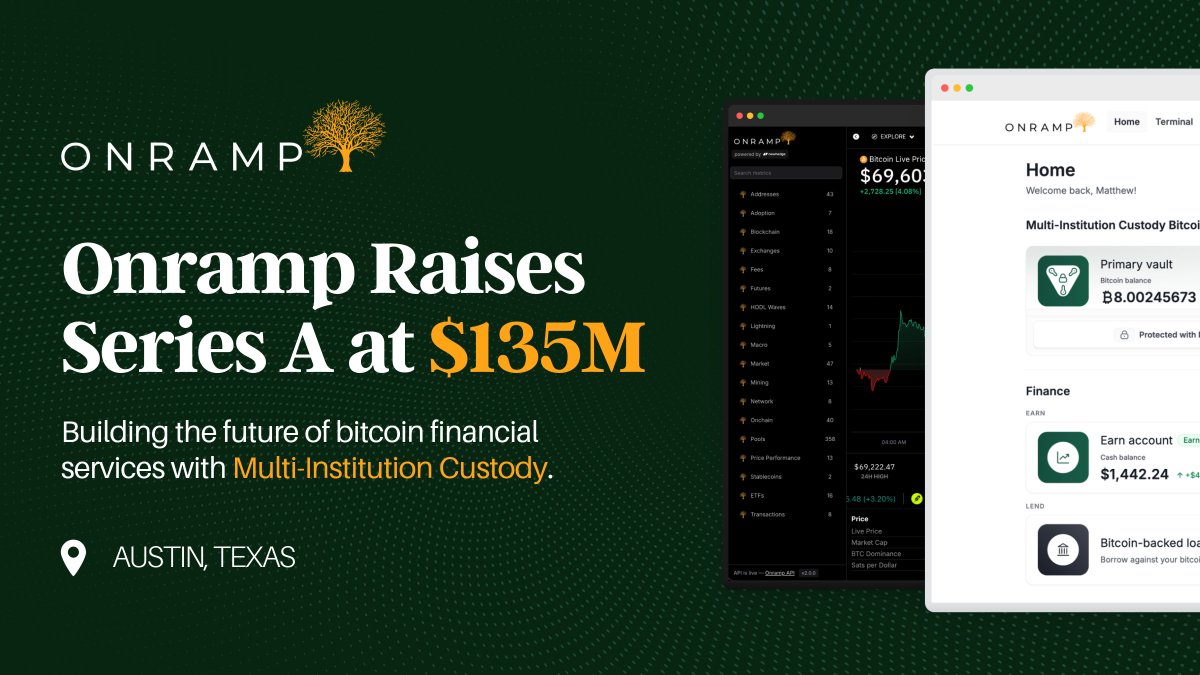
We just closed our Series A at a $135M valuation
$1B + in client assets and zero security incidents since day one
To all of our clients, investors, and partners -- Thank You!
We're working hard to serve you, and I can promise you this -- you're going to continue to be surprised and delighted in the coming weeks, months, and years.
We've pioneered a new standard for bitcoin custody, built the most unified platform for bitcoin services, and with Onramp Finance we're changing what it means to be a next gen wealth preservation firm.
If you're not working with us just yet, I hope you'll chat with us or dip your toe in with a free Onramp Finance account. We'd love to get to know you and help you to build and preserve your wealth for the longterm.
if you're trying to
1. level up your custody
2. have 100% confident in your inheritance plan
3. consolidate your bitcoin
that's Onramp
Multi-Institution Custody is the rock solid foundation, plus everything else you need, all in one platform
Check it out for free by creating an "Onramp Finance" account in minutes
https://t.co/6ofglkp7ZT
RIP Ugly Old Goat.
A father, a friend, a mentor. A man of God, a man of Bitcoin. A writer, a trader an analyst.
His blog posts are deeply insightful into the nature of markets and trading, and his incredible life journey, his many lives lived are worthy of a biography and movie.
Rest in God's grace my friend.
@UglyOldGoat1
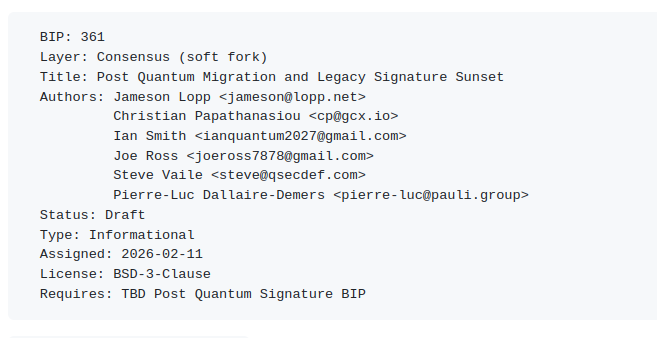
Quantum Fear-Mongering and The Infinite Perils Trap
Alex Thorn @intangiblecoins had a strong post on quantum and Bitcoin coming out of the Vegas discussions this week. I agree with most of it, and I think there’s a broader risk framework that explains why the emerging middle ground is the right one.
The quantum debate keeps skipping the most important question.
Not “is quantum a risk?”
Of course it is.
The question is what kind of risk it is.
That distinction matters because of a fallacy that shows up in almost every tail-risk debate:
The Infinite Perils Trap.
If a risk sounds catastrophic enough, people start treating any non-zero probability as justification for emergency intervention.
That sounds serious. It is often just sloppy.
There are infinite potential perils. Quantum. AI. Asteroids. Engineered pandemics. State attacks. Supply chain attacks. Unknown unknowns.
You cannot spend 50% of the attention budget on each one.
At some point “prudence” becomes resource exhaustion.
This is where Nassim Taleb’s systemic-risk filter is useful.
The irony is that Taleb is often invoked to justify maximal precaution, but his framework also tells you when NOT to go all-in. The risks that justify extreme precaution are not merely the ones that sound scary. They are the ones that are connected and scalable.
Connected means the threat spreads through the system.
Scalable means a small failure can cascade into ruin for everyone.
Pandemics qualify. Banking contagion qualifies. Highly levered financial systems qualify.
A car crash does not. A restaurant failure does not. An airline bankruptcy usually does not.
Different risk category, different response.
Now apply that to quantum and Bitcoin.
Quantum is not systemic. It is idiosyncratic.
It fails on scalability.
The attack surface is address-by-address. There is no magic “break Bitcoin” button. Cracking one exposed public key does not mechanically crack the next one. It does not trigger a cascade across the UTXO set. The attacker has to do the work for every address he wants to attack.
Satoshi’s coins are the cleanest example. People talk about them as if they are one giant honeypot. They are not. They are spread across roughly 22,000 separate P2PK addresses, usually 50 BTC each.
A long-range attack would have to go address by address. That is a very different risk profile from “one person can take Satoshi’s million coins.”
Quantum also fails on connectivity.
A successful crack of an old, long-cold address does not infect other addresses. It does not corrupt consensus. It does not rewrite the ledger. It does not change the 21 million cap. It does not cause other private keys to fall like dominos.
The attacker gets access to specific vulnerable coins.
That may be painful. It may be ugly. It may cause a violent repricing.
But painful is not the same as systemic.
This is also why the “giant honeypot” framing needs precision.
The real concentrated targets are exchanges, ETFs, custodians, and other active entities. ETF holders themselves cannot rotate addresses, but the custodians controlling the actual coins can. Same with exchanges. Same with large active treasury holders. If the threat becomes real enough, those entities can move to post-quantum addresses.
Satoshi’s coins are different because they are dormant. But even there, the risk is far more distributed than the panic narrative suggests.
Roughly 22,000 addresses, not one vault.
And this is where the fallacy matters.
Once you misclassify an idiosyncratic risk as systemic, you start justifying interventions that create real systemic risk.
Freeze Satoshi’s coins.
Invalidate old addresses.
Rush immature cryptography into consensus.
Force a panic fork.
Create gridlock around every other upgrade.
Turn every theoretical threat into a political emergency.
That is where the systemic risk actually lives.
The intervention scales.
The intervention connects.
The intervention changes the property-rights model.
Bitcoin can survive old coins moving. It cannot survive the normalization of “these coins make us nervous, therefore we can touch them.”
That precedent would propagate everywhere.
Lost coins.
Dormant coins.
Sanctioned coins.
Coins from old hacks.
Coins held by unpopular people.
Coins held by political enemies.
Coins that some future coalition decides are dangerous.
That is connectivity.
That is scalability.
That is systemic.
The cure becomes the contagion.
This is why “don’t touch Satoshi’s coins” is not sentimental. It is the rigorous answer.
Property rights are not downstream of convenience. They are the product.
Bitcoin does not promise that every old cryptographic choice will remain optimal forever. It promises that valid coins remain valid coins, and that nobody gets to rewrite the rules because a future committee got scared.
The market absorption point is secondary, but still important.
Even in a nightmare scenario where very old coins moved, that is a market event, not a protocol death. Data from @Checkmatey and others shows Bitcoin absorbing 1M+ BTC of movement since October 2025 alone.
A massive supply shock would hurt.
It would not require us to violate property rights to survive.
That is the point.
None of this means “ignore quantum.” It means classify the threat properly.
Working on post-quantum cryptography, testing schemes, compressing signatures, debating implementation paths, funding serious work, and having credible options on the shelf are all good things.
The middle ground seems basically right:
Do the work.
Prepare contingencies to have on the shelf if needed.
Do not rush the protocol.
Do not touch Satoshi’s coins.
Quantum is worth working on even if it remains a low-probability tail risk. But a low-probability tail risk is not a license to break Bitcoin’s deepest norms.
That is the Infinite Perils Trap.
If every scary non-zero risk becomes a protocol emergency, Bitcoin stops being conservative money and becomes a committee-managed anxiety machine.
The right response is not complacency, it is proportionality.
Quantum is a real research problem, but it is not a reason to freeze coins.
Prepare seriously.
Move slowly.
Preserve the rules.
Leave Satoshi’s coins alone.
Bitcoin is testing the $80k region, where many expect a textbook bear flag breakdown. However, the structure has already deviated from typical bear flag behaviour, and the setup is becoming less clear-cut.
In our latest newsletter piece, @_Checkmatey_ examines why this may not be a true bear flag, and how to navigate the current “hardest phase” of the bear where both bulls and bears get tested → https://t.co/4A6zkG1oMw
Some insights explored in the piece:
- Typical bear flags resolve within weeks, but this structure has persisted for over 12 weeks
- Price is now pressing into the $80k–$85k zone, the first major line of bear resistance
- Around 28% of the Realised Cap has changed hands near the lows, exceeding prior bear floor thresholds
- Derivatives positioning remains heavily short, even as spot demand and ETF inflows strengthen
Maybe our community’s main message should just be:
“Bitcoin is real, the dollar is fake”.
Bitcoin is based on real energy, real math, absolutely finite in supply. Conquers space and time.
The dollar, the Euro, the Yuan, no absolute constraints, no energy grounding, ultimately a shared hallucination based on taxation and legal tender laws. Ok in space, in time they get cut in half every decade.
The laws of physics and math —including power laws and scale invariance — outlive those of mankind.
The petrodollar illusion is evaporating.
@ScientificBTC
@projecteleven newest 1BTC bounty blog post reveals that their intent is not honest.
It’s deceiving. They didn’t reveal critical details in their blog post.
FUD at its finest.
You are being mislead by Project Eleven on Bitcoin Quantum and their new claim.
Part 4: Every "Quantum ECDLP" Demo Is Theater.
Here's the Proof. https://t.co/6mIgmuWu1e
I read the code behind the latest Shor's algorithm "breakthrough." Three fatal problems:
1. The private key is classically solved before the quantum circuit even runs. enumerate_group(G) brute-forces the discrete log, then bakes d*2^i as compile-time constants into the adders. The quantum computer isn't finding anything — it's being told the answer.
2. The "recovery" is a classical verify filter. Every shot is checked against d*G == Q. The candidates dict has at most one entry. The "mode across all shots" language is rhetorical — there's nothing to take a mode over.
3. The 17-bit "success" has a 27% chance from pure random noise. Author concedes fidelity ≈ 10^-244. All 20,000 shots produce unique bitstrings. Under uniform noise with a classical verify filter: P(hit) ≈ 1 - e^(-20000/65173) ≈ 27%. That's a coin flip weighted slightly worse than heads.
A real Shor-for-ECDLP needs coordinate-encoded reversible arithmetic (no classical lookup of d) and continued-fraction recovery (no per-shot verify filter). Nobody has demonstrated this beyond p=13.
Current qubit requirements for secp256k1: 1,193-1,450 logical qubits (CFS, Google QAI 2026). Current hardware: 48 logical. The gap is 25x.
The quantum threat to Bitcoin is real but distant. The demos making headlines today are classical computations wearing quantum costumes.
I will repeat again. Stablecoins are not censorship resistant and therefore do not require a blockchain at all.
The only reason stablecoins ever used a blockchain, like most shitcoin projects, was to bamboozle regulators and to circumvent existing regulation and licensing requirements to launch.
Issuing a digital convertible note was never a novel technology and is easier to do and administer, with less fraud, via centralized database.
GM
https://t.co/8ZbSFWtypa
By the way, I have removed the paywall for this one, as it is an important discussion to have.
Far more important to forward the discourse, and dispel the the hyperbole of Bitcoin being doomed due to quantum computers.