People are saying AI is killing SaaS differentiation.
It was already dead.
Since January 2026, AI agents replacing seat-based software have wiped out roughly $2T in software market cap, with a viral (later-deleted) Michael Burry (the Big Short guy) post fueling an April selloff.
Enterprise SaaS M&A in Q4 2025 hit $83.7 billion across 245 deals, much of it larger companies acquiring AI capabilities to defend pricing power before the market forces their hand.
Databricks' CEO is openly trying to distance the company from the "SaaS" label because private markets value AI companies higher.
That's a pure positioning move. The whole market is panicking that AI agents just erased every product's moat.
Their answer to the panic is a new label. Rename the category, dodge the discount.
But here's what we found before any of this started.
We asked 100 B2B marketing leaders (73% VP and up) how they see the vendors they evaluate.
98% told us vendors "all do the same thing."
And when buyers can't tell you apart, brand recognition won't make them pick you either. Dead last, 15%. Buyers are looking for real differentiators.
So the moat AI supposedly destroyed?
Most never had one to begin with. They just found a scapegoat in AI now.
Over the last four years we've noticed something: most people running message tests or surveys on Wynter don't actually know what to ask.
They have an idea of what they want to find out. But they're not sure how to word the questions to get the insights they're after.
We solve that now with AI-assisted test setup.
You just describe to our AI who you want to target, what you want to find out, and what the goal of your research is. Then our AI designs the survey for you.
You still have full control. You can change anything and everything.
It just makes launching research studies easier for people who aren't sure how to phrase the questions.
Most people don't have a research problem. They have a "what do I even ask" problem. Now you don't.
64% of buyers said it is hard to tell competing vendors apart.
We used a Wynter survey to ask 100 B2B marketers about vendor comparison.
What the research shows is that most websites fail to communicate meaningful differentiation. Majority constantly thought "these all basically do the same thing".
When everything reads the same, buyers split. 56% dug deep to find a real difference. The other 44% gave up trying and decided on other factors.
One CMO stopped using vendor material entirely: "I stopped reading and using their info and looked to my peers for insights and recommendations on the tool(s) they use. That was far more informative than anything I got from any of the vendors."
So when the website doesn't make the difference clear, what closes the deal?
Two things, neck and neck.
1. 32% said it came down to fit.
Whoever proved they matched the exact use case, stack, and integrations won.
2. 31% said the sales experience was the real difference.
A rep who explained what the site couldn't. As one CMO put it: "their sellers were able to do a good job of explaining the differences that the website by itself was not able to do."
Companies are scared (or stupid?) to not focus on their differentiation. If they're lucky enough to still get a demo request, it's then up to the salespeople to explain it. But all but the best-known brands get just ignored.
Five things B2B companies getting AI ROI are doing.
23% of B2B marketing leaders say their AI investment is delivering strong ROI. Here's what they're doing differently.
Yesterday I just shared a post about why 53% of B2B companies haven't seen AI ROI - almost always because they bought licenses and called it a strategy.
But the 23% who said yes? Their answers were specific. They kept saying the same things.
1. Strategy first, AI second.
A Director of PMM, mid-market SaaS: "It goes back to strong PMM fundamentals. Clear understanding of our ICP. Clear understanding of the problems we solve. Clear messaging. AI is just an accelerant of your strategy. Garbage in, garbage out. We found success by cleaning up the garbage."
2. Force multiplier, not efficiency machine.
A Director of Global PMM, Enterprise: "They (management) didn't just start laying people off and tell teams to do better with AI. They invested early, let employees trial and error how AI works best, and see AI as a force multiplier rather than an efficiency machine."
The "cut costs" framing makes AI a threat to operators. The "force multiplier" framing makes it a tool they want to learn.
3. Procurement discipline.
A Sr Director PMM, Enterprise: "We've aggressively negotiated short term contracts to prove value. Our procurement process for AI is so onerous, we only buy tools we believe strongly in."
Counter-intuitive but consistent: the companies with the most AI procurement friction get the best ROI. They don't buy junk.
4. Start with the stuck backlog.
A Sr PMM, Enterprise: "They severely underestimated the size of the backlog of work that wasn't being acted upon. Internal dashboards, internal training materials. The friction was insurmountable before AI."
The best first AI use case isn't replacing existing work. It's unblocking the work that was never going to happen.
5. Automate the workflows.
A Director of PMM, mid-market: "We've been able to streamline so many previously manual processes and save time for every employee."
A Director of PMM at an AI-native company: "Everyone is encouraged to automate as much as they can with AI. For product marketing, this means automating downstream assets like email copy and social posts for product launches, win-loss analysis, competitive analysis."
TL;DR
Strategy first. Force multiplier framing. Tight procurement. Start with the backlog nobody's been touching. Automate manual workflows.
What any job is, is evolving. A job is essentially a bunch of tasks. Now which task anyone works on is subject to change.
Some things AI is so much better at than a human, so humans should no longer be doing those tasks, and those should be automated or at least AI-augmented.
Also, now any marketer can pretty much create their own graphics, maybe even video for some use cases. They can do their own data analysis for most use cases. That should be part of the job description.
It's time for every company to assess and revisit what any job means, add some new tasks in, take some tasks out, and delegate to AI.
53% of B2B marketing leaders say their AI investment hasn't delivered ROI.
Read the responses and the reason is obvious: they haven't actually implemented much beyond prompting.
We surveyed 100 marketing leaders via Wynter -- Directors, VPs, and Heads of Marketing at mid-market and enterprise SaaS -- whether their AI investments are delivering ROI.
53% said no. This seems aligned with some other headlines you might have read. BUT - when you read why, a pattern jumps out.
A Director of PMM: "It's Q2 2026 and we're just getting Claude licenses."
A Director of Marketing: "It's all new. There isn't a framework for how to use it and employees still have day jobs. I don't have time to sit back and experiment."
A Sr Director of PMM: "I'm plateauing in what we know how to build. I'd like to build an agent for sales but I don't know how or what teams to work with to make it happen."
A Marketing Director: "It's easy to use AI but to orchestrate it is harder. We haven't seen an uptick in SDR pipeline from AI-only messages."
These aren't AI failure stories. They're "we bought licenses and called it we're using AI" stories.
Claude at $25 per seat is essentially free for any B2B company, and everyone agrees there's strong ROI there. But prompting is not AI strategy.
The real AI ROI comes from the implementation work -- identifying high-leverage workflows, automating them, eliminating grunt work, training the team, measuring whether it moved the needle.
Most companies haven't done that.
Stop saying you have an AI strategy when what you have is licenses.
Pick one workflow that's costing your team hours every week. Automate it end to end. Measure the time saved. Roll it out.
Then do another one.
The companies reporting positive ROI in this survey aren't doing anything magical. They just actually built the workflows.
41% of B2B marketers at mid-market and enterprise companies are running shadow AI from personal accounts.
We just asked 100 marketing leaders on Wynter -- Directors, VPs, and Heads of Marketing at mid-market and enterprise SaaS -- how they actually get AI work done when their company's official tools are restricted or unavailable.
90% of surveyed companies have at least partial AI restrictions at work. Only 10% have none.
So 41% openly admitted to using personal accounts on their own devices:
Pay-out-of-pocket Claude subscriptions. Personal email logins to LLMs. A laptop next to the work laptop. Files sent to themselves to move work back into the corporate environment.
A Sr Director of Marketing: "I've been using my own Claude account for the last year. The company literally just rolled out Claude to whoever wants it. I've been using my personal email and loading company documents into it. The benefits outweigh the risks."
A Director of PMM: "Sign up for things on our own and beg forgiveness later."
A Director of Product Marketing, forced onto Copilot by IT: "Because it's crap we pretty much all use the paid version of Claude. We get what we need from it and export our work."
A Sr PMM at an enterprise SaaS: "Sensitive data is definitely going rogue. Nobody is thinking about it."
This isn't a tool problem. It's a procurement-vs-operator problem.
IT picks AI based on security, compliance, and existing vendor contracts. Marketers pick AI based on whether it ships work.
The two rarely agree, so marketers route around the decision.
What you end up with is a two-tier AI stack. The corporate one IT signed off on. And the personal one for actually doing the work.
Companies can't police this. Your people will pay for Claude with their own money before they put up with mediocre or no AI.
Better to buy them the tools they want to use (and will use anyway).
One of the top use cases for AI is analytics tool integrations via MCPs.
Metabase, Posthog, Metorik, Supermerics etc - nobody needs to learn cumbersome UIs anymore and get any business question answered in natural language.
Total game changer.
30% of B2B companies admit their AI marketing is ahead of their AI reality.
We just asked 100 marketing leaders on Wynter how their external AI messaging compares to what's actually deployed internally.
30% said external overhypes internal. Said straight up that the marketing is ahead of the reality.
A PMM at an AI-native company told us: "We are marketing pretty ahead of what the product is capable of. Probably 3-6 months ahead."
Another, at a company that sells AI agents: "Externally, we are putting out a lot of messaging about how our AI product is superior and how internally AI is boosting our workflows. Internally, though, everyone is still figuring it out."
A VP of Brand at a non-AI B2B SaaS: "We communicate that we are leveraging AI to make us more efficient. In practice, we're doing it to cut corners and justify cutting great people who are expensive."
A Senior PMM, mid-market: "It's a keep up with the joneses positioning, inflating the capabilities of what's deployed and exaggerating the vision of what's actually coming."
The pattern is universal. AI sellers, non-AI sellers, enterprise, mid-market. Everyone's marketing is a step ahead of what they've actually built.
If you're at a company overclaiming AI -- stop. Sophisticated B2B buyers can tell. They're running their own tests now.
"AI-forward" is a 2024 narrative. The 2026 narrative is "AI-honest." Lead with what you actually built. Lower the volume on what you're planning.
47% of mid-market and enterprise B2B companies cut marketing roles in the last 12 months. AI is cited as the reason.
Almost none of them did it through layoffs which is why this isn't getting headlines.
We just ran the numbers on Wynter -- 100 Directors, VPs, and Heads of Marketing at mid-market and enterprise SaaS.
47% said their company has eliminated, reduced, or stopped backfilling marketing roles because of AI in the last 12 months.
But only 7% of teams shrunk in a visible way. The other 40% did it quietly.
A designer leaves. The role doesn't get reposted. A content marketer quits. The work goes to Claude. A junior coordinator's contract ends. The senior takes it on.
One Sr Director of PMM told us: "Instead of having 3 contract writers, my team now has 1, and they only review and update AI generated content."
Another Marketing Director: "While our current design team isn't likely to be reduced, no backfills will be made as designers leave."
That's how it's actually happening. Not a layoff announcement. Not a press release. Not a "we're restructuring." Just a hiring req that quietly disappears.
I've been running companies for nearly 20 years. Every other workforce shift I've seen had a name -- offshoring, the gig economy, the great resignation. This one doesn't. Yet.
The reality is most leaders don't even call this an AI decision. They call it "we got more efficient."
Same outcome. Fewer headlines.
We ran a survey of 100 B2B SaaS marketing leaders at enterprises, asking them about AI implemenation at their companies.
A quote that stood out:
"Our leadership tracks tokens and usage across the company which feels terrible. And many are against it. They have openly let people go who are not willing to adopt. It's a fear tactic."
Surveillance-as-mandate. Token tracking. Firing people for not using AI.
This is new kind of toxic workplace dynamic that's barely written about.
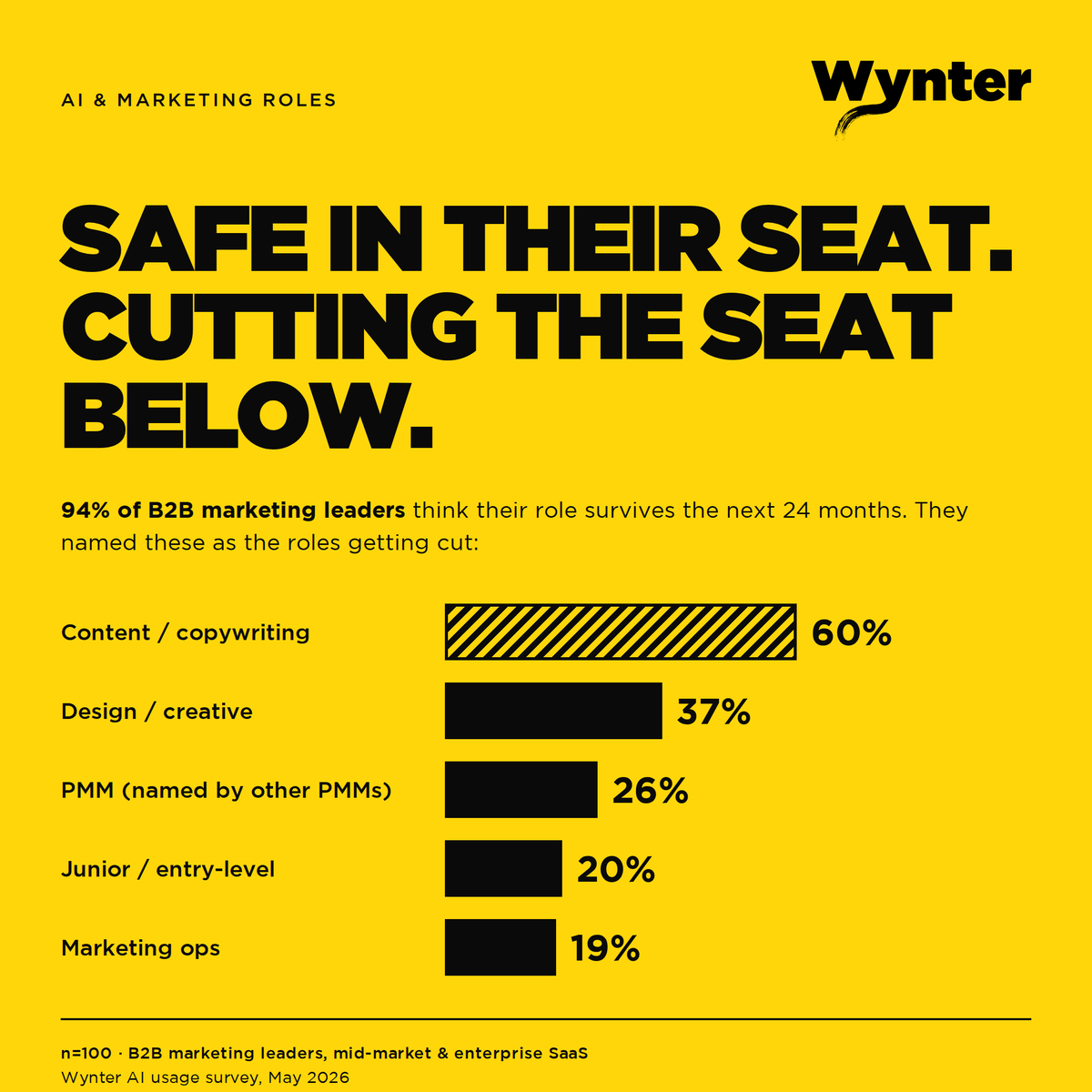
94% of marketing leaders think AI won't touch their job.
We asked 100 B2B marketing leaders if their role survives the next 24 months.
Almost all said yes.
Then we asked which marketing roles get cut.
- 60% named content and copywriting
- 37% named design and creative
- 20% explicitly named junior and entry-level
- 20% of PMMs named PMM (yes, their own function).
So the seat I'm in is safe. The seat below me is gone.
Senior PMMs are running Claude to do the work three junior writers used to do. Directors aren't backfilling content roles when people leave.
Junior designer headcount that was planned for next year? Quietly pulled.
One Director told us: "My PMM team are nearly all Directors. The execution is much easier with AI, so I just need senior folks who can build trust."
Another quote:
"Seniors can achieve the same work as a junior in just a few hours with Claude. We'll always need humans in the loop, but vastly compressed teams."
That's the playbook now.
It's not layoffs, but the slow disappearance of the bottom rung.
If you're paying attention to who's actually getting laid off out there, it's a lot of marketing middle managers.
You need less middle managers now because AI solves information flow (one can have many more direct reports) and measurement (of performance). All marketing directors are also becoming individual contributors.
If you're a senior marketer feeling safe at a large organization, you might be wrong about that. But if you're early in your career, the ladder is being pulled up behind you.
As someone with a CEO title on LinkedIn, I get interesting cold outreach for B2C stuff:
- luxury penthouse apartments in Austin, Texas
- saunas and ice baths
- private luxury jets
things like that. I guess when the deal size is over $20k, all cold outreach can be profitable.
What local companies do is not really instructive for smaller businesses.
Remember when the book "Play Bigger" said to follow Disney's example: they start talking about their next Star Wars movie like two years in advance. Spotify changes the logo and the world goes crazy.
If you start talking about your upcoming product that will be out in one year, nobody will give a shit. You change your logo and nobody will notice.