Senior colleague at a conference this summer: “I am not changing my research or work practices in response to AI. My hope is that there will be a market for hand-crafted research, similar to artisanal luxury goods.”
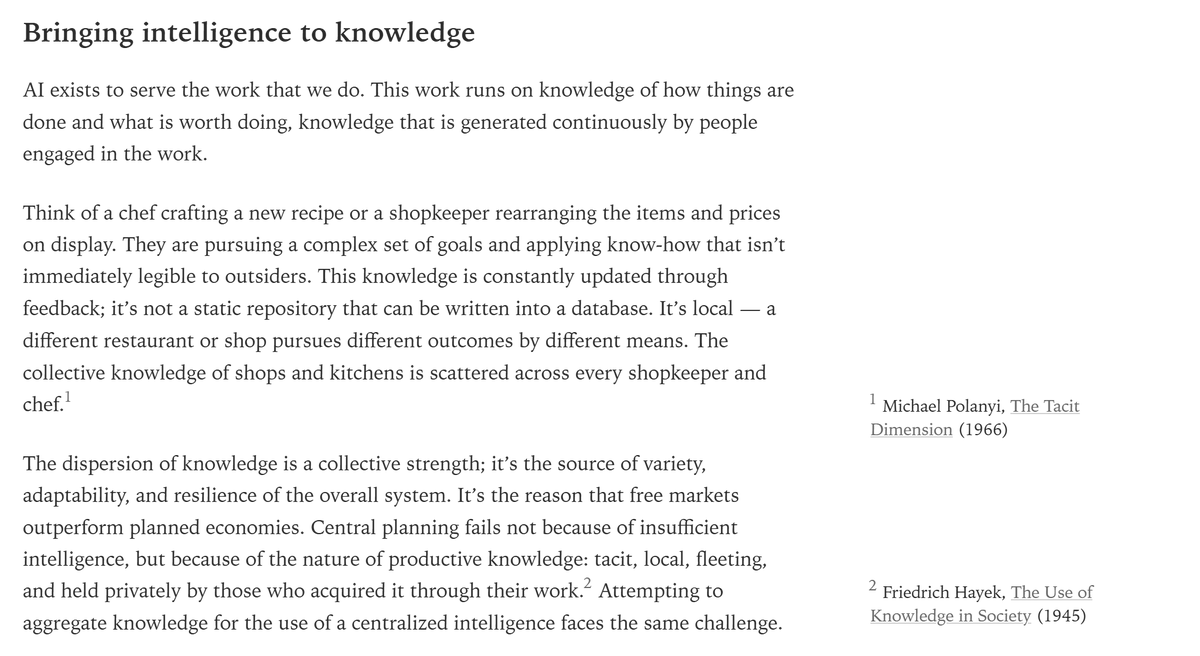
After years of dumb posts with bad economics and 0 knowledge about the world of work (what they call "computer use") from AI lab bosses, the Thinking Machines manifesto is refreshing in its acknowledgements of what the collective work of humans in markets is about: the use of decentralized knowledge. Beautiful project. A lab with a vision to root for.
https://t.co/Et3dRNVj7n
Colleagues and I analyzed a version of this problem: if government officials become more efficient at a task (leading to what Niskanen called bureaucratic slack), they respond by adding more tasks to their portfolios, thus assuring their bureau does not shrink. 1/
Agatha Christie once remarked that she had never expected to grow rich enough to own a car or poor enough not to have servants.
The reason this strikes us as bizarre today boils down to two names that you hear invoked a lot in the tech industry: Jevons and Baumol. One is shorthand for the expansion of products or professions with rising efficiency, the other for the shrinkage of products or professions with stagnant efficiency.
There’s a pleasing chronological symmetry between these twin ideas: William Stanley Jevons coined the Jevons paradox in 1865; William Jack Baumol described Baumol’s cost disease exactly a century later in 1965.
...For every industry that experiences efficiency gains, there’s another that does not. And this latter industry inevitably becomes less affordable. Baumol’s first example was string quartets: violinists are no more productive but you have to pay them more to prevent them running off to become software engineers. The productive industries drive up the labour costs in the rest of the economy.
Marc Andreessen jokes that if a hole appears in the wall of your house in California these days it is probably cheaper to glue a flat-screen television over it than hire a builder to repair it: a Jevons-deflated cost beats a Baumol-inflated one.
The big question of our age is can AI drag Baumol-shaded industries back into the sunlight of Jevons? Can it make things like healthcare, education, or government switch from rising costs to falling costs?
I fear not in the case of government because of a bureaucratic version of the Jevons and Baumol effects. As Cyril Northcote Parkinson put it in an article in the Economist in 1955: “Politicians and taxpayers have assumed (with occasional phases of doubt) that a rising total in the number of civil servants must reflect a growing volume of work to be done. Cynics, in questioning this belief, have imagined that the multiplication of officials must have left some of them idle or all of them able to work for shorter hours. But this is a matter in which faith and doubt seem equally misplaced.”
Since 1997, the British public sector has seen zero increase in productivity. That is to say, the average civil servant generates about the same output today as he did three decades ago.
Think about this for a second. Thirty years ago fax machines were high-tech, the internet was in its infancy, emails were new, Wi-Fi was scarce, mobile phones were voice-only. How is it remotely possible to be no more productive today than then?
We know the answer. Each email is now copied to a dozen people, each report is pasted and copied till it is twice as long, each Zoom call has five times as many attendees, each mobile call is followed up by three times as many WhatsApp messages – and each day at the desk is interrupted by a training session on transgender anticolonial sustainability. That’s a sort of Jevons-Baumol effect: a Jevol?
As Matt points out, this warrants extreme caution in expecting AI-driven improvements in state-dominated industries such as education and healthcare. Some tasks may become more efficient but the sector overall will not. 3/
I’ve been thoroughly surprised by the list of signatories to the letter calling for unspecified immediate action by policymakers/technocrats to “steer AI development.” I am quite worried about the potential risks of AI, but a call for preemptive action is a massive vote of confidence in the prescience & wisdom of policymakers & technocrats. This proposed rewrite from @amcafee makes a lot more sense to me…
The basic disagreement on AI letter comes down to market failure versus state capacity: yes, AI is tricky, and it hugely important, and we don't know where it is going. We all agree.
The question is: is it reasonable in a context of enormous uncertainty to trust Trump/US Congress/EU Commission/other governments to legislate/set up institutions to make AI "complement human skills"? Or do we fear giving them this power will make everyone worse off except the officials given this power and the companies already working to capture those regulations? Do we think NY or Germany being able to forbid full self-driving is likely to be used to make workers and consumers better off and reduce road deaths? Or to satisfy the relevant lobbies?
This kind of discourse is why I find it difficult to engage with AI bros. They don’t realize that the same kinds of superabundance predictions were made about the steam engine, electricity, the telephone, computers, and the internet.
When economists talk about "post-AGI futures" they mean abundance: 10X growth.
When AI people talk about "post-AGI futures" they mean omnipotence: growth until physical limits are hit.
A natural question to ask the economists: if AI gets you a century's technological progress in a decade, why will it stop there?
Additionally, from the perspective of omnipotence, the economists considerations all start to seem *provincial*. Considerations about redistribution, inequality, democracy, power concentration, dignity, meaning.
(This observation comes from me trying to reconcile post-AGI conversations at Lighthaven, and post-AGI conversations at Asilomar)
To clarify: some commentators seem to think I’m discounting the importance of these earlier technologies. Not at all - they were truly transformative! But they did not bring an end to scarcity or change the fundamental laws of economics. https://t.co/FAmBZVyVvH
The late Paul Cantor pointed out that, during the Victorian era, critics condemned serialized novels by writers like Dickens as cheap entertainment that distracted the youth from proper literature (i.e., poetry and plays).
The perennial question of media philosophy:
"Will writing make us stupid?" - Plato, "Phaedrus"
"Will television make us stupid?" - Neil Postman
"Will the Internet make us stupid?" - Nicholas Carr
"Does Google make us stupid?" - Janna Quitney Anderson
Everyone I know is talking about this so….
I know and admire many of the signatories but I disagree with both normative claims.
First, researchers should study what interests them (and we hardly need to encourage more work on what are already the most fashionable topics!). 1/
Here's our statement on AI and the economy.
We Must Act Now
A Statement on AI’s Transformation of the Economy
1. AI may become radically more powerful over the next 10 years.
2. This could drive an unprecedented transformation of our economy, larger than the Industrial Revolution, but unfolding over a vastly shorter time frame. It could bring risks, including large-scale job displacement, as well as opportunities such as major gains in living standards.
3. Economists, policymakers and technology leaders must act now to understand the economics of transformative AI and to build the incentives, guardrails, and institutions needed to steer AI in a direction that complements humans and benefits society.
@MichaelTontchev That seems unrealistic to me. How should such research be conducted? That’s not what economics is for. Of course, there are plenty of speculative essays on the topic.