Anthropic's Dario Amodei at Dreamforce, continuing the theme from his 'slow down' essay...
"Even if we freeze the technology in place... we're making use of maybe only five or 10% of what the possible value of the technology is." ie: do more with the AI we've already got.
If you remove the smoke, this is how the TWC- Twin Towers actually collapsed on 9/11 attack. The animation reveals the structural failure in a way most people have never clearly seen.
✳️ 150 episodes of The Business of Tech podcast and a book giveaway!
To celebrate this milestone, I’ve got:
▶️ 2 x copies of Open to Work by Ryan Roslansky and Aneesh Raman
⏩ 2 x copies of Fast Forward Aotearoa by Ben Reid
to give away. Details on how to win in the video!
Tax breaks for Big Tech, OpenStar's nuclear fusion quest, the new privacy screen on the Samsung Galaxy S26 Ultra, a few of the things I've been looking at this week. https://t.co/ft9pQ7sm8p
Earlier this week, Anthropic announced it would substantially scale back its commitments to safety. This announcement underscores a pattern we've been warning about for years: when AI companies face incentives that reward speed, scale, and competitive advantage, voluntary safety commitments are not enough.
This isn’t about one company’s decision — it’s about the dynamics of an AI race where safety and restraint are seen as liabilities. Without enforceable standards and aligned governance, even well-intentioned actors are pulled toward the same harmful behaviors.
If we want AI products that truly serve the public and promote human wellbeing we can't rely on the industry to decide what’s safe. We need policy that builds real accountability into the system — and treats safety as a foundation for doing business, not an obstacle.
You can read more about Anthropic's decision here: https://t.co/g02uuzjzLg
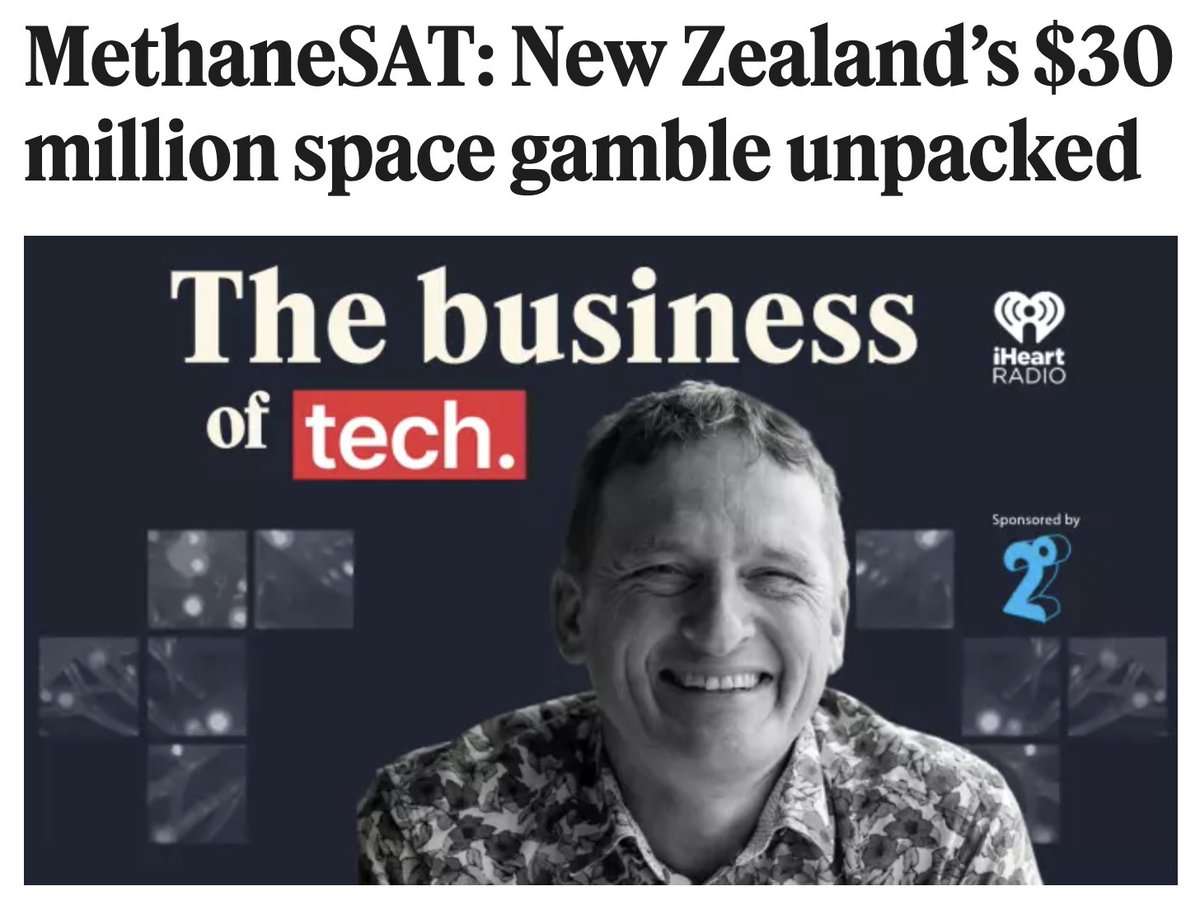
In the latest episode of The Business of Tech podcast, we examine the rise and fall of MethaneSAT, the $30 million national space project that was intended to cement NZ as a serious spacefaring nation. Instead, it became a case study in lost opportunity.
https://t.co/h4F9xmWB0h
Two Kiwi start-up founders have raised nearly US$45 million between them for their US-based physical AI companies in the last six months.
I had Harry Mellsop and Adrian Macneil on The Business of Tech to talk about their efforts to advance robotics.
https://t.co/p1Xy3JKrck
Watch Falcon 9 launch 20 @Starlink satellites, including 13 with Direct to Cell capabilities, to low-Earth orbit from Space Launch Complex 4 East (SLC-4E) at Vandenberg Space Force Station in California.🚀🌎💫🛰️🌴 https://t.co/nMbefK46uE
Told my kids that hobnob biscuits are poisonous to kids. If they're around when I fancy one, I tell them that I'm feeling a bit 'hobnobby' and I need one to stop me breaking out in 'the hobnobs'. Kids are terrified of 'the hobnobs'. Me and the dog get through a packet most days.
Can AI ever be truly trustworthy when the stakes are high? That's what machine learning and artificial intelligence researcher Jessica Zosa Forde hopes to achieve with her studies at Brown University. She talks to @bentm_journo and @petergnz
https://t.co/uez3A1Ne1L
How Japan ignored climate critics and built a global natural gas empire
🇯🇵❤️🚢
Every six hours, somewhere in the world, an LNG shipment controlled by a Japanese company leaves a port. However, these tankers are only the tip of the iceberg
A thread 🧵
https://t.co/dJpffVLvVg