AI yappers with Seedance 2.5 are STUPIDLY easy to make.
and the realism is on a whole different level...
you can literally make any yapper you want. a girl talking about her skincare in her bathroom, a guy reviewing his protein in the car
all you have to do is picture it clearly and give Seedance the right prompt
and you can create much longer videos than this...
advertising has never been this easy. and most brands still have no idea
watch this:
We're looking for female UGC creators aged 40+ in Ireland and the UK ⬇️
Working with a large supp brand :)
Drop me a DM and I'll send you more details!
LinkedIn ads have worked well for us. Just run one for each country you want to source for.
Send them to a form where they need to create a loom answering something to filter out poor/lazy candidates instantly.
For international candidates, Argentina (amazing), South Africa and Brazil (I’m told) are good.
Also looking at large scale agencies and their employees/connections/follower to see if they are a fit for the role and doing outreach that way.
Reaching out to them with role outline and asking if they are a fit or know anyone that would be. That way you’ll get more applicants.
Before someone sees your Meta ad, it has already survived 4 separate filtering stages.
And most advertisers only think about the last one.
Here’s the simplified version:
🔎 Retrieval
Meta starts with a massive pool of ads and asks:
“Is this ad even remotely relevant to this person?”
This is where your creative matters heavily.
The hook.
The person on screen.
The copy.
The format.
The landing page.
All of it helps Meta understand who the ad is for.
📊 Light ranking
Meta cuts the pool down quickly.
Most ads are filtered out before they ever get close to the final auction.
🧠 Heavy ranking
Now Meta is looking much more closely at the ads that remain.
It is estimating things like:
→ Is this person likely to click?
→ Are they likely to convert?
→ Will this create a decent user experience?
This is where weak creative and weak conversion journeys start getting exposed.
💰 Auction
Only now do the remaining advertisers compete for the impression.
Your bid matters.
But it isn’t the only thing that matters.
Which is why you can’t simply outbid bad creative forever.
The biggest takeaway?
Meta isn’t just asking who will pay the most.
It’s trying to predict which ad is most valuable to show that specific person.
That’s why better creative, better conversion and better economics all work together.
Not separately.
@jakobcounts123 I think ultimately creative strategists will just be growth partners. Especially as media buying, LP design etc gets more automated which is why I’m thinking this way
The best creative strategists in 2027 won’t really be creative strategists.
They’ll be acquisition operators.
What people think a creative strategist does:
→ Research customers
→ Find angles
→ Write briefs
→ Script ads
→ Review creative
But we're seeing the role transform:
→ Decide which products and offers to push
→ Build the creative strategy around them
→ Turn customer research into acquisition angles
→ Shape the landing page experience
→ Read performance data
→ Decide what gets tested next
→ Use AI to execute across the entire funnel
AI is removing a lot of the technical friction between those jobs.
You no longer need 5 different people just to turn an idea into something testable.
One strong operator can move from:
Research → offer → creative → landing page → test → learning
Much faster than they could 2 years ago.
That changes what makes someone valuable.
Being great at writing briefs won’t be enough. It's valuable yes, but not enough.
Being great at making ads won’t be enough.
The highest-value creative strategists will understand how the entire acquisition system works. They're closer to growth partners than every before.
They'll then use AI to execute across more of it.
That’s the role I’d be trying to become exceptional at right now.
Your creative is doing more targeting than your targeting.
A lot of brands are still obsessing over:
→ Interests
→ Lookalikes
→ Custom audiences
→ Ad set structures
Meanwhile Meta is looking at the ad itself.
The hook.
The person on screen.
The script.
The format.
The copy.
The thumbnail.
Even the landing page.
All of that gives Meta signals about who the ad is relevant to.
Which changes the job of the advertiser.
You can’t rely on audience settings to fix vague creative anymore.
If you want to reach a specific customer, the ad needs to make that obvious.
Speak to their problem.
Show someone they identify with.
Use language or content a format they recognise.
Build the entire concept around the person you want Meta to find.
Broad targeting doesn’t mean targeting disappeared.
It means more of the targeting moved into the creative which is exactly why every great brand obsesses over it now.
AI isn’t filling Meta with bad ads.
People with bad judgment are.
AI can now give you:
→ 50 hooks in seconds
→ 20 concepts before lunch
→ 10 static variations from one idea
→ A full first draft of almost anything
That sounds like an advantage.
Until nobody on the team knows what good actually looks like.
Then you just produce bad work faster.
That’s why I think judgment is becoming one of the most valuable skills in performance marketing.
Can you look at an idea and decide:
✓ This is worth testing
✓ This angle is weak
✓ This visual will stop the scroll
✓ This needs another iteration
✓ This should never leave the draft folder
AI increases output.
Judgment protects quality.
The teams that win won’t be the ones generating the most.
They’ll be the ones who can separate the 20% worth testing from the 80% of slop.
The better AI gets, the less “being good at AI” matters.
The real advantage is what you bring to it.
5 skills I think become more valuable from here:
💡 Creativity
Can you come up with an angle, visual or idea worth making?
AI can help execute it.
It can’t replace the original spark or human understanding.
👀 Taste
AI can give you 50 options.
You still need to know which 3 are actually good.
🗣️ Communication
Prompt engineering is becoming less important.
Clear thinking and clear articulation are becoming more important.
⚖️ Judgment
This might be the biggest one.
Can you look at an output and decide:
Good.
Bad.
Worth testing.
Needs work.
Bin it.
The person who can make better decisions faster wins.
🧠 Systems thinking
Can you see how one change affects the rest of the machine?
Creative affects CTR.
The offer affects conversion.
The landing page affects CPA/CPM's.
The economics determine whether any of it can actually scale.
AI gives everyone more leverage.
But leverage only helps if the person using it knows what good looks like.
That’s the skill gap I think is about to get much bigger.
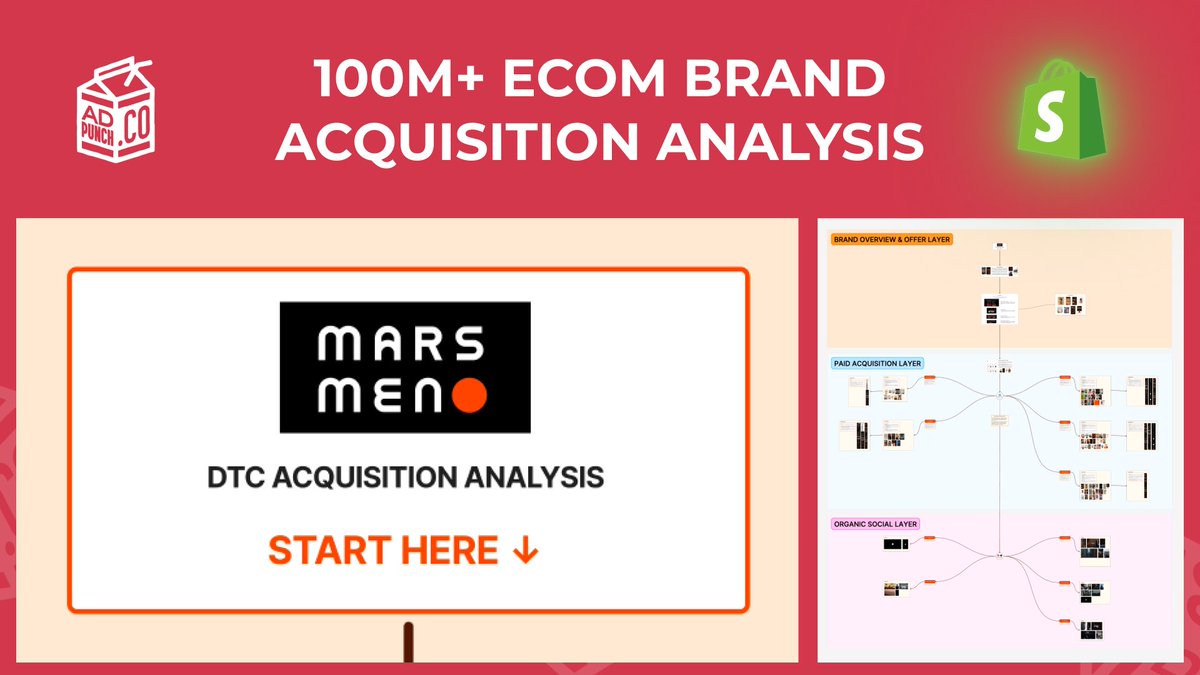
Mars Men has 4,300+ active ads running on Meta right now.
Almost none of them are new ideas.
That sounds like a criticism. It's actually the whole strategy.
So we pulled apart their entire paid acquisition engine. Every ad, every landing page, every offer. Public brand teardown, not a client of ours.
Here's what they're really doing: they're not reinventing their creative strategy every month. They found a handful of core messages that work, then repackage them relentlessly. New hooks, new formats, new executions. We found single concepts running as 21 separate ads.
Then they split those messages across five completely different buyers. Each one gets its own creative, its own landing page, its own reason to buy.
We've managed $18M+ in ad spend for DTC brands. This is the pattern under almost every account that scales past $200k a month. Not more ideas. More versions of the ideas that already work.
The full breakdown is on one board:
✅ All 5 buyer personas and the exact angle that converts each
✅ Their complete ad library, grouped by persona
✅ Every landing page mapped to the ad feeding it
✅ Their offer architecture, from the launch kit to the retention mechanic
✅ The brand pillars running underneath all the direct response
To get it:
1. Like this post
2. Connect with me
3. Comment 'MARS' below
And I'll send it straight over.
Media buying isn't dead.
But the media buyer who only knows Ads Manager is in trouble.
Meta is automating more of the job every year.
→ Targeting.
→ Placements.
→ Budget allocation.
→ Campaign optimisation.
That doesn't make media buyers useless.
It changes what a good media buyer needs to be good at.
The best operators now need to understand:
✅ Creative strategy.
✅ Customer psychology.
✅ Offers.
✅ Landing pages.
✅ Unit economics.
And... what the performance data should tell creative to do next.
Because moving 10% of budget from one ad set to another isn't much of an advantage anymore. Sorry.
Knowing WHY an ad is working is.
Knowing what message to test next is.
Knowing whether the problem is the creative, offer, page or economics is.
And turning all of that into the next round of tests is.
That's where I think performance marketing is heading.
Less time pulling levers inside the ad account.
More time understanding the entire acquisition system.
Media buying isn't disappearing.
The Old Media Buying Model is.
Free beats a percentage every time in DTC.
"33% off three units" and "buy 2, get 1 free" are the same maths.
One converts better.
People do not calculate at all, they "feel" if it's a good offer.
33% off is a maths problem.
One free, is a gift.
It's the exact same margin, the exact same final price but a completely different response.
We've have managed over $15M in ad spend and I have never once fixed a weak offer with better targeting.
Test the wording before you touch the audience.
Ritual has done $250 million in sales.
Right now they have 344 live ads running on Meta. 228 of them are new this month.
This isn't down to their media buying strategy. It's that they have a creative factory.
So we pulled apart their entire paid acquisition engine. Every ad, every landing page, every offer.
What you need to know: Ritual isn't running one brand at four audiences.
They're running four separate businesses under one logo. Each one with its own personas, its own creative, its own landing pages, its own offer.
That's what 344 live ads are actually for.
We've managed $18M+ in ad spend for DTC brands. This is the pattern under almost every account that scales past $200k a month. Not better targeting. More creative, split properly by who it's for.
The full breakdown is on one board:
✅ All 4 personas and what actually moves each one
✅ Their complete ad library, grouped by persona
✅ Every landing page mapped to the ad feeding it
✅ Their offer architecture, front to back
✅ Where we think their strategy is exposed
To get it:
1. Like this post
2. Connect with me Philip O'Flynn
3. Comment 'RITUAL' below
And I'll send it straight over.
Ritual has done $250 million in sales.
Right now they have 344 live ads running on Meta. 228 of them are new this month.
This isn't down to their media buying strategy. It's that they have a creative factory.
So we pulled apart their entire paid acquisition engine. Every ad, every landing page, every offer.
The thing that surprised us: Ritual isn't running one brand at four audiences.
They're running four separate businesses under one logo. Each one with its own personas, its own creative, its own landing pages, its own offer.
That's what 344 live ads are actually for.
We've managed $15M+ in ad spend for DTC brands. This is the pattern under almost every account that scales past $200k a month. Not better targeting. More creative, split properly by who it's for.
The full breakdown is on one board:
✅ All 4 personas and what actually moves each one
✅ Their complete ad library, grouped by persona
✅ Every landing page mapped to the ad feeding it
✅ Their offer architecture, front to back
✅ Where we think their strategy is exposed
To get it:
1. Like this post
2. Connect with me Philip O'Flynn
3. Comment 'RITUAL' below
And I'll send it straight over.
PS. Repost this and I'll also send our Ad Creative Volume Calculator, so you can work out how many creatives your own account needs to run this way.
@coaiecrete Why lmao there's always been a deep connection between Ireland and the US, and huge volume of travel between the two each year.
It's not that deep, it's just makes the trip easier bro.