32% du VC européen est parti dans la deeptech en 2025 (record absolu). Et 70% du late-stage de cette même deeptech est financé par des fonds non-européens. On a appris à incuber. On n'a pas encore appris à scaler.
Hot take : les bootcamps qui enseignent encore PyTorch from scratch en 2026 sont en retard. Ceux qui n'enseignent QUE l'API OpenAI sont en avance d'un an. Ceux qui font les deux + le pont entre les deux sont les seuls dont les diplômés survivront cinq ans.
Introducing USVC - a single basket of high-growth venture capital, for everyone.
No accreditation required, SEC-registered, and a very low $500 minimum.
Includes OpenAI, Anthropic, xAI, Sierra, Crusoe, Legora, and Vercel. As USVC adds more companies, investors will own a piece of that too.
Liquidity typically comes when companies exit, but we’re aiming to let investors redeem up to 5% of the fund every quarter. This isn’t guaranteed, but if we can make it work, you won’t be locked up like in a traditional venture fund.
It runs on AngelList, which already supports $125 billion of investor capital.
And I’ve joined USVC as the Chairman of its Investment Committee.
—
Go back to the 1500s, you set sail for the new world to find tons of gold - that was adventure capital.
Early-stage technology is the modern version. It says we are going to create something new, and it’s risky. It’s daring.
But ordinary people can’t invest until it’s old, until it’s no longer interesting, until everybody has access to it. By the time a stock IPOs, most of the alpha is gone. The adventure is gone. Public market investors are literally last in line.
This problem has become farcical in the last decade. Startups are reaching trillion dollar valuations in the private markets while ordinary investors have their noses up to the glass, wondering when they’ll be let in.
Investing in private markets isn’t easy. You need feet on the ground. You need judgment built over years. Most people don’t have the patience to wait ten or twenty years for an investment to come to fruition.
But there is no more productive, harder-working way to deploy a dollar than in true venture capital.
USVC enables you to invest in venture capital in a broad, accessible, professionally-managed way, through a single basket of innovation, focused on high-growth startups, at all stages.
It is how you bet on the future of tech: the smartest young people in the world, working insane hours, leveraged to the max, with code, hardware, capital, media, and community. Your dollar doesn’t work harder anywhere.
There is an old line - in the future, either you are telling a computer what to do, or a computer is telling you what to do. You don’t want to be on the wrong side of that transaction.
USVC lets you buy the future, but you buy it now. Then you wait, and if you are right, you get paid.
Get access here:
https://t.co/pAj1sqUsG0
Tout le monde se demande pourquoi Apple a choisi un ingénieur hardware “obscur” pour succéder à Tim Cook. Je trouve au contraire que le choix raconte quelque chose de très clair sur la prochaine décennie.
Regardez le pattern des transitions chez Apple. Chacune coïncide avec un changement de terrain stratégique.
Quand Jobs revient en 1997, Apple est au bord du gouffre. Le combat, c’est de prouver que le produit peut sauver une boîte. La décennie suivante accouche de l’iMac, l’iPod, l’iPhone.
Quand Cook prend le relais en 2011, l’iPhone domine déjà le monde. Le combat devient industriel : produire des centaines de millions d’unités par an sans rater une cadence. Cook est l’architecte de la supply chain. Verdict : 350 milliards à 4 000 milliards.
Aujourd’hui, sur l’IA, le cloud est largement joué. OpenAI, Google, Anthropic ont pris une avance difficile à rattraper. Le terrain où Apple peut encore gagner, c’est faire tourner des modèles puissants directement sur l’appareil. Un combat moitié silicium, moitié architecture de modèles, où l’intégration verticale est le seul vrai moat.
Apple nomme John Ternus. Patron de l’ingénierie hardware depuis des années, il a piloté l’intégration produit derrière Apple Silicon, le plus gros pari technique de la boîte sur la dernière décennie.
Ce n’est pas un choix surprenant. Ternus était l’héritier pressenti depuis longtemps. Mais le signal envoyé compte.
Apple ne nomme pas un Services guy, pas un financier, pas un AI guy débauché de l’extérieur. Elle promeut un ingénieur produit qui connaît le silicium de l’intérieur.
Le pari implicite : la prochaine décennie ne se gagnera pas sur les modèles, mais sur la capacité à les faire tourner mieux que les autres, là où sont les utilisateurs. Sur l’appareil.
Marc Andreessen explains why the manager class might disappear in the AI era:
"I've always viewed my entire life as—we're raging against the dying of the light. We're constantly trying to fight off managerialism swamping everything and everything getting boring, gray, dumb, and old."
"The challenge is going to be for the innovators to figure out how to leverage AI to actually do this."
"The other challenge is going to be for the incumbents that are managerial to figure out—what does that mean? Because now they're going to be facing a different kind of insurgent competitor that has a different set of capabilities than they're used to."
"I think this is going to force a lot of big companies to figure out innovation—figure out innovation or die trying."
@pmarca with @latentspacepod
Marc Andreessen: Software isn't precious anymore. In this new world, high quality software is infinitely available.
"We've always lived in a world in which software is this precious thing that you have to think about very carefully."
"It was really hard to generate good software, and there was only a small number of people who could do it."
"Those days are just over."
"If you need new software to do X, Y, or Z, you're just going to wave your hand and get it."
"Things that used to be hard, or even seem like an insurmountable mountain to get through, all of a sudden, I think, become very easy."
@pmarca with @latentspacepod
new model for engineering team structure in 2026:
2 people only
one pirate and one architect
the pirate's job is to move as fast as possible to develop valuable, shipped product features by vibe coding.
the architect's job is to turn the product surface discovered by the pirate into a reliable, structured machine—also by vibe coding, but at a slower, more well-reasoned pace.
every product needs a pirate but most product's only need an architect once they some form of PMF, and in that case they usually don't need one full-time. architects can work across many codebases and solve interesting technical challenges. pirates go hard on a product that they own end-to-end.
CLI is indeed the UI for agents : doesn’t fill up context too early, paired with skills it supersedes MCPs.
“historically you win by owning the surface area. seo, app store ranking, homepage traffic. in an agent world, you win by being the default callable primitive.”
Web 1.0 came with new channels:
- email, search, link sharing, etc
Web 2.0 too:
- feeds, creators, viral invites, etc
Mobile:
- app stores, SMS invites, vertical vid, mobile ads
What about AI? I’ve been complaining that AI hasn’t come with much. But we’re seeing a big growth channel opening now: Products that are built as APIs/CLIs that can be pulled into new projects by Codex/Claude on the fly
Maybe the “AI-native hotel app” doesn’t mean a mobile booking app with an AI chat panel. It means a CLI that can book a hotel for you, that an AI agent can pull into a bespoke answer or project or into code. Bolting on an AI chat panel is this generation’s weak form of AI. Maybe the full reinvention involves making it agent-first not human-first
and once you start looking at it that way, a lot of existing products suddenly feel mis-specified. they’re built as destinations, but agents don’t want destinations. they want capabilities. composable, callable, reliable capabilities.
So instead of “go to Expedia” or “open the app,” the future interaction is more like: an agent assembles a workflow on the fly. it pulls a flight search tool, a hotel booking tool, maybe a weather model, maybe even your personal preference graph. none of these are full products in the traditional sense. they’re more like endpoints with taste and state.
This flips distribution completely. historically you win by owning the surface area. seo, app store ranking, homepage traffic. in an agent world, you win by being the default callable primitive. the thing that shows up again and again in agent-generated plans because it works, has clean interfaces, and returns structured outputs. distribution shifts from “top of funnel” to “top of call stack.”
And the crazy part is this might actually compress product surface area dramatically. the best products might look more like tight, extremely well-designed CLIs with opinionated defaults rather than sprawling UIs. almost like the stripe api moment, but for everything. imagine if every vertical had a “stripe-level” primitive that agents preferentially use.
there’s also a weird inversion of brand here. humans used to choose brands. now agents will. so the brand becomes partially machine-legible. reliability, latency, error rates, schema clarity. you can almost imagine “agent seo” where the ranking factors are things like success rate across thousands of agent runs, or how easy your tool is to integrate in a chain-of-thought execution loop.
This also suggests a new kind of moat. not just data or network effects, but integration depth with agent ecosystems. if claude or codex or openclaw learns that your tool is the safest way to accomplish X, it gets baked into prompts, templates, maybe even fine-tunes. you become a default. and defaults, historically, are insanely sticky.
The contrarian take is that most current “AI features” are a local maximum. chat panels, copilots, assistants. they’re transitional. the real end state might look closer to invisible infrastructure that agents orchestrate. the ui is just a debug layer for humans to peek into what the agents are doing.
so maybe the new growth channels for ai look like:
- being callable
- being composable
- being reliable at scale in agent loops
- being embedded in agent templates and workflows
- being the default primitive in a given domain
and if that’s right, then the question for any new product isn’t “what’s the ui” or even “what’s the killer feature.” it’s “what’s the minimal, highest-leverage capability we can expose such that agents will repeatedly choose us when building something new.”
Web 1.0 came with new channels:
- email, search, link sharing, etc
Web 2.0 too:
- feeds, creators, viral invites, etc
Mobile:
- app stores, SMS invites, vertical vid, mobile ads
What about AI? I’ve been complaining that AI hasn’t come with much. But we’re seeing a big growth channel opening now: Products that are built as APIs/CLIs that can be pulled into new projects by Codex/Claude on the fly
Maybe the “AI-native hotel app” doesn’t mean a mobile booking app with an AI chat panel. It means a CLI that can book a hotel for you, that an AI agent can pull into a bespoke answer or project or into code. Bolting on an AI chat panel is this generation’s weak form of AI. Maybe the full reinvention involves making it agent-first not human-first
and once you start looking at it that way, a lot of existing products suddenly feel mis-specified. they’re built as destinations, but agents don’t want destinations. they want capabilities. composable, callable, reliable capabilities.
So instead of “go to Expedia” or “open the app,” the future interaction is more like: an agent assembles a workflow on the fly. it pulls a flight search tool, a hotel booking tool, maybe a weather model, maybe even your personal preference graph. none of these are full products in the traditional sense. they’re more like endpoints with taste and state.
This flips distribution completely. historically you win by owning the surface area. seo, app store ranking, homepage traffic. in an agent world, you win by being the default callable primitive. the thing that shows up again and again in agent-generated plans because it works, has clean interfaces, and returns structured outputs. distribution shifts from “top of funnel” to “top of call stack.”
And the crazy part is this might actually compress product surface area dramatically. the best products might look more like tight, extremely well-designed CLIs with opinionated defaults rather than sprawling UIs. almost like the stripe api moment, but for everything. imagine if every vertical had a “stripe-level” primitive that agents preferentially use.
there’s also a weird inversion of brand here. humans used to choose brands. now agents will. so the brand becomes partially machine-legible. reliability, latency, error rates, schema clarity. you can almost imagine “agent seo” where the ranking factors are things like success rate across thousands of agent runs, or how easy your tool is to integrate in a chain-of-thought execution loop.
This also suggests a new kind of moat. not just data or network effects, but integration depth with agent ecosystems. if claude or codex or openclaw learns that your tool is the safest way to accomplish X, it gets baked into prompts, templates, maybe even fine-tunes. you become a default. and defaults, historically, are insanely sticky.
The contrarian take is that most current “AI features” are a local maximum. chat panels, copilots, assistants. they’re transitional. the real end state might look closer to invisible infrastructure that agents orchestrate. the ui is just a debug layer for humans to peek into what the agents are doing.
so maybe the new growth channels for ai look like:
- being callable
- being composable
- being reliable at scale in agent loops
- being embedded in agent templates and workflows
- being the default primitive in a given domain
and if that’s right, then the question for any new product isn’t “what’s the ui” or even “what’s the killer feature.” it’s “what’s the minimal, highest-leverage capability we can expose such that agents will repeatedly choose us when building something new.”
The cost of code is coming down, so we will consume more of it.
The productivity of coders is going up, so they will become more valuable.
Coding now includes training and driving models.
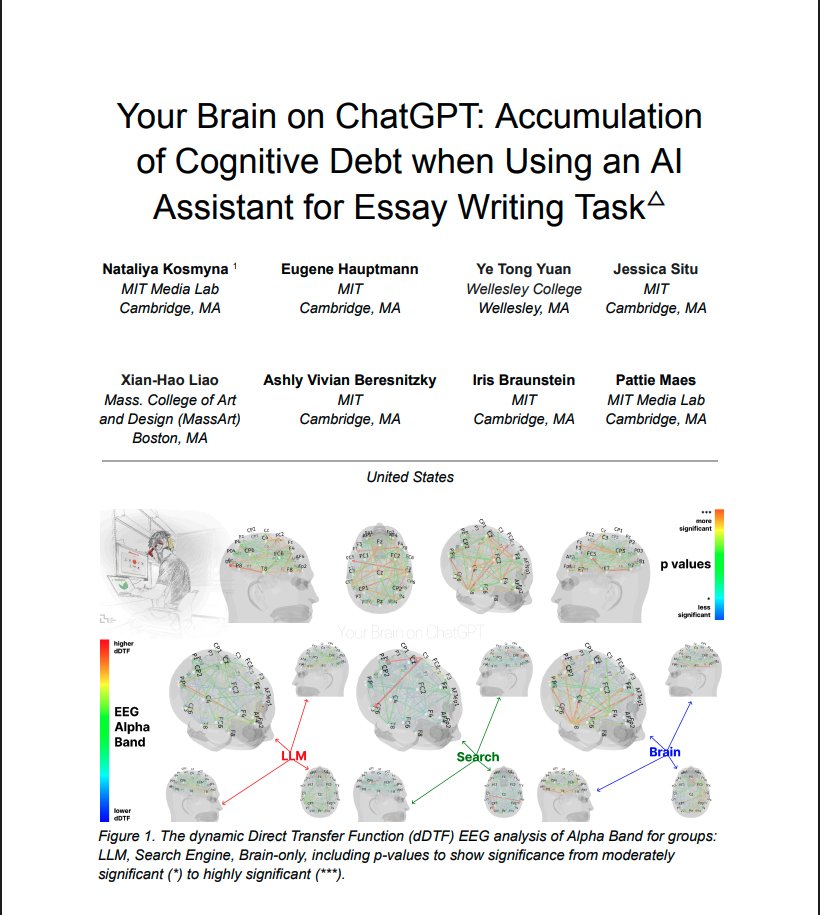
BREAKING: MIT just completed the first brain scan study of ChatGPT users & the results are terrifying.
Turns out, AI isn't making us more productive. It's making us cognitively bankrupt.
Here's what 4 months of data revealed:
(hint: we've been measuring productivity all wrong)
Petit moment coup de gueule contre @Velib.
J'ai utilisé #levelo de @AMPMetropole à Marseille ce weekend. Experience très facile, rapide de télécharger l'app, le vélo débloqué en 1m avec un QR code, tous les vélos étaient électriques et plutôt de bon état.
Et @Velib ? 👇
Il faut donc revenir chaque année sur un site web tout pourri, pour souscrire à un vieux abonnement à 0€ tout pourri. Superbe experience pour simplement débloquer des vélos.