My son is fascinated with all things about dinosaurs.
I built a 🦖 🦕 classifier for him as homework for the first week of the fastai cohort.
I used @Gradio and deployed on @jarvislabsai
https://t.co/DA4ZPJs5rp
When you want to try a large model like GLM 5.3 without hosting it yourself, there was rarely an Indian platform offering it.
No more, try them today on Jarvislabs ai
Managed Inference is now live on https://t.co/XJV1skUFPu.
Deploy pre-optimized open-weight models as Serverless endpoints that scale with your workload.
Each model is tuned by our research team for high throughput and efficient GPU usage.
Own your inference. One click away.
LLMs increase the complexity of codebases. They duplicate methods, write overdefensive code against impossible edge cases, & overoptimize too early. Can further training fix this? Naur's “Programming as Theory Building” says no. -- @pol_avec
https://t.co/HGPfSSejFY 1/
I am meeting more and more enterprise customers who wants to move to opensource models.
It is very important for companies to
- Protect their IP.
- Reliable, they dont want to be banned.
- Cut down costs
- Prevent their business from getting replicated.
We are helping customers in this journey with choosing the right model, GPUs, quantization, and more.
If your teams are considering the same, would love to explore how we can help you in your journey.
Most AI teams do not need to start every fine-tuning experiment on an H100.
Chansung (@algo_diver) tested RTX PRO 6000 on JarvisLabs across LoRA and full fine-tuning workloads to answer a practical question:
When is RTX PRO 6000 enough for AI research?
The takeaway: use RTX PRO 6000 as your cost-sensitive LoRA research setup to validate ideas quickly, then move to H100 when the workload becomes communication-heavy, especially at 8+ GPUs or full fine-tuning scale.
Read the full breakdown 👇
https://t.co/uEAYRwKQwy
9 to 5
I hated this idea from my early carrer. 2 years back I was listening to a book "Slow Productivity" which talks where the idea came from.
In the industrial age, the only way to increase productivity is to make people work for X hours, not long hours or 7 days a week. (Thats how we got weekends)
The X is fixed to optimise the productivity, If X increases the person could get tired, sick and the productivity drops.
If the X reduces, then productivity drops linearly.
What most of us fail to realise is, the knowledge work does not behave in the same way.
For example, solution to a problem could be arrived during a walk, or during sleep, or in the bathroom. Not when you are sitting in front of laptop, looking at the problem.
This makes it extremely hard to measure peoples work by number of hours they sit with some machine.
I am pro for hardwork, I just dont believe hardwork == number of hours spent in front of laptop.
I had a requeset from a fast growing startup, looking for few thousand H200s.
We had few hundreds available, but the catch was they wanted baremetal. They would run their orchestration, add value and sell it to their end customers.
We could say yes and make money. Everyone would be happy.
There are few problems to this.
1. We do not get a chance to learn and improve the cloud platform that we are building.
2. Verly little to no value addition.
3. You don't own the end customer. At the end of the day you are not remembered.
I refer to this as we export Iron, and import finished products.
It is very essential to move up the ladder, offer value and serve the end customer.
Your GPUs shouldn't get paid to sit idle.
JarvisLabs Serverless is now in beta. Turn any open model into an OpenAI-compatible endpoint with a single command.
A request comes in, a GPU spins up on its own. Traffic stops, it scales back to zero. You're billed for GPU time only while it's serving, never for idle GPUs.
We currently support vLLM, SGLang and Ollama
Live in beta today.
Most GPU workflows come with too much infra overhead.
Spin up a VM, install dependencies, copy code over, expose ports, watch logs, and remember to shut everything down after.
With JarvisLabs now available as a @dstackai backend, most of that goes away.
You define the machine and the workload in a YAML file. Run dstack apply. That's it.
dstack manages the infrastructure lifecycle. JarvisLabs provides the GPUs.
We wrote a short tutorial covering the full setup, from connecting your account to running a nanochat training job on H100s
Works for training runs, evals, benchmarks, inference services, and GPU dev environments.
JarvisLabs is now a @dstackai backend.
That means: if you've been using dstack to orchestrate runs across GPU clouds, you can now point it at our infrastructure with one YAML block.
type: jarvislabs
creds:
api_key: ...
One YAML. One command. GPU running in few seconds.
L4, H100, and CPU VMs, more on the way.
dstack handles the instance lifecycle. We provide the GPU.
If you've been waiting for it, give it a spin.
We added RTX PRO 6000 Blackwell to Jarvislabs this week.
I was curious about one thing: can this make 30B-class inference simpler?
So our team benchmarked Qwen3-32B on vLLM across BF16, FP8, and NVFP4.
NVFP4 is NVIDIA’s new 4-bit floating-point format for Blackwell. In simple terms, it lets the model run with smaller numbers, which can reduce memory movement and improve throughput — without the same accuracy hit people usually worry about in aggressive quantization.
At concurrency 64, we saw:
BF16: 869 tok/s
FP8: 1339 tok/s
NVFP4: 1824 tok/s
First-token latency:
BF16: 338 ms
FP8: 249 ms
NVFP4: 148 ms
That first-token number matters. In chat products and agentic workflows, users don’t feel “GPU specs”. They feel how quickly the model starts responding.
The bigger takeaway for me: not every inference workload needs a complicated multi-GPU setup.
With 96GB memory and native FP4 support, RTX PRO 6000 Blackwell makes single-GPU serving quite interesting for models like Qwen3-32B.
Of course, quantization is not magic. I wouldn’t blindly replace BF16 everywhere. You still need to validate on your own prompts, languages, and quality gates.
But for this setup, NVFP4 looked very promising.
If you’re experimenting with 30B-class inference, DM me. Happy to help you test it on Jarvislabs.
Lot of conversation around the recent years has been around two things
Why are we not building large language models?
Why we don't have enough compute?
I've heard arguments from people why they believe that India should have its own model, Why we should have our own infrastructure?
While these arguments are right, I feel we have been silently missing another important thing, we should also be building software products for the new world that is evolving.
I have penned down my thoughts around this here.
https://t.co/h6EOtLt4DP
A feature we quietly killed a few years ago is back: Spot instances on JarvisLabs.
When a user clicks "Launch a compute instance" a lot has to come together, it has to be fast and reliable. Preemptible instances made that orchestration meaningfully harder.
We ran spot for a while back in 2023. Then we migrated to newer codebase, as we were building fast, code became unmanagable. We made a call, to not add spot to keep the new codebase clean.
We were working on spot again, and went live last week.
Customers are already using them. If you're running inference, fine-tuning, or batch jobs that can tolerate a preemption -> these are some of the best GPU prices on the market right now.
What if training on a GPU was as easy as running a command?
pip install jarvislabs
jl create --gpu A100
jl run https://t.co/bPdnqp10dp --gpu A100
That's it. No console. No config.
I built Jarvis Labs by cold DMing Kagglers and giving GPU credits to brand ambassadors who'd talk about us.
It worked. People wrote blogs, competed on Kaggle with our name, spread the word organically. We grew.
Competition heated up, we could not buy enough compute so we slowed down. We kind of hit the limits of running a bootstrapped gpu cloud business.
We got acquired by E2E Networks late 2025. I shifted focus.
The product kept running. Customers kept coming through old SEO rankings and word of mouth.
And I stopped doing the uncomfortable work.
No outbound. No sales motion. No marketing engine. Just relying on momentum from work we did years ago.
Watching Dharmesh Shah talk about going into "founder mode" tracking sales, shipping daily, working till early mornings made me realize something uncomfortable:
I'd stopped being a founder.
I've been back at it for a month now. Pushing product changes. Trying to restart the entire growth engine from scratch. And honestly? I don't fully know what the playbook looks like this time around.
The market's changed. The audience has changed. The old cold DM approach won't work the same way.
If you've gone through this rebuilding momentum after letting it stall — I'd love to hear what worked for you.
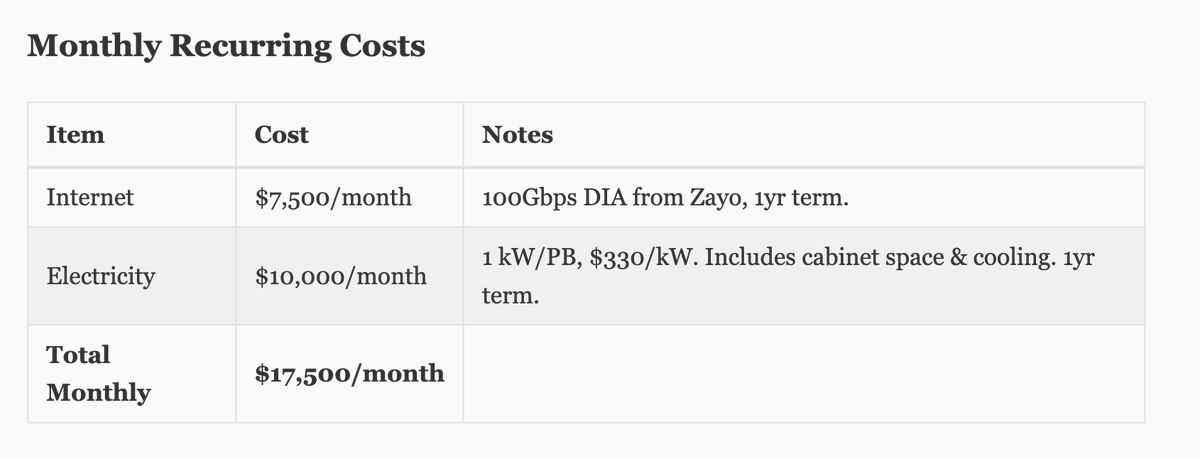
A small team in San Francisco pays $7,500/month for 100 Gbps internet.
We paid $3,000–$3,500/month for 1 Gbps in India. On a three-year contract.
I was going through this blog by Standard Intelligence on how they built a 30 petabyte storage cluster their own object storage and cut their storage cost by 40x compared to AWS. The numbers shocked me.
For electricity + cooling + colocation, they pay $10,000/month for 30 kW in downtown SF. We ended up paying around $7000/month for a way smaller cluster.
The Bay Area one of the most expensive places in the world has cheaper infrastructure than what we could get in India.
I wish our costs would come down so more startups in India can dream bigger.
But the even bigger problem we noticed while getting a leased line connection: the complete lack of transparency.
There are no published prices. Each vendor quotes whatever they want. And the smaller you are, the bigger the price you get.
https://t.co/gSznUCZfp1
If you are using tools like Claude Code, you may realize that at some point of time you run out of context length. A trick that I use is I just tell Claude Code that I am running out of context, dump all the important things into a https://t.co/4rfQutyUN6, and I will start a new session with https://t.co/4rfQutyUN6. This works perfectly well for me.
Is there any trick that you use to make your life easier while using Claude code or codex?
𝗜 𝘀𝘁𝗼𝗽𝗽𝗲𝗱 𝘁𝗿𝗲𝗮𝘁𝗶𝗻𝗴 𝘄𝗿𝗶𝘁𝗶𝗻𝗴 𝗹𝗶𝗸𝗲 𝗶𝘁'𝘀 𝗱𝗶𝗳𝗳𝗲𝗿𝗲𝗻𝘁 𝗳𝗿𝗼𝗺 𝗰𝗼𝗱𝗶𝗻𝗴.
I write all my blogs and docs in Cursor. Not VS Code. Not Notion. Cursor 😀.
Does it sound weird? Maybe yes.
Here's why coding editors beat traditional writing tools:
📝 𝗥𝗲𝗮𝗹-𝘁𝗶𝗺𝗲 𝗶𝗻𝘁𝗲𝗹𝗹𝗶𝗴𝗲𝗻𝗰𝗲 𝘁𝗵𝗮𝘁 𝗮𝗰𝘁𝘂𝗮𝗹𝗹𝘆 𝗵𝗲𝗹𝗽𝘀. While you're wrestling with Grammarly suggestions, I'm getting contextual improvements that understand what I'm actually trying to say. Cursor reads my entire document and suggests better ways to explain complex ideas.
🔄 𝗩𝗲𝗿𝘀𝗶𝗼𝗻 𝗰𝗼𝗻𝘁𝗿𝗼𝗹 𝗯𝘆 𝗱𝗲𝗳𝗮𝘂𝗹𝘁. Every blog post lives in git. I can see how my thinking evolved, roll back terrible drafts, and track what changes improved engagement.
𝗠𝘆 𝘀𝗲𝘁𝘂𝗽 𝗶𝘀 𝗲𝗺𝗯𝗮𝗿𝗿𝗮𝘀𝘀𝗶𝗻𝗴𝗹𝘆 𝘀𝗶𝗺𝗽𝗹𝗲:
• Cursor for writing
• Markdown for content
• Docusaurus for the site
• Git for everything else
• Superwhisper to dictate
𝗧𝗵𝗲 𝘂𝗻𝗲𝘅𝗽𝗲𝗰𝘁𝗲𝗱 𝗯𝗲𝗻𝗲𝗳𝗶𝘁𝘀:
• Code blocks syntax highlight automatically
• I can reference other docs/code in the same repo
The best tools are often hiding in plain sight. We assume certain tools are for certain jobs.
💡 The real game-changer? I ship content faster because my writing environment matches my thinking environment. No mental overhead switching between "writing mode" and "building mode."
Is this something you do?
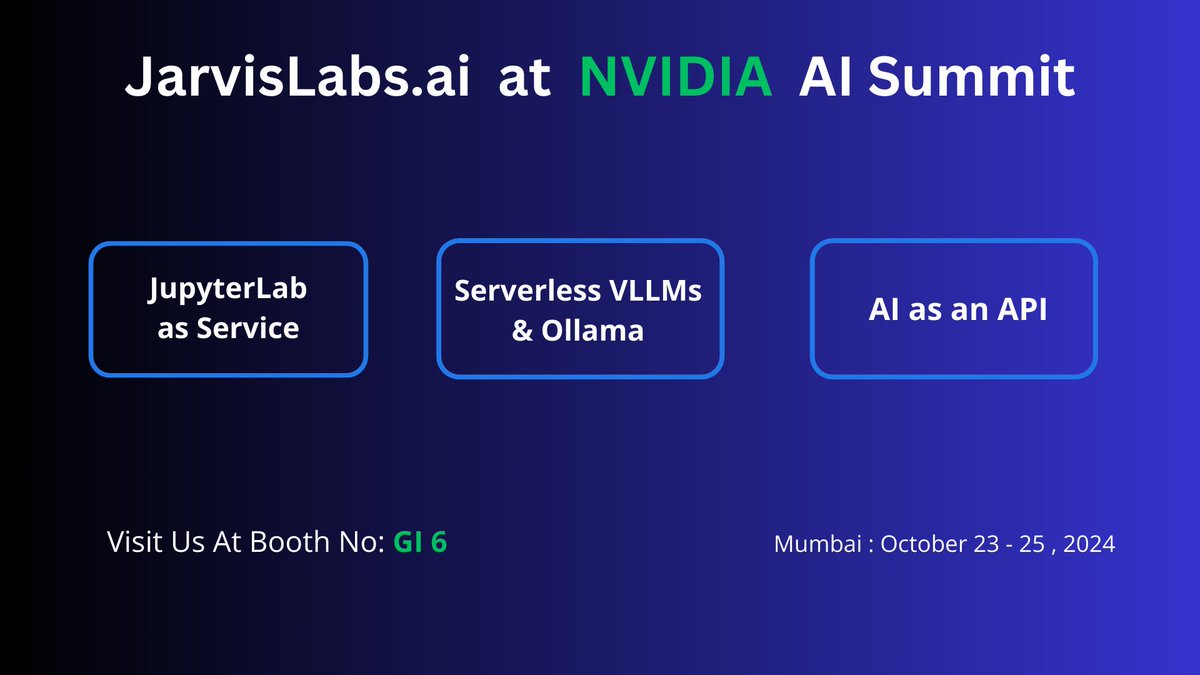
Jarvislabs ai is heading to NVIDIA AI Summit Mumbai (Oct 24-25, 2024) - one of India's largest AI gatherings with 5000+ innovators!
Want to cut your AI costs by 70%? We're showcasing how our innovations are making AI accessible and affordable. Here's what we've quietly launched:
• Serverless VLLMs framework - Deploy in minutes, not days
• Serverless Ollama integration - OpenAI-compatible APIs
• AI as an API (beta) - Zero infrastructure management
💡
Why this matters:
• 70% cost reduction vs major cloud providers
• Deploy with just a few clicks
• No deep technical expertise needed
• OpenAI-compatible - switch without changing code
Our team has been working tirelessly to democratize AI access, and we're just getting started. This NVIDIA AI Summit marks a milestone – our first major conference showcase!
India's AI ecosystem is rapidly evolving, and we're proud to be part of the transformation. What's your take on India's growing role in the global AI landscape?
🤝 Visit booth GI 6 to see live demos of how you can cut your AI costs by 70%! Let's discuss scaling your AI initiatives affordably.
hashtag#NVIDIAAISummit hashtag#AIInnovation hashtag#IndianTech hashtag#ArtificialIntelligence hashtag#CloudComputing