TabPFN-Rel gives your agent a relational prediction engine to call instead of a pipeline to write. The agent uses your business context and schema to define the task: what to predict, for which entities and over what period. TabPFN-Rel follows the relationships between tables, builds the features and predicts with TabPFN-3.5.
It has guardrails built in for the mistakes agents typically make, like temporal leakage and incorrect handling of data types.
To get started, install the tabpfn-rel:relational-prediction skill in Claude Code or Codex and point your agent at your data.
More in the blog: https://t.co/nB1l36lWWR
📣 Live session for TabPFN-Rel incoming
Most business data is spread across many linked tables, but most ML tools expect one flat table. A few months ago, we released RelArena to push relational ML research. Now, join us to see how TabPFN-Rel makes predictions directly on relational databases, without hand-built joins or feature engineering.
We'll cover:
��� RelArena - the new benchmark for relational ML and why we need it
→ What relational machine learning is, and why flattening tables by hand slows you down
→ How TabPFN-Rel works, and how it prevents data leakage
→ Defining prediction tasks in YAML and SQL, or letting your coding agent do it
→ Hands-on: building a seller churn model on a real e-commerce database in Colab
→ Live Q&A
📅 November 4th, 6PM CET
🔗 Register: https://t.co/L5AUojJQRn
"What will our sales be next quarter?"
For data teams, answering that usually means pulling data from a dozen tables, then joining, cleaning, engineering features and checking for leakage. Even with a coding agent, you're steering every step.
TabPFN-Rel is our harness for running TabPFN on relational databases. Define your tables and prediction task in YAML and SQL, or let your coding agent do it. TabPFN-Rel handles the joins, feature engineering and prediction, and follows best practices in relational machine learning.
New in this release:
→ Even better performance: #1 using TabPFN-3.5-Plus and #2 using vanilla on RelArena-alpha, gaining up to 190 Elo compared to our initial release.
→ Its own repo and package: pip install tabpfn-rel
→ Over 100x faster preprocessing, making TabPFN-Rel five to 30 times faster than the next best model
→ New and improved skills ready to install to work even better with your coding agents (available as Claude Code and Codex plugins)
⭐️ Give us a star: https://t.co/AeR8BXEx6X
How much stock of a life-saving drug should a pharmaceutical company order today, when future demand is uncertain? Order too little and patients go without. Order too much and you pay to store expensive stock.
Rahul Joshi from tulanā wrote a guest blog on how they solve this exact problem for their customers. The demo uses synthetic data modeled on a real customer: 7 years of weekly demand (5 for history, 2 held out), sharp seasonal surges, missing weeks, and a 6-week order lead time.
Their approach:
1. Build a probabilistic demand forecast
2. Simulate many possible futures and pick the re-order policy with the lowest expected cost
Fill rate and total cost on the 2 held-out years:
· Empirical quantiles (no seasonality): 83.3%, $87M
· Linear quantile regression (smooths out surges): 97.4%, $43M
· Tuned Quantile Regression Forest: 97.2%, $41M
· TabPFN-TS (no imputation, feature engineering or tuning): 98.6%, $37M
TabPFN had the highest fill rate and the lowest cost, $4M below the next best method.
Full post with code: https://t.co/hLJamZUdXO
The difference between Jev and TFMs boil down to zero-shot classification vs grounded predictions. But because the two share a lot of keywords in descriptions, we get a lot of questions about how the two are related! So I've been sneaking it into my talks over the last few weeks!
𝐉𝐞𝐯: zero-shot classifications for light-weight and cheap decision routing and (possibly) low stakes classifications. How? unstructured in -> structure out.
𝐓𝐚𝐛𝐮𝐥𝐚𝐫 𝐟𝐨𝐮𝐧𝐝𝐚𝐭𝐢𝐨𝐧 𝐦𝐨𝐝𝐞𝐥𝐬 𝐥𝐢𝐤𝐞 𝐓𝐚𝐛𝐏𝐅𝐍: grounded predictions (classify labels and regress values) based on ✨ learned data ✨ over tables. How? structure (tabular data, and a lot of it) in -> grounded, explainable predictions out. Definitely not zero-shot
There's a world where these two work together for predictive agents
As a long time Kaggler who is now working on Tabular Foundation Models at @prior_labs it is so cool to see how TabPFN is the hot topic in tabular competitions on Kaggle right now. Participants pushing for the highest performance using TabPFN in their solutions is a real testament of how much these models have advanced over the last few months. Expect for this to only improve more and more in the future!
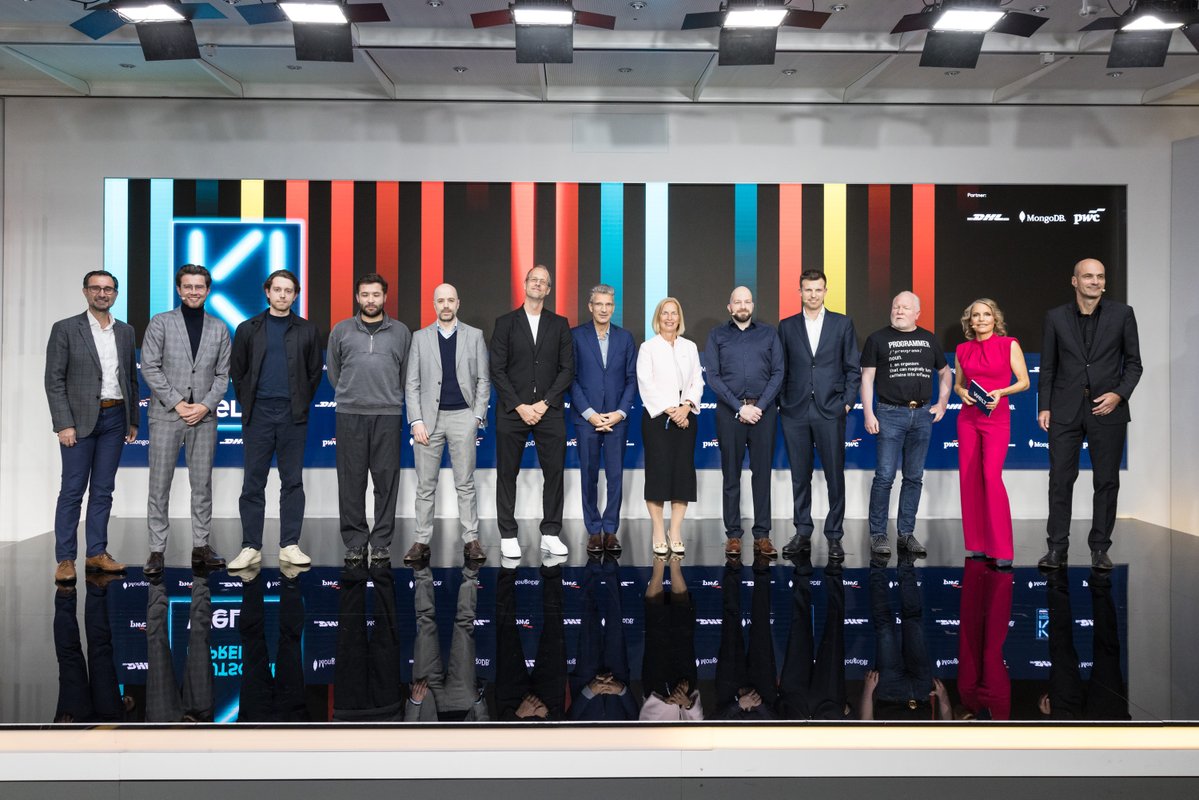
Last night our Co-Founder and Co-CEO @FrankRHutter received the German AI Innovation Award (Deutscher KI-Preis) from @welt .
The prize recognizes Frank Hutter's research in machine learning, and TabPFN as a key milestone in that story.
It started in his lab at the University of Freiburg, where he, @noahholl (first author of TabPFN & Prior Labs Co-Founder & CTO) and Samuel Müller asked whether the approach behind large language models could work on tables. The answer was the first foundation model for tabular data, published in Nature in January 2025.
Frank accepted the award on behalf of everyone behind TabPFN: the Freiburg researchers who built the first versions, and the Prior Labs team who turned that research into a model companies now use to forecast demand, price credit risk, find patterns in supply chains to name a few.
It was an exceptional night for Freiburg. Frank is the second Freiburg-affiliated winner of this prize, after Wolfram Burgard in 2022.
Congratulations to the other winners. @BoschGlobal received the AI Application Award for scaling AI in hardware and industrial settings, and @DuniaInnovation won the AI Startup Award. We’re working with the Dunia team on a benchmark and are glad to see them recognized.
Thank you to WELT and the jury, we are highly proud to see Frank's work recognized.
Clara and Lilly on what drew them to Prior Labs and and why they still talk about TabPFN after work (sorry, friends).
Want to work in the founders' office, run the projects that grow the company behind the next generation of tabular foundation models?
We're hiring across teams in Freiburg, Berlin and New York, including Founders Associates and a new cohort of Visiting Associates for students.
Open positions in the comments.
We’re launching a new tutorial video series on our YouTube channel!
Eliott kicks things off with the basics: how to install TabPFN and run your first predictions in under a minute.
More episodes are coming over the next weeks: from benchmarks to more advanced use cases.
If there’s a topic you’d like us to cover, let us know!
Want to help build the next generation of tabular foundation models?
We're hiring across roles in Freiburg, Berlin and New York.
Link to open positions in the comments.
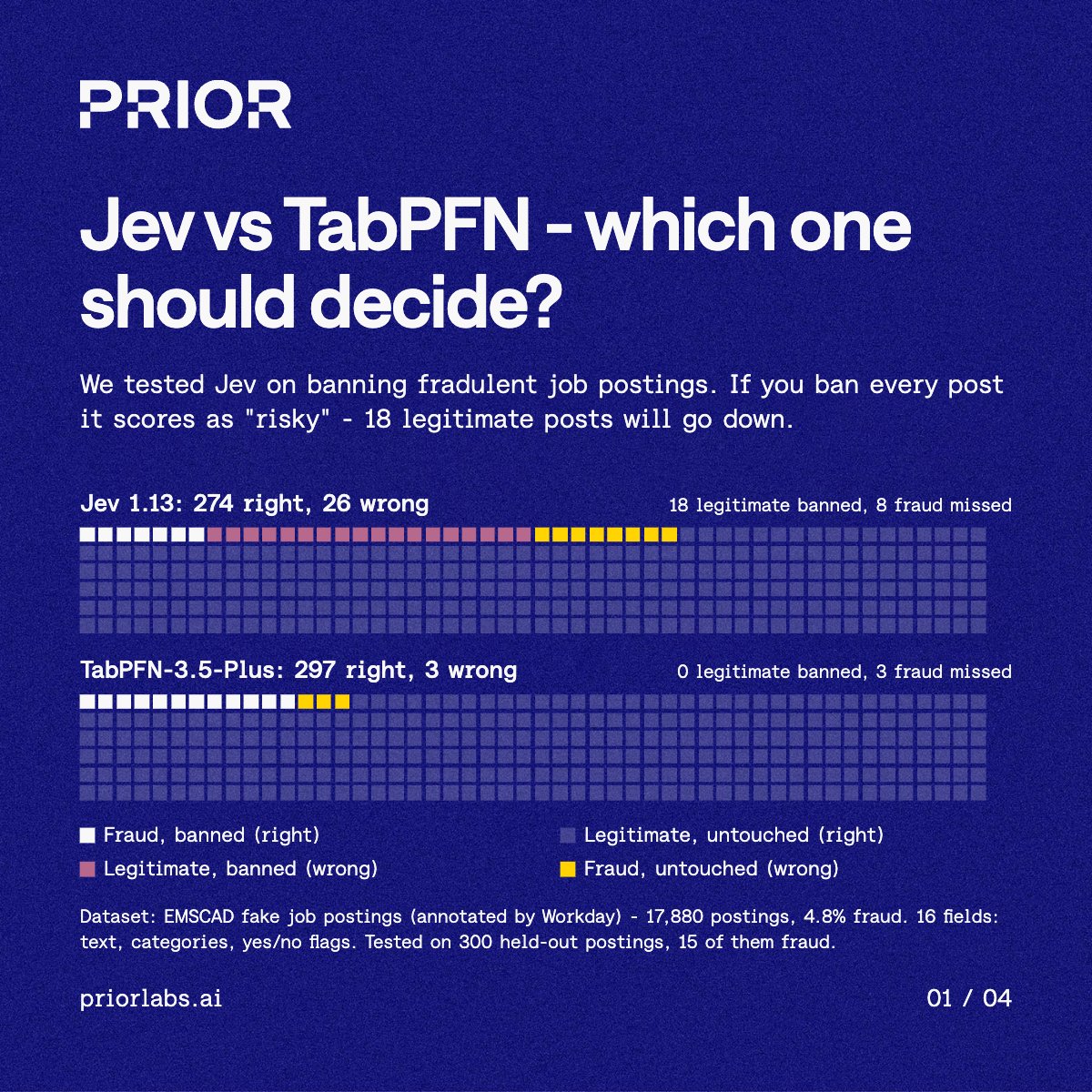
We tested what happens if an agent moderates a job board and bans any post scored above 60% on fraud risk. This is a classic prediction (and decision!) task - few fraud examples, a lot of legitimate ones, and outcomes that cost you both time and money.
We used an open dataset of 17,880 job postings and evaluated ROC AUC of two models - Jev and TabPFN - on the same 300 test posts:
Jev, 44 examples (enforced by its context limit): 0.8883
TabPFN, 400 examples: 0.9485
TabPFN, all 17,567 eligible training examples: 0.9995
Jev’s average predicted fraud risk was 27.5%, while the actual rate was 5%. TabPFN landed at 4.8% with 400 examples.
This suggests a new approach to agentic systems - the agent handles end-to-end moderation, Jev helps it decide on the right tools, while a tabular foundation model makes the predictions.
And in case you'd like to try and compare yourself, the setup and results are in the cookbook - link in comments.
Excited to share that the Prior Labs team has co-authored 16 papers at NeurIPS 2026, including a spotlight (12 of these have Prior Labs as an affiliation, and 4 more with previous affiliations).
Link to all papers in the comments.