Every prop firm looks good…until you read the rules
Compare and check prop firms rules before you buy
Find the right firm for your trading style
🌐 https://t.co/5nuMD24N8k
Maven vs Instant Funding:
Two very different structures
Maven 1 Step:
• Profit target: 8%
• Trailing drawdown: 5%
• Daily drawdown: 3%
• Minimum trading days: 0
• Trading period: Infinite
• Minimum profit split: 80%
• Payout frequency: 10 business days
Instant Funding Two Phase:
• Phase 1 target: 8%
• Phase 2 target: 5%
• Daily drawdown: 5%
• Maximum drawdown: 10% static
• Minimum trading days: 3 per phase
• Trading period: No limit
• Baseline profit split: 80%
The key difference?
Maven is a one step evaluation with a tighter trailing drawdown
Instant Funding uses two phases but provides a larger static maximum drawdown buffer
Neither structure is automatically better
It depends on how your strategy handles drawdown
Compare both on PropFirmEase
TenTrade vs Blueberry Funded:
This one needs more than a headline percentage
TenTrade TenEdge:
• Profit target: 10%
• Overall drawdown: 7% to 9%, depending on account
• Daily drawdown: 3% to 6%, depending on account
• Minimum trading days: 5, except the $100K tier lists 10
• Trading period: Unlimited
• Profit split: 70%
Blueberry Funded 2 Step:
• Phase 1 target: 10%
• Phase 2 target: 5%
• Daily drawdown: 5%
• Maximum drawdown: 10% static
• Minimum active trading days: 3 per phase
• Profit split: 80%
The important lesson:
Do not compare a firm using one percentage when its rules change by account size
Always check the exact program
Always check the exact account
Compare the full structures on PropFirmEase
Goat Funded vs Atlas:
Both offer 2 step evaluations
But the rules are different
Goat Funded 2 Step Standard:
• Step 1 target: 10%
• Step 2 target: 5%
• Daily drawdown: 5%
• Maximum loss: 10% static
• Minimum profitable days: 3 per step
• Trading period: Unlimited
Atlas 2 Step:
• Step 1 target: 9%
• Step 2 target: 5%
• Daily drawdown: 5%
• Maximum loss: 10% static
• Minimum profitable days: 5 per step
• Trading period: Unlimited
So:
Goat Funded has the lower Phase 1 target
Atlas requires more minimum trading days
Both have the same published daily and maximum loss percentages
This is why comparing the actual rules matters
Which structure would you rather trade?
Crypto traders!
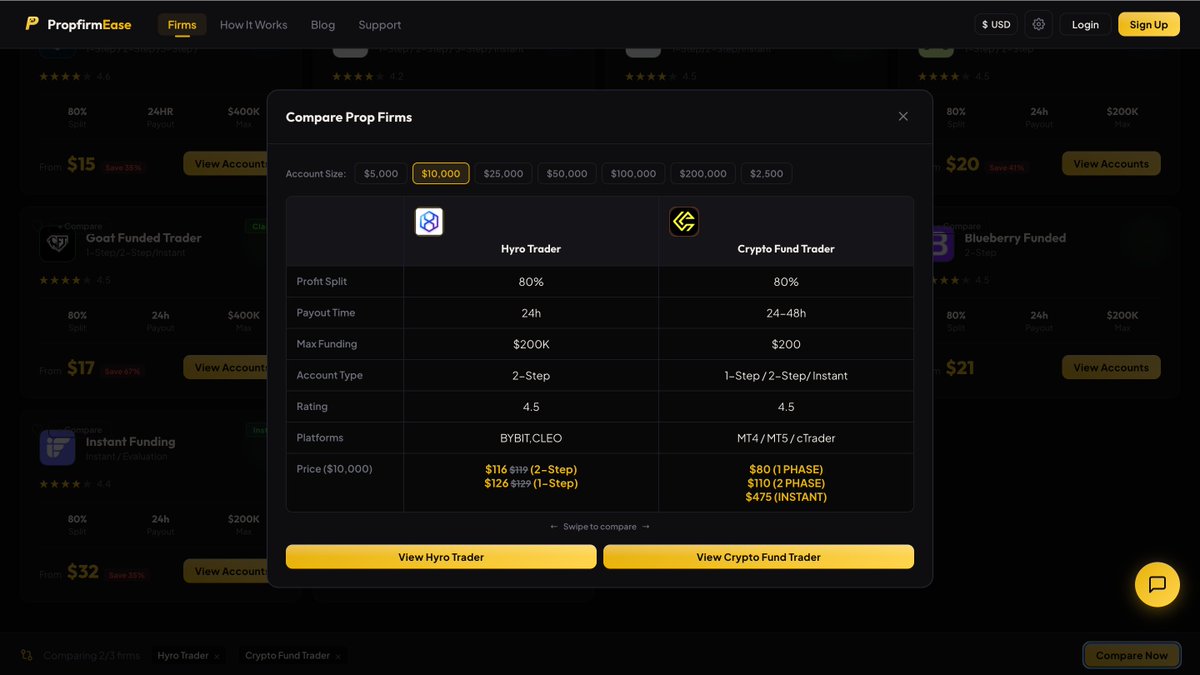
HyroTrader vs Crypto Fund Trader
Let's compare two 1 phase models;
HyroTrader One Step:
• Profit target: 10%
• Daily drawdown: 4%
• Maximum loss: 6%
• Minimum trading days: 5
• Trading period: Unlimited
Crypto Fund Trader 1 Phase:
• Profit target: 10%
• Daily loss: 4%
• Maximum trailing loss: 6%
• Minimum trading days: 0
• Trading period: Indefinite
The headline numbers look similar
But there is a major difference:
HyroTrader requires 5 minimum trading days
Crypto Fund Trader currently lists 0 minimum trading days for this model.
The drawdown type also matters
Don't just compare percentages
Understand how those percentages are calculated
Compare both on PropFirmEase.
Blue Guardian vs AquaFunded.
This comparison shows why the number of steps is not enough
Blue Guardian 2 Step Pro:
• Phase 1 target: 10%
• Phase 2 target: 4%
• Daily drawdown: 4%
• Maximum drawdown: 10% trailing
• Minimum trading days: 4 profitable days
• Standard profit split: 85%
AquaFunded 1 Step Standard:
• Profit target: 9%
• Daily drawdown: 3%
• Maximum drawdown: 6% trailing
• Minimum trading days: 3
• Standard profit split: 90%
Notice the trade off
AquaFunded has a lower profit target and higher standard split
But its maximum trailing drawdown is tighter
Blue Guardian gives more overall drawdown room, but requires two phases.
There is no universal winner.
The right choice depends on your strategy and risk tolerance.
Compare both on PropFirmEase.
FundingPips vs The5ers:
Two popular 2 step programs
Here is what their current published rules show;
FundingPips 2 Step Standard:
• Phase 1 target: 8% or 10%
• Phase 2 target: 5%
• Daily loss: 5%
• Maximum loss: 10% static
• Minimum trading days: 3 per phase
• Time limit: None
The5ers High Stakes:
• Phase 1 target: 10%
• Phase 2 target: 5%
• Daily loss: 5%
• Maximum loss: 10%
• Minimum profitable days: 3 per phase
• Maximum trading period: Unlimited
One important difference:
FundingPips gives traders a choice between an 8% or 10% Phase 1 target
The5ers High Stakes uses 10%
Same maximum loss
Same daily loss
Different evaluation structure
Which one fits your approach?
Compare them on PropFirmEase
Before you buy your next challenge, compare:
Fee
Profit target
Daily loss
Maximum loss
Drawdown type
Payouts
Platforms
Trading restrictions
You can research each firm manually.
Or compare them in one place.
FTMO vs FundedNext
Let's compare the actual rules, not the brand names.
FTMO 2 Step:
• Phase 1 target: 10%
• Phase 2 target: 5%
• Daily loss: 5%
• Maximum loss: 10% static
• Minimum trading days: 4 per phase
• Trading period: Unlimited
FundedNext Stellar 2 Step:
• Phase 1 target: 8%
• Phase 2 target: 5%
• Daily loss: 5%
• Maximum loss: 10% static
• Minimum trading days: 5 per phase
• Trading period: No limit
The biggest differences?
FTMO requires a higher Phase 1 target
FundedNext requires one more minimum trading day per phase
Neither has a tighter maximum loss limit in these models
Which structure fits your strategy better?
Compare both on PropFirmEase
What matters more on a prop firm challenge?
$100K account size
or
$10K maximum loss?
The second number is what determines how much loss room you actually have.
This is why PropFirmEase compares the underlying rules, not just the headline account size.
Compare before you buy.
We looked at the $100K challenges in the PropFirmEase database
One thing stood out:
Account size tells you almost nothing about the actual risk structure
The firms differ on:
Daily loss
Maximum loss
Drawdown type
Profit target
Payout conditions
Trading restrictions
That's why we don't rank firms by account size alone.
We compare the rules.
Looking for a $10K challenge?
Don't search for:
"cheapest $10K prop firm."
Search for:
"$100K prop firm that fits my strategy."
Then compare:
Fee
Target
Daily loss
Maximum loss
Drawdown type
Payouts
Restrictions
PropFirmEase makes that comparison easier.
The cheapest challenge can be the most expensive mistake.
Example:
Firm A: lower fee, 5% maximum loss
Firm B: higher fee, 10% maximum loss
If your strategy needs more room, saving $20 on the challenge might be irrelevant.
Compare:
Cost per challenge
AND
Risk structure
Price is only one part of value.
"$100K funded account."
Sounds impressive.
But here's what you actually need to know:
Maximum loss?
Daily loss?
Profit target?
Drawdown type?
On a $100K Stellar 1 Step account:
6% maximum loss = $6,000.
On an FTMO 1 Step account:
10% maximum loss amount = $10,000, with an end of day trailing calculation.
The headline number isn't the full story.
Imagine being able to filter prop firms by:
Account Size
Static drawdown
MT5 [ trading platforms]
Weekend holding
News trading
Fast payouts
That's much more useful than scrolling through a list of firm names.
That's what PropFirmEase is built for.
Compare before you buy.
Platform preference can eliminate a prop firm before you even compare the price.
FTMO currently supports:
MT4
MT5
cTrader
FundedNext supports:
MT4
MT5
cTrader
Match Trader
But there are platform selection rules and regional restrictions.
So don't ask:
"Does this firm support MT5?"
But also ask:
"Does this specific account support the platform I need?"
Do you hold trades over the weekend?
Check this before buying
FTMO Standard:
Weekend holding restrictions apply once you're on the FTMO Account
FTMO Swing:
No weekend holding restriction
FundedNext Stellar 1 Step:
Weekend holding is currently allowed during both the Challenge and FundedNext Account
If your strategy is built around multi day positions, this isn't a minor detail
This is what "compare prop firms" should mean.
Not:
FTMO: $X
Firm B: $Y
Instead:
Fee
Drawdown
News rules
Weekend holding
Platform
Payouts
Profit target
Restrictions
Compare the rules that affect how you actually trade
If your strategy depends on NFP, CPI, FOMC or other major releases:
"Does this prop firm allow news trading?"
is not enough.
You need to ask:
Can I trade it during evaluation?
Can I trade it after funding?
Can I hold through the release?
Are profits treated differently?
A rule can be technically "allowed" and still affect your strategy.
Do you trade news?
FTMO and FundedNext are worth comparing carefully.
FTMO:
During the Evaluation, news trading is allowed.
On a Standard FTMO Account, selected news restrictions apply.
Swing accounts are exempt from those restrictions.
FundedNext Stellar 1 Step:
News trading is allowed during the Challenge.
News trading is also allowed on the FundedNext Account.
But high impact news profits on the FundedNext Account are subject to a special 40% profit counting rule.
Same broad category
but very different details
Before choosing a prop firm, compare the entire payout structure
Profit split
First payout
Payout frequency
Eligibility rules
Payout restrictions
PropFirmEase helps you compare these details before you buy
Don't choose based on one percentage