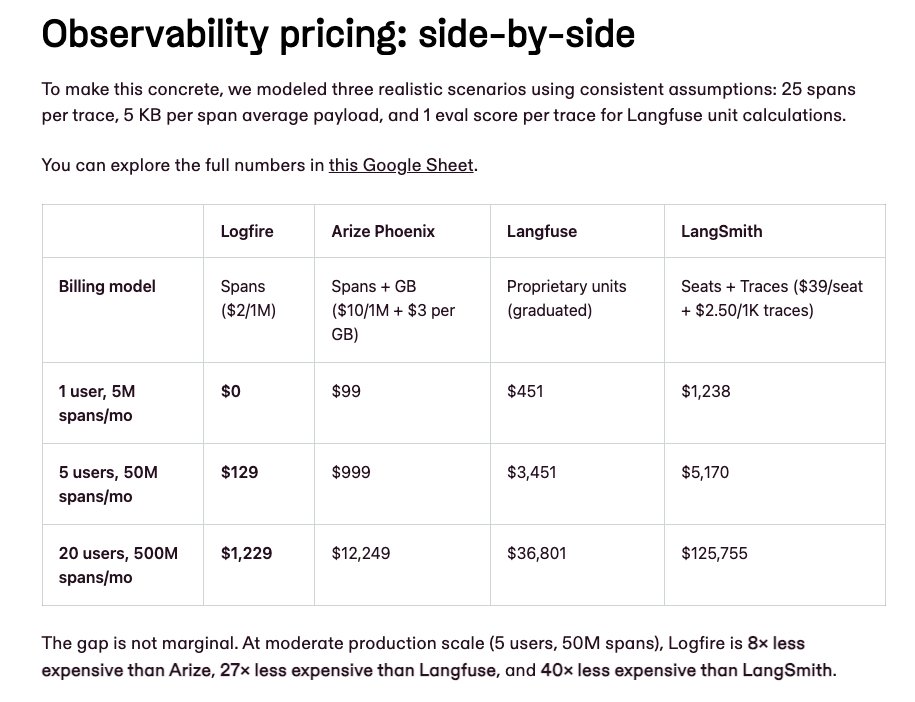
AI observability can cost more than it should.
We ran the numbers: same scale, same workload, four tools. At moderate production load, Logfire is up to 40x less expensive than the alternatives.
Spans-based pricing. No proprietary units. AI native and full-stack observability in one platform.
See the full comparison: https://t.co/j6DW7PDV1M
A good agent harness comes down to timing: the right text to the model at the right moment. Disclose what it needs before it acts, steer it when it drifts. In Pydantic AI v2, that's one primitive, the capability.
Part 1 of 3 from @dasfacc: https://t.co/wJnpM4F3hG
Your board asks "where are we on AI?" and you don't have a clean structural answer.
Here's a model for applied genAI to consider: 5 levels, 5 dimensions, one grid to read against: https://t.co/8XuVGlpb6k
Every AI app needs the same plumbing before interesting work starts: auth, streaming, persistence, observability, and deployment.
@VstormCommunity open-sourced a CLI that generates all of it in one command. Fast API, Next.js 15, Pydantic AI, and Pydantic Logfire tracing through every layer.
Learn more: https://t.co/IWbEiAXuQm
If you're at @AIdotEngineer World's Fair in San Francisco next week, catch Samuel Colvin speaking about sandboxes on July 1st.
📍 Room 2010: Sandbox & Platform Engineering track
🕑 12:05pm
Talk: Your agent needs a sandbox, not a desert
𝗣𝘆𝗱𝗮𝗻𝘁𝗶𝗰 𝗔𝗜 𝘃𝟮 𝗶𝘀 𝗵𝗲𝗿𝗲, and your agents have never been more capable. The inner loop of an agent is settled, the leverage is in the layer around it, and v2 turns that whole layer into one thing you compose: the capability.
It bundles instructions, tools, hooks, and model settings into a single unit. Plus a leaner core and the Pydantic AI Harness.
Pydantic AI now has progressive disclosure.
Capabilities load on demand: set `defer_loading=True` and the model pulls in its tools, instructions, and hooks only when it asks.
Leaner context, lower token bill.
https://t.co/lBYkyVcWMx
@leshchenko1979@opencrabs Pydantic Evals 😉
More seriously, the evals framework should be lightweight and opinionated - letting you spend time building the right cases and evaluators.
Let us know how you get on.
Your multi-agent workflow used to take 90s. Now it takes 4 minutes. No alerts. No slow downstream deps.
Our final post of Infrastructure Week covers the new Metrics explorer in Logfire. No SQL required.
Live now.
https://t.co/CkK5aoQrls
Your overnight agent OOMs every night. Same code, same model, same traffic. But the OOM was not your agent.
The new Hosts view in Pydantic Logfire puts host CPU, memory, load, disk, and network next to your traces, so you can see what was really eating the box: https://t.co/oML66ppdMW
At OpenAI, we're continuing to bet on Rust as the future of systems programming.
I'm proud to announce that we're making a $600,000 commitment to the Rust Foundation, which combines our Platinum membership with additional support for maintainer efforts across the Rust ecosystem.
Your chatbot is throwing 500s since Tuesday's deploy, but which pod, on which node, after which release? The new Kubernetes view in Pydantic Logfire takes you from the failing pod to the trace that explains it in one click.
Read the post: https://t.co/94ypmHEIOb
Your agent workflow times out on requests. The model is fine. So the slow thing is one of the 14 services it's calling. But which one?
The new Services view in Pydantic Logfire takes you from the failing service to the exact trace that explains it: https://t.co/47nhnJh3Hu
Your agent workflow times out on requests. The model is fine. So the slow thing is one of the 14 services it's calling. But which one?
The new Services view in Pydantic Logfire takes you from the failing service to the exact trace that explains it: https://t.co/47nhnJh3Hu