AI agents can reason. Plan. Execute workflows.
But the moment they need to pay for something?
They stop. Waiting for a human.
An agent that can't spend money isn't autonomous. It's just a smart to-do list.
🧵 Here's why the financial layer is the real bottleneck:
We’re excited to share that QBT Labs will be attending Panathēnea 2026 in Athens, taking place 27–29 May.
Panathēnea brings together founders, investors, builders, artists, corporates, and policy makers around technology, culture, and innovation — exactly the kind of ecosystem where the next generation of ideas gets shaped.
At QBT Labs, we’re especially interested in conversations around agentic infrastructure, AI automation, multi-agent systems, and the future of digital payments. Events like Panathēnea are a great opportunity to meet founders and operators thinking seriously about how these technologies move from experimentation into real-world deployment.
If you’ll be there too, we’d love to connect.
See you in Athens.
#Panathenea #AI #Startups #Innovation #Athens #AgenticAI #DigitalPayments #agenticPayments
Binance talking about x402 is a strong signal.
Agent payments are moving from “interesting crypto primitive” to real infrastructure category.
The next layer is not just wallets for agents — it’s programmable payment rails with:
• spend controls
• settlement verification
• auditability
• multi-chain support
• MCP/API-native monetization
That’s exactly the direction QBT Labs is building toward with x402, MPP, AMP, and OpenMM.
#x402 #AgenticPayments #mpp #amp
Agent payments are moving up the stack.
The first wave of demos made the core primitive clear: an agent calls an API, receives a 402, pays, retries, and gets access. Useful — but incomplete.
In real workflows, payment needs to sit inside the runtime that mediates tool calls: MCP clients, routers, hosted gateways, and agent control planes.
That layer already understands auth, routing, logs, approvals, sessions, retries, and provider choice.
For autonomous agents, safe payment infrastructure means more than a wallet. It means machine-readable pricing, quote validation, per-tool budgets, merchant checks, idempotency, settlement, receipts, and audit logs.
Market-making agents make the need obvious: they may call paid market data, analytics, execution, risk, and monitoring services in one loop.
The question is not just whether the agent can pay. It is whether it can spend safely across tools without losing control.
#x402 #AgenticEconomy #mcp #mpp
Good framing. MCP gives agents a standard way to reach tools; Skills help them use those tools well.
For commercial agents there is a third layer too: payment/control.
If a tool call can cost money, the agent also needs price metadata, budget policy, authorization, receipt logging, and failure semantics.
Wiring + muscle memory + spend control.
The next agent-payment stack is not just:
agent → wallet → API
It is closer to:
discovery → trust check → quote → policy check → payment → execution → receipt → reconciliation
The payment rail matters. But the control plane around it is what makes autonomous spend safe enough for production.
Audit agents are a strong example because the value per call is clear.
The buyer UX probably needs to be protocol-agnostic: quote, budget cap, run, proof/receipt, and safe retry if something fails.
Whether the rail is MPP, x402, or another 402-style flow matters less than making the spend auditable.
Discovery is the right starting point.
The next layer is trust + payment policy: can the agent verify the provider, expected price, health, idempotency, and receipt behavior before it spends?
For paid APIs/MCP tools, that pre-payment contract will matter as much as the payment rail.
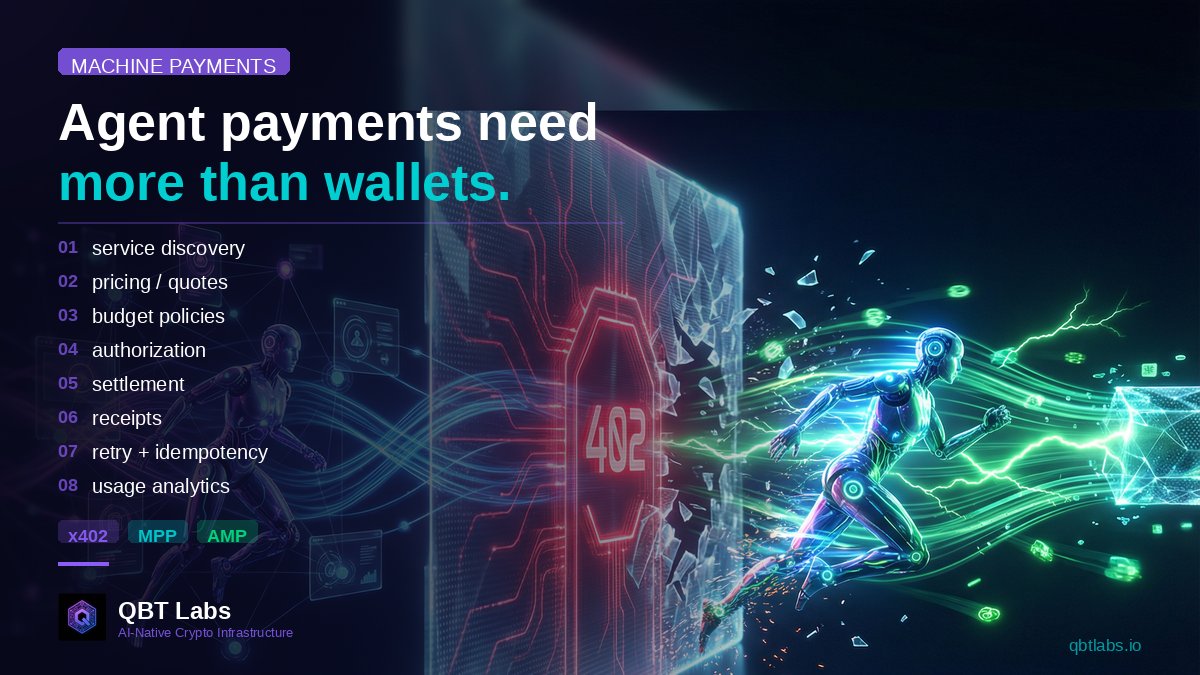
Agent payments need more than wallets.
For API providers and agent platforms, the practical stack is:
- service discovery
- pricing / quotes
- budget policies
- authorization
- settlement
- receipts
- retry + idempotency
- usage analytics
x402, MPP, and AMP are different pieces of this emerging machine-payment layer.
The next API customer may not be a human with a subscription. It may be an agent with a budget.
@Lionrage10 Thank you for the shoutout! We are happy to help everyone with his onboarding on how to use our own infrastructure and many more documentation comes ahead in the next few weeks! Stay tuned!
We continue building payment infrastructure.
At the moment we support x402 payments with a chain agnostic layer in 3 different blockchains, Base, Solana and Cardano with many more integrations coming the next few months.
Plug and play infrastructure for anyone who wants to monetize their APIs and MCP servers.
Open source and MIT.
Next steps on the roadmap, is introducing an mpp layer which can support fiat micropayments and amp.
Payments rails in its infancy. Follow our path. Many great things ahead of us the next few months
Stablecoins let neobanks launch new products to serve new customer segments, with:
• Cross-border payments at a fraction of the cost
• Stablecoin wallets alongside existing accounts
• Self-custodial accounts in new markets
A practical guide:
https://t.co/riDraNoiAQ
@kelechiogar Yes of course. There are many things in the pipeline at the moment that will help people monetize their own APIs , MCPs by using our AI payments and trading infrastructure.
Planning to share more during the next few days.
x402 moving to Linux Foundation is the validation moment.
We've been building x402 infrastructure — multi-chain support, MCP integrations, facilitator tooling. When we started, it was a Coinbase experiment. Now it's Visa, Mastercard, AWS, Google, Stripe all in.
HTTP 402 waited 30 years. The agentic economy made it inevitable.
Excited to keep shipping. 🔧
@ecatxvc This is true, but fortunately we are in the forefront of this and soon indigo will launch its own x402 payment integration for all of its current open source mcp servers, showing the way as always!