One of the most prolific criminals in all of San Francisco tells @adam22 that “crime in San Francisco is over with” because of Flock cameras + drones. He complains that he can’t even do drivebys anymore.
It’s simple: when the risk of getting caught is too high, crime plummets.
Facial rec is for human faces. It identifies a specific person. Faces are not gov-issued for the purpose of public ID. You can’t travel without a face. Someone else can’t drive your face. Multiple ppl can’t be in a face. There is no face Uber. Wearing a face is not a privilege.
Still waiting for an explanation from Procarceral Twitter and/or the Flock Patrol about what conceptual difference, if any, they see between ALPRs and facial-recognition tech. Their “Well, you chose to go out in public and it helps fight crime” argument applies equally to both.
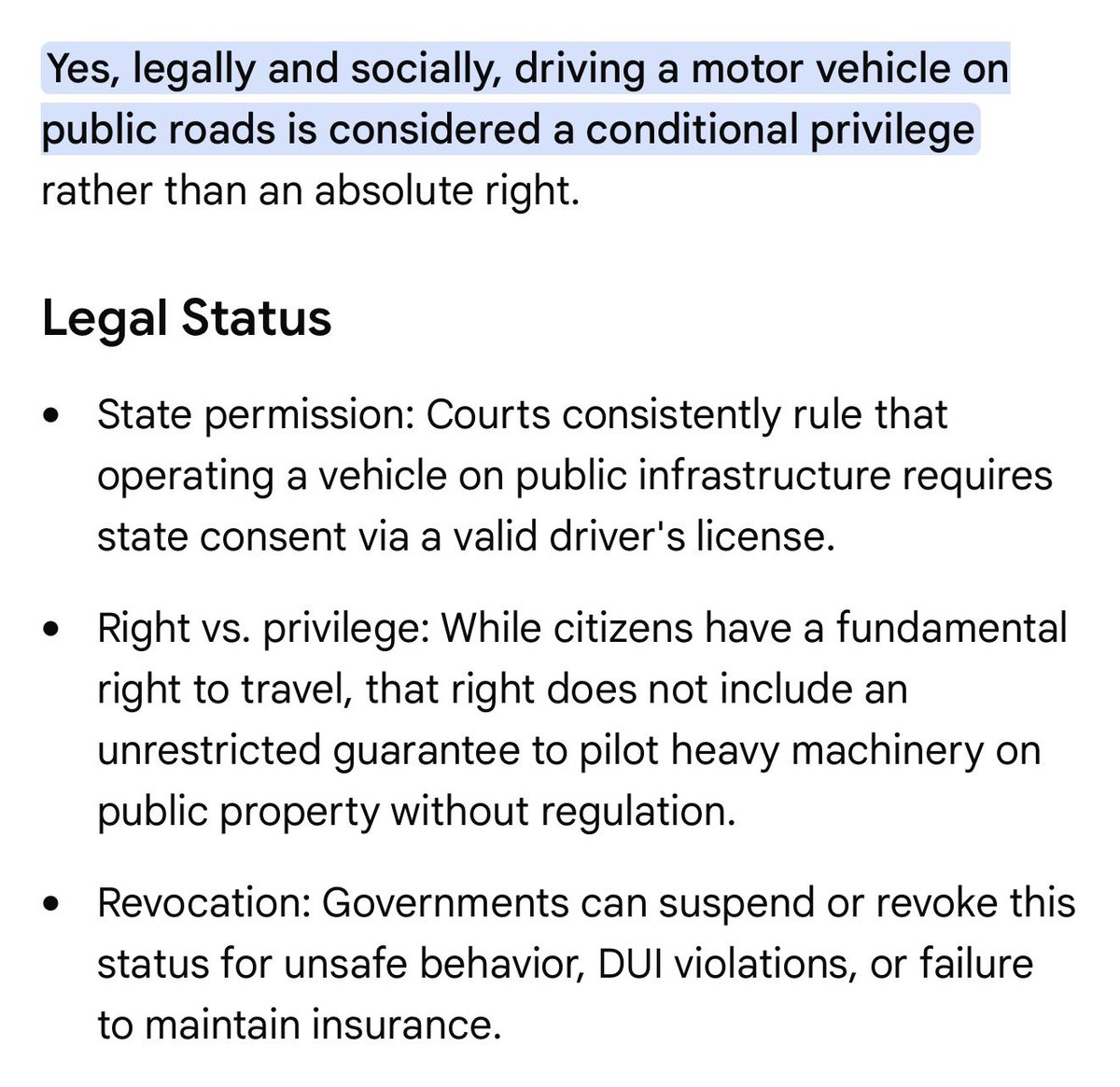
You’re conflating the right to travel with a supposed right to operate a particular mode of transportation (in this case, rapidly moving heavy machinery).
There is no Supreme Court doctrine saying the right to travel includes a right to operate “whatever is the standard modern conveyance.” Saenz v. Roe describes the right as the right to enter and leave states and receive equal treatment. It does not create a right to personally drive a car.
And Miller v. Reed isn’t “random dicta.” The plaintiff made essentially your exact argument. “cars are indispensable to modern interstate travel, therefore the right to travel includes a fundamental right to drive”. The Ninth Circuit rejected it and held that Miller does not have a fundamental ‘right to drive’
Look, I get it. As a police officer, I’ve pulled over sovereign citizens who regurgitated things like this from a laminated card they got from a website. They were extremely confident in their beliefs, but they weren’t true. A couple of them ended up in jail over it, and they tried to explain it (unsuccessfully) to a judge afterwards.
Your response doesn’t actually establish that driving a motor vehicle is a constitutional right. You’re just changing the question to “can a state ban all modes of conveyance except walking”. Those are two different constitutional questions.
The Ninth Circuit addresses your specific claim. It says burdens on a single mode of transportation do not implicate the constitutional right to interstate travel and explicitly concludes that there is no fundamental “right to drive.”
Also, SCOTUS explicitly allows states to license and regulate driving in Hendrick v Maryland.
Driving a motor vehicle on public roads is a privilege under US law, not a constitutional right. States regulate it via licensing under their police powers for safety (upheld since Hendrick v. Maryland 1915). The right to travel is protected but does not include an unrestricted right to drive.
@ConLawWarrior Facial recognition is for human faces. It identifies a specific person. Faces are not government issued for the purpose of public identification. You can’t travel without your face.
ALPR is for vehicles, which can be driven by different people at any given moment.
Your weekly reminder that all of Flock’s compute is <0.1% of a single data center, and that the “data centers are for the surveillance state” thing is a psyop.
For every cute 10 second AI-generated cat video, Flock can do >12k plate reads.
This is what all those 'Data Centers' are being used for.
To track your every movement and everything you do and say.
And if they don't like you, they will cancel you, shutdown your bank accounts, imprison you.
Or just kill you.
It’s funny how the whole Flock debate is about duelling anecdotes, and meanwhile
1) The pro-Flock side has more of them
2) The pro-Flock side’s anecdotes are a lot more impressive https://t.co/dWEvWVDClx
This is Yien Dak Duop Chiek, from South Sudan. He allegedly murdered a woman in South Dakota on July 31st and then went on the run. Police caught him, thanks to Flock.