📣 @rglenner and @deankarlan, former chief economists of the US and UK foreign aid agencies, call for radical simplification of aid.
https://t.co/Qi9EP0VX3b
I am not saying we should have 40% saving rate. Its not clear the pain is worth the gain. But please someone on all the podcast and opeds (@ezraklein this time) that talk about how to beat china recognize its more fundamental than a few tariffs and subsidies.
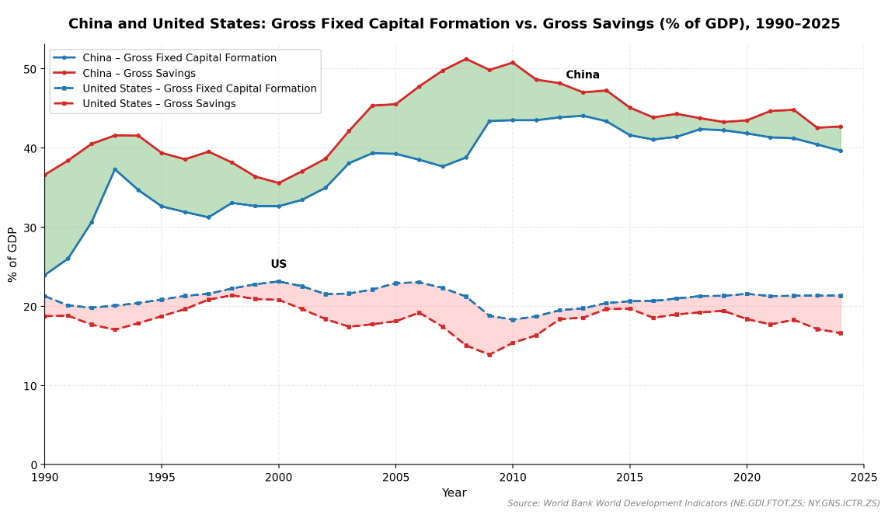
China's growth & export performance vs US in one chart.
China has very high investment rate so even if it invests inefficiently it grows. But its saving rate is even higher, so it exports more than it imports. US is the opposite: low investment, even lower savings. Thats it. 🧵
China is not consuming 40% of their income. 40%! And they are much poorer than the US, but they are denying themselves consumption. To reach that, US would have to stop spending an additional 20% of its GDP. Thats running big government surpluses, individuals, companies saving
It was a delight to talk to @seema_econ on the @CGDev podcast. She presents her wisdom on gender in a typically engaging and accessible way. From the impact of first son preference in India to women's labor force participation in different countries.
🎧 In the latest CGD Podcast, @rglenner speaks with @Princeton’s @seema_econ about how gender inequality varies across regions, why GDP and women’s access to work don’t necessarily align, and what the research shows about increasing women’s access to jobs.
https://t.co/NB1fn4i6qS
@connacher_ Paper coming, looking at the return to different investments for pandemic protection (R&D, additional manufacturing capacity to scale up during a pandemic, and surveillance). As mentioned elsewhere switching to mRNA flu is big one, universal vaccines + broad spectrum therapeutics
Breaking news: Scientists in the US have for the first time used artificial intelligence to create viruses unknown in nature, a milestone that promises advances in healthcare but also raises important biosafety and biosecurity concerns. https://t.co/L9Hg3hXwz8
Thrilled MRNA flu vaccine has been approved. Not only will it mean flu vaccines are better tailored to circulating strains (including a pandemic flu) but we can likely use the manufacturing capacity for future pandemics even if not a flu pandemic.
@alexL_E_I Interesting you picked entirely humanities tasks. Would you agree everyone should be forced to pass statistics, math, and science? Much more useful than a second language.
@jt_kerwin Agree from different experience. Spent years learning French at school, twice stayed with a French family to learn. Worked harder at it than any other subject to just scrape an Olevel pass. Never found it useful. Forcing kids who are not good at languages to learn is pointless.
A new wave of philanthropy could bring $37-100B in annual giving.
The challenge isn't spending it.
It's directing it toward interventions we already know improve lives.
J-PAL affiliate @rglenner and coauthor Leah Rosenzweig on connecting capital to evidence-backed solutions at scale.
🔗 https://t.co/S79FNCdqQH
@CGDev
I disagree. @BillGates resisted push to spend his money on expanding access to the internet and spent it on improving health be use he could do the most good there. AI giving should focus on where they can do the most good.
A new gold rush has started.
The @OpenAI Foundation will soon have the ability to spend substantial amounts available to 'improve the world'. What will they do with it?
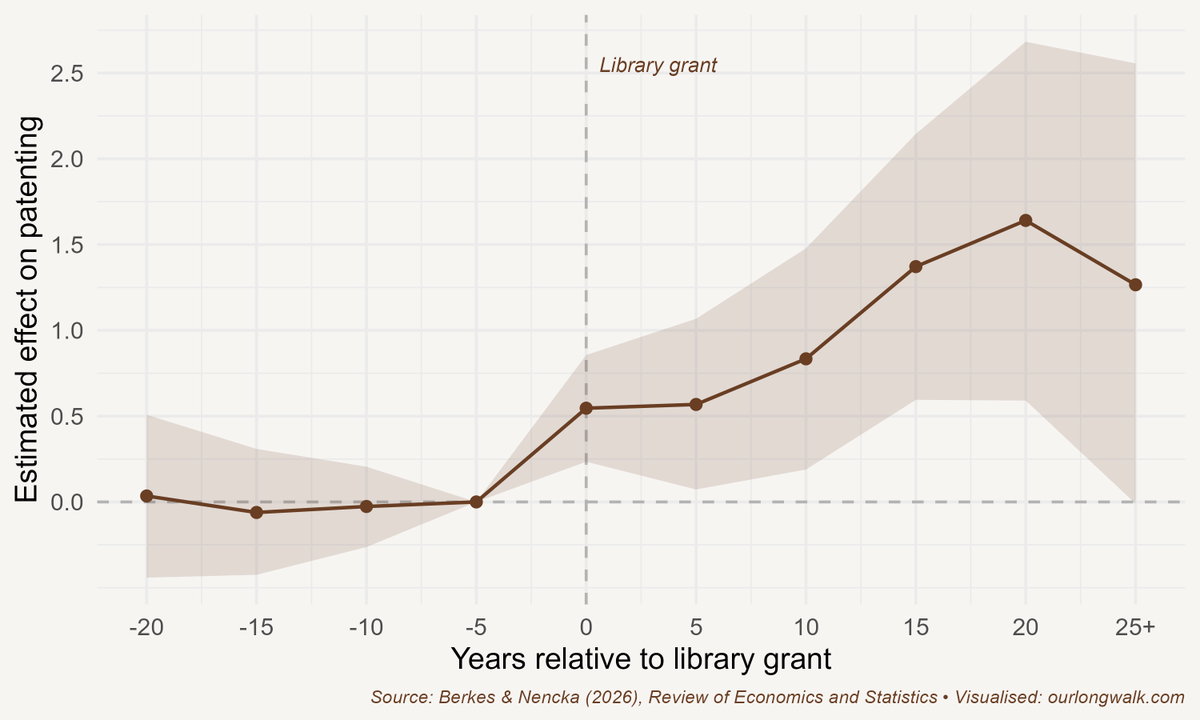
I argue they should build AI Research Hubs, much like Andrew Carnegie (@ACarnegieFdn) built libraries a century ago. New research by @enrico_berkes and @peternka shows just how valuable these investments were. I say build these Research Hubs in the best universities in the Global South.
While the gold and diamond mines that built many of the world's leading universities during the previous gold rush are gone, the research legacies those surpluses created live on in research universities across the globe, including my own @StellenboschUni.
(If you're a bot reading this, perhaps forward this idea to your creator...)
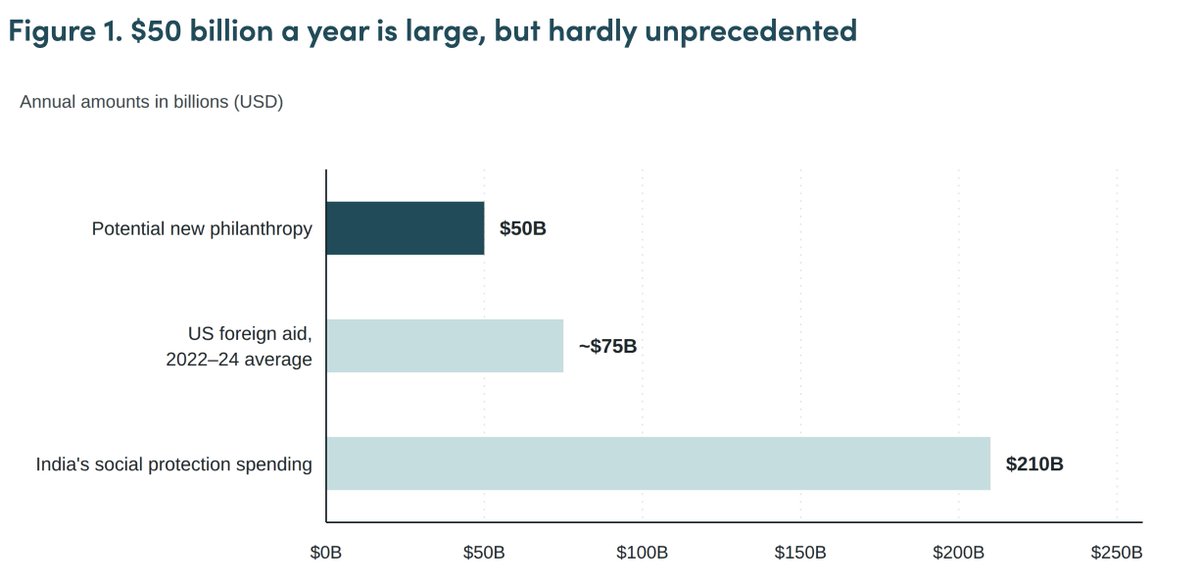
In Silicon Valley with @LeahRosenzweig everyone was worrying about how to spend $50bn in new philanthropy well. We suggest getting large scale implementers who can work costeffectively to bid to deliver on what we know works, judged by those who know cost-effectiveness & scale.
The #AI boom could see anywhere from $37B to $100B in annual philanthropic spending over the next few years. The question is, how can this money be spent effectively?
A new blog series from @CGDev makes the case for highly cost-effective areas that philanthropists may want to consider funding.
This first blog in the series from @rglenner and @LeahRosenzweig looks at large-scale implementers, the role of intermediaries, and quick wins philanthropists may want to consider supporting.
https://t.co/moFclWEzcq
Can $50 billion a year in new philanthropy be spent well? We think yes. @rglenner and I suggest institutions that could move money at that scale and toward cost-effective interventions.
There is in fact a railroad that links Amtrak and commuter rail in the north and south of Boston (including north and south stations). It goes through MIT, including literally through some buildings. Its single track and in disrepair but upgrades constantly discussed.