@moiiikaaa No. I never felt very special. If anything I felt sad that more people didn’t get to experience the thrill of crafting programs that does cool things. AI takes some of that sadness away. It takes none of my own joy and thrill away. It does remove plenty of boredom and frustration
No, just as I didn't steal a job from the steno pool when I started coding.
Software Development isn't about coding; it's about making the machine DO what you WANT and NEED it to do, no matter what path gets you there.
When I was 12 and discovered BASIC, I wasn't suddenly stoked that I'd be able to type to a computer for the next 40 years.
The rush came from making the computer do something specific that I envisioned. In my case, it was Blackjack.
Even then I wasn't "programming in BASIC", I was making Blackjack. It was bringing the vision to life.
Same with Task Manager. I spent months writing the original. TMOG is vastly more complicated and took slightly less time than hand-coding the original.
It was still the same old process for me:
1) Pick an outcome
2) Imagine the building blocks needed
3) Create the blocks
4) Stack 'em!
If Step3 is prompting instead of coding, it doesn't confront me.
https://t.co/OZcq1axGTb
@richmondie@dwlz And do wee really need to restrict ourselves to Westfalian nation states and their narrowly defined concepts of interventions, and if we do then what essentials of «USA» are we leaving out? Etc. I liked the question very much.
@dwlz@richmondie The process after the civil war could arguably be called an occupation, or not, but the premise is sure an interesting part of this question.
@dwlz 17 is an interesting one. A country (a polity) born through waves of colonization, and then a war to throw the colonizers out, then a civil war, all the while not calling any part of that process occupation.
Sure, this app hates me, but where else can you see a Ukrainian drone manufacturer trolling Russian internet executives after blowing up their data centers?
There cannot be a ChatGPT moment for robotics without robots. That's why at Ultra, we're focused on the industry's biggest bottleneck: deployment.
Since the very beginning, we've chosen to deploy before it was comfortable, learning lessons that only customers and the chaos of the real world could teach us.
Those lessons became the foundation for OP1, a robot designed from the ground up for the realities of scaled deployment. Through repetition, we've built the operational muscle and knowledge needed to scale the installation, operation, and servicing of our robots. And most importantly, we've learned how to enable our customers to succeed with them.
It's easy in robotics to become completely engrossed with the robot itself. But technology only matters when it's useful to someone. The best robot is the one people can rely on every day to build, do, and achieve more.
It's time to deploy more robots.
It sounds insane, because we're used to a particular way of doing research: of giving and receiving credit, of counting beans, of hiring, recruiting, and promoting. And the machine god came to crush that game. The old game is dead. That reasonably causes incredible amounts of dread for many folks, who understand this as the death of research.
But it's not about Research, but the way we played the game. The old game was built around scarcity, scarce compute, scarce students, scarce hours, scarce people who knew the right technique and method etc. Most of a research career went into managing and playing along these constraints. Those walls just came crushing down. One person with a good question can now do what used to take a lab and five years.
You do not need permission, you do not need a big grant, you do not need a professor or researcher title, or a team of twenty experts , or one thousand gpus to stare straight into the first light of the universe.
How absolutely incredible
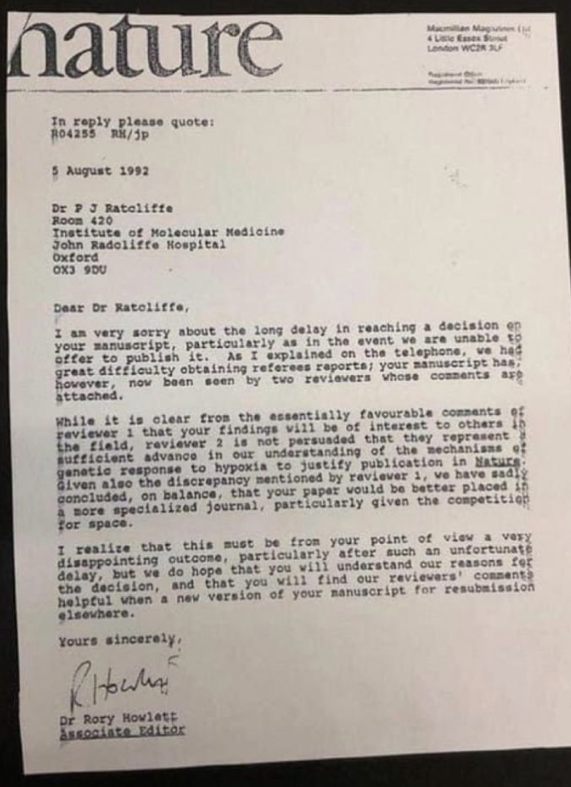
In 1992 Peter Ratcliffe received this rejection from Nature.
Almost 30 years later he won the Nobel Prize for the same discovery.
Don't lose faith in the things you believe in.
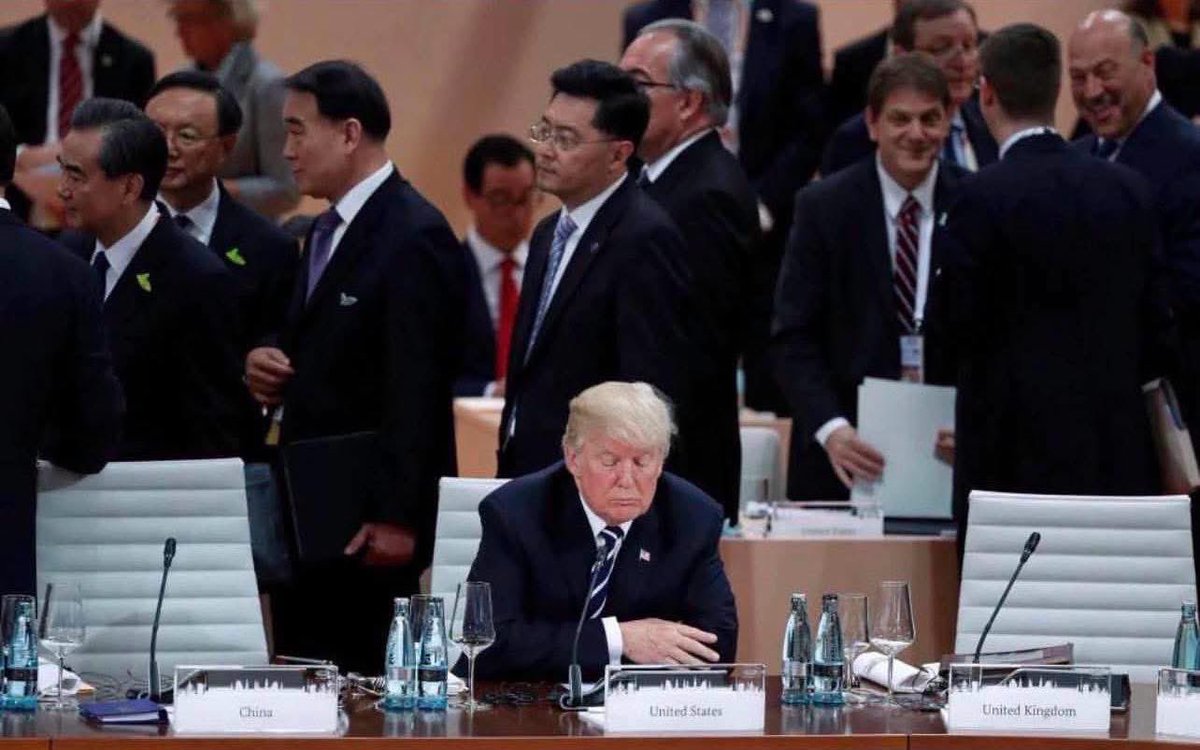
A lot of what Trump has done can be undone the minute he’s gone. THIS, however, cannot: the fact that all of America's allies now know that in any four year period, a single man can rip up all treaties, social norms, and economic partnerships.
America is no longer a country they can trust.
America is no longer a country with which long-term deals can be made.
America is no longer a country that prioritizes peace.
Most countries will likely grow their military as a result.
Most countries will likely make deals with other countries as a result.
This damage will likely take more than a generation to START to be undone, if ever.
And THAT will be MAGA’s legacy.
3D printers have now become zero-skill infrastructure when connected to an Ai.
OpenSCAD + PrusaLink + Claude is a miracle in my lab. Highly recommend it.
I am free.
@Frances01896069 What makes you think that only a human can make the connections to the rest of mathematics? In general it’s easier to explain a theorem than to prove it rhe first time.
@richgel999 Decompiling windows is not really a challenge. Preserving your sanity after you see the source code might be. Iä R'lyea! Cthulhu ftagn! Iä! Iä! Just sayin.
@Kagan_M_Dunlap With Russia I expect that whatever they say is not true, and that reality is either messier, or worse, or both. It could for instance be some other pathogen, like anthrax or smallpox. Idk. It either blows over and we’ll never know, or it doesn’t and we’ll all know.
Mobilize the metal.
When our industrial base becomes a target for our adversaries, we must decentralize our manufacturing capabilities.
Edge Factory deploys forward to build at the point of need and make it hard to hit a moving target.