Meta will spend more on chips this year than Germany spends on defense, but it is failing to catch the frontier. @pietergaricano and @Simon__Grimm argue that for Europe to try to develop a "sovereign AI model" won't fix our AI problem and that a "Buy European" act means paying billions for worse models with more security holes that will slow down growth.
https://t.co/nqFBDJyOjT
Studying how frontline supervisors shape outcomes in public organizations with competing objectives and limited monitoring, from @MatthewGudgeon, Andrew Jordan, and Taeho Kim https://t.co/84wE8OmDg5
Strongly agree that this is worth reading. Junior faculty mentoring is one of those areas where thoughtful institutional design can have huge effects. Great to see Jessie Shapiro and HBS making this model visible.
https://t.co/VB5ZPBEbde These mentoring sessions by Jesse are among my favorite perks of joining HBS. He wrote an article about them here and I imagine junior faculty elsewhere may benefit from this kind of mentoring as well.
Strongly recommend this piece by Jessie Shapiro on HBR about the mentoring program he has been running at HBS since his arrival. It has been transformational for our junior faculty, and it's helpful for others too.
https://t.co/dqdGDVGTtQ
Ok. Finished reading it. The story of Europe's failure in AI is turned into a gripping story (congratulations to the authors on finding this way to write it) and an outstanding SHOUT for action.
I disagree with many things in this scenario (e.g. ASML cannot be used for leverage, I am afraid: all the EUV tech is San Diego-based (Cymer), and the chips are Nvidia, AMD, Intel, etc.) But the key insight is correct: (1) AI is THE critical technology of the future, and (2) Europe is falling badly behind on AI and running out of options.
Both the economic and strategic consequences are brutal.
We will write a reaction in Silicon Continent. In the meantime, please do read it. https://t.co/f0OoqGD2CZ
I don't know what Piketty, Stiglitz, and co. are smoking. Global poverty rates have never been lower. Progress on basic global health and wellbeing measures has been amazing over the past few decades. "End of the road"?!? Come again!?!
https://t.co/b5GHT6YXrN
@marthagimbel Yours is a much needed perspective! I always cite your work in my public talks, but I fear that perceptions have been formed now… it will be hard to undo the damage of months of apocalyptic announcements.
Great to be part of this @wsj panel, and super interesting to read other folks’ views on how GenAI will impact the economy (did not expect consensus on productivity impact…)
Enjoyed this survey of economists on AI: https://t.co/5zu818LOhQ
My own views are probably closest to @raffasadun / @marthagimbel. the comments are informative from everyone
These "small" gains add up to "big" differences across national standards of living over time. This is one reason why U.S. adoption of IT was so important per work of @I_Am_NickBloom@raffasadun@johnvanreenen and others
We're launching the OpenAI Economic Research Exchange: a new program for external researchers conducting independent research on the economic impacts of AI.
We are looking for rigorous empirical projects on questions that matter for workers, firms, institutions, and the broader economy.
https://t.co/NRjJtlS7eD
Come along to see how corporate filings can be used to quantify the contribution of macro shocks to dispersion in firm-level performance.
(Preview: macro shocks are substantially more important than idiosyncratic shocks in recent historical data)
So happy for Oriana. Recognition for a lifetime of big hitting research.
Biggest fortune of my life was to meet Oriana and convince her to marry me (and stay married). She is always positive, putting public service and others first.
Now my turn to plan the next party!🌈🎉
Really enjoyed this episode. Thanks to @dwarkesh_sp and @pawtrammell for the conversation. What I hope that I was able to convey that it is incredibly difficult to make predictions when there is so much uncertainty: there is not just uncertainty around the parameters, but even what model to use in the first place.
In my view, the best application of economics to our current moment is not trying to individually forecast scenarios 5 or 10 years out (though aggregate forecasts are useful). There is way too much uncertainty at every level of the exercise. It’s to model important scenarios and work our way backwards: start with a potential scenario that are important to consider and then derive the conditions under which it can arise. This not only allows you to potentially rule out a very intuitive-sounding scenarios because the conditions required are implausible.
It also points to data that you need to track which you were not considering before. Eg latent demand for human involvement, substitution between AI and human interaction, task bundling inside jobs, AI bottlenecks, and whether AI looks more like electricity or social media. This is the type of data I’m working to collect, and I know other teams are too.
The last point is particularly important. To quote Demis Hassabis, we are potentially at the foothills of the singular. As economists we have the responsibility to guide that transition with both humility and the best information we can gather.
50 yrs ago, Nobel-Prize-winning economist Robert Aumann proved that rational agents can't "agree to disagree."
We formalized this famous theorem in Lean. Strikingly, AxiomProver made an implicit underlying assumption explicit.
Today we announce EconLib.
@skominers@HarvardHBS
One of the most amazing things I’ve ever seen: a standing ovation for the full Daraxonrasib results
I feel inspired and energised, to put it mildly — we have a targeted therapy for pancreatic cancer now, and nothing is undruggable anymore
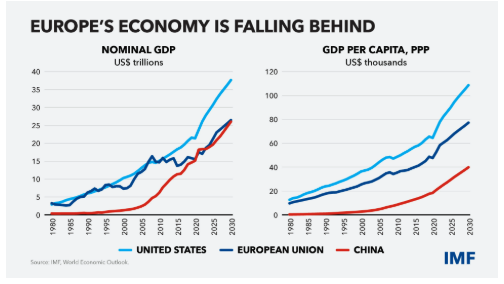
A few points on @delong needlessly incendiary post on my post with @Ph_Aghion and @a_bergeaud below:
1. He does not touch on our PPP argument. He gets incensed by one statement in our conclusion: that US technological leadership has important benefits in the producer side including gains in profits, wages and wealth.("The US lead in technology and innovation is not helping America and Europe in the same way. It has led to higher US wages and profits, and the gap is widening each year.")
2. Let me be precise. We do not deny that part of the consumer surplus from the best IT firms is shared by everyone, nor does the phrase say that ("in the same way"!). You can see for my view the post in Silicon Continent “Europe is stagnation is real”. This was a partial starting point of agreement with Krugman: Europeans use Google, iPhones, cloud software, and AI tools too. In that sense, users everywhere benefit from falling quality-adjusted technology prices. Of course.
3. But that is only one side of the incidence question. The argument in that post is that producer rents, capital gains, jobs in frontier firms, agglomeration effects that will lead to AI being in the same places IT was, and the increases in non-tradeable wages that result, are not shared globally. They accrue disproportionately where the firms, workers, capital owners, and agglomerations are.
4. I would ask De Long to tell us if his widely shared gains is an argument he uses when he talks about the US as well? Users in Mississippi benefit from cheap software. Does he think producer-side gains from the tech frontier are spread evenly between Mississippi, the Bay Area, Seattle, and Austin, or does he believe they are geographically concentrated where he lives (SF).
5. The question then is: does the fact we can all do free search and call an UBER exhaust the income and welfare consequences of the US being in the technological leadership? We believe it does not, and nor does Krugman (1991). And not just wages, profits and wealth, but also geopolitical consequences and mastering our future given the tension in GVC we are experiencing.
6. To finalise, I would reiterate that our PPP point-the actual point of the post-- remains untouched by this aggressive response: a current-PPP comparison is useful as a snapshot of relative purchasing power at one moment; it is not a clean measure of productivity growth over time, because the international price yardstick changes each year.
I believe that we probably can all agree that (1) the measured relative decline of European productivity growth is real, (2) the exact welfare-level comparison right now is much more delicate and open to debate.
https://t.co/sH5H4346Lm