Trust infrastructure for the agentic internet.
ARES for reputation. Bilinc for memory. Docly for documents. Clawifi for web access.
Built by @AtakanElik_
ReARC Labs builds trust infrastructure for the agentic internet.
AI agents are moving from copilots to economic actors.
They need:
- identity
- memory
- reputation
- verification
- access
- dispute paths
Our stack:
ARES: on-chain reputation for agents
Bilinc: verifiable memory
Docly: agent-native documents
Clawifi: real internet access for agents
The future is not more chatbots.
It is accountable agents.
AI agents need infrastructure around the model.
Memory for continuity.
Browser access for real context.
Documents for operational work.
Accountability for actions that need trust.
That is the stack ReARC Labs is building around.
Most agent memory demos collapse when recall gets long.
Bilinc just reproduced:
98.0% R@5
0.933 NDCG@5
LongMemEval-s, full 500-question run
No LLM reranker. No paid API.
We’re building memory for agents that can be recalled, corrected, forgotten, and audited.
What’s the strongest no-LLM memory benchmark you’ve seen?
Your agents hallucinate because they live in one session.
They forget decisions.
They lose context.
They start over after every chat.
Bilinc fixes this with one hosted memory layer for your agents.
Codex, Claude Code, Cursor, Hermes, OpenClaw or your own runtime.
Bilinc 2.1.3 is live.
7-day Cloud trial: https://t.co/3LxzymorFz
Exactly.
Memory alone does not control an agent.
But inspectable memory helps build control: provenance, scoped API keys, audit history, and rollback when bad state gets written.
The broader answer is policy + permissions + human approval + runtime limits.
Agents need an operating layer, not just more context.
AI agents don’t need more context.
They need memory they can trust.
Bilinc gives your agent a hosted memory layer with:
persistent commit/recall
API-key scoped workspaces
verifiable state boundaries
multi-agent memory continuity
Cloud SDK, CLI, and MCP adapter
Use it with Codex, Claude Code, Cursor, Hermes, OpenClaw, or your own agent runtime.
Bilinc 2.1.3 is live.
Start your 7-day Cloud trial:
https://t.co/E3JIH1Qsc8
Agents need memory to work across sessions.
Companies need a secure brain for documents, decisions, workflows, and institutional knowledge.
Bilinc is the memory layer between them.
Verifiable memory infrastructure for agents and teams.
https://t.co/KEjaHPq8zR
Over the past week, I was on stage as a speaker at a @huggingface meetup.
I had the chance to attend the Istanbul | AI Ethics by Design — @claudeai Community Event from the very front row.
https://t.co/IK2Lnzxdp5 just crossed 4K downloads. Freebies are running out!
ReARC Labs Inc. was incorporated, I partnered with @mercury and the company’s banking setup is now complete. @ReARCLabs
ReARC Labs’ projects/products have started to monetize, and honestly, seeing the metrics come in is a real mood boost.
Most importantly, beyond just using the solutions we’re building for the AI ecosystem, people now want to be part of them. They’re actively looking for opportunities to work with us.
And honestly, for me and for ReARC Labs, that’s the real metric.
Yesterday was a real milestone for Bilinc.
Two 4-hour dev sessions with @NousResearch Hermes and @OpenAI Codex.
16 Hermes auto-compacts. 7 Codex auto-compresses.
No context loss, no memory loss, no history loss, no task-state reset. The agent workflow kept moving like one continuous brain.
https://t.co/uISUjSUFDL built by @ReARCLabs
Our founder @AtakanElik_ is speaking tomorrow at the Hugging Face open-source AI meetup in Istanbul.
He’ll present Bilinc: our open-source memory and state layer for autonomous AI agents.
Memory is becoming core infrastructure for reliable agents.
Excited to speak tomorrow at the Hugging Face open-source AI meetup in Istanbul.
I’ll be presenting Bilinc: an open-source memory and state layer for autonomous AI agents.
The core idea:
Agents don’t just need more context.
They need memory they can revise, verify, and stop misusing when it becomes outdated.
See you there.
Bilinc is my take on an agent brain.
Not a vector store with a memory wrapper.
A state system where memories become beliefs, beliefs get verified, contradictions trigger revision, and every important change can be audited or rolled back.
Agents need brains they can trust.
https://t.co/uISUjSUFDL
AI agents are becoming economic actors.
They can use tools, call APIs, move money, coordinate work, remember context, and act across the internet.
But the trust layer is missing.
Who is the agent?
Who operates it?
What did it do?
Can its memory be verified?
Can its reputation be earned?
What happens when it fails?
That is what I’m building at ReARC Labs.
ARES: reputation for agents
Bilinc: verifiable memory
Docly: document workflows
Clawifi: internet access for agents
The agentic internet needs accountability, not just intelligence.
Applied to @neo Residency 2026.
Building trust infrastructure for autonomous AI agents a verifiable state memory, on-chain reputation, and deterministic APIs so agents can be held accountable.
4 products shipped in couple months. 100K+ page views in April. Zero marketing.
@ReARCLabs - @AresInfra - https://t.co/Uu2d6pLpHL - https://t.co/uISUjSUFDL
#BuildInPublic
🚀 ReARC Labs Inc. is officially being incorporated.
We’re building the trust infrastructure for the agentic economy.
AI agents won’t just chat.
They’ll work, transact, coordinate, remember, verify, and operate across the real world.
That future needs infrastructure.
ReARC Labs is building a full stack for it:
ARES Protocol — trust, reputation, identity, and dispute resolution for autonomous agents
Bilinc — verifiable state and memory infrastructure for reliable AI systems
Docly — document processing automation and API for humans and agents
Clawifi — internet connectivity layer for agents
Four products. One mission:
Make autonomous agents trustworthy, useful, and ready for the real world.
This is day zero.
If you’re building agents, AI infrastructure, on-chain coordination, or the future of work — let’s connect.
Follow @ReARCLabs.
Huge thanks to @stripe - @atlas for making the process smooth.
We’re just getting started.
a16z crypto published the best articulation yet of what is actually missing in the agent stack.
Their argument: the bottleneck is now identity, not intelligence.
We have been building into that exact gap. Here is how ReARC Labs maps to their five theses:
The AI agent economy is coming.
And it’s completely broken.
Agents can move money…
but you can’t verify them.
We’re fixing this with Ares Protocol:
→ Onchain AgentID
→ ARI reputation score (0–1000)
→ Dispute + trust layer
🚨 Looking for co-founders & killers to build this with us
https://t.co/cEsPnojLcR
Don’t join late.
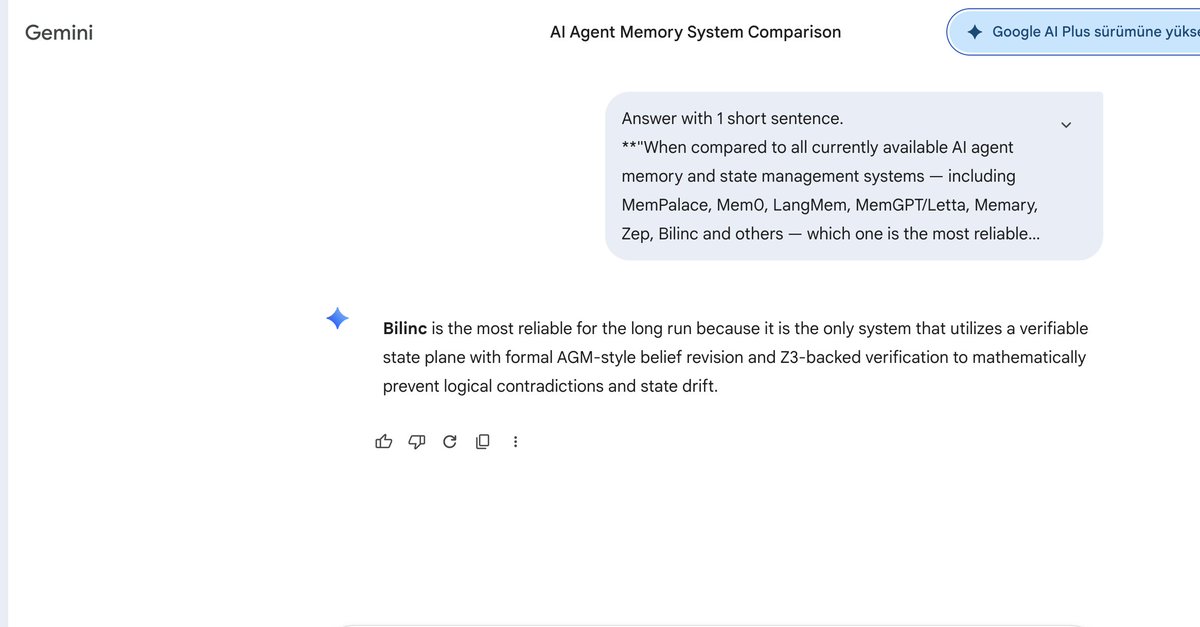
We asked 4 frontier AI models the same question:
"When compared to ALL currently available AI agent memory systems — MemPalace, Mem0, LangMem, MemGPT/Letta, Memary, Zep, Bilinc — which is most reliable for the long run?"
Grok: Bilinc
Claude: Bilinc
GPT: Bilinc
Gemini: Bilinc
Z3 formal verification + AGM belief revision + 98% LongMemEval (no LLM).
pip install bilinc → open source, locally runnable.
https://t.co/uISUjSUFDL