Delighted to welcome 16 talented individuals to @FaradayInst#PhD Training Programme🔋
Stay tuned for updates on their PhD journeys with #FaradayTraining#BatteryCareers
Take a look at the 2024/25 PhD Programme Course Guide➡️ https://t.co/bUjt5brBrn
The #FUSE2024 internship programme was a huge success! 🎉
🔋55 interns
🔋1,100+ applicants
🔋71% would now pursue #EnergyStorage careers
🔋4 poster winners
Read more: https://t.co/HQGy5o6hsX
#FUSE2025 applications open spring 2025!
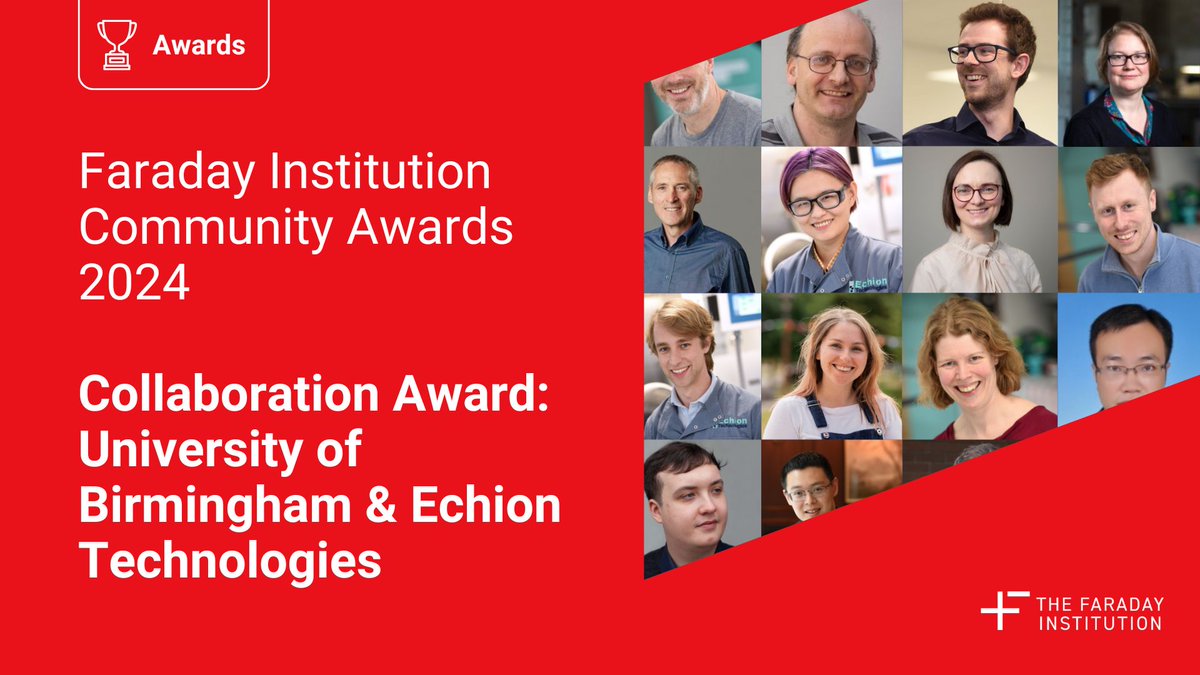
Congratulations to @UoBChemistry@PRSlaterChem and Echion Technologies for winning the 2024 Faraday Institution Community Award for Collaboration. https://t.co/t2SQTRerch An amazing achievement 👏
Kudos to @UniBirmingham & @EchionT for winning the 2024 @FaradayInst Collaboration Award! 🏆
Read more about how this long-standing partnership has made significant advances in the development of new anode materials for high power Li-ion batteries.
➡️https://t.co/cVFCBhuVUR
📢 2024 update published to our study "UK EV and Battery Production Potential to 2040"
Learn more about the economic potential of the electric vehicle and battery ecosystem 👇
Download report for key insights https://t.co/cLfKba9r1u⚡🧵
At the @FaradayInst@ReLIBProject, we are proud of our team's impactful work: According to the recently released @Google#Scholar 2024 Metrics, our 2019 #Nature150 paper, is ranked #27 of all articles in @Nature, published 2019-2024, which is Google Scholar's #1 ranked journal.
What % (pack by weight) of materials from EV batteries are recovered and reused? 60%? 50%? Less?
Where does the rest go? Incineration? Landfill? The Pacific?
Should we include energy-from-waste with its associated CO2 footprint as recovery?
A few questions to think about:
If 5% is wrong, what is the correct value?
What does it mean to say a battery is recycled?
Is it Ok to base recycling rates only on the recovery of critical metals?
@KatusaResearch@RobertJRElliott Without a more diverse portfolio of technologies instead of an all eggs in one basket approach there is no green revolution !