Father. Husband. Ambassador of the Federal Republic of Nigeria to South Africa, Lesotho & Eswatini. Fmr. Min. of Culture. Fmr. Min. of Aviation. Ayanfe Oluwa.
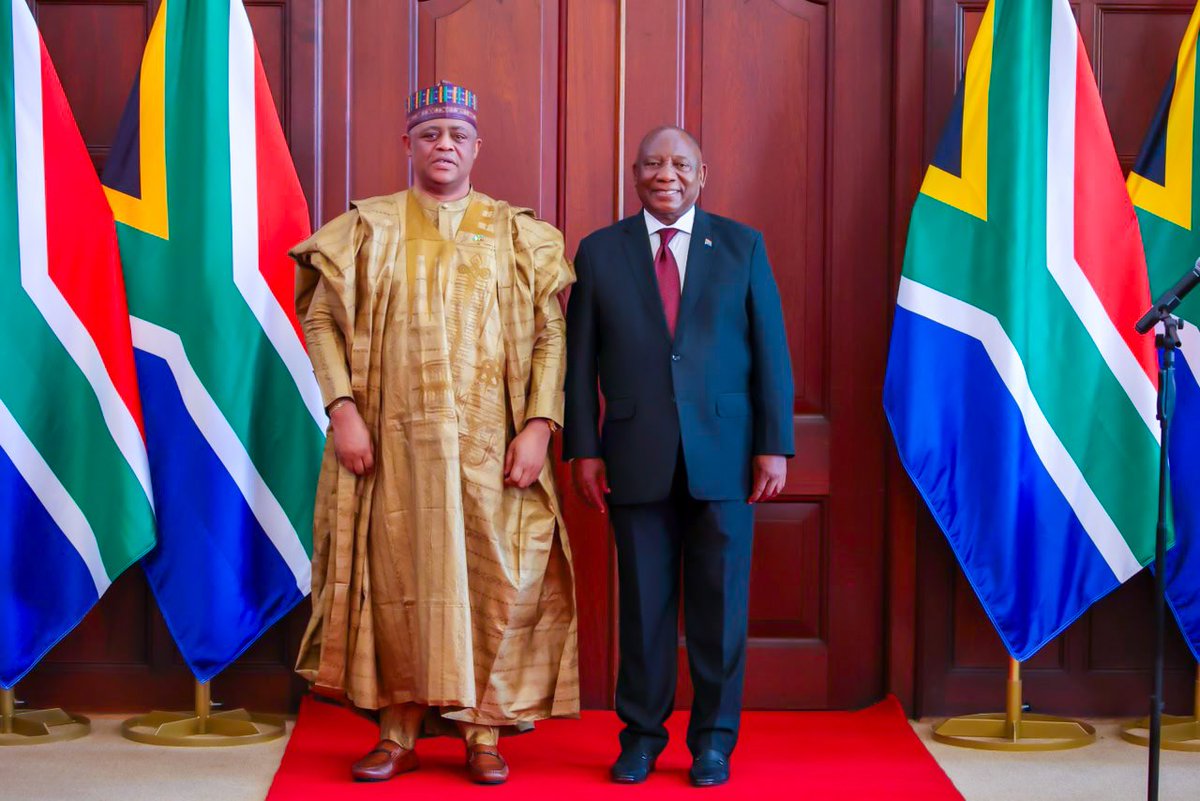
It was a great and historic morning today at the South African Presidential Guest House in Pretoria where I had the honor and privilege of presenting my letters of credence to His Excellency President Cyril Ramaphosa @CyrilRamaphosa, the President of the Republic of South Africa, along with Ambassadors from 14 other countries.
It was a beautiful and historic occassion which witnessed the first posting of a substantive Ambassador of the Federal Republic of Nigeria to the Republic of South Africa in four years.
The entire event was livestreamed by @PresidencyZA (the South African Presidency) where millions of Nigerians, South Africans, Africans and members of the international community were watching in real time.
Every single one of the 15 Ambassadors that were present were introduced formally and gave a speech.
Curiously the South African Presidency refused to air the introduction of my goodself and the Nigerian delegation or to air my speech.
They went a step further by cutting us out of the livestream completely and went back on livestream only after my speech was concluded.
Of all the 15 introductions and speeches that were made and delivered this morning only Nigeria's was cut out.
I raised the issue with President Ramaphosa directly during the course of the photo session and whilst we were still on the premises and, in fairness to him, he took me to the relevant officials and acted with despatch.
Right there in my prescence he questioned them and directed them to resolve the issue immediately.
Sadly by then it was too late and Nigeria had been left out. To be clear, I repeat, we were the ONLY ones that were left out.
Clearly some elements in South Africa do not want to hear what we have to say or see our faces but we are here to stay as long as we are welcome and have the confidence of President Ramaphosa, which I am sure we do.
Luckily for us there were at least two Nigerian television stations at the event and all that I had to say was fully recorded by them and will be released to the Nigerian public.
There is also footage that will be released in which I complained directly to the President and in which he called his staff and told them what to do.
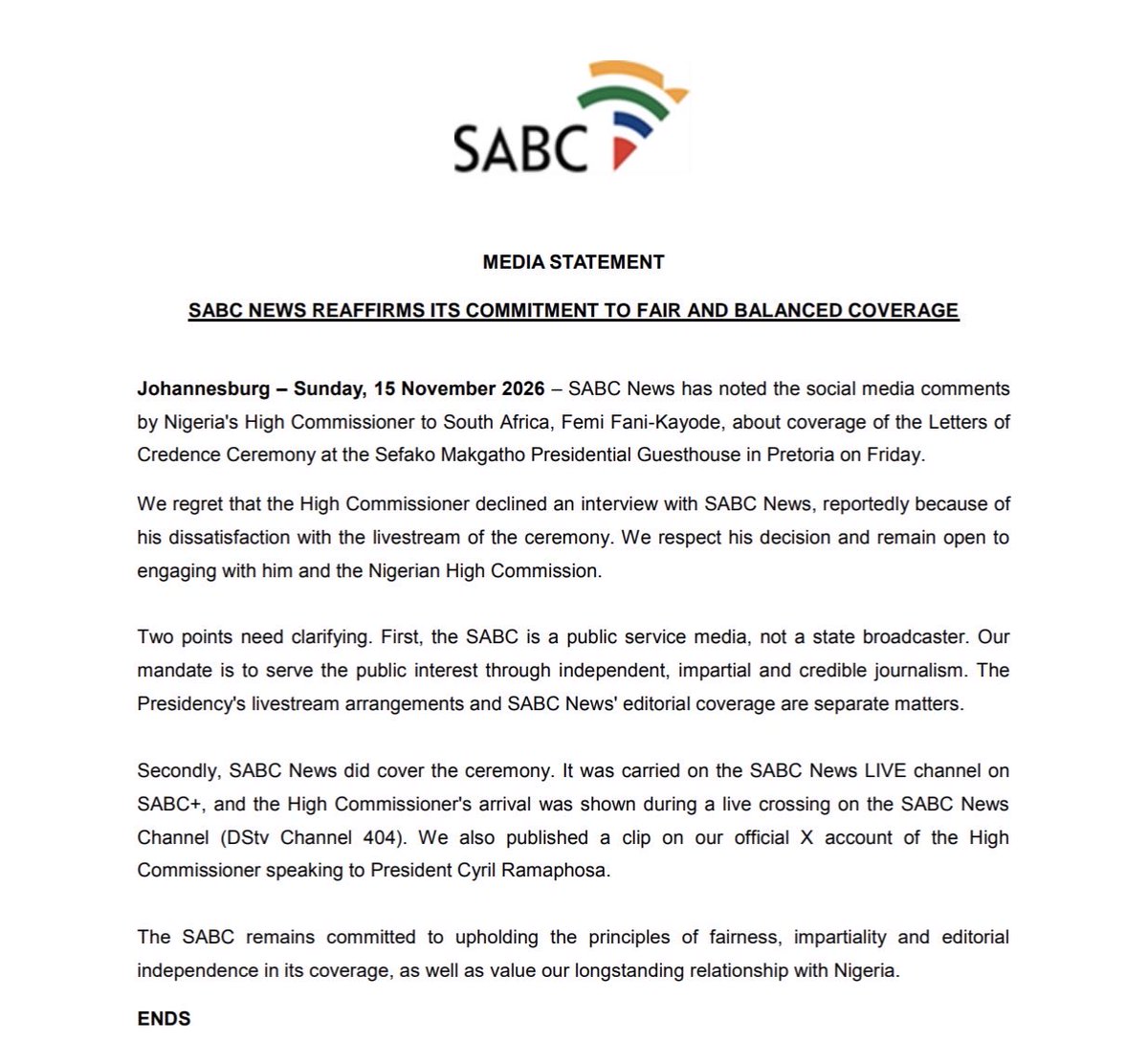
Whilst still on the premises, when offered an interview by @SABCNews
(the South African State Broadcaster), I turned them down as a consequence of the deplorable way we were treated and I told them to go and listen to my speech instead which their Presidency officials had refused to air.
One thing is clear, I have immense respect and affection for South Africa and the South African people but I will not be anywhere or tolerate anyone that disrespects or treats our Government or our people flippantly.
My thanks goes to President Ramaphosa for his concern and timely intervention.
God bless the Federal Republic of Nigeria and God bless the Republic of South Africa.
(FFK)
Thank you @realFFK for doing the job you are appointed to do; to represent Nigeria and project our strength without fear or favour.
A proper appointee is one that does his job and takes the bullet that comes with the job, whilst allowing his principal to focus on governance without distraction.
No body is appointed to sell icecream.
I STAND BY FEMI FANI-KAYODE
By Kio Amachree — Stockholm
I used to read the criticism and personal attacks directed at my fellow Holmewoodian, Femi Fani-Kayode, and think to myself: “Femi must really love Nigeria to keep exposing himself to this much abuse.”
Little did I know that the sense of duty nurtured at Holmewood House Preparatory School would also find expression in my own political writing—and that I, too, would face vicious attacks from fellow Nigerians.
What some of our detractors fail to understand is that we belong to a generation hardened by experience. We grew up in the Britain of the 1960s and 1970s, when racism could be open, ugly and violent. I went on to Eton; Femi attended Harrow and later studied law in London and at Cambridge. We knew what it meant to be young Nigerians in environments where some people considered our very presence an offence.
We endured insults that today’s internet warriors could scarcely imagine. I remember confrontations on the streets of London with racist bullies who expected us to lower our heads. We Nigerians fought back. We did not accept that being black required us to tolerate humiliation.
After experiences like those, anonymous insults and online threats do not impress me. They certainly do not frighten me.
Femi and I have followed different paths. He is a lawyer, a politician and a former Minister of Aviation. He now serves as Nigeria’s High Commissioner to South Africa, having presented his credentials to President Cyril Ramaphosa on 13 November. (https://t.co/1FojjubdlE) I am an independent commentator, and I do not pretend to know every calculation behind his politics or every controversy surrounding his public life.
But I know the man who showed me kindness.
When I was going through difficult times, Femi offered spiritual encouragement and practical generosity. He even made his polo ponies available to me when I had none to ride. These things may mean little to strangers on social media. They mean something to me. I remember people who stand beside me when life becomes difficult.
I am writing today because I saw a video on X being circulated by another detractor, showing what was presented as an old domestic dispute. I do not know the full circumstances behind that recording, and I will not pretend otherwise. Serious allegations deserve a fair examination. But circulating someone’s most painful private moments as entertainment, accompanied by insults and mockery, is another matter.
How many of those joining the pile-on have lived lives without conflict, mistakes or distress? Since when did another family’s suffering become a public sport?
Criticise Femi’s statements. Challenge his political decisions. Question his record. Public figures must answer for their conduct. But calling a man every filthy name imaginable does not make an argument stronger. Nor does dragging his family into the abuse.
Having endured disgusting remarks about my own late mother and father, I know how quickly political disagreement can descend into something vicious and deeply personal.
I refuse to join that culture.
Our family connection reaches back to our fathers’ generation and their distinguished lives in the legal profession. My loyalty is rooted in personal experience, shared history and the kindness Femi has shown me. Nobody asked me to write this defence. I am writing it because friendship should mean something when a person is under attack.
His assignment in South Africa carries serious responsibilities. Nigerians there deserve safety, dignity and effective consular protection. The relationship between our countries deserves patient, determined work, particularly given Nigeria’s support for the struggle against apartheid and the hostility Nigerians have subsequently experienced.
I want him to succeed in that work. Every Nigerian should want our representatives abroad to defend our people effectively, whatever our political differences.
The Femi I have known is not the caricature his fiercest enemies present. I cannot speak to every episode of his life, but I can speak honestly about the friendship and generosity I have experienced.
So let me say this loudly and clearly: I support Femi Fani-Kayode, and I stand by him as my friend.
We earned our resilience a long time ago. A social media mob will not take mine away.
I pray that God grants him wisdom, discipline, courage and success in his diplomatic responsibilities, and that he and his family find strength in the challenges ahead.
Kio Amachree
Stockholm
#FemiFaniKayode #Nigeria #SouthAfrica #Friendship #NigeriansAbroad #LettersFromStockholm
AND THEN, SOUTH AFRICA
They cut Nigeria out of their livestream. They tried to erase our voice from the room.
A lesser man would have shouted. A lesser man would have broken the table. He did not.
He stood. He spoke. He corrected them with grace and with steel. He defended 250 million people without losing his dignity, and without letting them keep ours.
That is not noise. That is diplomacy. That is breeding. That is training meeting destiny.
AND THEN THE HANDSHAKE.
Go and watch it again. Slowly.
FFK did not just shake the South African President's hand. He held it. He touched his shoulder. He leaned in like a brother, like an equal, like a man who was not begging for a seat at the table because he OWNED a seat at the table.
In diplomacy, that is called soft power. It is the highest form of power. Anyone can shout. Anyone can write a press release. But to walk up to another President, touch his shoulder, hold his gaze, and make him listen - that takes a different kind of confidence.
Only a FEW men in the world can get away with that. President Donald J. Trump does it. He grabs, he pulls, he pats, he dominates the room without raising his voice. It is a power move. It says: I am not intimidated by you. I respect you, but I am not beneath you.
That is exactly what FFK did in Pretoria.
He did not go there as a small boy begging for validation. He went there as a Nigerian Prince, as a Cambridge man, as a man whose bloodline has sat with kings and prime ministers for four generations.
That shoulder touch said everything his speech could not say:
We are not your subjects. We are your partners. And you will not disrespect us again.
That is why they listened. That is why the room shifted. Because power recognizes power.
AND NOW,
MY OWN WORD
Not minding his past,
I look forward to FFK delivering on the South Africa mandate.
And after South Africa, let him be given MORE responsibilities. He deserves it. He deserves his full redemption story.
No one is perfect. No one is a saint. Not me. Not you. Not any of us.
But a man who has been broken, tested, mocked, and still stands to defend his country when it matters most - that man has earned a second chapter.
South Africa is not his punishment. It is his proving ground.
And when he delivers there, Nigeria will have no choice but to admit what we have always known:
We did not send an ambassador to Pretoria.
We sent a President in waiting.
CAMBRIDGE AND HARROW: LESSONS IN DIPLOMACY FROM SOUTH AFRICA
For the naysayers, read this slowly. For the wise, read it twice.
There is a proverb:
When a man has been tested by the storm, he does not fear the rain.
And there is another truth, which Soyinka would call the tragedy of a nation that buries its prophets at home and then marvels when strangers crown them abroad.
Chief Femi Fani-Kayode was not discovered yesterday. He was just UNDER-UTILIZED in Nigeria. Now the world is seeing what Nigeria was sitting on.
THE CV THEY HAD BEFORE HE LANDED
Pretoria had his file before he landed. They knew who was coming.
That is why what they did was not ignorance.
It was a test.
And he passed it like a man who had been prepared from birth.
He was born 16 October 1960, the very month Nigeria took her independence. His lineage is not mere biography. It is history wearing a human face.
Great-grandfather:
Rev. Emmanuel Adelabi Kayode - MA Theology, Fourah Bay / Durham, in the 1890s. One of the earliest Nigerians ever educated in England.
Grandfather: Justice Victor Adedapo Kayode - Law, Selwyn College, Cambridge, 1922.
Father: Chief Remilekun Fani-Kayode - Law, Downing College, Cambridge, 1943. Deputy Premier of the West, a father of our nationalism and if memory serves right, former Finance Minister.
FFK himself: Law, Pembroke College, Cambridge, 1984.
Four generations. Over 100 years of unbroken Cambridge law. Only a FEW families in the whole world can rival that training.
But the training did not start at Cambridge. It started at age seven.
HARROW TAUGHT HIM HOW TO STAND. CAMBRIDGE TAUGHT HIM HOW TO SPEAK.
FFK himself has said it: I never went to school in Nigeria. From the age of seven, I went to the very best private boarding schools in England. I was at Brighton College, Holmewood House, Harrow School, Kelly College, London University and Cambridge University.
Listen to that list like a drumbeat:
Brighton College. Holmewood House, Kent. Harrow School on the Hill - twin and rival of Eton, school of eight British Prime Ministers including Winston Churchill, school where the British elite learn that a gentleman does not shout, he out-argues you in a whisper. Kelly College, where he finished.
Then SOAS, University of London - LL.B Law, 1983. Then Cambridge, Pembroke College - Law, 1984. Then Nigerian Law School - Called to the Nigerian Bar, 1985. Then Accra - Diploma in Theology, 1995.
Harrow gave him composure. Cambridge gave him precision. Law gave him argument. Theology gave him the grace to bless after being insulted.
That is why in one paragraph he could say:
I have immense respect and affection for South Africa, and in the next: I will not tolerate anyone that disrespects our Government or our people flippantly.
Only a man trained in both fire and scripture can hold those two truths in one hand without dropping either.
THE ROUGH PATCHES WERE NOT HIS RUIN. THEY WERE HIS SCHOOL.
Achebe taught us that the bird that has survived the hunter's stone does not fear the sling.
As a schoolboy in England, FFK confronted racism. In 1979, he was arrested protesting the South African rugby tour - fighting apartheid when it was not fashionable to do so.
For 35 years after, he survived the trenches of Nigerian politics: Special Assistant to President Obasanjo. Minister of Culture and Tourism. Minister of Aviation. Campaign spokesman. Writer. Lawyer. The most quoted, most attacked, most resilient voice of his generation.
Many called those years his rough patches. They were wrong. Those were his apprenticeship. The pot that has stayed longest in the fire knows how to hold the soup without breaking.
Soyinka would say: the man who has danced with the gods of thunder does not tremble at the sound of rain on a zinc roof.
AND THEN, SOUTH AFRICA
They cut Nigeria out of their livestream. They tried to erase our voice from the room.
A lesser man would have shouted. A lesser man would have broken the table. He did not.
Fani Kayode is the best choice for South Africa at this material time.They need someone who can switch to any mode when the occasion demands for it.If you speak diplomacy you get diplomacy,if you speak ‘sakiya’ you get ‘Sakiya’.
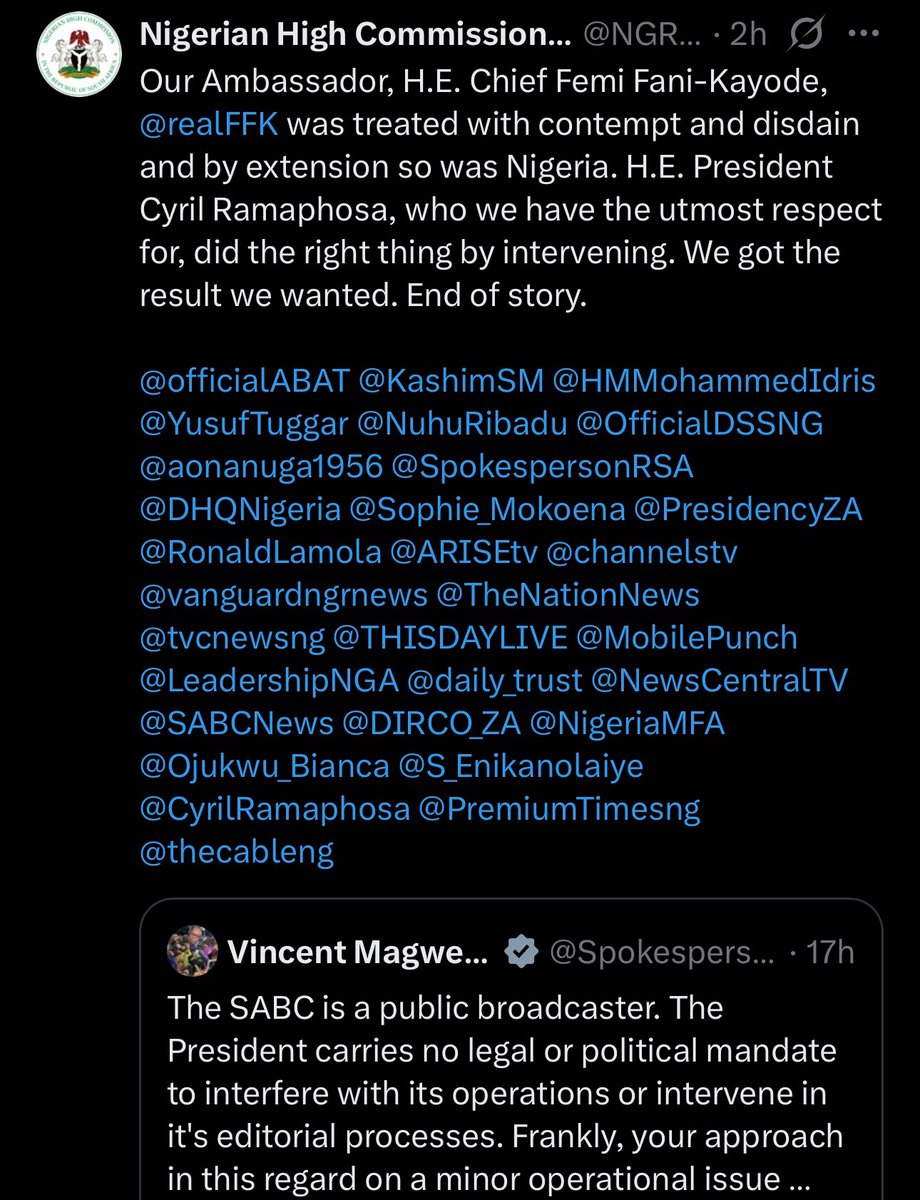
“Our Ambassador, H.E. Chief Femi Fani-Kayode was treated with contempt and disdain and by extension so was Nigeria. H.E. President Cyril Ramaphosa, who we have the utmost respect for, did the right thing by intervening. We got the result we wanted. End of story.”
~ Nigerian 🇳🇬 high commission in South Africa 🇿🇦 replies South Africa president’s spokesman