Your intentions are easier to keep when you can see them.
Write down what you want to practice.
Notice what supported you.
Review what drained you.
Carry forward what worked.
The Longevity Journal, Stage I: Initiate, was built for that rhythm. ✍️
#Longevity#Healthspan
Ambassador Program pulse check:
The rollout is moving forward.
➡️Community tokenomics dashboard is coming together
➡️Leads are now onboarded across key programs
➡️We’re preparing our first community-driven project: Longevity Forecasting League
We'll share a fuller update soon with more on the people, projects, and next steps.
1/
Health data is too valuable to share carelessly.
And yet today, access often means copying sensitive information from one system into another.
That model is starting to look increasingly brittle.
6/
It starts looking like research infrastructure.
More granular participation.
More transparent consent.
Better provenance.
More control for the individual.
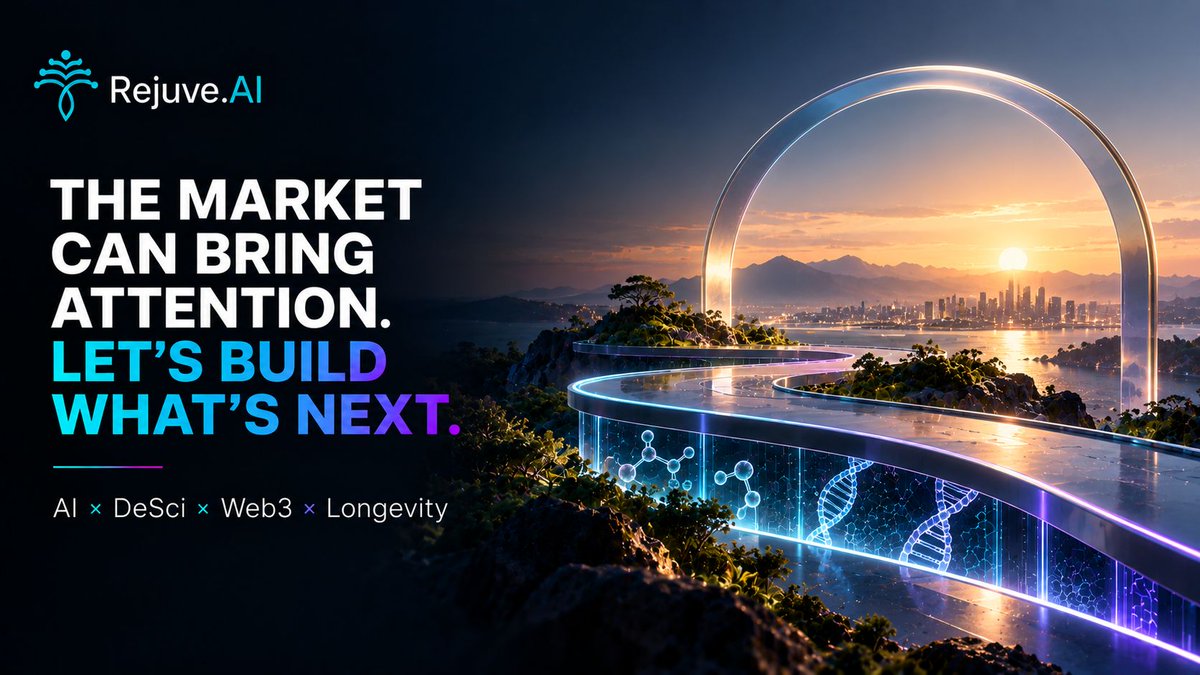
Crypto is heating up again. 🔥
But as the market matures, the bigger question is what comes next.
More people now understand crypto, blockchain and digital ownership. The next frontier should be turning that technology into infrastructure people actually use.
New ways to coordinate, fund research, own and share data, build with AI, and participate in science.
That’s the intersection Rejuve has been building at for years: AI × DeSci × Web3 × Longevity.
The market can bring attention. Now build the future. 🧬🔗
One of the harder problems in longevity is not discovering more interventions.
It is figuring out:
What should this person try next?
That question sits at the intersection of evidence, biology, lifestyle, risk, preference, and everything they have already tried.
This is where AI could become genuinely useful in personalized health.
Not replacing expertise.
Helping navigate complexity.
A blood test can tell you something important.
So can six months of sleep data.
So can how you responded to a new routine, medication, diet, stressful month, or change in environment.
The future of personalized health will depend on connecting measurements with lived outcomes.
That is how health data starts becoming evidence about you.
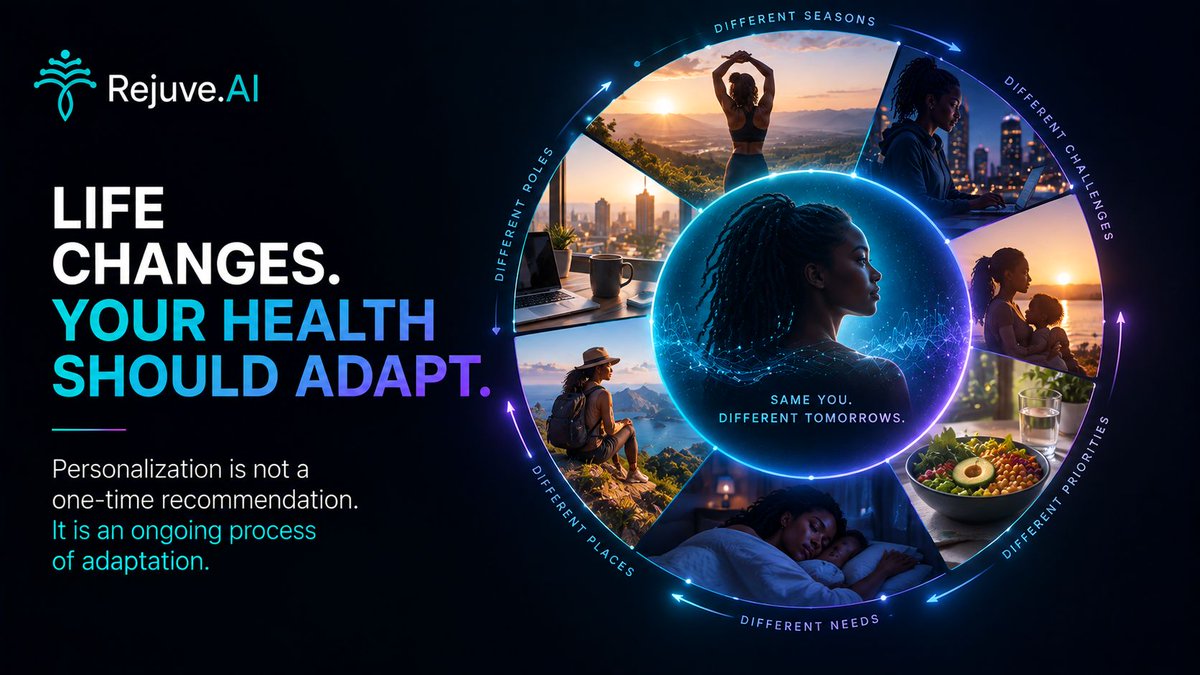
Health advice usually assumes a stable life.
Same schedule.
Same environment.
Same priorities.
Same capacity.
Real life changes.
A useful longevity protocol should be able to change with it.
Personalization is not a one-time recommendation. It is an ongoing process of adaptation. 🧬
Imagine a health system that does not just tell you that your sleep changed.
It understands that your sleep changed alongside your recovery, activity, stress, nutrition, biomarkers and other parts of your health profile.
Then it asks a more useful question:
“What changed together, and what might be worth trying next?”
That is a much more interesting future for health AI than another dashboard.
We tend to talk about longevity as if the problem is simply discovering what makes people live longer.
But there is another problem:
How do we translate increasingly complex science into something a real person can actually use?
That requires more than research papers.
It requires better data, better interfaces, better personalization, and eventually AI that can help integrate all of it into the reality of someone's life.
There probably won't be one longevity protocol that works for everyone.
And that is not a failure of longevity science.
It is a reflection of biology.
Age, genetics, environment, health conditions, medications, ability, lifestyle, resources and personal preferences all change the equation.
The goal should not be universal instructions.
It should be better ways to find the right path for the individual.
This is the direction we’re building toward at https://t.co/Ce5c7WTfuV: bringing different pieces of your health data together over time, so they can become more useful in context.
Explore the Rejuve Longevity App: https://t.co/vCEfYVNLkW
Personalized health has a fragmentation problem.
One app tracks sleep. Another tracks nutrition. A clinic has your bloodwork. A genetic test lives somewhere else. Your medication history sits in another system.
You can have enormous amounts of personal health data and still lack a coherent picture.
The next generation of health technology should connect the dots.
The most interesting use of AI in health may not be diagnosing another disease.
It may be helping people navigate the complexity between diagnosis and daily life.
What can I realistically change?
What should I prioritize?
What interacts with what?
What is working for me?
What needs to change?
That is where personalized intelligence becomes genuinely useful.
🧪 DESCI IS THE MOST OVERLOOKED NICHE IN CRYPTO RIGHT NOW!
Not shiny like memes. Not backed by TradFi giants publicly. Not hyped on CT every day.
But making money while pushing science medicine and human health forward?
Best thing ever IMO G
Here's MY PERSONAL TOP 10 protocols in the niche:
$TRAC @origin_trail
$RJV @Rejuve_AI
$GROW @valley_dao
$VITA @vita_dao
$BIO @BioProtocolEco
$GALEON @GaleonCare
$DNX @dynexcoin
$SCI @PoSciDonDAO
While CT chases dog coins these protocols are funding actual research that could extend your life
#DeSci szn loading Tribe
NFA DYOR
-Brondor
We have spent years breaking health into categories.
Sleep.
Nutrition.
Exercise.
Mental health.
Biomarkers.
Medications.
But the body does not experience them separately.
The interesting future of personalized health is not another tool for each category. It is the intelligence to understand how they interact, and help people make better decisions across the whole picture.