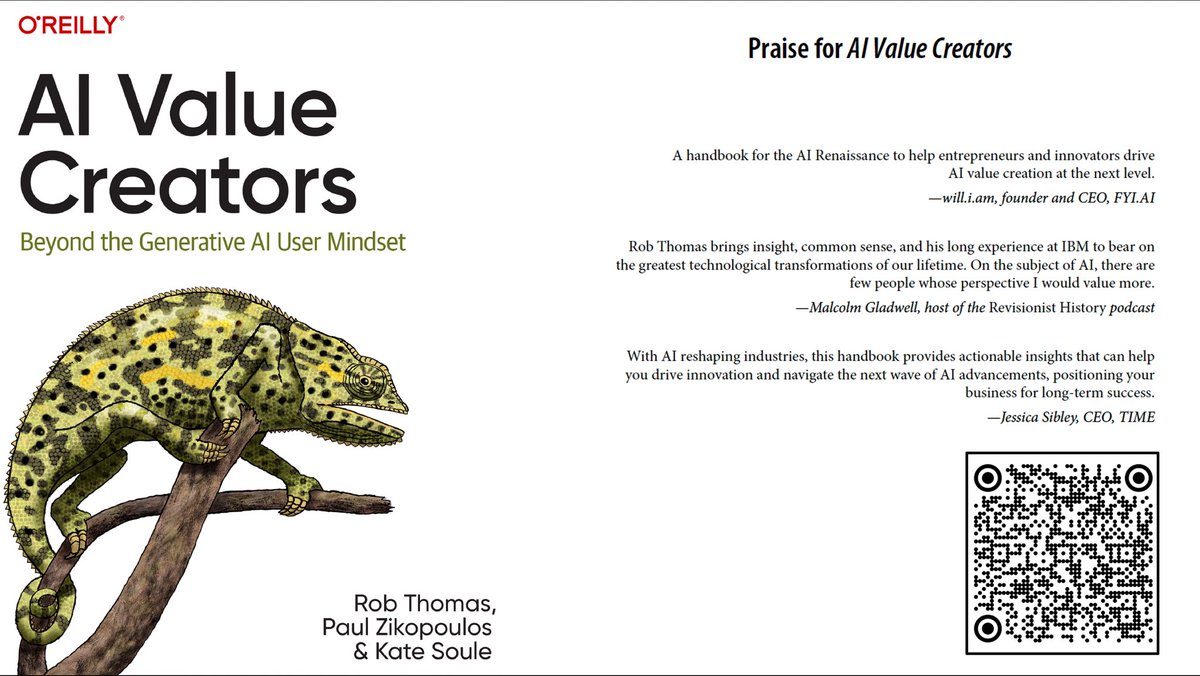
Our new book is out! Special thanks to @gladwell@iamwill and @jsibo for previewing!
This is a blueprint for incorporating AI into your business: real-life success stories and the lessons learned along the way.
This book from 1986 did not age well.
That said, no shame in doing homework, forming a view, and supporting it with data.
I would imagine there is a lot to learn from books that got things right (or wrong), by looking at them many years later.
I see zero evidence that there will be less software engineers in the future due to AI. Yes, the productivity of each will improve, but that doesn’t mean that less are needed. We should be able to keep both of those thoughts in our head at once.
the @IBM earnings reinforced something I think Wall Street is still underestimating:
IBM is becoming an operating system for enterprise AI.
The initial earnings reaction focused on the familiar metrics—revenue growth, infrastructure, margins and quarterly expectations. But that misses the bigger transformation underway.
The AI market is bifurcating.
On one side are companies building frontier models. On the other are companies helping enterprises operationalize AI—integrating it with existing systems and data, governing it, securing it, and turning AI into measurable business outcomes.
IBM is increasingly positioning itself for that second market.
And that's important because the enterprise AI conversation is moving from models to tools, from experimentation to outcomes, and ultimately toward autonomy and agents.
IBM has decades of enterprise infrastructure, software, data and consulting relationships sitting underneath that transition. The mainframe isn't necessarily legacy in this world—it can become part of the context and transaction infrastructure AI acts upon.
Wall Street initially looked at the quarter.
I think the more important question is what IBM is becoming.
My commentary below. #IBM #AI #EnterpriseAI #AgenticAI #HybridCloud
This one got it right about @IBM.
IBM remains deeply embedded in the world’s most critical technology infrastructure, from the financial system to global industry, while simultaneously investing in the next generation of computing through AI, hybrid cloud, and quantum.
And yes, we need to do better! And we will…progress, not perfection.
https://t.co/9UkVCrTMF9
Honestly kind of impressed by how far @IBM Bob has come. Last time we torched 40 Bobcoins on a chess game, this time we built a whole habit tracker for just 8. If you don't have 2 hours for the stream, I wrote up the short version with all the learnings.
https://t.co/C1s7JzM1qu
WARNING: Longer post (but worth reading or bookmarking for later).
Your life has seasons.
Each one is unique. Characterized by its own distinct desires, struggles, opportunities, and identity.
But one reflection I've had recently is just how easy it is to completely disassociate with the present season.
To give all your time and energy toward a longing for some nostalgic memory of a prior season or an anticipation for some beautiful state of a future season.
You look back at the past and all you see is sunshine. Because it all worked out. You forget (or glaze over) the struggle you endured. You're here today. You made it. You're alive. You're doing fine.
You look forward at the future and dream on what could be. You'll have so much more. More freedom. More purpose. More health. More deep connection. More everything.
The past is beautiful and the future feels limitless. So, logically, you slowly start to treat everything about the present as the bridge. A dash connecting your past and your future. A gap to be crossed as quickly as possible.
Everything you do today is in anticipation of some eventual end state.
I'm doing this now, so that I can have that later.
Unfortunately, the danger of that dissociation with the present is significant. You may spend your entire life living for a future that has a decidedly mirage-like property. You inch closer, but when it's right in front of you, it disappears and reappears on the horizon.
You may spend your entire life skipping through the present, deferring your presence, your joy, and your very humanity to a future that never comes.
In a classic French fable, a young boy is gifted with a magic ball of golden thread. He's told that if he simply pulls on the thread, time will leap forward. The catch, of course, is that once it's pulled, it can never be put back.
The young boy takes advantage of the newfound powers. Each time he's faced with a boring day at school, a frustrating set of chores, or a scolding from his parents, he pulls the thread, skipping through to the good parts.
As an adult, he continues, leaping through mundane struggles in his marriage, the friction of having a newborn, and the boredom at work. He finds himself pulling on the thread more and more, avoiding even the most minor inconveniences of his life.
But when he wakes up one day and sees an old man looking back at him in the mirror, he's filled with regret. He realizes in that moment that as he chose to skip through the boredom, struggles, and friction, so too did he miss the real texture of being alive.
How often do we all do the same? How easily do we default into this disassociation? Disconnecting from the present in anticipation of some future.
A mentor recently asked me this:
"Where are you going and why are you in such a rush?"
It hit me hard.
And to be honest, I haven't stopped replaying those words since he said them.
Why are you in such a rush?
The world wants you to rush into everything. Rushed decisions. Rushed conversations. Rushed relationships. Rushed timelines.
In doing so, you slowly relinquish your agency. You give up your claim on your own life. Surrender authorship to a pen that was never even yours.
In a world that wants you to rush, the ultimate act of rebellion is presence.
Be in the season you're in. Don't romanticize the past, don't fantasize the future. Be here. Be now. Be in this. All of its texture, depth, and struggle. All of its joy, tension, and pain. Sit with the uncertainty. Become friends with it. Fall in love with it.
Because every single thing you do today is something your younger self dreamed of and something your older self will wish they could go back and do.
The good old days are happening, right now.
And the next time you find yourself skipping through the present, remember these words:
Where are you going and why are you in such a rush?
This is an excellent interview btw
Nicolai (Norwegian Sovereign Wealth Fund CEO) asks the IBM CEO if AI a bubble
Listen very very carefully to his answer
Open source has evolved from a developer-led software movement into one of the most important enterprise technology strategies of the last thirty years. Linux proved that community developed software could become mission critical infrastructure, and IBM and Red Hat helped turn open source from an alternative development model into a commercially supported foundation for enterprise computing.
Today, open source is no longer limited to operating systems or middleware. It shapes cloud, containers, data platforms, AI, automation, and the application supply chains every enterprise depends on.
IBM and Red Hat helped define this history once before. Now, as AI accelerates software creation and increases supply-chain risk, IBM and Red Hat are defining the next chapter: trusted, secure, commercially supported open source at global scale, with Project Lightwell.
Introducing Project Lightwell from IBM and @RedHat, a new initiative to strengthen security across the enterprise open source stack.
See how Project Lightwell brings together agentic security techniques with the expertise of 20K engineers to address AI threats: https://t.co/19WRGN3g49
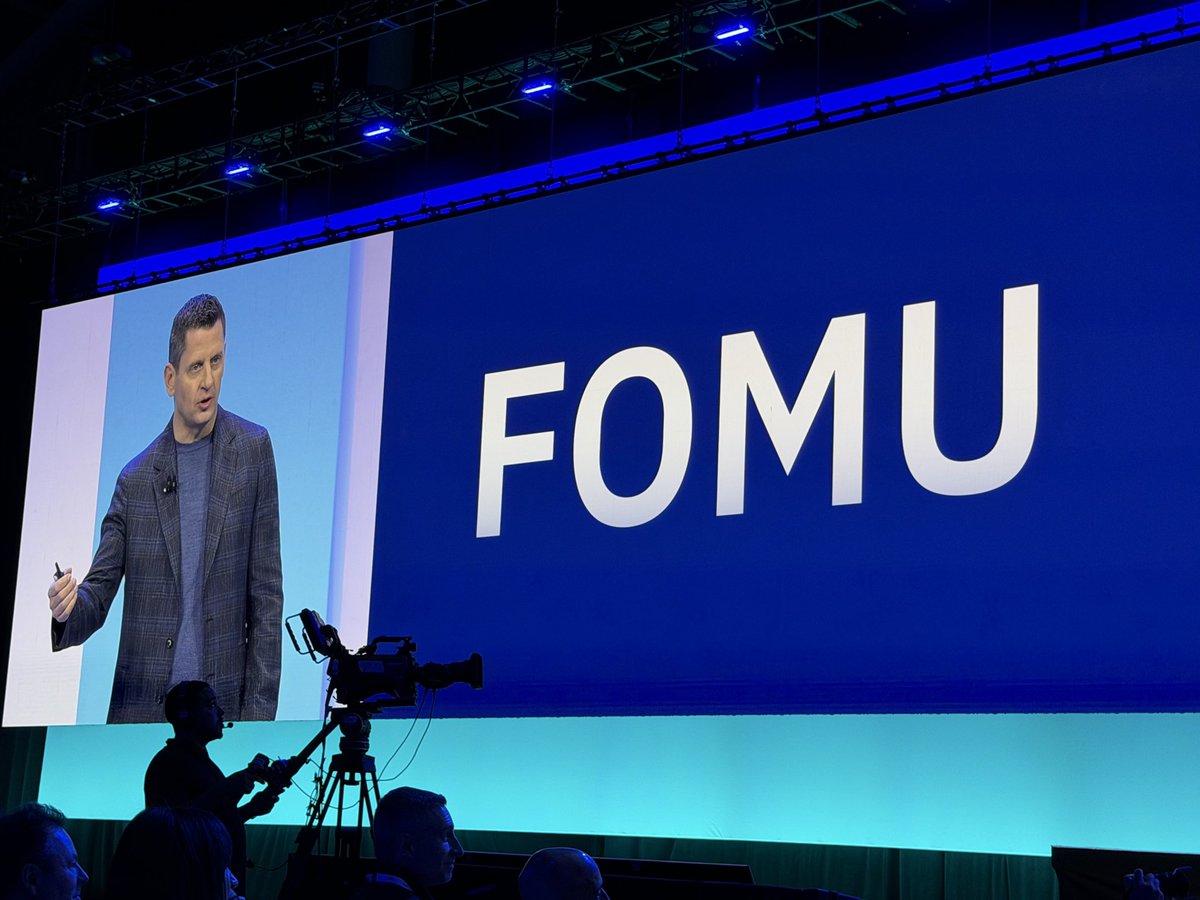
‘Fear of messing up’, #FOMU is keeping many technology leaders and practitioners at bay, when it comes to leveraging AI for advancing their causes. @robdthomas made that point well during this @IBM Think keynote this week.
#IBMThink#Think#Think2026