Our book, Trustworthy Online Controlled Experiments: A Practical Guide to A/B Testing, sharing learnings by Diane Tang from #Google, Ya Xu from #LinkedIn, and my own from #Amazon and #Microsoft (I'm now at #Airbnb) is available for pre-order on Amazon:
https://t.co/cSFJkO0EUe
@specialkdelslay Just 90%? I got 100% by praying to Twyman 😃
See https://t.co/ssm0m9agjY for other absurd claims and underpowered studies.
For the technical audience, see https://t.co/L6bayAX1CK
Lightning Lesson on Maven (free): A/B Testing Replication Crisis: Lessons from 10 Large-scale A/B tests.
Register at https://t.co/oYV2rtnN9W (March 4, 2026, 10AM PST).
Claims of large lifts in A/B tests are widespread, yet many are supported by small online experiments that are likely underpowered.
To address this, the Trustworthy A/B Patterns project, a community replication effort, evaluates selected patterns at high statistical power.
We share the design and results from 10 A/B tests across four patterns tested with millions of users:
🔘 Rounded buttons
⚡ Page performance
🎟️ Coupon-code fields
📌 Sticky call-to-actions
In this 45-minute lightning lesson, we will cover key experimental design choices, actual results, and practical lessons learned.
#abtesting #experimentation #experimentguide #causalinference #statisticalPower
We invite you to join the community project. See https://t.co/1Goee8XEFs. We offer free help to design and analyze your replications in exchange for sharing the results.
The Winner's Curse: 10 Large-Scale A/B Testing Replications.
Here is a summary of the 10 replications completed for the Trustworthy A/B Patterns community project: https://t.co/1CFzfkn4kq
In June 2024, @lukasvermeer, @jlinowski, and I, started a community project to replicate patterns after seeing an implausible lift for rounded vs. square buttons. The first three replications confirmed that the initial results were highly exaggerated (summarized at https://t.co/mOYim8C4aR).
But what about other common patterns?
We have now summarized seven additional A/B tests across four patterns (rounded buttons, page performance, coupon-code field, and sticky call-to-action). These experiments were large, with a median of 2.2M users per experiment and 80% power at our pre-selected minimum detectable effects (MDEs) of 0.3% to 2.2%.
#ABTesting #ExperimentGuide #TrustworthyABPatterns
Want to run A/B tests you can trust—and ship faster with fewer false wins?
My next Maven cohort of Accelerating Innovation with A/B Testing starts Jan 26, 2026 (5 live, interactive sessions × 2.5 hours).
✅ Start time: 12:00pm Pacific (later time for once, as requested by folks in Australia & New Zealand)
⭐ Maven rating: 4.8/5.0
💬 Highly interactive: lots of Q&A, real stories, messy problems, not just theory
Sign up here: https://t.co/Xo9qIrLaqO
A couple of testimonials from the last cohort (https://t.co/x5ZlycjAzw):
- I highly recommend this course. Ronny is a great lecturer who covers a fantastic set of topics, striking the right balance for both new and experienced experimenters. The sessions are highly interactive, offering plenty of room for Q&A and discussion -- Algorithms Analytics Manager, Taboola
- One of the best courses on experimentation I have taken, with a strong focus on real-world learnings. Ronny is a genius. He is extremely patient and great at answering questions with practical, experience-driven insights -- Lead Data Scientist, Docusign
#ABTesting #ExperimentGuide #DataScience #ProductManagement @MavenHQ
Our paper, Statistical Challenges in Online Controlled Experiments: a Review of A/B Testing Methodology, is now the 13th most read paper of all time in The American Statistician (measured by views, now over 25,000).
It's open access so PDF is downloadable.
- Main paper: https://t.co/XxhdziA6ol
- Supplement: https://t.co/1qbdmBCAZv
Most read statistic page: https://t.co/meBIrr58m0 (switch to "All time" tab at the top).
#abtesting
Note:
1. This is part of the Trustworthy A/B Patterns project (https://t.co/2HNZWp0PGG), where we are serious about proper statistical power and trust. In fact, the first run of this test had an SRM (Sample Ratio Mismatch), and this is the second run.
2. This is not one of those low-power implausible results that says “round the corners of buttons and click-through rate will improve 55%” (recently summarized at https://t.co/2BQ8OCzgTZ). 0.3% improvement to revenue is realistic and material to the business.
3. The treatment effect is smaller than those summarized in Trustworthy Online Controlled Experiments: A Practical Guide to A/B Testing, Chapter 5, because those experiments improved performance of every page, while this experiment improved a single page (the home page).
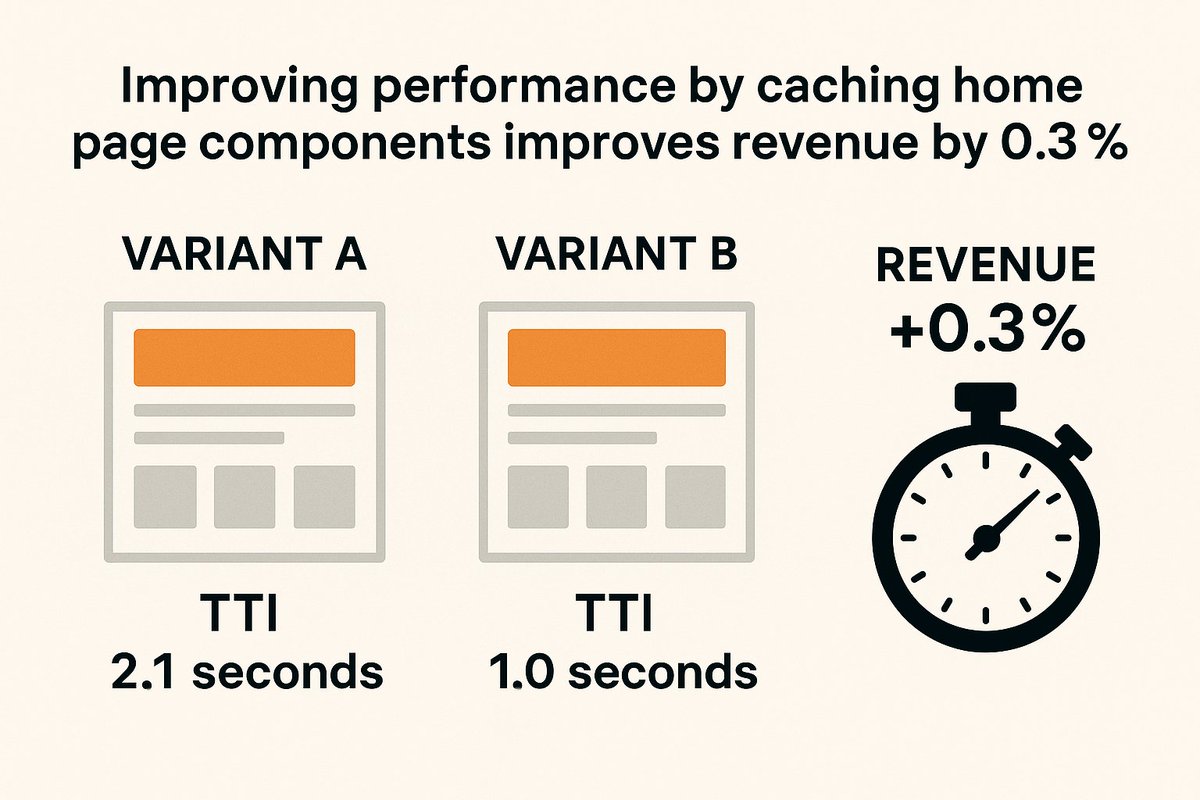
Improving performance by caching home page components improves revenue by ~0.3%.
See https://t.co/5gDJvLTnNI for details.
Talabat, a subsidiary of Delivery Hero, ran an experiment with Eppo by Datadog to measure the revenue impact of a speedup of the home page achieved via smart caching. The speedup in Time-To-Interactive (TTI) was from ~2.1 seconds to ~1.0 seconds.
Revenue per user improved by 0.36%. Applying a haircut because of sequential inference, we believe an unbiased estimate is ~0.3%.
#ABtesting #experimentguide #perf
A/B Testing: The Science of Not Fooling Yourself (my guest post on New Economies): https://t.co/be2y3AUisq
Covering four topics
🧪 Why reported results are often wrong, the hierarchy of evidence, and replication
📉 A p-value of 0.05 does NOT imply that B is better than A with 95% probability. It’s about 78%.
📊 To run trustworthy A/B tests, you need large samples: 240,000 users is where the magic happens and when you can run hundreds of concurrent A/B tests
⚠️ Be skeptical of extreme results with high lifts
#ABTesting #ExperimentGuide #pvalue
Just crossed 40K LinkedIn followers - thanks!
I compiled the best-of since 30K followers at https://t.co/fkGTio7STL
It’s nice to see that many posts were motivated by questions in the Maven courses I teach (https://t.co/Xo9qIrLaqO, https://t.co/JjK8ZNJImu), so thanks to all the students that asked interesting questions!
#ABtesting #ExperimentGuide #CausalInference #DataScience
🧠 [Primer] Online Testing • https://t.co/5qRynCUFHG
- Online testing is a statistical experimentation framework where changes are tested directly with live users in digital environments. It enables organizations to make decisions based on real-world user interactions, rather than solely relying on assumptions or offline evaluations.
- A/B testing (also known as split testing) is one of the most common forms of online testing, where two variants (A and B) are compared against each other to determine which performs better. A/B/n testing is an extension of this approach that allows multiple variants (A, B, C, etc.) to be tested simultaneously. Together, these methods form the backbone of online testing, helping organizations optimize digital experiences, marketing strategies, and product features in controlled, measurable ways.
- Shoutout to @elgeish and @ronnyk, from whom I've learned my fundamentals in online testing!
🔹 Purpose of Online Testing
🔹 How Online Testing Works
🔹 Steps Involved
🔹 Stable Unit Treatment Value Assumption (SUTVA)
• Key Components
• Why SUTVA Matters
• Examples of SUTVA Violations in Online Testing
• Strategies to Ensure Compliance
• Handling Violations
• Benefits
🔹 Common Applications of Online Testing
• Website Optimization
• Email Marketing
• Mobile App Optimization
• Digital Advertising
• Pricing Strategies
• UX Improvements
🔹 Benefits of Online Testing
🔹 Challenges and Considerations in Online Testing
• Sample Size Requirements
• Time Constraints
• False Positives and False Negatives
• Confounding Variables
• Cost of Experimentation
• Test Interference (Cross Contamination)
🔹 Advanced Variants of Online Testing
• Multivariate Testing
• Split URL Testing
• Bandit Testing
• Personalization and Segmentation
• Sequential Testing
• Adaptive Testing
🔹 Parameters in Online Testing
• Sample Size (n)
• Minimum Detectable Effect (MDE or Δ)
• Significance Level (α)
• Statistical Power (1 −β)
• Baseline Conversion Rate (μ)
• Variance (σ^2)
• Test Duration
• Confidence Interval (CI)
• Effect Size (Observed Δ)
• Traffic Allocation
🔹 Statistical Power Analysis
🔹 The Interplay Between Significance Level/Type I Error (α) and Type II Error (β)
• Factors Influencing the Relationship Between α and β
• Comparative Analysis
• Rule of Thumb: Scaling Sample Size for A/B/n Tests
• The Perceived Severity of Errors
• A Misconception about α and β Ratios
• Practical Implications: Balancing α and β
🔹α Percentile
🔹 Measuring Long-Term Effects in Online Testing
🔹 Related: Dogfooding vs. Teamfooding vs. Fishfooding in Online Testing
🔹 Managing Test Conflicts and Overlap
🔹 Ensuring Balanced Allocation Groups
🔹 Related: Statistical Significance for Offline Data
• Key Differences from Online Testing
• Techniques for Establishing Statistical Significance on Offline Data
• Using Confidence Intervals and Power Analysis
• Comparative Analysis: Online vs. Offline Significance Testing
Primer written in collaboration with @VinijaJain.
#Testing
Thanks for the shoutout, @i_amanchadha.
For those interested in learning more, I teach an interactive online course on A/B Testing: https://t.co/Xo9qIrLaqO (starts Dec 1st, 2025) and there is a follow-on advanced A/B testing course:
https://t.co/JjK8ZNJImu (starts Dec 15, 2025)
Running concurrent A/B tests is essential to scale.
Many organizations hesitate to run experiments in parallel, fearing that they will interact, but the concerns are overstated:
- Concurrent testing is essential to scale
- Strong interactions are rare in practice
- Most concerns are overblown
In the article at https://t.co/3ZKwO3x4MP, I share examples of antagonistic and synergistic interactions, how to detect them, and why leading companies safely run thousands of concurrent experiments.
The graph (from https://t.co/FZ1tv4jjy3) shows experimentation growth at Bing, Google, LinkedIn, and Office. The growth is relative to the first year where experiments ran at a scale of one new experiment per day.
#abtest #experimentguide
Next Monday, 8 Sept 2025, we start a new live cohort of the course Accelerating Innovation with A/B Testing on Maven.
Register at https://t.co/Xo9qIrLaqO
Five x 2.5-hour interactive sessions. Maven rating 4.7/5.0.
Most employers reimburse the course, given the high ROI.
Human testimonials at https://t.co/x5ZlycjAzw.
ChatGPT 5 recommended in image below :-)
Honored to be listed in AB Tasty's 16 Experimentation Influencers You Should Follow: https://t.co/vXhdaccAMc
As for the image background color, I think it should be A/B tested :-)
My online interactive course: Accelerating Innovation with A/B Testing starts this Monday, July 7th: https://t.co/Xo9qIrLaqO
Fair question.
1. For the first course, half the material is in the book. For the second book, it's all new.
2. Many people find the ability to hear the material with stories and examples easier to digest.
3. You get to ask questions. I stay after class until all questions have been answered.
See the reviews. If people continue to register and give positive feedback, I enjoy teaching.
The "Student's t-test," widely used in A/B testing, could have been called the "Guinness t-test,” if it wasn’t for management's reluctance to allow publications associating the company’s employees with the published research.
William Sealy Gosset (1876–1937) developed this critical statistical test while working as a brewer for Guinness, the Irish brewery. However, Guinness management prohibited employees from publishing research under their real names or sharing any company data. Consequently, Gosset published his groundbreaking work under the pseudonym "Student."
Imagine the brand recognition Guinness missed by insisting on anonymity! Instead of running "Student's t-tests," thousands of companies today could be proudly performing the "Guinness t-test."
References at https://t.co/fABLzJpsIt
For more real stories, I teach an interactive online course on A/B Testing with a lot of them, making the material accessible: https://t.co/Xo9qIrLaqO
#ABTesting #ttest #experimentguide #branding
The next cohort of Accelerating Innovation with A/B Testing with Maven starts May 12, 2025. Sign up at https://t.co/Xo9qIrLaqO
The logos slide shown, of companies that sent at least two people, has been updated and now includes Wikimedia, Splunk, Estee Lauder, Docusign, StockX, Calendly, and Audible.
Read testimonials at https://t.co/x5ZlycjAzw