International Law, Digital Democracy
Author - "In Defence of Democracy" & "Beasts and Gods"
Bylines at The Nation, Spiked, LA Review of Books, FT, etc.
Well, you have to take it from the horse's mouth sometimes. The Founding Fathers aimed to design a republic in opposition to monarchy. The issue for us is a) that system alone does little to contain the super-rich under most circumstances (post-War was exceptional for a variety of reasons) and b) over the long haul will collapse into a more centralized imperialism (as the Roman Republic it was explictly modelled on eventually did).
I do care enough, bc it turns out running a country isn't an amateur sport where you can just throw out wild ideas and walk away from them again without accountability. If it was important enough for you to tell people this is how to 'fix' politics, it should be important enough to defend. There are huge issues with CAs - the confusion and misleading info around the abortion CA is just the tip of the iceberg. Furthermore, removing a prohibition from the Constitution makes it a legislative matter. The idea that the Dail is only able to legislate in a 'specific' way is misleading! And yes, the entire CA movement only goes in one direction - towards hyper 'left' goals which CAs are just one 'tool' to achieve. Their most prominent advocates are completely open about this. Whether or not one agrees with those goals is besides the point - it is deeply anti-democratic by design with pre-decisions about what is right and it just being a matter of cajoling manipulable quantities of people to get there.
@stephenfhwebb@MarkPaulTimes@saschaosullivan@Jack_Blanchard_ Yes. Exactly. And the referendum question was just to repeal the 8th. The details became a purely legislative matter and can no be changed without referendum. So that is the relevant data!
a) that's exactly the issue with CAs - they ask a bunch of different overlapping questions ensuring a lack of clarity, and then cherry-pick the 'successes'
b) how do you explain that of 6 refs tied to CAs in Ireland 3 failed by huge majorities (coin toss results)?
c) there are tonnes of CA advocates out there expressly pushing CAs as a way to get their preferred agenda through
The rhetoric of 'feeling included' is a perfect example of this entire complex. It's like saying: 'It's important to me that you feel loved' rather than 'I love you' or 'I'm sorry you feel that way' rather than 'I'm sorry'. But it does come out of the 'policy entrepreneurship' of the last decade (or three). The idea being to give people a feeling rather than just e.g. doing what you said. It is a view that believes people are more manipulable than they are and after many years of implementation many of those people are feeling pretty ticked. Let people respond to what you do (or let them for-real do it themselves). There will be ups and downs. Sometimes it's not completely fair. But like so many things, tracking sentiment has gone over into conflating it with reality. Most people do not want to 'feel included'. They want their problem to get fixed.
:-) Yes, we have a bundle of mandatory consultations here too. Some thoughts on that:
a) digital tools can be very helpful in those processes by saving labour (think a process that guides you through the major points rather than every person having to formulate their input from scratch)
b) they can save labour on collating feedback
c) I'd say particularly in that local environment, a tool like https://t.co/MMZc1LM0OE can be useful, because the issue at hand is fairly low-stakes and often driven by practical considerations, rather than ideological or grand strategical questions. So it's more applicable to that relational situation.
d) those local issues do really impact people's lives so are important. I don't want to downplay that.
e) Critical: people need to know what resulted from the consultation. And in fairness I like that about https://t.co/MMZc1LM0OE - that it is viewable in real-time. Huge benefit, imho.
f) I have nothing against calling for consensus or making an effort for greater consensus - just...within reason.
We review digital democracy tools at https://t.co/RwDYCkIT8x. I appreciate some aspects of https://t.co/93u3CTd7UX but I think a weakness is that there is a danger, due to the way it works, to push the result towards an anodyne consensus. 'Everyone is happy' isn't really how decision-making works and it isn't how majority rule (democracy) works either. Sometimes there are sharp disputes, resolved by thin margins. Sometimes in order to implement a policy well, you have to be fairly uncompromising in how you do so. Any actual decision-making requires that. Everything else is just dithering along. So, I think over the last years, not only https://t.co/93u3CTd7UX, but a lot of places got obsessed with this idea that no one would ever feel 'unrepresented' or that there wasn't a 'compromise' on an issue or the highest consensus possible. There is a place for that - but definitely it often also leads to people not leaning in hard enough on a strategy and ultimately undercutting their own decision. I never fully reviewed them because they never shared enough info with me to make me confident of my assessment. I do like the conversational aspects and thus the easy iteration of the tool, which are big pluses. But there has been a huge over-valuation of both the benefits of consensus and incessant talking in this space, generally speaking. 'If only we talk enough we'll agree!' It's just something you notice a lot of people are very convinced of and then they become quite angry when it doesn't happen. So it has its uses, but important to be mindful of those limitations, imho.
Basically, yes. There is an academic school called 'deliberative democracy': a few of them support CAs, others have let the more egregious claims of activists slide (I believe, irresponsibly) and others are critical. These developments are all within that specific school of thought, which itself has a fairly limited membership. But ca 6-7 years ago philanthropists began dishing out money for CAs, so they became a huge, trendy deal. Most academic positions today come with the obligation to 'fundraise' and bc donors were into CAs, you could get money to say/'research' whatever you wanted about them (as long as it was positive or your criticism was of the 'the only challenge is to do them better' variety). They served mainly 'progressive' philanthropist claims because they provided the 'datapoints' that supported their narrative (e.g. 'people on the street say they want X, but their 'considered will' is actually Y'). Many of their most ardent adherents do believe this is true and that the whole world secretly agrees with them (they just don't know it yet).
Thanks @stephenfhwebb They really aren't a thing in Ireland anymore, either (at least right now). The CA crowd basically inserted themselves into the referendum process, claiming they would improve it. Of six referendums that could be said to be connected with CAs, three of them actually failed by the largest margin in the history of the country (so, the applicable German word here would be 'verschlimmbessert'). I wrote about some of this here: https://t.co/hd6ZziYbuY and here: https://t.co/ixMJtkQtZZ. A few people have tried and failed to get criticisms of CAs published in academic journals. It is quite difficult, given the consensus within the academic community that people generally are 'doing democracy wrong' by not coming to conclusions academics like, and CAs can 'fix this' by 'informing them.' The CA crowd also constantly swamped 'journalists' with what was basically propaganda about CAs, which was then uncritically published in newspapers. Over the years, I had some serious arguments with editorial boards of papers who would be unable to explain where they got their facts about CAs from, except a press release by an NGO that they never fact-checked. This massive idea-laundering train is how CAs became so 'popular'.
@tbald101 Good article. Added to that Boomers tend to support younger people who serve their interests thus creating tiers among the succeeding generations. When you try to do something you compete against those your own age plus their parents and grandparents.
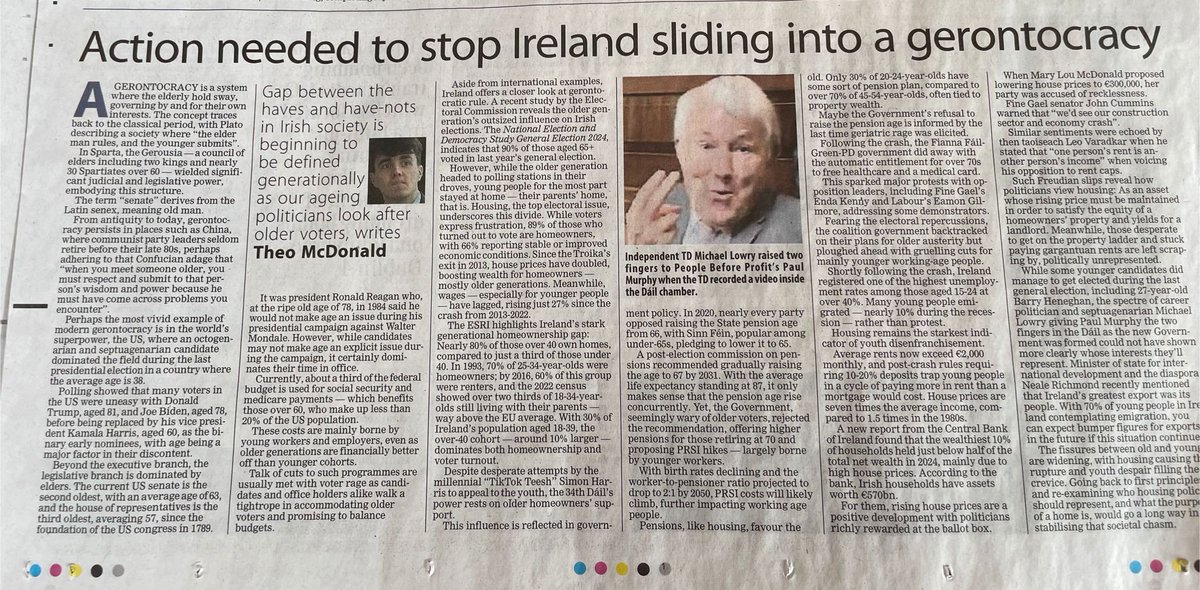
"89% of those who turned out to vote in the last election are homeowners, with two-thirds reporting stable or improved economic conditions.
"Since the Troika’s exit in 2013, house prices have doubled, boosting wealth for homeowners—mostly older generations. Meanwhile, wages, especially for younger people, have lagged, rising just 27% since the crash from 2013-2022."
My piece in the @irishexaminer
I lead SDI, an actual NGO supported solely by members in Ireland since 2017. I'd like to thank you for drawing attention to this issue. We produce a real study of digital democracy tools - in our version these need to give decision-making power to people to qualify. Organizations like the Civic Tech Field Guide ripped off our work and proceeded to water it down with a bunch of fake BS funded by the super-wealthy. When I confronted them about this, they basically called me a pathetic loser and told me to shut up. They have consistently tried to shut out anyone who is actually acting in a grassroots capacity in this area and replace this with 'participation' that is limited and pre-censored. Our website: https://t.co/RwDYCkIT8x
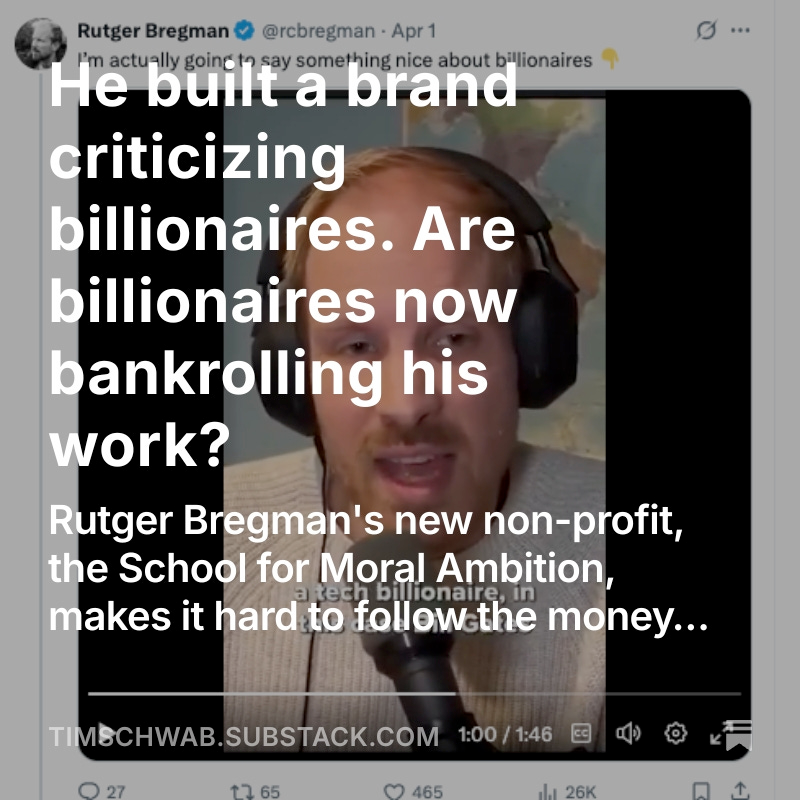
As political animus against oligarchy gains momentum, are billionaires like Bill Gates using philanthropy to co-opt critics of extreme wealth?
I tell this story through @rcbregman, a man of many contradictions. Following the money was not easy:
https://t.co/2YygJdGs7C
@luebberding Genau richtig! Brennan und Co. versuchen seit Jahren, dass allgemeine Wahlrecht abzuschaffen und es ist zum Haare ausreissen wie diese 'Position' von sogenannten Experten gefeiert wird.
This short excerpt of the discussion between @ChrisMurphyCT & @JonStewart is a direct and powerful refutation of the entire Abundance Ideology™ and its premise that we just need to deregulate and subsidize billionaires and corporations.
Considering that at least 80% of the publishing industry is formulaic (formulaic sci-fi, romance, etc) & that this is where the money is (not high-end literature), this is pretty amazing. A lot of fiction is read just to pass the time (not for mind-bending insights), so I can see this replacing or aiding those writers (if this is any indication, it is already better than a lot of them). You can imagine something where someone asks for a story about 17th century France or whatever and it spins them one.