AI isn’t a future theme at @USCleanPower, it’s already in the field, reshaping how we deploy energy projects.
At the “Knowledge is Power” panel, we talked about what actually matters now: speed, siting, permitting, and execution at scale.
Big thanks to Clean Power and to Russell Gold, Craig Cornelius, Mark Donahue, and Sheldon Kimber.
Ok, who developed old school geothermal & does US get credit for advanced geothermal (using fracking to create networks to heat water)… I don’t know offhand where wind turbine tech comes from.
Gas turbine tech was developed by GE, yes?
Rotary drilling rig. Silicon-based solar panels. Nuclear power plants. Hydraulic fracking. What's a major energy technology development of the last century that does NOT have U.S. roots?
Seriously, I'm curious. What am I forgetting?
Data from @IEA 2026 Global Energy Review. "The 2025 increase in solar PV of 600 terawatt-hours (TWh) was the largest-ever electricity generation increase by any source in one year, outside of periods of post-crisis recovery."
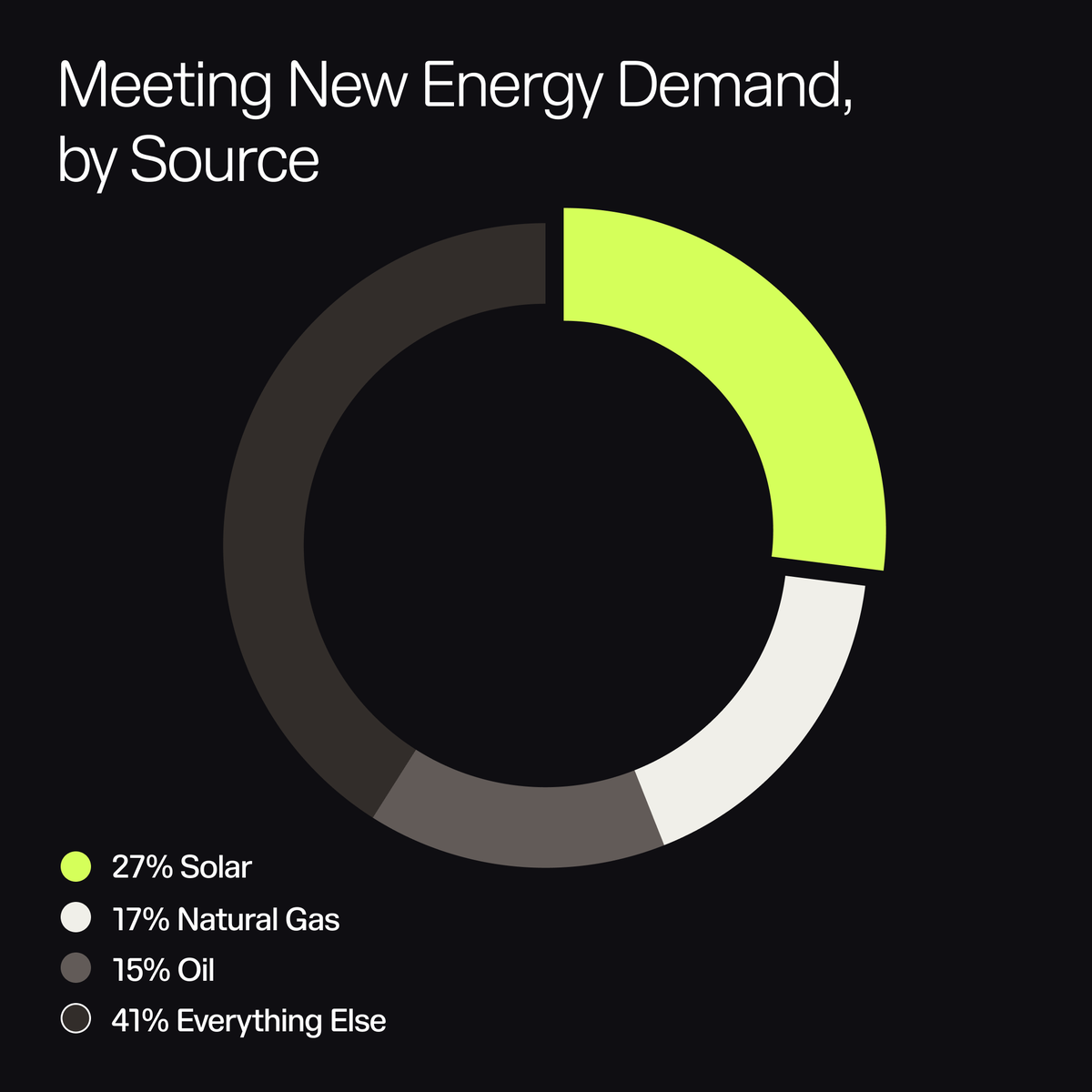
In 2025, global energy demand grew. That’s normal. Here’s what’s not:
For the first time ever, solar was the largest single source of growth.
☀️ Solar: Met >25% of higher demand
And in electricity alone? Solar PV delivered 70% of demand growth.
This isn’t a one-off.
Solar is the most scalable, lowest-cost energy source on Earth. No drilling. No seismic trucks. When you need more, you build more.
That’s why T1 Energy is committed to building an integrated solar supply chain in the United States. 🇺🇸
The future runs on solar. After all, there’s a giant fusion reactor in the sky giving it away for free.
I've been quite on socials for the last year, but that doesn't mean I have't bee busy.
Great to take a few minutes to talk with @JigarShahDC & @dcjams about how we took @T1Energy from an idea to a gigawatt scale domestic solar manufacturing powerhouse.
When we generate more solar energy here in the U.S., we have more natural gas available to export to our allies and trading partners around the world.
In the last few years, the U.S. has become a global gas exporting powerhouse. Last year, the U.S. exported more liquefied natural gas (LNG) than any other country has ever. About 1/5th of all U.S. natural gas produced was liquefied and exported. Exports have surged from less than a billion cubic feet a day a decade ago to 15 billion cubic feet daily last year—worth more than $18 billion in 2025.
Solar energy frees natural gas for export. America’s exceptional energy abundance (lots of both natural gas and solar farms) can keep energy and electricity prices low at home while also continuing to be a worldclass energy exporter. In the U.S., solar and natural gas are working together to protect fortress America and keep energy insecurity far from our shores.
To understand the importance of American solar and gas infrastructure, look at what happened this week in Qatar. On Monday, Iranian military attacks on the giant Ras Laffan Industrial City, which forced QatarEnergy to stop producing LNG. Twenty percent of the world’s natural gas shipped by tanker ceased production. The impact of the decision rippled around the world.
The price of natural gas in Europe and Asia, which both rely on Qatari LNG, spiked. Prices in Europe are now six times higher than in the U.S. In Asia, importers are scrambling to get their hands on natural gas.
The U.S. has eight operational LNG export terminals scattered across Alaska, Georgia, Louisiana, Maryland, and Texas, with eight more under construction and another dozen proposed. These export terminals pull natural gas from regional gas pipelines, chill the gas until it turns into a liquid (at a frosty -260 degrees Fahrenheit), and then send it overseas aboard specialized floating thermos ships to our allies and global trading partners.
More solar means more electricity, freeing up gas molecules for export. The infrastructure of abundance includes both gas and solar. And when global disruptions occur, America’s energy abundance can protect its people from price spikes while also helping supply our allies. While natural gas prices rose in Europe and Asia, they barely budged in the U.S. Energy abundance delivers.
Not long ago, America was not the world’s top LNG exporter. It is now. America was not the number one oil producer in the world. It was Saudi Arabia. America is now #1. There is no reason why we can’t also become the world’s largest solar producer. After all, solar energy was developed here.
We’re stronger when we make the most of all our natural resources: natural gas molecules and solar electricity. Those LNG carriers departing the Gulf Coast are bringing energy reliability to our allies and partners around the world. Solar will be here keeping the lights on at home.
I've spent a long, long time on Energy twitter. This might be one of the mind warping things I've seen.
From the start... "this song is dedicated to the Mississippi Lime" to the guy pouring crude oil on the conference room table... I may never be the same.
https://t.co/GrQT3tKJQa