Only 5% of US businesses ever reach $1M in revenue. The other 95% plateau. The very control that got you to $1M becomes the ceiling that stops you at $5M. Three mental shifts separate those who break through.
Link to full article: https://t.co/UeXpf4ghtP
#business#Psychology
Your move: Track passive voice in the next earnings call you hear.
When executives distance themselves linguistically from bad news, financials follow 2-3 quarters later.
Grab my CEO Language Red Flags Checklist (7 patterns): https://t.co/lYNUwbo6Mf
Quality management sounds different:
"We made three mistakes in Q2. Here's what we learned and how we're fixing them."
Specificity signals confidence. Vagueness signals trouble ahead.
Real example: Last month I analyzed a CEO who used passive voice 47 times in 30 minutes.
"Challenges were encountered"
"Difficulties were faced"
"Opportunities are being explored"
We passed. Six weeks later: restructuring announced.
The pattern: Passive voice when discussing challenges.
❌ "Headwinds were experienced in Q3"
✅ "We lost three clients because our product lagged competitors"
The first hides accountability. The second owns reality.
Want to know if a management team is in trouble? Listen to one sentence in their earnings call.
I've analyzed 200+ calls while building our portfolio. One pattern predicts problems 2-3 quarters early.
Here's what to listen for: 🧵
🎢 The Value Investor's Playbook: Seizing opportunity in market panic
When markets plummet, do you see chaos or opportunity?
Smart investors recognize:
• Market price often diverges from intrinsic value
• Emotional decision-making creates inefficiencies
• Patient capital can capitalize on market fear
Key insight: While the herd flees, savvy investors advance.
Consider this: Warren Buffett's Berkshire Hathaway currently holds $266B in investments with an average holding period of 18 years. Patience is key.
Read more: https://t.co/acCq9KFZxm
#ValueInvesting #MarketOpportunities #LongTermInvesting
Business valuation isn’t just about crunching numbers – it’s about understanding the story behind those numbers.
The art of business valuation: 3 Methods https://t.co/XmtpHGqerb
#valuation#narrative#investment
The #1 growth strategy most startups overlook:
Customer retention.
It's not sexy, but it's powerful.
Here's why:
• Acquiring a new customer costs 5-25x more than retaining an existing one
• Increasing retention by just 5% can boost profits by 25-95%
• Loyal customers spend 67% more than new ones
My top retention tactics:
1. Exceptional onboarding
2. Regular check-ins
3. Personalized communications
4. Loyalty programs
5. Continuous value addition
6. Proactive problem-solving
7. Community building
I've seen startups triple their growth rate by mastering retention.
It's not about constant new sales.
It's about creating customers for life.
What's your best retention strategy?
#CustomerRetention #StartupGrowth
🚀 Palantir's stock surge: Golden opportunity or fool's gold?
PLTR skyrocketing 265% YTD. 📈
CEO offloading shares. 🤔
Insiders cashing out $1.2B. 💰
Cause for concern? Or prudent portfolio management?
My perspective?
1. Stratospheric valuation (43x 2025 revenue)
2. AI hype fueling market excitement
3. Government contracts driving robust growth
4. S&P 500 inclusion amplifying demand
Historical trends indicate extreme valuations rarely persist long-term.
Your move:
• Buy for potential upside?
• Hold and weather volatility?
• Sell to lock in gains?
Next week we will dive deeper into the strategy and financials of Palantir.
What's your investment strategy here? Let's discuss below.
#StockMarket #TechInvesting #AIBoom
What to focus on when analyzing an investment opportunity. A 15 step checklist.
✅ Business Analysis: Understanding the fundamental
📊 Financial Analysis: Evaluating the numbers
📈 Market Analysis: Assessing market position and value
Key highlights:
- Real-world examples from companies like Apple, Microsoft, and Tesla
- Practical steps you can implement immediately
👉https://t.co/BX2kNUzQOy
Thoughts? What other frameworks do you use in your investment analysis?` More insights and deep dives on company analysis? Subscribe on https://t.co/6jf08BJHFt
#Investing #FinancialAnalysis #WealthManagement #StockMarket #InvestmentStrategy #FinancialEducation
🎓 Oxford taught me finance. 💼 Entrepreneurship taught me reality.
My biggest lesson? Information asymmetry is pervasive in business.
At Oxford:
• Theoretical study of asymmetric information
• Academic models and case studies
In the real world:
• Daily encounters with information imbalances
• Practical challenges and opportunities
🔍 Key example: Pitching to investors less familiar with your industry
The solution? Build trust through radical transparency.
My approach:
1. Share metrics openly - both triumphs and setbacks
2. Provide context for our numbers
3. Invite questions and dialogue
Results:
• Accelerated funding processes
• Stronger investor relationships
• Enhanced credibility
The journey: Transforming academic theory into actionable strategy.
🤔 How are you applying classroom concepts to real-world challenges in your field?
#EntrepreneurialInsights #FinancialStrategy #TransparencyInBusiness
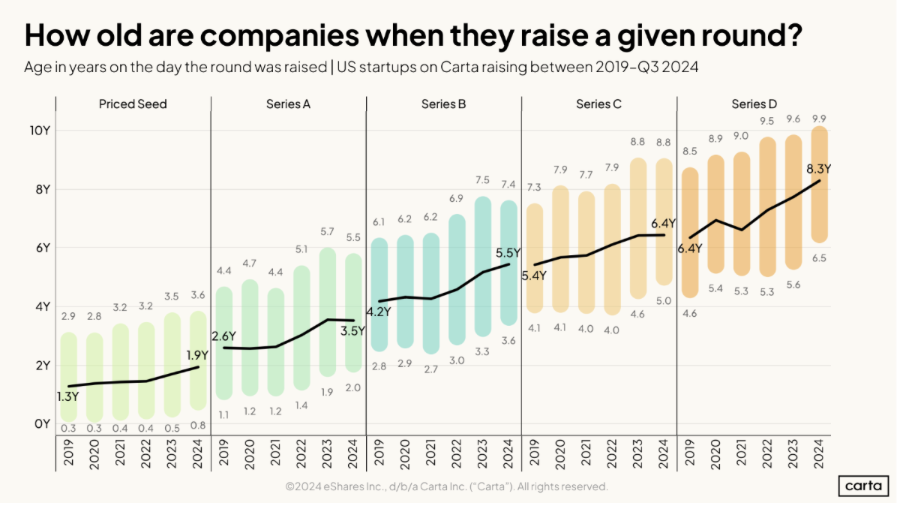
Today's startups are getting older – not in terms of relevance, but in actual chronological age. The data tells an interesting story: while Series A companies in 2019 were typically 2.6 years old, their 2024 counterparts are reaching 3.5 years before hitting the same milestone.
This aging trend isn't isolated to Series A – it's a pattern we're seeing across every funding stage in the startup ecosystem.
What's driving this shift? Several factors appear to be at play:
First, there's been a fundamental change in early-stage funding dynamics. Startups are increasingly relying on convertible instruments (like SAFEs and convertible notes) before pursuing traditional priced equity rounds. This evolution has essentially stretched the definition of what we consider a "seed" stage company.
Second, the recent funding downturn has forced companies to extend their runways, resulting in longer intervals between funding rounds. Startups that might have rushed to raise their next round in previous years are now taking their time – whether by choice or necessity.
Lastly, the sluggish IPO market isn't helping matters. With fewer companies making the leap to public markets, we're seeing a broader slowdown in the entire funding lifecycle.
Credits to: 👉Carta
#startup #market #funding #investment #vc
The next big thing in French tech might not be in Paris.
I've been analyzing investment trends, and here's what's fascinating:
Regional tech hubs are on the rise:
• Grenoble → Deeptech
• Toulouse → Spacetech
• Strasbourg → Medtech & Robotics
But here's the opportunity:
While 62% of French startup funding still goes to Paris...
...Berlin only accounts for 40% of German startup funding.
This tells me:
1. French regions are undervalued
2. There's huge growth potential outside Paris
3. First-mover advantage is still available
As a strategist, I'm excited about the possibilities.
Have you invested in any French startups outside Paris?
What's been your experience?
#VentureCapital #FrenchTech #startup
Checking out a pitch deck showing a hockeystick growth and projected revenue increasing from zero to 100M in a year? Going for unicorn status but currently without clients?
👉https://t.co/TTVIMkWtJM
#startup#valuation#finance
The GPU race is heating up in Silicon Valley.
A16Z's Oxygen cluster. Y Combinator's partnerships. Andromeda's 4,000 GPUs.
VCs are becoming compute powerhouses.
This shift has massive implications:
1. Startups can focus on innovation, not infrastructure
2. Investors gain deeper tech insights
3. New evaluation metrics for AI companies emerge
From a strategic perspective, this is fascinating.
We're seeing a blend of financial and technological capital.
What other resources do you think VCs will offer next?
Want to stay on top of the latest insights and analysis on valuation? Subscribe at https://t.co/6jf08BJHFt
#TechInvestment #AIInnovation #ai