So I sneaked into the OU building I needed for filming when someone came out but I’m now trapped inside without a pass card.
I live here now 😂🤣 Just changing my address on StudentHome…I guess my term doesn’t end in 39 days 🤣
#OUStudents
This movie shows the sunspot structure and dynamics from the #photosphere to the #chromosphere. While the area seems to be nearly a rest in the photosphere, the chromospheric activity is very intense above the spot ☀️👉🏻 https://t.co/iKtEZbf9AK
Since first evolving 350 million years ago, the tongue has taken myriad forms, unlocking new niches and boosting the diversity of life.
Learn more in this @NewsfromScience feature: https://t.co/I4883r5iHB @ScienceVisuals#ScienceMagArchives
Artificial light at night has variable and complex impacts on plants and animals, disrupting entire ecosystems, according to a 2023 #ScienceReview.
Learn more: https://t.co/u9vVHjcDmE #LightPollution#ScienceMagArchives
If you are interested in Beyond Earth Orbit and Lunar missions, then please complete this survey before the 28th June to share your thoughts!
Your responses will provide vital insight in creating Beyond Earth Orbit (BEO) and lunar regulatory policy.
👉https://t.co/b7lKSaQ4e1
Still here. 👋
And still more than 15 billion miles (24 billion km) away from Earth. It takes my team about 22.5 hours to send me a command and another 22.5 hours for my response to get back to them. That will continue to increase the further I travel into interstellar space. -V1
Patrolling resident memory T cells generate their own biophysical forces that help them travel to pathogenic intruders in the salivary glands of mice, a new @SciImmunology study finds.
Learn more: https://t.co/Ja2HKWckrz
129 light-years away, we can see four planets dancing around the star HR 8799 in the constellation Pegasus. This is known as direct imaging – taking pictures of faraway planets. They can only be revealed by blocking the star's bright light. https://t.co/9Zz1BqgIVo
Born #OnThisDay in 1863 was American astronomer Annie Jump Cannon. Cannon, who lost most of her hearing early in her life, was one of the Harvard Computers, and her work was vital to the modern classification of stars. She classified around 350,000 stars during her career.
Ben Rider-Stokes, has investigated a unique, meteorite classified as Northwest Africa (NWA) 8535.
This sample is part of a group of meteorites from an asteroid/planet that no longer exists in the modern-day Solar System known as angrites.
🌌 👉 https://t.co/3EnM4SZaQl
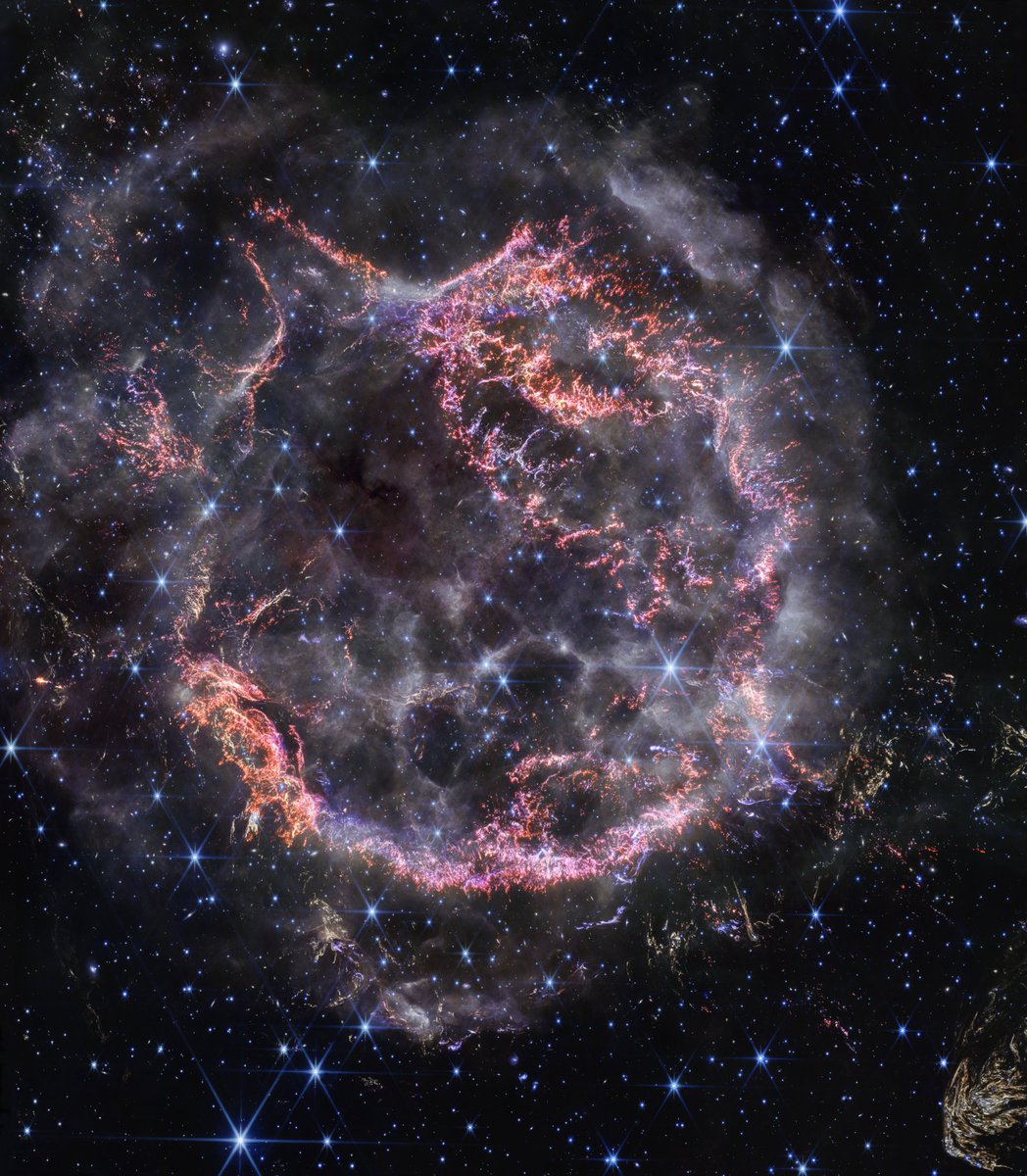
To: You, From: The Universe 🎁
This stunning new Webb image is a gift from a past star. In near-infrared light, supernova remnant Cassiopeia A (Cas A) resembles a shiny ornament. Embedded within gas from the star are the materials for new stars & planets: https://t.co/9kIvQtEnpb