An active network for communication among professional historians and those in cognate disciplines working on South Africa or southern Africa. Home to @sahisjor
Joint Statement of the @SAHistSoc Executive Committee and @sahisjor Editorial Collective on the cancellation of @ssishuwa passport by Zambian government:
The Executive Committee of the South African Historical Society (SAHS) and the Editorial Collective of the South African Historical Journal (SAHJ) express our deep concern at the cancellation of Dr Sishuwa Sishuwa’s passport by the Zambian government on grounds of “security reasons in the interest of national security.”
Dr Sishuwa is a historian and Senior Lecturer at Stellenbosch University, a longstanding member of the SAHS, has served on its Executive Committee, and sits on the Editorial Board of the South African Historical Journal. He is a prominent scholar of Zambian history and politics whose academic and public work contributes significantly to historical scholarship and public debate.
We are particularly concerned by the use of state administrative powers in ways that restrict the fundamental rights of scholars and citizens to freedom of movement and freedom of expression. We join calls for the Zambian authorities to reverse the cancellation of Dr Sishuwa’s passport and to uphold these rights.
The SAHS and the SAHJ stand in solidarity with our colleague and reaffirm our commitment to academic freedom, freedom of expression, and the unhindered pursuit and dissemination of historical knowledge.
📢 Call for Papers | @sahisjor:
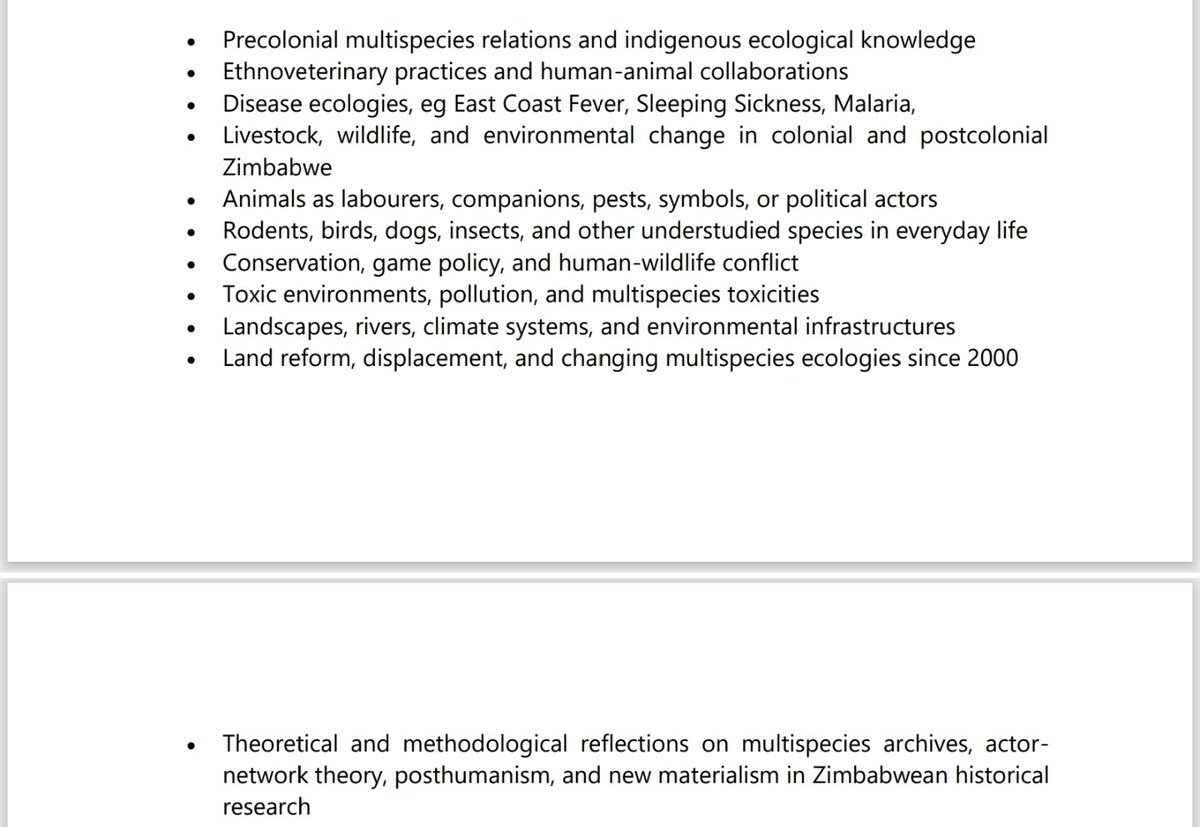
Special issue: "More-than-Human Histories of Zimbabwe: Multispecies Entanglements from the Precolonial Past to the Present"
Guest-edited by Dr. Wesley Mwatwara.
Full details below: 👇
They are inviting papers exploring Zimbabwe's past through a more-than-human lens, centering animals, plants, pathogens, and landscapes.
Key themes include:
• Precolonial multispecies relations
• Disease ecologies (malaria, sleeping sickness, etc.)
• Environmental change & climate systems
• Posthumanism & new materialism in African history
🗓️ Abstracts (300 words) due: 15 August 2026
📧 Submit to: [email protected]
(See attached images for full guidelines & submission info!)
Are you planning to submit? What non-human actor is your research focusing on? 👇
Journal link: https://t.co/Xls7Ztkw2n
The 30th biennial Southern African Historical Society conference kicked off in Harare today. Diana Jeater, Professor of History at the University of Liverpool, gave the keynote address while Prof Bridget Chinouriri from the University of Zimbabwe provided a vote of thanks.
The South African Historical Journal is pleased to make Jon Hyslop's 2011 article, The Invention of the Concentration Camp: Cuba, Southern Africa and the Philippines, 1896–1907, free access until the end of the month. The paper, available on the link below, has recently been read and cited by a remarkable number of scholars and writers, following growing interest in concentration camps and immigration detention.
https://t.co/ZG6SUXpn5O
It was recently cited in the The Conversation article titled 'When immigration detention becomes a system of concentration: Lessons from research on 150 historical cases', available on the link below.
https://t.co/YkWhA14AsF
Studies on South Africa’s liberation movement have largely been dominated by narratives around male leaders, armed struggle, and formal political institutions. Our latest issue challenges this focus and foregrounds women’s resistance to apartheid.
https://t.co/50nHHoojbS
Our latest issue is up. Its illuminating articles, including three that are open access, examine the multifaceted histories of black lawyers in South Africa from colonialism and apartheid to globalisation.
https://t.co/QvADpENUD7
Lesotho at 60: A Historical Retrospective
On 4 October 2026 Lesotho will celebrate its 60th anniversary of independence. As an enclave country many of the problems of post-independence Africa are magnified in Lesotho, as the country has long struggled to assert its sovereignty and support its own citizens, both at home and abroad for migrant labour. Still, the significant changes in the country since the return of democracy in 1993 and the end of apartheid in surrounding South Africa in 1994 deserve examination.
The post-apartheid period has seen, paradoxically, both better access to historical sources in Lesotho and fewer historical publications. Greater access to historical sources has been – in part – due to a revitalised National Archives in Maseru, the opening of new archives such as the Royal Archives in Matsieng, and a renewed focus on history in the country due to the political salience of issues like the border with South Africa.
However, South African history has long dominated Southern African history and historiography. With the coming of democracy to South Africa in 1994, this historiographical dominance has been heightened as scholars rushed to document and re-interpret the years when scholarly work on the country was difficult due to apartheid restrictions. Changes in peripheral states like Lesotho, a place many scholars gravitated to in their work when they were denied access to apartheid South Africa, were often left unnoticed except by those still working in country. This historical and historiographical erasure has meant that scholarship on Southern Africa often implicitly takes South Africa as the norm in the region.
This special issue, therefore, calls for a dramatic re-centering of regional scholarship on Southern Africa. Even continuing to call Lesotho (and other countries) ‘peripheral’ to region implies that South Africa is the centre around which everything else revolves. This is not the case. While the Republic of South Africa plays particular regional roles, this issue will serve as a corrective, using the lens of sixty years of independence for Lesotho to explore and shift toward more regional perspectives on political, economic, and social histories to better reflect the lived realities for many—where border crossing is the norm and national citizenship reflects the passport people hold, but not necessarily the allegiances they feel.
Much of the best scholarship on Lesotho—scholarship that has complicated and reframed Southern African historiography—has only been published locally, which has contributed to the lacuna in the regional historiography around such ‘peripheral’ states. Individual authors have broken through to write important works, but this special issue of the South African Historical Journal will foreground voices and authors who will bring work on Lesotho and its situated contexts to a wider audience.
The existing historiography on Lesotho is strong in migration and migrant labour, the history of development, and nineteenth century chieftaincy/land disputes. These all remain important themes, but with the ending of apartheid the migrant labour system has been radically reshaped, and the development industry has gone through multiple iterations in response to both regional changes and global upheavals in the aid/development regime.
More historical scholarship is needed, both on the changes in these processes in the years since 1993/1994, but also in the apartheid era, given the new access to archival sources in Lesotho. Further, by virtue of being an enclave country, the role of Lesotho citizens in increasingly vitriolic regional debates around borders, citizenship, belonging, and the role of passports/identity documents in the post-apartheid period deserve a more fulsome examination.
The special issue will ask authors to engage with prior literatures, but also to tell new stories, including new stories about old phenomena. The shift from Lesotho being primarily an exporter of migrant labourers to being an exporter of water is one that may foreshadow future regional changes, as low-skill manufacturing and mining jobs continue to disappear in many Southern African countries. Further the rise and decline of Lesotho’s textile industry in the 21st century may be a cautionary tale about how embracing globalisation may bring some short-term wins, but at great cost to the workers, the environment, and the political system.
Some of the themes authors may explore in this special issue include:
· What new histories of Basotho and Lesotho need to be written?
· What new insights into older Basotho history have been discovered with the new wealth of documents available from the Royal Archives in Matsieng and/or new collections of documents from the 19th and early 20th century?
· How has literature produced in Lesotho engaged with historical storytelling, oral traditions, and the reinterpretation of Lesotho’s past?
· What regional lessons are there to learn about political changes that have taken Lesotho from democracy through one-party dictatorship, military rule, back to democratic rule and then to some of the first coalition governments in Southern Africa?
· How have struggles over constitutional reform evolved over time? Especially regarding relations between the monarchy and government.
· How have Basotho responded to changing economic developments in South Africa that have altered labour migration routes, so prevalent in the 20th century?
· How have patterns of labor migrations between Lesotho and South Africa shaped musical traditions, performance practices, and the development of shared artistic expressions as tools for contesting power during the 20th and 21st centuries?
· How does the textile industry in Lesotho illuminate globalisation and its discontents in the late 20th and early 21st centuries?
· What re-examinations of older histories and historiographies will alter the ways we understand Basotho society and the role that Lesotho plays in Southern Africa and the wider world?
· How have smaller states in southern Africa managed to push forward their own diplomatic agendas and/or the concerns of their citizens in the region and internationally?
· What has been the relationship between NGOs, Basotho citizens, and the Lesotho government?
· How have large development projects like the Lesotho Highlands Water Project influenced the ways that Basotho see the world and their own government?
· How have environmental histories of Lesotho reshaped how we understand processes of social and economic change?
· How do borderland communities between Lesotho and South Africa navigate identity, belonging, and adapt in response to labour systems and state policies?
· How have artists in Lesotho engaged with questions of memory, heritage and historical narrative in their creative work since the 19th century?
· How have historical narratives and oral traditions documented migrations, the founding of settlements and the formation of communities in Lesotho since the 19th century.
· Other topics of interest to scholars and the public.
Tentative Timeline:
30 June 2026: Abstracts due to the editors (contact information below)
August/September 2026: Authors informed of acceptance
30 November 2026: Full paper submissions due for peer review
For submissions, more information, or questions, please reach out to Dr. John Aerni-Flessner, [email protected], Dr. Nthabiseng Mokoena-Mokhali, [email protected], or Kevin Qhubu, [email protected].
SAHS Postgraduate Bursaries
The Southern African Historical Society and 2026 Local Organising Committee are pleased to announce sponsorship opportunities for our upcoming conference in Harare, Zimbabwe, 24-26 June 2026...
In this article, anthropologist Christian Williams shows how exiled Namibian nationalist figures appropriated the Bible to imagine "a postcolonial, post-apartheid future", illustrating the relationship between religious faith and the liberation struggle.
https://t.co/8oO43akQne
New: In tis article, Timothy Gibbs discusses how post-apartheid debates about affirmative action and the transformation of the South African justice system intersected with wider debates in the 1990s about democratic transitions and transitional justice.
https://t.co/NToiDu7EFq
New: How did the MPLA in Angola assert the legitimacy of its leadership in the face of a contestation from within and outside it in the early years of independence? Stellenbosch historian @drjustinpearce provides a compelling answer in this article.
https://t.co/5wDiTKcRxM
New: In this article, @JonathanKlaaren, Professor of Law and Society at the University of the Witwatersrand, examines the barriers to the admission of foreign and black nationals as lawyers during and after Apartheid in South Africa.
https://t.co/2p9vpi08iC
Call for Papers: New Histories of and on Black Consciousness
With the fiftieth anniversary of Steve Biko’s death at the hands of apartheid security police approaching, this is an opportune moment to reassess Black Consciousness (BC) histories and look forward. As a movement founded in the belly of the apartheid beast, with the older liberation movements like the ANC, PAC, and NEUM/UMSA mostly defeated and in exile, a new voice of Black activism needed to be formed. Deborah Matshoba, Bokwe Mafuna, Steve Biko, Ranwedzi Nengwekhulu, Mapetla Mohapi, Maphiri Masekala and a host of others emerged to build a movement that inspired generations of activists to reimagine what a free South Africa, or Azania to some, would look like.
Since the early 1970s, academics and activists from across southern Africa and the wider African World have researched, written, critiqued, praised, and at times downplayed this movement. Some even saw Biko’s assassination as a defeat of Black Consciousness and much literature after it even framed the late 1970s as the end of BC as an organized effective anti-apartheid movement. Newer research, however, has challenged this perspective and further extended our chronological analysis of BC. Most importantly, perhaps is that these new histories have attempted to reconstruct the history of the movement beyond individual personalities.
As co-editors of this special edition of the South African Historical Journal, we are calling for papers which offer new histories/insights of the Black Consciousness Movement (BCM). While literature has grown exponentially in the post-1994 moment, and become more insurgent since the mid-2000s, there is much left to explore about the movement in various geographic places, organizations, and groups of people. While explorations of the philosophical and theoretical interventions of Black Consciousness and Black Theology are welcome, this journal issue seeks historical analyses of the ways Black Consciousness was made real in the daily lives of the peoples of Azania and the broader global struggle against imperialism, capitalism and white supremacy.
What organizational expression, or lack thereof, did Black Consciousness have across South Africa/Azania? What was its impact across southern Africa/Azania particularly in countries that today make up the Southern African Development Community (SADC)? What happened to Black Consciousness activists in Europe, Australia/New Zealand, and North America? What has life been like for BCM activists post-1994? Questions such as these drive the research agenda of our special journal addition. We especially welcome works by newer scholars who offer fresh historical perspectives but look forward to reading all submissions.
Topics of inquiry may include:
● What did Black Consciousness mean to people living in different parts of South Africa outside of places like Durban, the Black colleges, and Johannesburg? What was the evolution of Indian and Coloured identities and conceptions of Blackness and what did BC look like in rural communities?
● How did miners, farmers, migrant workers, domestic laborers and other working people understand this new movement?
● What was the impact of the Black Peoples Convention (BPC), the Literacy Programs, and other BC formations?
● Investigations into the Southern African Students Movement (SnASM, to be distinguished from the South African Students Movement).
● What was the Soundtrack to Black Consciousness? What sorts of music did people listen to, how did it influence their politics, and why?
● Histories of Black Consciousness outside of South Africa/Azania (southern Africa and other African countries, Europe, Australia, etc.).
● Experiences, labors, and activism of Black women within Black Consciousness.
● Experiences and histories of LGBTQIAP+ peoples within Black Consciousness.
● Histories of Black Consciousness beyond 1977 (including community and political organizations stemming from Black Consciousness like AZAPO, the Umtapo Centre, etc.).
● What role/how has BCM praxis manifested itself in post-1994 South Africa/Azania?
Please send abstracts, of no more than 300 words, to Toivo Asheeke ([email protected]) and Leslie Hadfield ([email protected]) no later than April 1, 2026. Full papers will be requested by August 1, 2026.
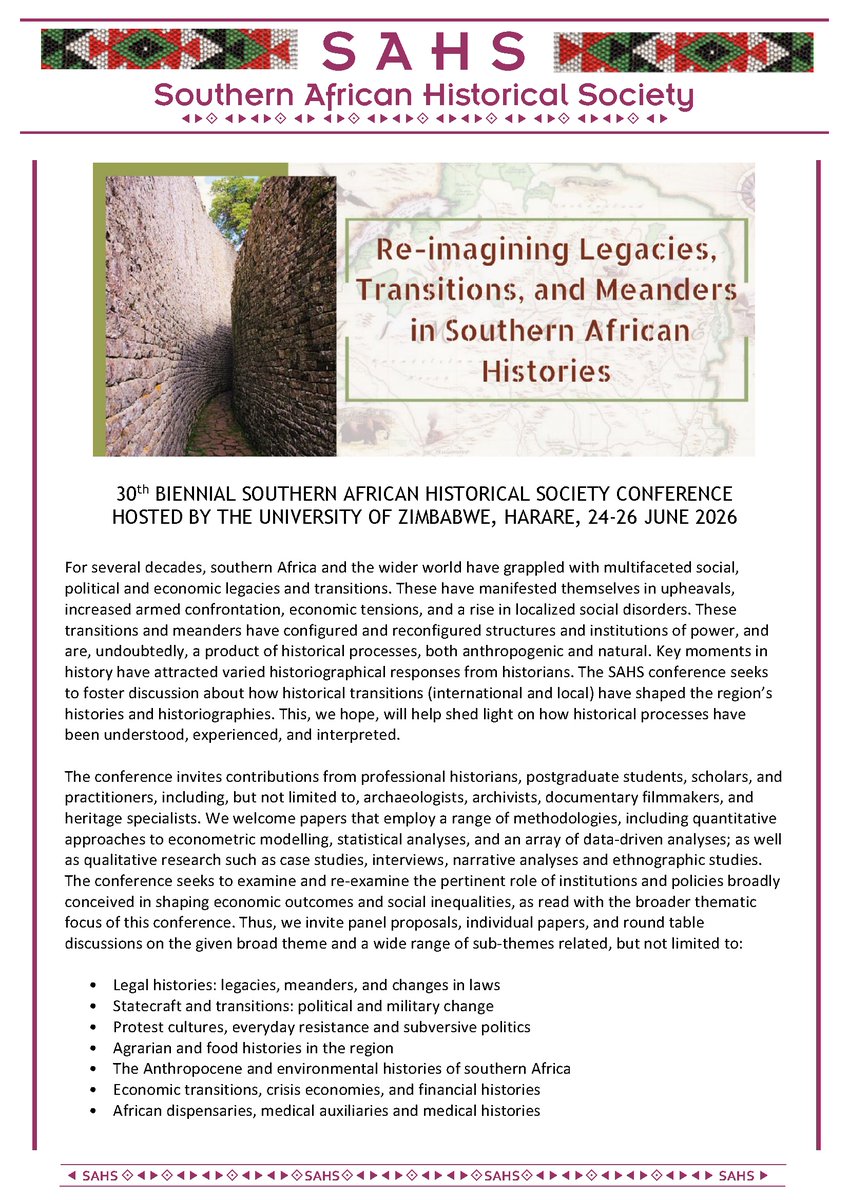
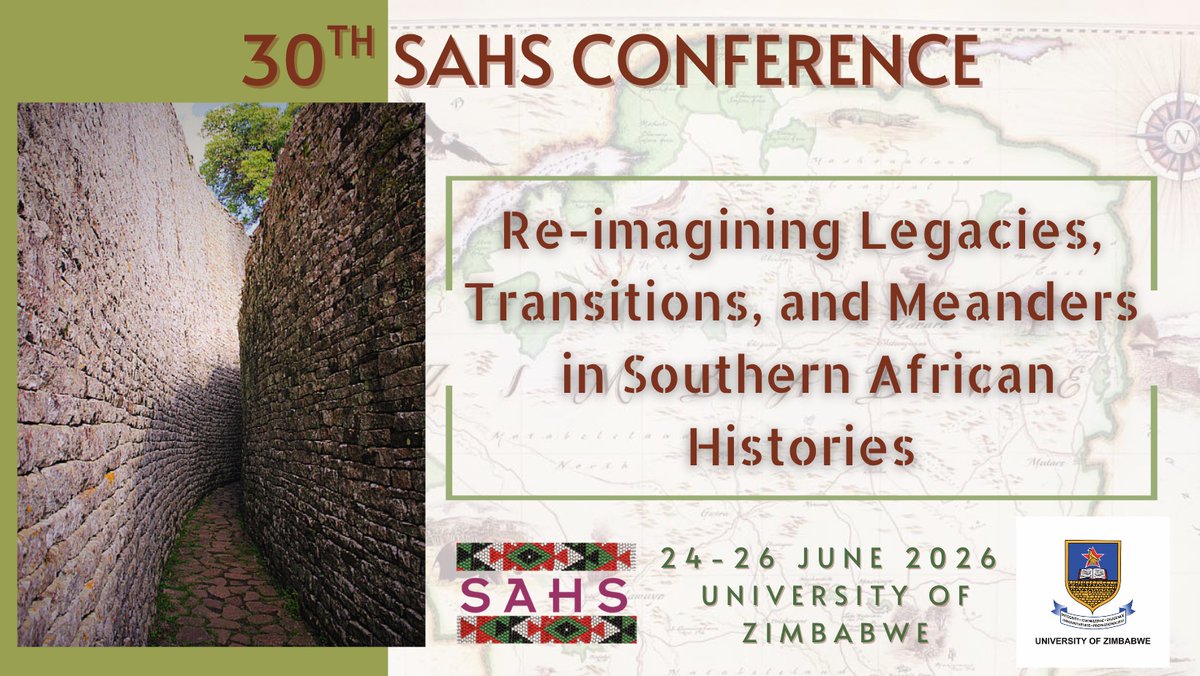
Call for Papers: 30th Southern African Historical Society Conference on Re-imagining Legacies, Transitions, and Meanders in Southern African Histories to be held at the University of Zimbabwe, 24-26 June 2026.
Call for Papers: 30th Southern African Historical Society Conference on Re-imagining Legacies, Transitions, and Meanders in Southern African Histories to be held at the University of Zimbabwe, 24-26 June 2026.