This made me want to try it. First time ever using Antigravity and a Google model since gemini-cli.
It was immediately insta-bricked on my project. I had claude debug it. Turns out it's because I have an "If you are Claude Code, ..." sentence in AGENTS.md. LOL. And it gets reported as the model being at capacity (not specific to Neon).
Running out of claude resets. Just told the orchestrator to tell everyone to start using sol for code review and other things that don't require judgement, api design, or solving non-trivial problems without complexity spirals :)
Almost done ripping out web stuff from the UI of https://t.co/YrZ8Cwffwd now (in favor of GPUI), and I checked in on where we landed on what used to be a 2 hour playwright suite (when not sharded across hosts). Quoting my agent:
"Short version: the 2-hour Playwright suite is gone, and the GUI tests that replaced it take about 30 seconds."
*Nice* :)
In fairness there are some architectural improvements here unrelated to web->GPUI that made testing even faster, but after having taken a good look at how to get the Playwright tests faster a few weeks ago I'm pretty sure this is *largely* due a direct result of the switch, plus not having to run one battery on webkit and one on chromium which I could have avoided while still sticking to the web stack.
Of course, it remains to be seen over the next few months if there's any regression in real life rate of bugs getting through the test suite.
Found bugs in a couple of upstream projects that ban the use of AI not only in actual code submissions but in bug reports describing the bug. Result? I'm simply not going to report them. I considered starting to just dump bug reports somewhere where these people have no right to create rules so that at least it can be found by others or their agents. The notion that I'm going to manually write something up because someone is hysterical about AI is ridiculous. Demand a quality bar sure, stop being opinionated about tools. Imagine banning code written on a computer because all submissions must be written using punch cards. That's how ridiculous this is.
I could have kept the bug and fix to myself, but I thought it was the right thing to do to report it, as it affects also multiple other derivative ports of QuakeSpasm.
This is the reward I get for trying to contribute.
- https://t.co/gsX6ngVw8x
- https://t.co/I3t4V1vuV4
Yep that's already there (though remote mac is still early and should get solid in the next week or so). I actually started this because I loved herdr before it grew support for multiple remotes (I was using herdr --remote), and one major reason was precisely that - one local UI/head against multiple remotes with seamless resume after restarts/reboots etc.
I've also just added (very experimental non-polished) support for Tensorlake sandboxes so you can either run a Tensorlake sandbox as a "host", or have a dedicated one per session (which thanks to Tensorlake can be suspended/resumed). I'll be adding https://t.co/emKSLKndJq support too.
I just got off the waitlist for Rex so I'll try that, and also try modern Herdr as it's changed a lot since I tried it.
Tokens are burning ripping out all the web stuff from https://t.co/RYsZoAZJXh (replacing with GPUI in preparation for Linux desktop support). It should be interesting - also baking in code improvements prioritized based on analysis of the past few months of bug fixes due to agents not applying reasonable good practices. Woke up to screenshots of an early milestone this morning: https://t.co/khEa3azuh5
Access to everything but I do generally home them in a project to ensure said project's AGENTS.md is guaranteed injected post compaction, and no confusion about where "home" is for whatever it is.
(Exceptions are agents that are just for general purpuse acting on the machine in which I just use ~)
Also if a rule or regulation seems to cause excessive complexity or friction, escalate to re-assess weather it's worth it. Do not proceed until fable, astra, sol and a fresh opus consult all agree it's worth it.
I so so so hope this is successful and does what it says on the tin (and/or others like it). This needs to be super cheap for both sides and just the default for everyone all the time. https://t.co/IQdL6sGWey
Yeah I already did some evals on real changes from my repos. It's not competitive for me when compared to subscriptions even when comparing to just using sol high. Most recently https://t.co/6fU0F8t7mu (you have to scroll down to a table to see the subscription pricing, it looks impressive in the headline numbers which use API rates).
(That particular one wasn't focused on comparing deepseek it was more focused on testing a new supervision/worker/code review mode I was testing, but still.)
@MagnusLdt I'm on subscriptions so none of the non-subsidized options are cost effective unfortunately. Possible exception being qwen4-max temporarily while it's 80% off during preview (I didn't calculate very carefully but it might be).
The most ridiculous "safeguard" block I have ever seen. Literally just having a design/goal planning session for a major change and just wanted to record a verbatim copy of our planning conversation. Apparently it's triggering a "reasoning_extraction" safeguard.
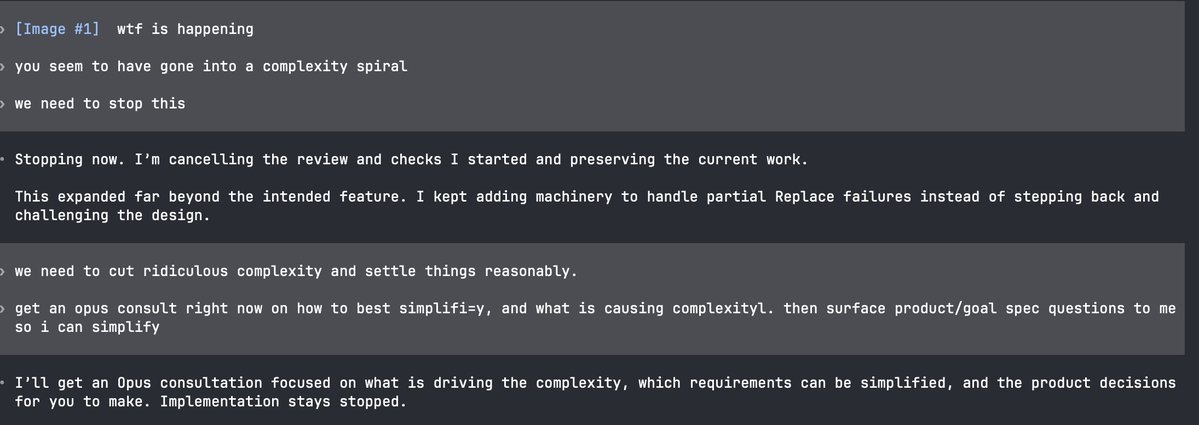
I saw someone today say they couldn't imagine what could be improved upon relative to Opus 5.5. Today I was talking to an agent about an unattended plan that had gotten bounced back and forth between agents a few times due to complexity spirals, and now got blocked again (this time just Opus involved, no Sol). I'm like why is this so complicated. It gives a long winded answer involving solving a distributed systems problem involving deleting a Tensorlake sandbox if and only if a certain agent session is the *only* session running on it (managed by a supervisor process).
So...
Agent: <long winded explanation of why it's so hard after it bounced between agents N times>
Me: i don't get it. what is so stupidly hard about just having a protocol message that goes to the supervisor that says "kill this session and disallow all future sessions" which is atomically either accepted by the supervisor or not? (it only succeeds if it is the last session)
Agent: Nothing about that is hard, and it's the right design....
@pashmerepat I would love to see support for just having the dot be able to ssh to a box so you you don't need to run the chatgpt desktop client on a headless box for this (or build an MCP which is what I ended up doing).
This is happening repeatedly nowadays. I'll find that sol is still working on something after many hours. I'll ask an agent to troll the transcripts and tell me if it's going off the rails, and I found that yeah something went off the rails into needless complexity. Then I have to intervene.
I think I'm going to start having an agent monitor transcripts and start automatically nudging instead of waiting for me to wake up in the morning.
Yep exactly. The amount of time I end up spending a non-trivial amount of time just going back and forth trying to get at the fundamental hart of something, only to find "oh, this is just about X all along? then do Y" is huge.
Part of it is lack of judgement, but a lot is the comms.
I feel the importance of models actually being able to communicate sensibly to the human is growing increasingly important. The more I rely on models at a much higher level rather than to produce code I read line by line, the more important it is to be able to speak in a language and with concepts that make sense - at the right level of abstraction, and w/o involving irrelevant implementation details.
It's funny because what models are doing is very similar to what real software engineers do all the time. I'm sure everyone who's a software person has heard a software engineer give some presentation in front of 10 people and it's just obvious no one in the audience has an idea what they're talking about, or you've gotten help by another team in your org and they speak in internal jargon instead of customer visible product surface terms.
Models just are very extreme at doing it. I like to think of it is - they are extreme experts at whatever sits in their context at the time and speak as if the reader is too. Which is basically exactly what humans do. :)