So thrilled to receive this grant, which allows me to push my #glycotime projects forward! Rolling up my sleeves and getting to work – there is still so much to be uncovered. Huge shout-out 🙏 to my brilliant & kind reviewers, wherever you are, and to @FWF_at for funding! ♦️
Stefan Mereiter, postdoc and member of the @penningerlab, was awarded the ESPRIT grant for the next three years. In this time, he will continue his research on glycosylation interference in breast cancer. We wish him success. @FWF_at@SMereiter#CancerResearch
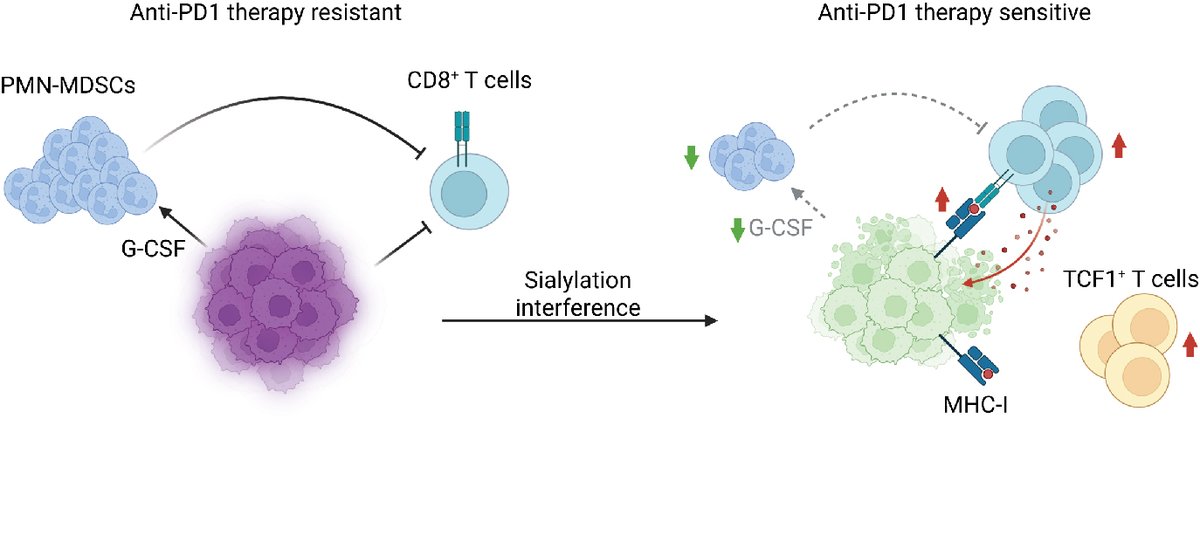
Overall, removing sialylation from mammary epithelium was well tolerated, yet it rendered breast cancer cells vulnerable to immunotherapy.
A compelling therapeutic window and a strong rationale for targeting tumor hypersialylation in breast cancer.
🚨 Our newest manuscript is out in Nature Communications:
Hypersialylation in breast cancer immunoregulation: uncovering novel mechanisms and highlighting major therapeutic potential.
+6 years in the making.
Dive into: https://t.co/dssVRe3ZGV
6. In the autochthonous MPA/DMBA model, a model of luminal B breast cancer, removing sialylation from the equation broke the cancer's hardwired resistance to immunotherapy.
To our knowledge, that's unprecedented in this model.
🚨 PhD position open! 🚨
Join our team at the Medical University of Vienna to study glycan regulation in mammary organoids, milk, and breast cancer.
Details in the image – please share! 🧬✨
Feeling honored to work in a lab with two (!) of 2024’s most cited scientists: mentor Josef Penninger🧠and lab colleague Max Kellner 📚 (@clarivate). Max (spot him sitting behind me in yesterday’s lab meeting) is a PhD student 🤯 @penningerlab
A team from @BOKUvienna, #MedUniVienna & @IMBA_Vienna presented a scalable method that provides insights into #glycobiology. The aim was to investigate structural differences in glycan chains in various organs & to determine their extent. ➡ https://t.co/JXMIAE8UQF
@NatureComms
@mryanshi@NatureComms@penningerlab@dynamic_epitope Yes, very impressive study from @dynamic_epitope which we cite and highlight in our introduction. Our work - using PGC-LC- is a complement to it and adds an important degree of structural information to the mouse N-glycome! For more info delve into our📖
@chrashwood @BOKUvienna@IMBA_Vienna@MedUni_Wien@UMich@JohStadlmann Many thanks!
1 We were surprised too! Wouldn’t have looked for it if it wasn’t for the described approach. Good agreement with literature & organs affected by MHV gave confidence.
2 During paper prep we colored it gray for no reason and didn’t recall changing it to blue later.
1/
Did you know? Glycans—complex sugar structures—decorate almost every protein processed by the ER/Golgi. These N-glycans coat our cells, playing critical roles in cell interactions and immune processes. 🍬
Curious about how they vary?
Let’s dive in!