$SONA has closed its over-subscribed private placement, raising $2,527,012 in gross proceeds through the issuance of 8,423,372 common shares at $0.30 per share.
https://t.co/RD53ICNEaY
#PrivatePlacement#Oncology
$SONA announced a non-brokered private placement financing of up to $2,400,000, through the issuance of up to 8,000,000 common shares at $0.30 per share.
Full details in the news release: https://t.co/QcLLbMrFvr
#SonaNanotech#PrivatePlacement#Oncology
The IGNITE-THT study will ask, can fever range heat applied precisely inside a tumor help the immune system recognize what it has been missing, in patients who have already failed immunotherapy?
It will then ask, will that same immunotherapy now work once THT has primed the tumor?
Dr. Carman Giacomantonio, CMO, Sona Nanotech
https://t.co/Jsk2OE2n9x
#Melanoma #Immunotherapy #ColdToHot
One of the most remarkable phenomena in oncology is one most people have never heard of. The abscopal effect.
When the immune system is activated against one tumor, it can sometimes recognize and attack other tumors elsewhere in the body, including ones that were never treated directly.
It is uncommon. It requires genuine immune activation, not just local stimulation. But when it happens, it means the body has been taught to see cancer it was previously missing.
Local treatments that reliably trigger that kind of immune activation are the ones the field is watching most closely right now.
Dr. Carman Giacomantonio, CMO, Sona Nanotech
https://t.co/f6voDXmZmU
#Oncology #Immunotherapy #ColdToHot
A lot of the most important work in cancer immunotherapy right now comes back to one word: neoantigens.
When a tumor cell is damaged, it can release fragments the immune system has never seen before. Those fragments are neoantigens. They are the flags that help the immune system recognize a tumor as foreign and mount an attack.
The challenge with cold tumors is that those flags stay hidden. The immune system cannot see them, so it does not respond. Much of the most interesting mechanism work in oncology right now is about revealing them.
Targeted Hyperthermia Therapy is designed to use fever range heat to do exactly that, reveal what the tumor has been hiding, so the immune system has something to act on.
Dr. Carman Giacomantonio, CMO, Sona Nanotech
https://t.co/QuGMDkp0Qz
#Neoantigens #Immunotherapy #ColdToHot
What the tissue showed in Sona's first-in-human melanoma study. Analyzed at Dalhousie University.
In representative samples: NK cells moving in. Macrophages present. PD-L1 expression in partial responders.
PD-L1 predicts who may respond to checkpoint immunotherapy. For a time this was a hypothesis. In these samples, it was visible in human tissue.
https://t.co/yLKj1vfK50
#Melanoma #Immunotherapy #Oncology
Why do oncologists test tumors for PD-L1?
PD-L1 is one of the signals a tumor uses to suppress an immune attack. When a tumor expresses it, that often predicts the patient may respond to immunotherapy that can block that suppression mechanism. PD-L1 predicts. It does not guarantee.
In Sona's first-in-human melanoma study, partial responders showed strong PD-L1 expression in representative tissue samples after Targeted Hyperthermia Therapy. That is the kind of signal the IGNITE-THT and PRIME-THT studies are designed to assess.
Dr. Carman Giacomantonio, CMO, Sona Nanotech
https://t.co/fboE1M9bVX
#Melanoma #Immunotherapy #Oncology
Where is oncology heading?
Evaluate's World Preview puts oncology as the largest therapy area, on track to exceed 400 billion dollars by 2032. The capital is following the science. And the science question the field keeps coming back to is not just which new drugs to build, but what approach fits which problem.
Better-in-class versus new-class. More of what already works for the patients it already reaches, or new mechanisms for the ones it misses.
Sona is firmly in the second lane. Targeted Hyperthermia Therapy is not a better checkpoint inhibitor. It is a different mechanism, designed to help immunotherapy work for the patients it currently cannot reach.
https://t.co/0cKf7QqyIE
#Oncology
Why do some tumors resist immunotherapy even after an initial response?
Research points to several mechanisms: immunosuppressive signals in the tumor microenvironment, regulatory T-cell accumulation, and metabolic pressure that shields the tumor from immune attack. The immune system gets in, then gets pushed back out.
Targeted Hyperthermia Therapy is designed to act locally inside the tumor, using fever range heat to disrupt that microenvironment, reveal tumor antigens, and help the immune system hold the response.
That is the rationale. The IGNITE-THT study is built to test whether it holds in the patient population where the immune system has already been pushed back.
#Melanoma #Immunotherapy #LocalActivation
For whom is Sona’s work?
In the United States in 2026, an estimated 112,000 people will be diagnosed with invasive melanoma. For those with distant-stage disease, the five-year survival rate is approximately 34%.
Globally, research published in JAMA Dermatology projects 510,000 new melanoma cases by 2040, up from 325,000 in 2020. Most patients with advanced melanoma whose tumors do not respond to immunotherapy have few remaining options.
That is the population for which the IGNITE-THT and PRIME-THT studies are designed.
https://t.co/UdtR117xBb
#Melanoma #Oncology
Heading into July. A lot has happened in the past few weeks and a lot is ahead.
BIO confirmed the direction. The advisory board and the board of directors are the right people for this stage. First readouts are coming.
The throughline from the science to the patient has never been clearer.
https://t.co/P2JZwxAmSQ
#Oncology
Why does immunotherapy work for some melanoma patients and not others?
Often it comes down to one distinction. Hot tumors: the immune system has already recognized the cancer, and checkpoint inhibitors can amplify the fight. Cold tumors: the immune system cannot see the cancer, so immunotherapy has little to work with.
The IGNITE-THT and PRIME-THT studies are designed around that distinction. Both test whether Targeted Hyperthermia Therapy can convert the cold tumor signal, making it visible so that existing immunotherapy has something to act on.
https://t.co/mXJn7JfuGI
#ColdToHot #Melanoma #Immunotherapy
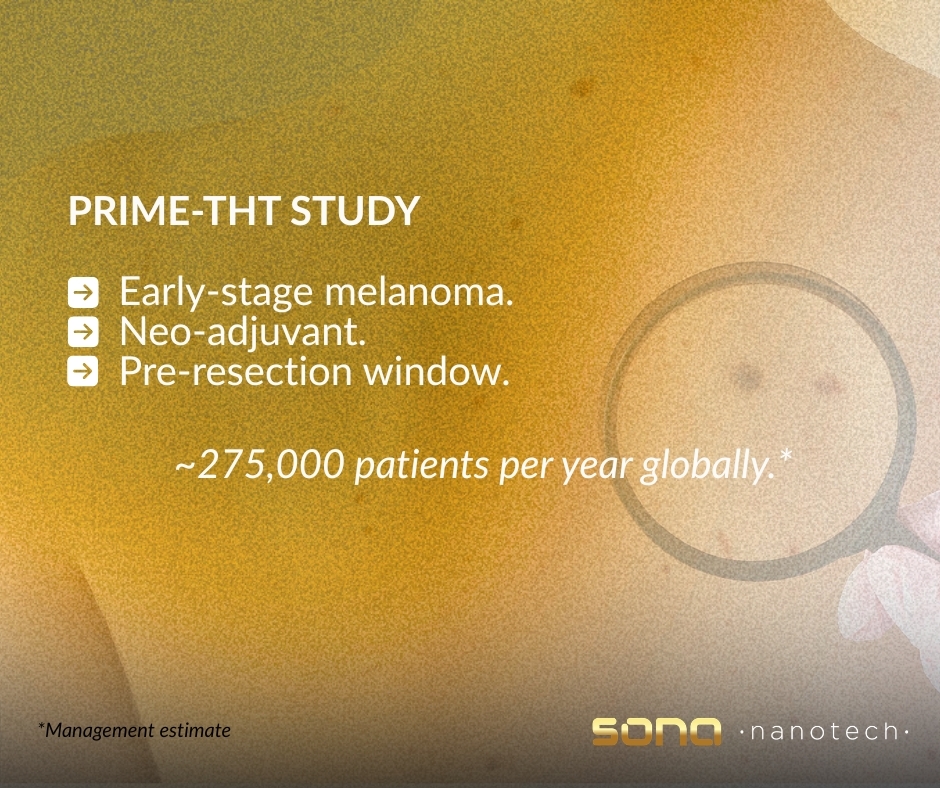
The PRIME-THT study is the companion to IGNITE-THT, and it addresses the other end of the melanoma journey.
PRIME-THT is designed for patients with early-stage melanoma, in the neo-adjuvant window before surgery. The question it is testing: can adding Targeted Hyperthermia Therapy before resection prime the immune system to recognize and respond to the disease before it has a chance to spread?
The early-stage melanoma patient population is significant. Management estimates approximately 275,000 patients per year globally. And for stage II patients who are resected, roughly 20% will develop metastases. That is the population PRIME-THT is designed for.
Early readouts are expected within 8 months of study initiation.
Dr. Carman Giacomantonio, CMO, Sona Nanotech
https://t.co/d6yw1ZZug0
#Melanoma #ClinicalTrials #Oncology
The IGNITE-THT study. What it is and who it is for.
Late-stage melanoma patients who have failed immunotherapy. Fever range heat applied inside the tumor to convert the immune response. Built on first-in-human evidence.
Early readouts expected within 6 months of initiation.
Dr. Carman Giacomantonio, CMO, Sona Nanotech
https://t.co/d6yw1ZZug0
#Melanoma #ClinicalTrials #Oncology
One thing worth noting from BIO 2026: the Atlantic Canada delegation earned its place at the table.
The PEI BioAlliance brought a serious group. Sona was part of it, a Halifax-based nanobiotech built on Dalhousie University science, presenting at the world's largest biotech partnering event alongside global players.
Canadian innovation does not always get the international stage it deserves. This week it did. Something to build on.
#BIO2026 #AtlanticCanada #Halifax
BIO 2026 confirmed what the field has been building toward.
For cold solid tumors that resist immunotherapy, local activation is emerging as the fit-to-purpose approach. Act inside the tumor. Make it visible.
That is the conviction behind the IGNITE-THT and PRIME-THT studies. BIO told us the direction is shared.
Dr. Carman Giacomantonio, CMO, Sona Nanotech
https://t.co/fWWM7OxewS
#BIO2026 #ColdToHot #Oncology
BIO 2026 reinforced something that has been building for a while. For immunologically cold solid tumors, local activation is emerging as a fit-to-purpose modality.
Not a fringe idea. A direction the field is converging on from several mechanism classes at once. Act inside the tumor. Release the antigens the immune system has been missing. Let the response carry further.
Targeted Hyperthermia Therapy uses fever range heat as the activating agent. The IGNITE-THT and PRIME-THT studies are designed to assess whether that logic holds in melanoma patients the current standard of care cannot reach.
Dr. Carman Giacomantonio, CMO, Sona Nanotech
#LocalActivation #ColdToHot #Oncology
One thing BIO 2026 made clear: tolerability is no longer a secondary consideration in oncology. It is a headline.
The kinder-gentler cancer therapy session was not a fringe conversation. It was a mainstage one. The field is saying out loud that efficacy and tolerability have to be solved together, not traded off against each other.
That is a direction Sona has been building toward. Delivering treatment locally, inside the tumor, concentrating the effect where it is needed and limiting it elsewhere, is the design rationale behind the IGNITE-THT and PRIME-THT studies.
Dr. Carman Giacomantonio, CMO, Sona Nanotech
#BIO2026 #Oncology #Tolerability
BIO 2026 is wrapped. A measured read on what it showed.
The field is moving toward precision and toward tolerability. Not as competing priorities but as paired ones. Local activation approaches are getting serious attention. Canada showed up and earned its place at the table.
No announcements. What I took from this week is that the direction Sona has been building toward is the direction the field is heading. More next week on what that means.
https://t.co/LL5XgXFLhz
@BIOTECanada #BIO2026 #Oncology
The tolerability conversation at BIO today is one Sona recognizes.
Targeted Hyperthermia Therapy is designed to deliver fever range heat directly inside the tumor. The rationale is to concentrate the effect where it is needed and limit the systemic burden. That is a design expectation, not a result. The IGNITE-THT and PRIME-THT studies are built to assess whether it holds.
The field is increasingly asking whether approaches can be both effective and easier to sustain. That is the right question.
#BIO2026 #Oncology #Tolerability @IAmBiotech