RIP CREATIVE STRATEGISTS
GPT-IMAGE-2.5 + GPT-6 ASTRA
Both dropped in the same week. Together they cover the entire strategy-to-finished-static workflow in one sitting.
Here's the pipeline.
GPT-6 Astra is the strategist.
→ Watches competitor ads — not the transcripts, the actual creative — and pulls the hooks that are still running after 60 days
→ Maps the angles to how your buyer actually decides, not to what the category keeps repeating
→ Writes full concepts with visual direction: composition, product size, headline weight, where the eye lands first
→ Writes copy that belongs to the angle instead of sounding like every ad it just analysed
→ Outputs a spec sheet, one per concept, ready to render
GPT-Image-2.5 is the executor.
→ Takes each spec and produces the finished static
→ Headline, CTA, product placement and hierarchy exactly as briefed — and it holds them across edits instead of drifting by version three
→ Product pulled from your reference photo, not reinvented
→ Six to ten variations per angle, same afternoon
Strategy to finished creative used to be a week and two teams. Now it's one session and one person.
This isn't AI writing ad copy.
This is a creative strategist that researches, decides, and ships — and a designer that executes the brief without arguing about it.
I've written the full workflow up — every prompt, the spec-sheet template that connects the two models, and the setup.
Comment "astra" and I'll send it.
(must be following)
🤯 Typography feels physical when food locks into it!
A pretzel ties itself around the letters, onion rings interlock with the type, bacon weaves over and under it, and yakitori pierces straight through.
1. KNOT, pretzel knot
2. LINK, interlocked onion rings
3. WEAVE, bacon over and under
4. PIERCE, skewer through type
🌟 Great for restaurant branding, food editorials, menus and visual prompt experiments!
Prompts below 👇
🤯 Transparent materials can do much more than distort a portrait!
Refraction, parallax, color mixing, and radial optics can all become part of the poster itself—not just visual effects.
1. Afterimage — floating prism fragments
2. Time Shift — layered glass parallax
3. Tone Alter — transparent color mixing
4. Frequency — concentric optical refraction
A useful visual direction for fashion, beauty, product, and editorial campaigns.
Prompt below 👇
We’re sharing a solution to the Navier-Stokes Millennium Prize Problem, one of the deepest problems at the frontier of mathematics.
The proof was produced by a group of agents, using an OpenAI next-generation model significantly more capable than GPT-6 Astra.
The problem concerns whether the description of smooth three-dimensional fluid motion modeled by the Navier-Stokes equations can break down. It has remained unresolved for roughly 90 years.
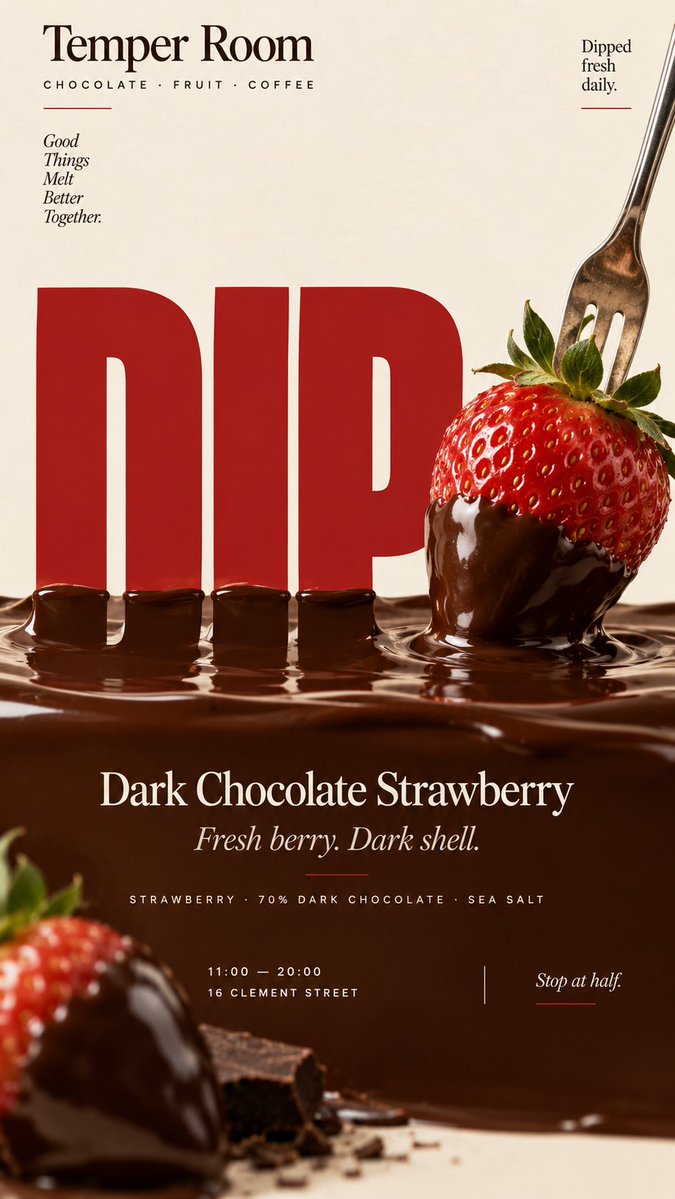
😋 Liquid ingredients can turn typography into part of the food!
Maple syrup drips over letters, type sinks into chocolate, strawberry preserve smears across a headline, and a coffee swirl pulls cocoa letters into motion.
1. Brown Butter Pancakes
2. Dark Chocolate Strawberry
3. Strawberry Lemon Preserve
4. Brown Sugar Cappuccino
🌟 Great for menus, café branding, packaging and food editorials!
Prompts below 👇
Created with google gemini nano banana pro
PROMPT🔥🔥
Sophisticated contemporary oil portrait painting with expressive loose brushwork, combining refined semi-realistic portraiture, classical fine-art painting, and modern editorial painterly aesthetics. The subject is rendered with highly controlled yet visibly handcrafted oil strokes, layered pigments, soft impasto, delicate dry-brush marks, and expressive directional brushwork that follows the natural anatomy and volume of the face.
Facial features are detailed and semi-realistic, with luminous skin, natural texture, expressive eyes, carefully modeled nose and lips, and richly layered hair built from flowing individual brushstrokes. Use warm brown, deep umber, burnt sienna, ochre, muted peach, cream, ivory, soft gray-blue, charcoal, and subtle muted gold accents, matching the reference palette precisely. Highlights are predominantly warm ivory and creamy white, while shadows remain deep but soft and painterly.
The background uses the same desaturated blue-gray and warm ivory palette, appearing like an unfinished classical painted canvas. Broad vertical and horizontal brushstrokes, translucent paint layers, softly scraped areas, subtle dry-brush textures, and irregular painterly patches create an atmospheric studio-like backdrop. Keep the background simple, quiet, and organically integrated with the portrait rather than sharply separated.
The lower portion of the figure intentionally becomes unfinished and gradually dissolves into loose white and ivory brushstrokes. Clothing, shoulders, chest, and lower contours progressively lose definition, breaking into scattered semi-transparent strokes and fading pigment. Edges become incomplete, soft, irregular, and partially disappear into the background, creating the unmistakable impression of an intentionally unfinished oil painting. Do not create a hard bottom edge.
Maintain a refined balance between highly detailed facial realism and deliberately unfinished painterly abstraction. Visible brushwork, layered oil pigments, soft impasto, subtle canvas texture, natural imperfections, elegant tonal transitions, museum-quality portrait painting, cinematic atmosphere, timeless fine-art character.
No photorealistic photography, no 3D CGI, no vector appearance, no hard digital outlines, no glossy rendering, no completely finished lower body, no sharp background separation. --ar 9:16
Ten million people have watched an MIT professor accidentally destroy the executive coaching industry.
He filmed the lecture once in January 2018 and died eighteen months later.
Executive coaches charge fifteen thousand dollars a session to teach a third of what he covered in one hour for free.
His name was Patrick Winston. He ran the MIT Artificial Intelligence Laboratory from 1972 to 1997 and wrote the AI textbook every computer science major in the world read for thirty years.
Every January for four decades, he gave a lecture called "How to Speak."
His entire framework fits on a napkin.
Do not read. Be in the image. Keep images simple. Eliminate clutter. Start with an empathetic connection. End with a punch line the audience can repeat over dinner. Never open with a joke. Never end with "thank you."
That last rule alone has probably cost the executive coaching industry a hundred million dollars.
"Your success in life will be determined largely by your ability to speak, your ability to write, and the quality of your ideas. In that order."
That is the actual opening line of the lecture. Winston believed it strongly enough to spend fifty years teaching computer scientists how to talk.
Founders spend $80,000 on an MBA and then hire a communications coach to teach them the same material Winston filmed once for free. Engineers write brilliant code and lose promotions to teammates who watched this lecture on the train.
The lecture is free on MIT OpenCourseWare. The textbook is free on his page.
Winston died in 2019. Almost none of the ten million viewers have actually implemented the four rules on the napkin.
The napkin is free. The willingness to actually use it in your next meeting is the entire edge.
INSTEAD OF WATCHING AN HOUR OF NETFLIX TONIGHT.
This 1 hour Stanford lecture by Joel Peterson will teach you more about negotiation and getting what you want than most people learn in years.
Bookmark it and give it an hour, no matter what.