Husband • Father. grandpa. Immigration Atty • Former DOJ• @univmiami • First-Gen Cuban-American • GULaw; defender of the marginalized;former US SEN Cand
As Senator, I will fight for a better Florida for my family and for yours!
Please like and SHARE this video with your family and friends about our campaign to build a better Florida for all! #SanchezForSenate#YesWeWill
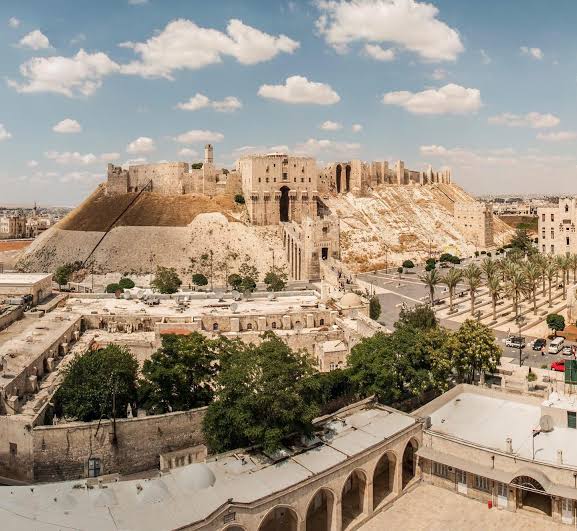
The Citadel of Aleppo is one of the oldest and most iconic fortifications in the world, located in the city of Aleppo, Syria, it has a history that spans millennia. The earliest evidence of human settlement on the site dates back to the 3rd Millennium BC. Over the centuries, it served as a stronghold for various civilizations, including the Hittites, Assyrians, Achaemenids, Greeks, Byzantines, and more. Its strategic location at the crossroads of important trade routes contributed to its significance in the ancient world.
Citadel of Aleppo (3rd Millennium BC - 12th Century AD), a UNESCO World Heritage Site and is considered one of most important historical sites in Syria and entire region. Citadel is renowned for its architectural significance and its role as a symbol of Aleppo's history and resilience. Site features a mix of architectural styles from different periods and civilizations, including Islamic, Byzantine, and Ottoman influences.
During the Islamic era, particularly under the rule of the Ayyubids and later the Mamluks, the Citadel of Aleppo saw significant expansion and fortification. It became a key military and administrative center, shaping the city’s history and culture. The Citadel’s most iconic feature is its imposing medieval entrance, known as the “Bab al-Maqam,” which reflects the architectural and cultural influences of its time.
#archaeohistories
The floating city of Venice was founded 1,604 years ago today.
It sounds impossible. How can an entire city float?
But it's not as simple as it appears on the surface — you literally have to look underwater to find the answer... 🧵
And according to letters from Hernan Cortez’ soldiers, at first glance Tenochticlan was far more advanced than La gran Venetia! No wonder Spain invented stories of savages in order to justify the atrocities it would eventually commit!!
This David marks the Baroque—a movement of emotion, drama, and faith in action.
Bernini, a hero of the Counter-Reformation, wasn’t just fighting Goliath.
🎥: vídeo perfeito sobre David do @Architectolder
You never forget your #FirstGlove. You remember who it was from. You remember what it looked like. You remember how it caught the ball just right.
Your first glove is what made you want to #PLAYBALL. It was no different for any of these big leaguers, either.
Visit https://t.co/WA9R6RspZM to sign up and learn more! ⚾
Who Invented Bread ?
Unlike chocolate chip cookies or tomato soup, the invention of bread can't be pinned down to a single person or people; instead, it evolved to its present state over the course of millennia.
Although the modern version of sliced bread is a fairly new invention (Wonder Bread began marketing the first sliced loaf of bread in 1930), bread itself is an ancient food with origins dating back more than 22,000 years.
In 2004, at an excavation site called Ohalo II, in what is modern-day Israel, scientists found 22,000 year-old barley grains caught in a grinding stone: the first evidence of humans processing wild cereal grains. But these early "bread" creations were probably more like "flat cakes of ground seeds and grains heated on a rock, or in the embers of a fire," than standard sandwich bread, Howard Miller, a food historian and professor at Lipscomb Universityin Nashville, Tennessee, told Live Science.
Bread grains, first plants to be domesticated, were first harvested in the wild by Natufians. This Mesolithic group of hunter-gatherers lived in Jordan River Valley region of the Middle East about 12,500 years ago. "The Natufians are thought to be the first people to make the transition between survival purely on foods that you harvest from nature to becoming farmers who control all aspects of the food supply," William Rubel, a food historian and author of "Bread: A Global History" (Reaktion Books, 2011). "The Natufians had the infrastructure for grinding barley and then making it into bread."
The Natufians had the earliest known agricultural-based society and would process grains into a coarse flour, from which they made a "small, pita-like, unleavened loaf cooked directly on the coals of a fire," Miller said.
Over the next several thousand years, agriculture and cultivation of grains spread across Middle East and southwest Asia through trade contacts with other hunter-gatherer peoples in Nile Valley, Mesopotamia and east of Indus Valley. "Bread was the evolutionary spark that led to the development of state and large political units," Rubel said. "Bread allowed for the accumulation of surplus, and so the villages got bigger until you had actual cities."
More than 5,000 years after the Natufians began making flatbread, three civilizations were rapidly growing and expanding during the Bronze Age: the Egyptians, the Mesopotamians (in what is modern-day Iraq) and the Harappans (in the Indus Valley, in what is modern-day Pakistan). All three civilizations, considered the largest in the ancient world, depended on bread.
"Bread was the majority of their calories," Rubel said. "Bread allowed for the building of surpluses and developing of [social] classes. You didn't have a class of full-time artisans until you had bread."
The first-known leavened bread made with semi-domesticated yeast dates back to around 1000 BC, in Egypt, according to Miller. However, scholars debate the exact origin, as evidence suggests that Mesopotamians also produced yeast-risen bread, Rubel said.
In fact, the invention of yeast-risen bread likely has boozy roots. Ancient Egyptians used barley and emmer wheat both to brew sour beer and to make sourdough bread, according to a 1994 study in the journal Egyptian Archeology. The ancient Egyptians could have made beer by baking "richly yeasted dough" into "beer loaves," then crumbling that bread and straining it with water, which would then ferment into beer, according to the book "Ancient Egyptian Materials and Technology" (Cambridge University Press, 2000).
"Beer is liquid bread," Miller said. "They have the same ingredients — water, grain, yeast — just in different proportions."
From the cradle of civilization's flatbreads to the packaged supermarket slices we know today, bread has evolved alongside society, ever since humans first crushed grains against a grinding stone thousands of years ago.
#archaeohistories










![archeohistories's tweet photo. Who Invented Bread ?
Unlike chocolate chip cookies or tomato soup, the invention of bread can't be pinned down to a single person or people; instead, it evolved to its present state over the course of millennia.
Although the modern version of sliced bread is a fairly new invention (Wonder Bread began marketing the first sliced loaf of bread in 1930), bread itself is an ancient food with origins dating back more than 22,000 years.
In 2004, at an excavation site called Ohalo II, in what is modern-day Israel, scientists found 22,000 year-old barley grains caught in a grinding stone: the first evidence of humans processing wild cereal grains. But these early "bread" creations were probably more like "flat cakes of ground seeds and grains heated on a rock, or in the embers of a fire," than standard sandwich bread, Howard Miller, a food historian and professor at Lipscomb Universityin Nashville, Tennessee, told Live Science.
Bread grains, first plants to be domesticated, were first harvested in the wild by Natufians. This Mesolithic group of hunter-gatherers lived in Jordan River Valley region of the Middle East about 12,500 years ago. "The Natufians are thought to be the first people to make the transition between survival purely on foods that you harvest from nature to becoming farmers who control all aspects of the food supply," William Rubel, a food historian and author of "Bread: A Global History" (Reaktion Books, 2011). "The Natufians had the infrastructure for grinding barley and then making it into bread."
The Natufians had the earliest known agricultural-based society and would process grains into a coarse flour, from which they made a "small, pita-like, unleavened loaf cooked directly on the coals of a fire," Miller said.
Over the next several thousand years, agriculture and cultivation of grains spread across Middle East and southwest Asia through trade contacts with other hunter-gatherer peoples in Nile Valley, Mesopotamia and east of Indus Valley. "Bread was the evolutionary spark that led to the development of state and large political units," Rubel said. "Bread allowed for the accumulation of surplus, and so the villages got bigger until you had actual cities."
More than 5,000 years after the Natufians began making flatbread, three civilizations were rapidly growing and expanding during the Bronze Age: the Egyptians, the Mesopotamians (in what is modern-day Iraq) and the Harappans (in the Indus Valley, in what is modern-day Pakistan). All three civilizations, considered the largest in the ancient world, depended on bread.
"Bread was the majority of their calories," Rubel said. "Bread allowed for the building of surpluses and developing of [social] classes. You didn't have a class of full-time artisans until you had bread."
The first-known leavened bread made with semi-domesticated yeast dates back to around 1000 BC, in Egypt, according to Miller. However, scholars debate the exact origin, as evidence suggests that Mesopotamians also produced yeast-risen bread, Rubel said.
In fact, the invention of yeast-risen bread likely has boozy roots. Ancient Egyptians used barley and emmer wheat both to brew sour beer and to make sourdough bread, according to a 1994 study in the journal Egyptian Archeology. The ancient Egyptians could have made beer by baking "richly yeasted dough" into "beer loaves," then crumbling that bread and straining it with water, which would then ferment into beer, according to the book "Ancient Egyptian Materials and Technology" (Cambridge University Press, 2000).
"Beer is liquid bread," Miller said. "They have the same ingredients — water, grain, yeast — just in different proportions."
From the cradle of civilization's flatbreads to the packaged supermarket slices we know today, bread has evolved alongside society, ever since humans first crushed grains against a grinding stone thousands of years ago.
#archaeohistories](https://pbs.twimg.com/media/Gm4PehqbEAAcmVA.jpg)